LUOYANG DATANG ENERGY TECH CO.,LTD


How to Specify Brass Hose Fittings for a Purchase Order
“Please quote 1/2-inch brass hose fittings, 2,000 pcs.”
It sounds like a complete request. It isn’t.
A supplier reading that line has no idea whether 1/2 inch refers to hose ID, barb OD, or thread size. They don’t know if it’s NPT or BSP, male or female. They don’t know the brass grade, the surface finish, the working pressure, or the media. And they have no way of knowing whether 2,000 pieces should be packed individually or in bulk.
A good PO specification should remove assumptions. Every dimension, every standard, every requirement — written down, not implied.
This article gives you a practical framework for specifying brass hose fittings on a purchase order, so the first sample matches the final production run.
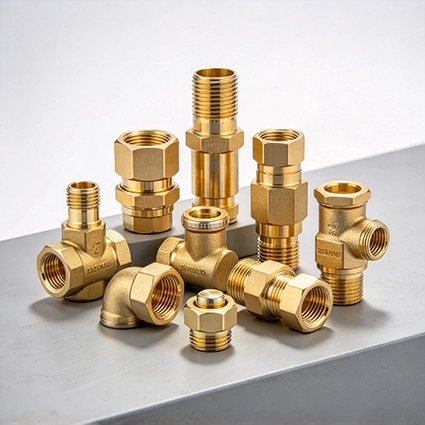
1/2-inch brass hose fittings
Why Specifications Matter on a Brass Hose Fitting PO
A vague PO creates a chain reaction of problems:
| What the PO Says | The Problem |
|---|---|
| 1/2″ brass fitting | Which dimension is 1/2″? |
| 1/2″ hose barb | Is that hose ID or barb OD? |
| 1/2″ thread | NPT or BSP? Male or female? |
| Brass fitting | Which brass grade? Lead-free required? |
| 1,000 pcs | What packaging? Individual or bulk? |
| Standard fitting | Which standard? Which tolerance? |
Every ambiguity creates a decision point where the supplier must guess. And when suppliers guess, the result is often a sample that doesn’t match the drawing, a production delay, a rework request, or a return shipment.
The goal of a complete PO specification is not to be complicated. It’s to be unambiguous.
The 10 Specifications to Include in a Brass Hose Fitting PO
A complete brass hose fitting specification covers ten areas:
- Product type — hose barb, adapter, connector, coupling
- Hose connection size — hose ID
- Barb size — nominal and actual OD
- Thread type — NPT, BSP, GHT, metric
- Thread size — nominal designation
- Gender — male or female
- Material — brass grade, lead-free requirement
- Surface finish — natural, nickel-plated, chrome-plated
- Performance — pressure, temperature, media
- Commercial — quantity, packaging, labeling, drawing
Not every PO needs all ten. But the more you specify, the fewer surprises you’ll get.

brass hose fittings
1. Specify the Fitting Type First
“Brass hose fitting” is a category, not a product. The supplier needs to know what form the fitting takes.
| Product Type | Example Description |
|---|---|
| Straight hose barb | Brass straight barb, 1/2″ barb |
| Elbow hose barb | 90° brass hose barb |
| Tee hose barb | Brass tee barb |
| Barb adapter | Barb × male thread |
| Barb connector | Barb × female thread |
| Bulkhead barb | Panel/bulkhead connection |
For a deeper look at how connector, adapter, and coupling differ, see: Three Common Brass Hose Connection Parts: Connector, Adapter and Coupling.
2. Specify Hose Size and Hose ID Clearly
Do not write “1/2-inch hose fitting” and assume the supplier knows what you mean.
Specify the hose ID — the inner diameter of the hose the fitting is designed to fit.
| Specification | Example |
|---|---|
| Hose ID | 1/2 in / 12.7 mm |
| Hose OD | 18 mm (if relevant) |
| Barb size | 1/2 in (nominal) |
| Barb OD | Per manufacturer drawing |
| Hose material | PVC / rubber / silicone / reinforced |
Hose ID and thread size are two completely different parameters. A fitting can have a 1/2″ barb on one end and a 1/2″ NPT thread on the other — the two “1/2 inches” mean different things.
For a complete guide to matching barb size to hose ID, see: Brass Hose Barb Sizes Explained: How to Match Barb Size to Hose ID.

brass hose fittings
3. Specify the Thread Standard, Not Just Thread Size
This is where most POs fail.
Do not write: 1/2″ thread
Write: 1/2″ NPT male or G1/2 female (BSPP).
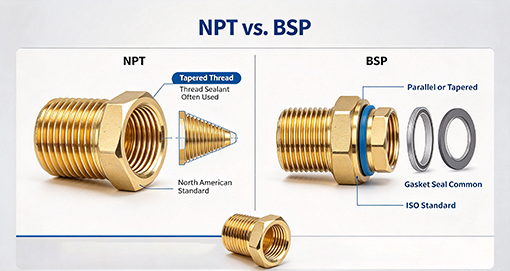
NPT vs. BSP: A Quick Reference
| Specification | Example |
|---|---|
| NPT male | 1/2″ NPT male |
| NPT female | 1/2″ NPT female |
| BSPP female | G1/2 female |
| BSPT male | R1/2 male |
NPT is a 60° tapered thread form used primarily in North America. BSP is a 55° Whitworth thread form used in the UK, Europe, and many other markets. At 1/2″ size, both have 14 threads per inch — so a BSP male will start into an NPT female. But the thread forms are different, and the joint will not seal properly.
Always specify the thread standard. If you’re unsure, see our guide: NPT vs. BSP Threads: Which Thread Should You Choose for Brass Fittings?
4. Specify Male or Female Connection
“1/2 NPT” is not enough. The supplier needs to know whether the thread is male (external) or female (internal).
| Connection | Example |
|---|---|
| Male thread | 1/2″ NPT male |
| Female thread | 1/2″ NPT female |
| Barb × male | 1/2″ barb × 1/2″ NPT male |
| Barb × female | 1/2″ barb × 1/2″ NPT female |
This seems obvious. But it’s one of the most common causes of wrong-part shipments.
5. Specify Brass Material When It Matters
For some purchases, “brass” is sufficient. For others, the grade matters.
| Material Information | Example |
|---|---|
| Basic material | Brass |
| Alloy grade | CW617N or CW614N |
| Lead-free requirement | Lead-free brass (Pb < 0.25%) |
| Manufacturing method | Forged / machined |
| Material certificate | Required / Not required |
CW617N (CuZn40Pb2) is a standard hot forging brass. CW614N (CuZn39Pb3) is a standard free-cutting brass used for machined parts. Both offer a balance of corrosion resistance, mechanical strength, and machinability.
Do not write CW617N on every PO. Specify the grade only when your application, market, or customer requirement calls for it.
NPT vs. BSP
6. Specify Surface Finish and Plating
| Finish | When It May Be Specified |
|---|---|
| Natural brass | Standard applications |
| Nickel plated | Appearance or surface requirements |
| Chrome plated | Specific appearance or application needs |
| Custom finish | Customer specification |
If no finish is specified, most suppliers will default to natural brass. If you need plating, say so.
7. Specify Working Pressure and Temperature
This moves the PO from “what to buy” to “will this product work in my system?”
| Requirement | Example |
|---|---|
| Media | Water |
| Working pressure | XX bar |
| Working temperature | XX °C |
| Peak temperature | If applicable |
| Pressure test | If required |
Do not assume a universal pressure rating for “brass hose fittings.” A small hose barb may be rated at 150 psi. A heavy-duty industrial fitting may be rated much higher. The manufacturer’s specification for the specific product is the only reliable number.
8. Specify the Media or Application
“Brass hose fitting” alone does not define media compatibility. Specify:
- Water
- Compressed air
- Fuel
- Oil
- Gas
- Chemicals
For a deeper look at water, air, and fuel compatibility, see: Can Brass Hose Fittings Handle Water, Air and Fuel?

Brass hose fitting in Chemicals
9. Specify Dimensions or Attach a Drawing
If the fitting is a standard catalog item, the manufacturer’s part number may be sufficient. If it’s custom or critical, attach a drawing.
Dimensions worth specifying:
| Dimension | Example |
|---|---|
| Overall length | Per drawing |
| Barb length | Per drawing |
| Thread length | Per drawing |
| Hex size | Per drawing |
| Body diameter | Per drawing |
| Tolerance | ± specified value |
“See attached drawing” is a valid and highly effective PO specification. It removes ambiguity and gives the supplier a single reference point.
10. Specify Quantity, MOQ, and Packaging
This is where the PO becomes a commercial document.
| Item | Example |
|---|---|
| Quantity | 2,000 pcs |
| Unit | pcs |
| MOQ | Per supplier agreement |
| Packaging | 100 pcs/carton |
| Individual bag | Required / Not required |
| Label | Customer SKU |
| Carton mark | Customer requirement |
Typical MOQ for brass hose barbs is around 1,000 pieces. Packaging is commonly plastic bag → inner box → carton → pallet. If you need individual bagging, custom labels, or specific carton marks, specify them on the PO.
A Complete Brass Hose Fitting PO Specification Example
Here’s what a well-specified PO line item looks like:
| Item | Specification |
|---|---|
| Product | Brass Hose Barb Adapter, Straight |
| Hose ID | 1/2 in |
| Barb | 1/2 in nominal |
| Thread | 1/2 in NPT male |
| Material | Brass, CW617N |
| Finish | Natural brass |
| Media | Water |
| Working Pressure | Per approved specification |
| Temperature | Per approved specification |
| Quantity | 2,000 pcs |
| Packaging | Bulk packed, 100 pcs/carton |
| Drawing | Customer drawing attached |
Bad PO vs. Complete PO
| PO Description | Information Level |
|---|---|
1/2″ brass fitting | Too vague |
1/2″ brass hose barb | Better, but incomplete |
1/2″ barb × 1/2″ NPT male | Much clearer |
| Full specification + drawing | Most complete |
The difference between the first and last rows is the difference between a supplier asking five clarifying questions and a supplier sending you a quote the same day.
PO Checklist Before You Send the Order
Product
☐ Fitting type
☐ Connection configuration
Size
☐ Hose ID
☐ Barb size
☐ Thread size
Thread
☐ NPT / BSP / GHT / metric
☐ Male / Female
Material
☐ Brass grade
☐ Lead-free requirement
Performance
☐ Media
☐ Pressure
☐ Temperature
Commercial
☐ Quantity
☐ Packaging
☐ Labeling
Technical
☐ Drawing
☐ Tolerance
☐ Inspection requirements
Common Mistakes When Writing a Brass Hose Fitting PO
Mistake 1: Only writing “1/2 inch.”
Which 1/2 inch? Hose ID? Barb OD? Thread size?
Mistake 2: Not specifying hose ID.
The barb size depends on the hose ID — not the other way around.
Mistake 3: Not specifying NPT or BSP.
Both can be marked “1/2 inch.” They are not the same.
Mistake 4: Forgetting male/female.
A male thread and a female thread are not interchangeable.
Mistake 5: Not specifying material requirements.
“Brass” may be enough for some applications. For potable water, lead-free brass may be required.
Mistake 6: Ignoring media.
Water, air, fuel, and oil have different compatibility requirements.
Mistake 7: No drawing for custom dimensions.
If it’s not a catalog item, attach a drawing.
Mistake 8: Not confirming packaging and labeling.
Your warehouse needs to receive and identify the parts. Specify how.

Brass hose fitting in Water
FAQ
Q1: What information should I include when ordering brass hose fittings?
Product type, hose ID, barb size, thread type and size, gender, material grade, surface finish, working pressure, temperature, media, quantity, packaging, and a drawing if the fitting is custom.
Q2: How do I specify a brass hose barb on a purchase order?
Start with the product type (straight barb, elbow barb, etc.), then specify hose ID, barb size, thread standard, thread size, and gender. Add material, finish, and performance requirements.
Q3: Should I specify hose ID or barb size?
Specify both. Hose ID is the primary reference — the fitting is designed for a specific hose ID. Barb size (nominal) and barb OD (actual) are also important.
Q4: Do I need to specify NPT or BSP?
Yes. NPT and BSP are different thread standards. Both can be marked “1/2 inch,” but they are not interchangeable.
Q5: Should I specify the brass alloy grade?
Only when your application, market, or customer specification requires it. For general-purpose fittings, “brass” may be sufficient. For potable water or specific standards, specify lead-free brass or a specific grade like CW617N.
Q6: What dimensions should be included in a hose fitting drawing?
Overall length, barb length, thread length, hex size, body diameter, and tolerances. The drawing should be the single reference point for all dimensional requirements.
Q7: How do I avoid receiving the wrong brass hose fitting?
Remove assumptions. Specify every critical dimension: hose ID, barb size, thread standard, thread size, gender, material, finish, pressure, temperature, and media. Attach a drawing for custom items.
Q8: Can I use a product drawing instead of listing every dimension on the PO?
Yes. “See attached drawing” is a valid specification and often the most effective approach for custom or critical fittings.
Need Help Preparing a Brass Hose Fitting Specification?
The right PO specification is the one that leaves nothing to interpretation.
Send us your requirements and we’ll help you build a complete specification:
- Hose ID
- Fitting type
- Thread standard
- Material
- Application
- Quantity
- Drawing or photo
Luoyang Datang Energy Tech Co., Ltd. will confirm the appropriate configuration and provide a quote with the details you need.
RELATED POSTS
Is Black Plastic Pipe Safe For Water Supply Lines
How To Id Unmarked Pipe “Water Supply”
Analysis of HDPE Water Supply Pipes And HDPE Drainage Pipes

Yellow PE Gas Pipe: Color Code That Saves Lives

PPR Water Pipe Vs PE Water Pipe: Which Is Better?