ЛУОЯН КЕЛДЕ ЭНЕРГИЯ ТЕХ КО.,ЛТД


Brass Hose Barb vs Threaded Fitting: Which One Is Right for Your Hose?
You have a flexible hose in hand, but the fitting options seem confusing. Should you push the hose over a barb? Connect it to a threaded fitting? Or use something that combines both?
Here’s the key fact that most buyers don’t realize at first: A hose barb and a threaded end often serve different connection points, and many brass fittings actually combine the two.
This article will walk you through how a brass hose barb works, how a threaded fitting works, the real differences between them, when to choose each type, and how to match hose ID, thread standard, and application requirements to get the right fitting the first time.
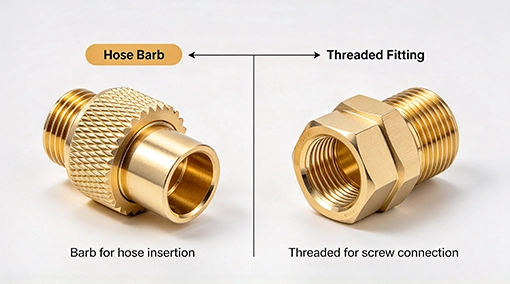
Brass Hose Barb vs Threaded Fitting
Hose Barb vs Threaded Fitting: What Is the Real Difference?
What Is a Brass Hose Barb?
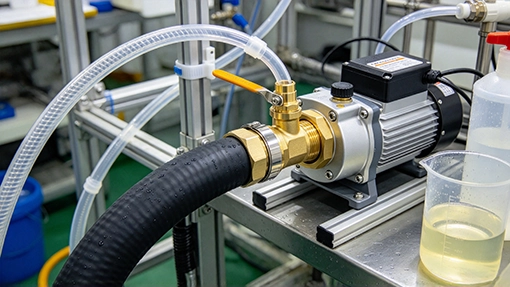
А brass hose barb is a fitting with a ribbed, tapered stem designed to be inserted into the inside of a flexible hose. The hose slides over the barb, and the raised ridges create mechanical grip to hold the hose in place. A hose clamp is typically added for extra security.
The sizing rule here is straightforward but frequently misunderstood: a hose barb marked 3/8″ refers to the inside diameter (ID) of the hose it fits, not the thread on the other end. A 3/8″ brass hose barb is designed to be pushed into hose with a 3/8″ inside diameter.
Brass hose connections come in several forms, including connectors, adapters and couplings. If you want to understand how these common connection parts differ, see our guide to [Өс дөйөм ҡорос шланг тоташтырыу өлөштәре: Тоташтырғыс, Адаптер һәм муфта].
Brass Hose Barb
What Is a Threaded Fitting?
A threaded fitting connects through matching threads — male or female — rather than by inserting into a hose. The most common thread standards in brass fittings include:
- НПТ (National Pipe Tapered): The US default for plumbing, gas and industrial fittings. Threads are tapered and seal on thread flank interference, usually with PTFE tape or pipe dope.
- БСП (Британия стандарт торбаһы): Common in the UK, Europe and Asia. Available as BSPT (tapered) and BSPP (parallel). The thread angle is 55° for BSP, compared to 60° for NPT.
- ГХТ (Garden Hose Thread): Straight thread sealed by a rubber washer. GHT is straight with a 1.0625″ major diameter at 11.5 ТПИ, while 3/4″ NPT is tapered with a 1.050″ outside diameter at 14 ТПИ.
Critical point: Different thread standards cannot be interchanged just because the nominal size is the same. A “1/2 inch” NPT fitting doesn’t actually measure half an inch anywhere on the part — its outside diameter is 0.840″.
For a deeper look at why these two standards are not interchangeable, see our article on [3/4″ GHT vs 3/4″ NPT: Why Are These Brass Hose Fittings Not Interchangeable?]. You can also explore [НПТ ҡаршы БСП ептәре: Ҡорос арматура өсөн ниндәй еп һайларға кәрәк?] for a broader comparison.
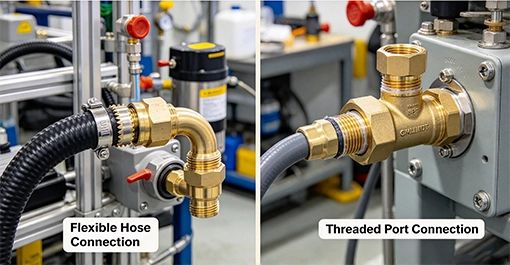
The Key Difference: How Does the Hose Actually Connect?
This is where it all comes together. Here’s a side-by-side comparison:
| Factor | Brass Hose Barb | Threaded Connection |
|---|---|---|
| Тоташтырыу ысулы . | Hose slides over barb | Threads mate with threaded port |
| Main sizing reference | Hose ID | Стандарт еп + nominal size |
| Hose requirement | Flexible hose | Hose may require threaded end/adapter |
| Герметизациялау ысулы | Hose wall + сәнскеле + clamp | Thread seal, gasket or sealing face |
| Ҡуйыу | Push-on + clamp | Screw/thread connection |
| Removal | Cut/remove clamp and hose | Unscrew connection |
| Main selection concern | Hose ID | Тип нити, size and pitch |
| Typical use | Flexible hose | Equipment/pipe/adapter connection |
These are not always competing fitting types.
Consider a 1/2″ barb × 1/2″ NPT монтаж. The first “1/2″” refers to the hose ID that the barb side fits. The second “1/2″” refers to the NPT thread size on the other end. Two different “1/2 inch” measurements, two different connection points — one fitting.
This concept is the backbone of the entire selection process. For a complete breakdown of hose ID, OD and thread matching, беҙҙең ҡара [Brass Hose Fitting Size & Thread Matching Guide].
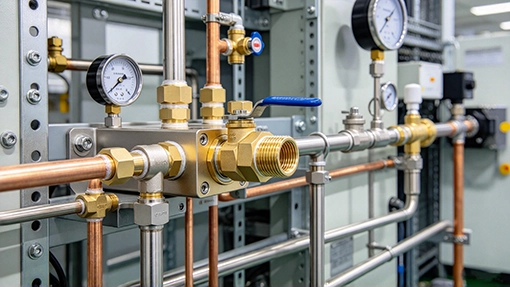
Threaded Fitting
When Should You Choose a Brass Hose Barb?
1. You Are Connecting Directly to Flexible Hose
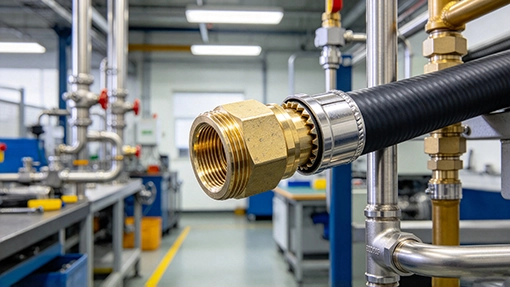
Rubber hose, PVC hose, pneumatic hose, flexible water hose — if the connection point is the hose itself, a barb is the natural choice. The barbed edges provide positive connection and excellent vibration resistance.
2. You Need a Simple Hose Connection
Push the hose onto the barb, add a clamp, done. Installation and replacement are straightforward. For maintenance scenarios where hoses are replaced periodically, this simplicity has real value.
3. Hose ID Is Known
Measure the hose ID first. Don’t confuse hose ID with fitting or thread size. If you have 1/2″ ID hose and you need to connect directly to it, you need a 1/2″ barb — regardless of what the other end looks like.
4. The Application Allows a Clamped Barb Connection
This is important: баҫым, температура, pulsation, vibration and hose material must all be confirmed against the specific fitting and hose specification.
A Parker brass barb fitting may list a maximum operating pressure of 150 psi — but that’s for that specific product, not for all brass hose barbs. Some brass barbed fittings with NBR hoses can handle 16 bar maximum working pressure.
Don’t assume “low pressure” applies universally. Always check the datasheet.
When Should You Choose a Threaded Fitting?
1. The Equipment Already Has a Threaded Port
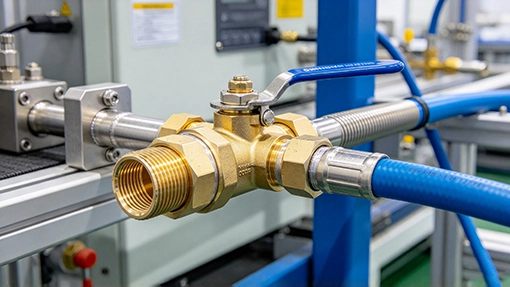
Клапандар, насостар, коллекторҙар, regulators, machine ports — if the connection point on the equipment side is threaded, you need a threaded connection there. This is where a barb × NPT йәки barb × BSP combination fitting becomes essential: barb side for the hose, threaded side for the equipment.
2. You Need a Threaded Connection at the Equipment Side
Threaded connections are strong, durable and reusable. For equipment that may need servicing, upgrading or repositioning, a threaded connection makes disconnection and reconnection far easier than cutting a hose off a barb.
3. You Need Easier Repeated Disconnection
Equipment maintenance, removable hose assemblies, service connections — threaded connections excel in these scenarios. But don’t take it to the extreme: threaded connections can be prone to leaks if improperly installed. Correct thread sealant or gasket is essential.
4. The Thread Standard Is Already Defined
If you already know the equipment uses NPT, БСП, GHT or another thread system, then the thread side is settled. What remains is matching the other end to your hose.
“1/2 inch” alone is not enough information. You need to know the thread standard, the nominal size, the pitch/TPI, and whether it’s male or female.
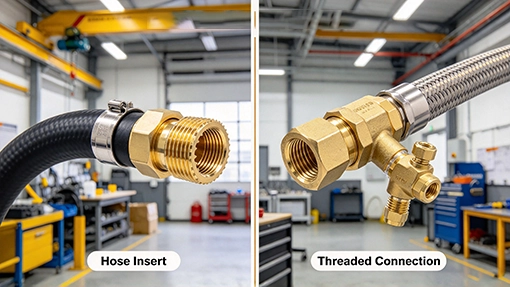
a Brass Hose Barb vs a Threaded Fitting
What If You Need Both? Use a Brass Barb-to-Threaded Fitting
This is where the article goes beyond a simple “vs” comparison. Many real-world connections require both a hose barb and a threaded end on the same fitting.
Barb × NPT
The most common combination in North America. Hose side gets the barb; equipment side gets the NPT thread.
Barb × BSP
For equipment with British Standard Pipe ports — common in European, Asian and many international machines.
Barb × Other Thread Types
GHT for garden hose connections, SAE flare for automotive and refrigeration lines, һәм башҡалар.
| Your Hose Side | Your Equipment Side | Possible Fitting |
|---|---|---|
| Flexible hose | NPT port | Barb × NPT |
| Flexible hose | BSP port | Barb × BSP |
| Flexible hose | GHT connection | Barb × GHT |
| Шланг | Another hose | Barb × Barb |
| Шланг | Different size port | Barb × Reducer/Adapter |
Need help understanding connector types? See our guide to [Ҡорос шланг тоташтырғыс типтары: Нисек дөрөҫ һайларға?].
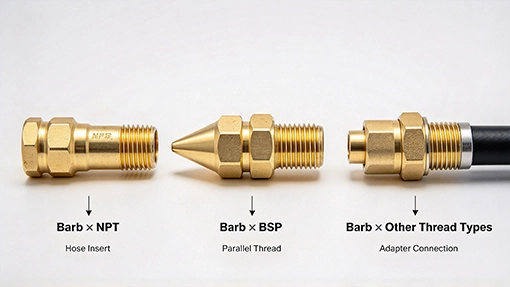
a Brass Barb-to-Threaded Fitting
How to Choose Between a Hose Barb and Threaded Connection
Here’s a practical step-by-step selection process:
Аҙым 1 — Identify the Hose
Ask yourself: What is the hose material? Is it flexible or rigid? What is the hose ID? What is the hose OD? What is the wall thickness?
Before choosing a barb size, make sure you know the hose inside diameter and the fitting connection size. For a deeper look at sizing, беҙҙең ҡара [Brass Hose Fitting Size & Thread Matching Guide].
Аҙым 2 — Identify the Equipment Port
Male or female? Threaded or unthreaded? НПТ? БСП? ГХТ? Икенсе? If threaded, what’s the thread size and pitch?
Аҙым 3 — Check the Medium
Һыу, һауа, май, яғыулыҡ, coolant — these all have different compatibility profiles. Brass itself offers good corrosion resistance against many media including water, compressed air and neutral hydraulic oils. For applications involving potable water, lead-free brass fittings certified to NSF/ANSI 61 may be required.
The correct connection type is only one part of fitting selection. You also need to check whether the fitting material and sealing components are suitable for the fluid being transferred. Stay tuned for our upcoming article: [Can Brass Hose Fittings Handle Water, Air and Fuel?]
Аҙым 4 — Check Pressure and Temperature
Do not apply a universal pressure standard. Check the pressure and temperature rating of the specific fitting, hose and connection assembly. Different brass barb products have dramatically different ratings.
Аҙым 5 — Decide Whether You Need a Barb, Thread, or Combination
The logic is simple:
- Hose → Barb
- Equipment → Thread
- Both → Barb × Thread
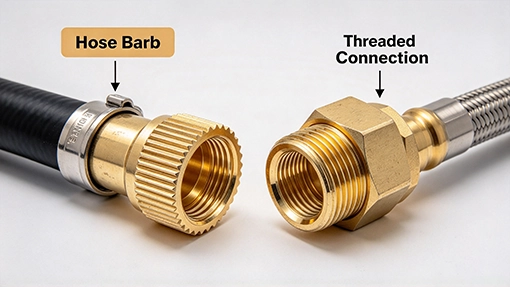
a Hose Barb and Threaded Connection
Brass Hose Barb vs Threaded Fitting: Quick Selection Table
| If your situation is… | Consider… |
|---|---|
| Flexible hose needs direct connection | Brass hose barb |
| Equipment has NPT port | Barb × NPT |
| Equipment has BSP port | Barb × BSP |
| Hose itself has a threaded end | Threaded fitting |
| You need a removable equipment connection | Threaded connection |
| You know hose ID but not thread | Start with barb side |
| You know equipment thread but not hose size | Identify thread first, then hose side |
| Both hose and equipment require different connection types | Combination fitting |
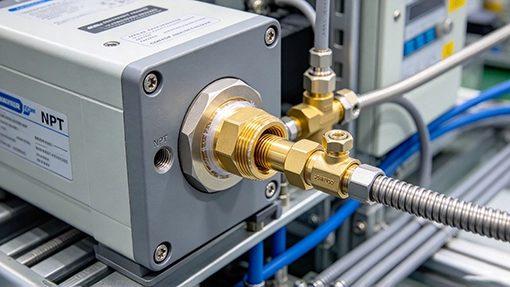
Equipment has NPT port
Дөйөм һайлау хаталарҙан ҡотолорға кәрәк
1. Choosing by Hose OD Instead of Hose ID
This is the single most common mistake. Barb sizing relates to hose ID. A 1/2″ barb fits 1/2″ ID hose — not hose that has a 1/2″ outside diameter.
2. Assuming Barb Size = Thread Size
А 1/2″ barb × 3/4″ NPT fitting exists and is perfectly standard. The barb size and the thread size are independent specifications.
3. Assuming 3/4″ GHT = 3/4″ NPT
GHT is straight with a 1.0625″ major diameter at 11.5 TPI and seals on a rubber washer, while 3/4″ NPT is tapered with a 1.050″ outside diameter at 14 TPI and seals on the threads themselves.
This is exactly why we wrote [3/4″ GHT vs 3/4″ NPT: Why Are These Brass Hose Fittings Not Interchangeable?]. Same nominal size, completely different threads.
4. Choosing a Thread by Diameter Alone
Стандарт еп, pitch/TPI, male/female, and sealing method all matter. The BSP trap is particularly dangerous: at 1/2″ and 3/4″ the two systems share the same 14 ТПИ, so a BSP male will start into an NPT female — but the 55° vs 60° thread angle means the joint will never seal properly.
5. Ignoring Hose Material
Different hose materials have different flexibility, wall thickness and compatibility. A barb that works beautifully with one hose may not grip well with another.
6. Ignoring Clamp Requirements
Whether a barb connection requires a clamp depends on the specific fitting design, hose and application requirements. When using a hose clamp, install it so that it presses down on the indentation between the barbs — this ensures the barbs bite into the hose. For large diameters or high-pressure applications, two clamps installed in an offset pattern may be needed.
7. Selecting the Fitting Before Measuring the Hose
Measure first. Order second. This simple principle prevents the majority of fitting selection errors.
Threaded Fitting
Brass Hose Barb vs Threaded Fitting: Which One Is Right for You?
A simple decision matrix:
| Your Situation | Your Choice |
|---|---|
| Flexible hose + direct hose connection | Барб |
| Threaded equipment port | Barb × Thread |
| Threaded hose assembly | Епле |
| Different standards/sizes | Adapter or combination fitting |
What Information Should You Have Before Ordering?
| Information | Ни өсөн мөһим | Миҫал |
|---|---|---|
| Hose ID | Determines barb size | 1/2″ ID |
| Hose OD | Helps select clamp | 3/4″ OD |
| Hose material | Affects compatibility | Юйғыс / ПВХ |
| Тип нити | Determines equipment-side fit | НПТ / БСП / ГХТ |
| Thread size | Determines connection dimension | 1/2″ |
| Male or female | Determines mating connection | Male NPT |
| Уртаса | Affects material/seal selection | Һыу |
| Баҫым | Determines suitable fitting design | Project-specific |
| Температура | Affects material performance | Project-specific |
| Connection type | Determines fitting configuration | Barb × NPT |
When requesting a quotation, provide these specifications to avoid ordering the wrong fitting.
Brass Hose Barb
FAQ
1. Is a hose barb better than a threaded fitting?
Not better — different. They serve different connection purposes. A barb connects to flexible hose; a thread connects to an equipment port or another threaded fitting. The right choice depends entirely on what’s on each end of your connection.
2. Does a 1/2-inch hose barb fit a 1/2-inch threaded port?
Not necessarily. A 1/2″ hose barb fits 1/2″ ID hose. It has no thread at all unless the fitting is a combination type. To connect to a 1/2″ threaded port, you need a fitting with a 1/2″ thread on that end.
For a complete guide to size and thread matching, күрергә [Был ҡорос шланг монтаж һеҙҙең шланг тура киләме? Ҙурлыҡ һәм еп тап килтереүҙе аңлатты].
3. Is a hose barb size the same as the thread size?
Юҡ. Barb size = hose ID. Thread size = the nominal thread dimension on the other end. A 1/2″ barb × 3/4″ NPT fitting has a barb sized for 1/2″ hose ID and a 3/4″ NPT thread on the opposite end. Two completely independent specifications.
4. Do brass hose barb fittings need a clamp?
This depends on the specific hose, ҡоролма дизайны, pressure and application requirements. Many manufacturers recommend using a hose clamp, similar clamp, or a crimped ferrule for secure connections. For low-pressure, low-risk applications, some push-on designs may work without a clamp — but always check the manufacturer’s recommendation.
5. Can a brass hose barb connect to an NPT port?
Yes — through a barb × NPT combination fitting. The barb side connects to your flexible hose, and the NPT threaded side connects to the equipment port.
6. Can I use NPT and BSP fittings together?
Do not assume they are interchangeable. They have different thread angles (60° vs 55°) and different thread forms. In some cases a BSP male may start into an NPT female, but the connection will not seal properly. Use an appropriate adapter if you need to bridge the two systems.
See our full guide: [НПТ ҡаршы БСП ептәре: Ҡорос арматура өсөн ниндәй еп һайларға кәрәк?]
7. How do I choose the correct brass hose fitting size?
Two steps:
- Hose side: Measure the hose ID → that’s your barb size.
- Equipment side: Identify the thread type (NPT/BSP/GHT), nominal size, pitch/TPI → that’s your thread size.
For more detail, күрергә [Был ҡорос шланг монтаж һеҙҙең шланг тура киләме? Ҙурлыҡ һәм еп тап килтереүҙе аңлатты] һәм [Ҡорос торба арматураһы аңлатылды: Ҡорос йоҙроҡ, Шланг тоташтырғысы & Шланг муфтаһы].
Brass Hose Barb vs Threaded Fitting
Need Help Choosing the Right Brass Hose Fitting?
Tell Луоян Датанг Энерджи Тех Ко., ООО your specifications and we’ll help you get the right fitting the first time:
- Hose ID
- Hose OD
- Тип нити
- Thread size
- Уртаса
- Баҫым
- Температура
- Connection configuration
The core takeaway: A hose barb and a threaded end do different jobs. The barb connects to the hose; the thread connects to the equipment. When you need both, use a barb × thread combination fitting. Measure first, order second.
БАЙЛАНЫШЛЫ ЯҘМАЛАР
Ҡайһыһы яҡшыраҡ .?HDPE торбалар ҡаршы PE торбалар.
Һыуытыу һыуытыу системаларын сәнәғәт торбаларын һөҙөмтәле проектлау менән оптимальлаштырыу
1600 мм HDPE торбаһы - Юғары тығыҙлыҡтағы полиэтилен торбаһы
Нисек эҫе һыу менән тәьмин итеү торбаларын таҙартырға
Нисек билдәләнмәгән торбаны асыҡларға “Һыу менән тәьмин итеү”