LUOYANG CAME ENERGY TECH CO.,LTD

HDPE cijevi i fitinzi: How to Match Pipe, Fittings and Connections
You ordered the right pipe. The diameter matches the drawing. The material grade is PE100. The SDR is correct. Then the pipe arrives on site, and the fittings don’t fit.
It happens more often than most buyers expect—and it almost never has anything to do with the pipe itself. A DN110 metric pipe and a 4-inch IPS pipe look like the same size until you put a caliper on them. One measures 110 mm preko vanjske strane. The other measures 114.3 mm. That 4.3 mm difference is enough to make fusion impossible and force a site crew to stop work.
Matching HDPE cijevi i fitinzi comes down to three decisions: does the outside diameter match, does the SDR fall within the fusion or fitting’s allowable range, and does the connection method suit both the pipe and the installation conditions? Get those three right, and the rest of the order falls into place. Get any one wrong, and you’re looking at returns, delays, or a joint that fails inspection.
This guide walks through each decision in order—the way you’d actually check them before placing an order.
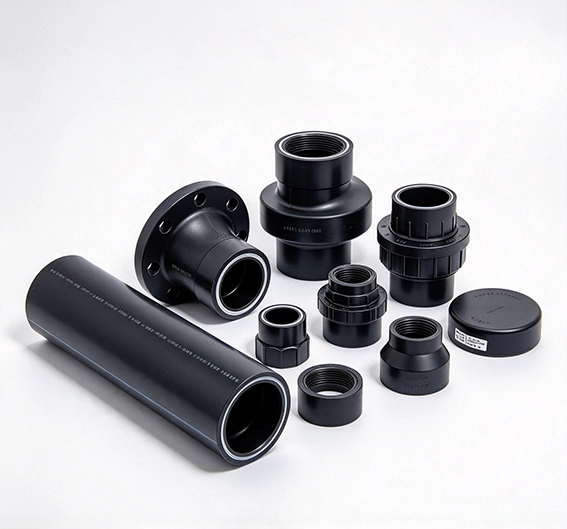
HDPE pipes and fittings for compatible pipeline connections
1. What Determines Compatibility Between HDPE Pipes and Fittings?
Compatibility is not a single specification. It is the alignment of five parameters. If any one of them is off, the fitting and pipe will not join correctly—or will join but underperform under pressure.
| Provjeri | What to Confirm | Why It Matters |
|---|---|---|
| Vanjski prečnik (OF) | The actual outside diameter and the sizing system it belongs to | Determines whether the fitting physically fits the pipe end |
| SDR / debljina zida | The pipe SDR and the fitting’s allowable SDR range | Affects fusion compatibility, joint strength, and pressure capability |
| Material grade | PE80, PE100, or PE4710 as specified | Affects design performance and which fitting standards apply |
| Pressure requirement | System design pressure versus the rated capability of every component | A system is only as strong as its weakest rated component |
| Način povezivanja | Butt fusion, elektrofuzija, kompresija, or flanged | Determines fitting type, installation equipment, and crew requirements |
These five parameters do not operate independently. A fitting that matches the OD but not the SDR range is not compatible. A connection method that works for the pipe but not for the available equipment on site is not practical.
The compatibility check starts with the OD.
2. How to Match HDPE Pipe Diameter and Fitting Size
Outside diameter is the number that matters most. Not nominal size. Not the inch label. The actual outside diameter.
HDPE pipe is kontrolisan vanjskim prečnikom. For a given nominal size, the OD stays fixed while the wall thickness changes to achieve different pressure ratings. A heavier-duty pipe of the “same size” has a smaller internal bore, not a larger outside diameter.
This design convention means that fusion equipment, saddle fittings, and butt-weld faces all reference the OD. If the OD doesn’t match, nothing downstream can compensate.
Zašto “4-inch” i “110 mm” Are Not the Same Pipe
Two sizing systems dominate HDPE pipe globally: metric (ISO-based) i IPS (Iron Pipe Size) , with DIPS (Ductile Iron Pipe Size) used in some North American water and sewer applications.
The confusion starts because the numbers look interchangeable. They are not.
| Nominal Label | Actual Outside Diameter | Difference |
|---|---|---|
| DN110 (metric) | 110.0 mm | — |
| 4″ IPS | 114.3 mm (4.500″) | +4.3 mm |
| 4″ DIPS | 114.3 mm (4.500″) | Varies by system |
| DN160 (metric) | 160.0 mm | — |
| 6″ IPS | 168.3 mm (6.625″) | +8.3 mm |
A DN110 metric pipe and a 4-inch IPS pipe are not interchangeable. The IPS system inherited its outside diameters from 19th-century iron pipe standards, which is why a “4-inch” pipe measures 4.5 inches across—not 4.000 inches.
The practical consequence is straightforward: fusion joints and fittings must match the OD system. A metric fitting will not fuse to an IPS pipe. A 110 mm electrofusion coupler will not accept a 4-inch IPS pipe end, because the pipe won’t physically enter the coupler to the correct depth.
What to Confirm Before Ordering
| What You Might Say | What the Supplier Needs to Hear |
|---|---|
| “DN110” ili “110 mm” | “Metric OD 110 mm, ISO 4427” |
| “4-inch HDPE” | “4″ IPS, OF 114.3 mm, ASTM F714” |
| “Electrofusion coupler” | “Za 110 mm OD, SDR11–SDR17 range, per manufacturer’s data” |
| “Flange adapter” | “PE100, 110 mm OD, SDR11, drilled to ANSI B16.5 Class 150” |
If you need a detailed reference for pipe sizes across both metric and inch-based systems, vidi naše HDPE pipe sizes and dimensions guide.

HDPE pipes OD, Wall Thickness, and SDR Dimensioning Diagram
3. How Do SDR and Pressure Rating Affect Fitting Selection?
You’ve confirmed the OD. Now the question shifts from “does it fit” to “will it hold.”
SDR—the Standard Dimension Ratio—links diameter and wall thickness into a single pressure classification. It is calculated as outside diameter divided by minimum wall thickness:SDR=Minimum Wall ThicknessOutside Diameter
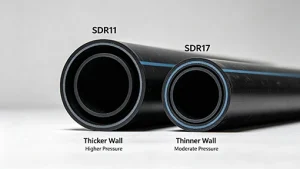
A 110 mm OD pipe with a 10 mm wall is SDR11. The same 110 mm OD pipe with a 6.6 mm wall is SDR17. Same outside diameter, different wall thickness, different pressure rating, different fitting compatibility requirements.
| Parametar | What It Means for Selection |
|---|---|
| Lower SDR | Thicker wall relative to diameter. Generally higher pressure capability under the same material grade and standard. |
| Higher SDR | Thinner wall. Lower pressure capability for the same material grade and standard. |
| PN / klasa pritiska | Confirmed against the applicable standard and product technical data—not inferred from SDR alone. |
| Fitting rating | Must be verified independently. A pipe rated PN16 does not guarantee a PN16 system if the fitting is rated lower. |
For PE100 pipe under ISO 4427 at 20°C, the commonly referenced relationships are:
| SDR | Typical PN (PE100, ISO 4427, water at 20°C) |
|---|---|
| SDR11 | PN16 |
| SDR13.6 | PN12.5 |
| SDR17 | PN10 |
| SDR21 | PN8 |
These relationships are standard- and condition-dependent. Change the material grade (PE80 instead of PE100), the design coefficient, or the operating temperature, and the PN values shift. A PN10 pipe in SDR17 under one standard may correspond to a different pressure class under another.
The SDR Compatibility Rule for Butt Fusion
This is where compatibility gets concrete—and where site crews most often run into trouble.
Butt fusion requires that the pipe ends being joined do not differ in wall thickness by more than one SDR step. The commonly cited examples are SDR9 to SDR11, or SDR11 to SDR13.5. Beyond one SDR step, the wall thickness mismatch creates an unacceptable high-low misalignment at the joint face.
| Pipe End A | Pipe End B | Butt Fusion Possible? |
|---|---|---|
| SDR11 | SDR13.5 | Da — one SDR step apart |
| SDR11 | SDR17 | br — two SDR steps apart |
| SDR17 | SDR21 | Da — one SDR step apart |
| SDR17 | SDR11 | br — use electrofusion or a transition fitting |
The “one SDR step” rule applies to butt fusion specifically. Electrofusion couplers are manufactured for a defined SDR range—typically SDR11 or SDR17 for a given coupler model—and the coupler must match the pipe’s SDR within that range. Compression and flanged fittings have their own size and pressure limitations, which are defined by the fitting manufacturer and the applicable product standard.
The practical takeaway: don’t assume that a fitting rated for the pipe’s diameter is automatically rated for the pipe’s SDR. Check the fitting’s specified SDR range.
For a closer look at how SDR11 and SDR17 differ in wall thickness, material consumption, and pressure capability, see our comparison of SDR11 vs SDR17 HDPE pipe.
4. Which HDPE Pipe Fitting Type Should You Use?
Once you know the OD and the SDR range, the next question is: what kind of fitting does the job require?
ISO 4427-3 classifies PE fittings into three broad categories: fusion fittings (electrofusion and spigot-end fittings for butt fusion), mechanical fittings (compression and flanged), i fabricated fittings. Each category has distinct installation requirements and is suited to different site conditions.
| Fitting Type | Primary Use | What to Verify |
|---|---|---|
| Lakat | Change pipeline direction | Angle (45°, 90°), veličina, način povezivanja |
| Tee | Branch connection | Equal or reducing, branch size, ocjenu pritiska |
| Reducer | Connect different pipe diameters | Both end sizes, SDR compatibility, ocjenu pritiska |
| Butt fusion fitting | Fuse to compatible PE pipe ends | OD match, SDR within one-step range, welding procedure |
| Electrofusion coupler | Fuse via integral heating element | OD match, specified SDR range, scraping and clamping requirements |
| Compression fitting | Mechanical clamp connection | Size range, ocjenu pritiska, sealing method, support requirements |
| Flange adapter | Connect to valves, pumpe, or flanged equipment | Flange standard, bolt circle, gasket, klasa pritiska |
Flange adapters deserve particular attention because they connect PE pipe to non-PE equipment. A flange adapter’s bolt pattern must match the mating flange. In North American practice, PE flange adapters are typically drilled to ANSI B16.5 Class 150 bolt patterns, but the project may specify AWWA C207 or ASME B16.47 depending on the application and size.
The most common flange mistake is specifying the PE pipe size correctly but forgetting to confirm the mating flange standard, bolt hole diameter, and bolt circle. These are not interchangeable across flange standards, even when the nominal pipe size matches.
If you are selecting fittings for a specific pressure pipeline system, our guide to choosing HDPE pipe fittings for pressure systems covers the selection process in more detail.

Comparison Chart of HDPE Metric Pipe and IPS Pipe Outside Diameters
5. HDPE Pipe Connection Methods Compared
The connection method determines not just the fitting type, but the equipment, crew skill, and site conditions required. There is no universally “najbolje” method—only the method that fits the pipe, the fitting, and the installation environment.
| Metoda | How It Works | Ključna razmatranja |
|---|---|---|
| Butt fusion | Pipe ends are faced, heated, and pressed together | Requires sufficient space for the fusion machine and pipe movement; end preparation and alignment critical; wall thickness must be within one SDR step |
| Elektrofuzija | Coupler with integral heating wire melts pipe and fitting together | Requires power supply, scraping and clamping tools, and controlled cooling time; often preferred for smaller diameters and confined spaces |
| Kompresija | Mechanical clamp compresses a sealing element onto the pipe | No fusion equipment needed; size and pressure limits defined by the fitting manufacturer; suitable for specific size and pressure ranges |
| Prirubnički | PE stub end and backing ring bolt to a mating flange | Standardized bolt patterns allow connection to valves, pumpe, and equipment; gasket and torque requirements must be followed |
When to Use Butt Fusion
Butt fusion is the primary joining method for HDPE pipe in sizes above roughly 63 mm OD, and it is the method of choice for long runs where the fusion machine can be positioned along the pipe alignment. The joint, when properly executed, achieves essentially the same strength as the pipe itself.
The limitation is practical: you need enough space to move the pipe ends apart for facing, then bring them together under pressure. In a trench with limited working room, or when tying into an existing line, that space may not exist.
When Electrofusion Makes Sense
Electrofusion couplers are well suited to uskim prostorima, vezivanja, and smaller diameters. They can also join different grades of PE pipe—for example, MDPE to HDPE—where butt fusion might not be suitable.
The trade-off is that electrofusion requires more precise surface preparation (scraping and cleaning) and depends on the coupler being matched to the pipe’s OD and SDR range. It is not a shortcut—it is a different precision requirement.
When Mechanical or Flanged Connections Are the Right Choice
Compression fittings are useful for transition points and situations where fusion equipment is not available or practical, within their defined size and pressure limits. Flanged connections are the standard solution for connecting PE pipe to valves, pumpe, metara, or any flanged equipment—the demountable joint allows the PE line to be isolated and the equipment serviced.
The common thread across all four methods: the project specification, the fitting manufacturer’s instructions, and the welding or assembly procedure govern the work. No connection method is universally “correct.” The method is correct when it matches the pipe, the fitting, the site conditions, and the applicable standard.
For pressure rating considerations that apply across connection methods, vidi naše Naziv tlaka HDPE cijevi guide.

HDPE common fittings
6. Uobičajene greške When Matching HDPE Pipes and Fittings
Most compatibility failures trace back to a small set of procurement decisions made without checking one parameter against another.
| Greška | What Goes Wrong | How to Prevent It |
|---|---|---|
| Specifying by nominal size only | Wrong OD system delivered (metric vs. IPS) | Specify actual OD and sizing system in the RFQ |
| Checking pipe pressure but not fitting pressure | System limited by the lowest-rated component | Verify every component—pipe, uklapanje, and joint—against the system design pressure |
| Assuming any fitting works with any SDR | Fusion impossible or joint outside the fitting’s rated range | Confirm the fitting’s allowable SDR range against the pipe SDR |
| Ignoring flange pairing details | Bolt holes don’t line up; gasket won’t seal | Specify flange standard, bolt circle, bolt hole diameter, and pressure class |
| Comparing unit price only | Lowest-cost fitting arrives without required documentation or in incompatible packaging | Compare complete specifications, including certification and delivery format |
| Overlooking the one-SDR-step rule | Butt fusion attempted between incompatible wall thicknesses | Check SDR difference before fusion; use electrofusion or a transition fitting if needed |
7. What Information Should Buyers Provide When Ordering?
A complete RFQ eliminates most of the back-and-forth that delays a project. The list below is not exhaustive, but it covers the parameters that most often cause compatibility problems when omitted.
| Information | Example or Note |
|---|---|
| Aplikacija | Vodovod, navodnjavanje, drenaža, industrijski |
| Materijal cijevi | PE100 (or PE80 / PE4710 as specified) |
| Vanjski prečnik | 110 mm, and specify the sizing system (metric / IPS / DIPS) |
| SDR / pressure requirement | SDR11, PN16, or the project design pressure |
| Fitting list | Tip, veličina, ugao (for elbows), quantity per item |
| Način povezivanja | Butt fusion, elektrofuzija, kompresija, flanged |
| Applicable standard | ISO 4427, ASTM F714, IN 12201, or as specified |
| Delivery destination | Country, city, or port of discharge |
| Required documents | Certifikati, test reports, compliance documentation |
If some specifications are not yet determined, provide the application and the known operating conditions. A supplier familiar with the project application can help narrow down the SDR and pressure class, but the final selection should align with the project’s design requirements.
Before you finalise the fitting list, run through our HDPE pipe fittings specification checklist to make sure nothing has been omitted. For broader order preparation, vidi naše HDPE pipe RFQ checklist.
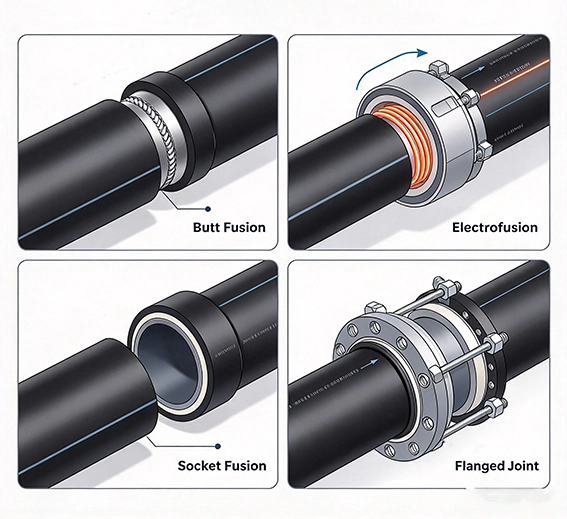
HDPE joining methods
Često postavljana pitanja
1. Can any HDPE fitting connect to any HDPE pipe?
br. Compatibility depends on outside diameter, sizing system, SDR range, and the fitting’s specified connection method. A fitting that matches the OD but not the SDR range may not fuse correctly. A metric fitting will not fuse to an IPS pipe.
2. Do HDPE pipe and fittings need to have the same SDR?
Not always the same SDR, but the fitting must be within its rated SDR range for the pipe. Za fuziju zadnjice, the wall thickness difference should not exceed one SDR step. Electrofusion couplers are specified for a defined SDR range. Compression and flanged fittings have their own size and pressure limits.
3. How do I choose the correct size of HDPE pipe fitting?
Start with the actual outside diameter and the sizing system. Then confirm the SDR or pressure requirement. Then select the fitting type based on the connection method and site conditions. Do not select by nominal size alone.
4. What is the difference between butt fusion and electrofusion fittings?
Butt fusion joins two pipe ends directly using heat and pressure—no coupler is required. Electrofusion uses a coupler with an integral heating element that melts the pipe and fitting together. Butt fusion is generally used for larger diameters and long runs; electrofusion is often preferred for tie-ins, confined spaces, and smaller diameters.
5. Can HDPE fittings connect to PVC or metal pipes?
Mechanical fittings and flange adapters are typically used for transitions between HDPE and other materials. The transition fitting must be specified for both the PE pipe size and the mating material’s standard. Fusion methods (butt and electrofusion) are for PE-to-PE connections only.
6. What information should I provide when requesting a quote for HDPE pipes and fittings?
Provide the application, pipe material grade, outside diameter and sizing system, SDR or pressure class, fitting types and quantities, način povezivanja, applicable standard, delivery destination, and any required documentation. If some parameters are open, describe the application and ask the supplier to assist.
Need HDPE Pipes and Fittings for Your Project?
If you are matching pipe and fittings for a project—or you have a fitting list and want to confirm compatibility before ordering—send us the pipe specifications, fitting types, quantities, and delivery destination. If the SDR or pressure class is not yet finalised, tell Luoyang Datang Energy Tech Co., doo. the application and operating conditions, and we will help identify the parameters that need to be confirmed.
[Request a Quote for HDPE Pipes and Fittings] ili [Send Your Pipe and Fitting Specifications]
POVEZANI OBJAVE
Ima li San Diego bilo kakve olovne cijevi za dovod vode
Osiguravanje usklađenosti s industrijskim otpadnim vodama: Sistemska rješenja cijevi
SDR11 vs SDR17 HDPE cijev: Koju ocjenu tlaka trebate odabrati?
Atwood 10 Galonski bojler – Koja je veličina dovodne cijevi za plin??
PVC cijevi vs. HDPE cijev: Što je bolje?