


LUOYANG CAME ENERGY TECH CO.,LTD


Kial Latunaj Hose-Fittings Estas Ankoraŭ Preferata Elekto por Industriaj Aplikoj?
Industrial maintenance managers don’t choose brass hose fittings because they’re fashionable. They choose them because brass works — day after day, in wet environments, under pressure, and with minimal fuss. Copper and zinc come together in brass to create a material that balances corrosion resistance, mechanical strength, maŝinebleco, and cost in a way few other materials can match. The global brass fittings market alone was valued at approximately USD 2.63 miliardo en 2025 kaj estas projektita atingi USD 3.84 miliardo per 2033, kreskanta je CAGR de 4.83%. That’s not the trajectory of a material on its way out.
Whether you’re connecting water lines in a food processing plant, running compressed air through a workshop, or building fire suppression systems, brass hose fittings remain a reliable answer. This article covers what they are, why they outperform alternatives in most industrial settings, where they’re used, and how to select the right type for your application.

latuna garnituro
What Are Brass Hose Fittings?
Brass hose fittings are connection components made from a copper-zinc alloy, designed to join hoses to equipment, connect two hose sections, or adapt between different thread types and sizes. The alloy typically contains 60–70% copper, with the remainder being zinc and small amounts of other elements to improve machinability or corrosion resistance.
Four product families dominate the industrial market: latunaj hosekonektiloj (hose-to-equipment), brass hose couplings (hose-to-hose), brass hose adapters (thread or size conversion), kaj brass hose barb fittings (barbed shanks inserted into hose ends and secured with clamps). Each serves a distinct role in fluid and pneumatic systems.
Common Types of Brass Hose Fittings
| Tajpu | Funkcio | Tipa Apliko |
|---|---|---|
| Latuna Hose Konektilo | Connect hose with equipment | Water supply, industrial equipment |
| Latuno Hose Coupling | Join two hose sections | Fire hose, industrial hose |
| Latuna Hose-Adaptilo | Ŝanĝu konektotipo | Different pipe systems |
| Latuno Barb Fittings | Secure hose connection | Low pressure fluid systems |
Why Are Brass Hose Fittings Widely Used in Industrial Applications?
This is the core question. The answer comes down to four factors that, in combination, make brass hard to beat for the vast majority of industrial hose connections.
1. Excellent Corrosion Resistance
Brass naturally resists corrosion from water, varmego, and humid environments. Unlike carbon steel, which requires zinc plating or other surface treatments to survive moisture, brass develops a protective oxide layer on its own. This is why it performs well in industrial wash-down areas, food processing facilities, and any environment where moisture is constant.
But here’s something a lot of buyers don’t realize: not all brass is created equal when it comes to corrosion. Standard brass can undergodezinkiĝo — a process where zinc is selectively leached out of the alloy, leaving behind a porous copper structure that looks intact but has lost most of its mechanical strength. This is especially a problem in soft water with high chloride content, sistemoj de varma akvo, and situations where water sits stagnant in the fitting for extended periods.
The solution is DZR brass (dezincification-resistant brass), which is heat-treated to produce a single alpha-phase microstructure that resists zinc leaching. DZR fittings are tested according to ISO 6509 and are marked with “CR” or “DZR.” If you’re specifying brass hose fittings for potable water or hot water applications, always confirm the fitting carries this designation.
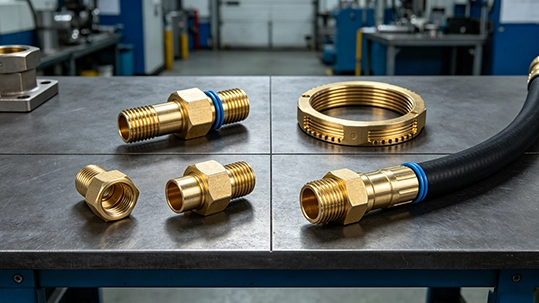
Common brass hose fitting products
2. Strong Mechanical Performance and Long Service Life
Brass isn’t the hardest metal around — carbon steel outmuscles it in raw tensile strength. But for hose fitting applications, brass hits a sweet spot that steel often misses. Its relative softness means the threads deform slightly under tightening, creating a tight metal-to-metal seal that resists leaks far better than harder materials. It also doesn’t gall — that annoying problem where threads seize up during assembly or disassembly — which matters enormously in maintenance-heavy environments.
| Proprieto | Profito |
|---|---|
| Alta forto | Reliable connection under pressure |
| Wear resistance | Longa servodaŭro |
| Stable structure | Reduced maintenance |
| No galling | Easy disassembly after years of service |
Industrial users also appreciate that brass withstands higher pressure than copper, thanks to a heavier wall structure, and offers a wider operating temperature range — typically -65°F to 250°F (-53°C to 121°C) depending on the specific alloy and fitting type. Some brass fittings are rated up to 2,000 psi maximum operating pressure. That covers a lot of ground: from compressed air lines running at 150 psi to hydraulic return lines that see occasional pressure spikes.
3. Facila Instalado kaj Prizorgado
Walk into any industrial maintenance shop and ask why they keep brass fittings on the shelf. The answer is almost always the same: speed. Brass hose fittings install without welding, without specialized tooling, and without the learning curve that comes with complex metal connection systems. Thread them on, tighten, and you’re done.
For barbed fittings, push the barb into the hose, secure with a clamp or ferrule, and the connection is ready. For threaded connections, hand-tighten plus a quarter turn with a wrench usually does the job. If a fitting needs replacement, it comes off just as easily — no cutting, no re-welding, no downtime drama.
This ease of use translates directly into lower maintenance costs. A worker can swap a worn brass coupling in minutes rather than waiting for a specialized technician. In facilities running multiple shifts, that difference adds up fast.
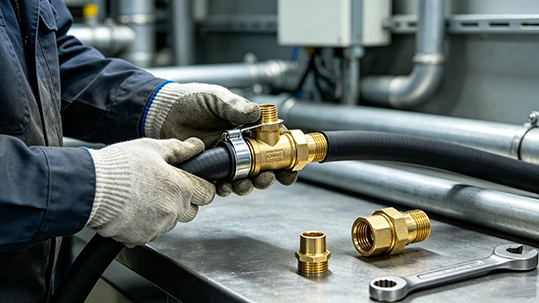
Brass hose fitting Installation
4. Good Balance Between Performance and Cost
Here’s where brass really earns its reputation among procurement teams. Compared to stainless steel, brass fittings typically cost 20–40% less for the same size and configuration. A 1/2″ NPT elbow in brass might run $2.50–$5.00, while the stainless equivalent costs $6.00–$12.00. Scale that across a facility with hundreds of connection points, and the savings become significant.
| Materialo | Avantaĝoj | Limigoj |
|---|---|---|
| Latuno | Durable, economical, excellent machinability, leak-free sealing | Not for highly aggressive chemicals; standard brass vulnerable to dezincification in certain waters |
| Neoksidebla ŝtalo | Superior corrosion resistance in harsh environments | 30–50% higher upfront cost; harder to machine |
| Plastic | Malpeza, malalta kosto, kemie inerta | Pli malalta mekanika forto; not for high pressure or repeated connection |
Plastic fittings have their place — light-duty, occasional-use applications where weight and cost matter most. But in environments where hoses are connected and disconnected daily, plastic cracks and strips over time, while brass keeps working. For most industrial buyers, the math is straightforward: brass costs a little more upfront than plastic but lasts several times longer under real working conditions.
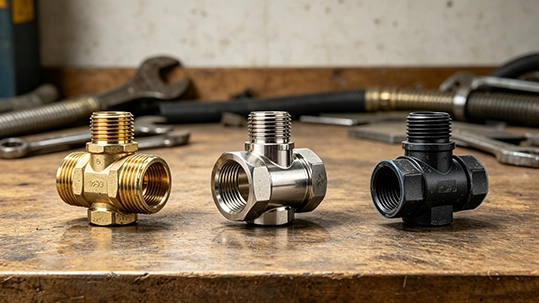
Brass vs Stainless Steel vs Plastic
Where Are Brass Hose Fittings Used?
The range of aplikoj is wider than most people assume. Brass hose fittings aren’t just for garden hoses — they’re specified across water systems, compressed air networks, fire suppression, agrikulturo, and general industrial machinery.
| Apliko | Why Brass Is Suitable |
|---|---|
| Water Systems | Good corrosion resistance; DZR grades handle potable and hot water |
| Compressed Air Systems | Reliable sealing performance; no spark risk |
| Fajraj Hose-Konektoj | Forta, durable connection under high flow |
| Agricultural Equipment | Suitable for outdoor environments; resists weather and moisture |
| Industrial Machinery | Easy maintenance and replacement; long service intervals |
Water systems are the largest application by volume. Brass hose fittings are suitable for both cold and hot water lines, with DZR grades being the standard choice for potable water. They’re used in wash-down stations, coolant circulation systems, and process water lines across food and beverage, farmacia, and general manufacturing.
Compressed air is the second major category. Brass hose fittings perform well in pneumatic systems because brass is spark-resistant — a safety advantage in environments with flammable vapors or dust. The tight sealing properties of brass also help maintain air pressure without the slow leaks that plague poorly seated fittings.
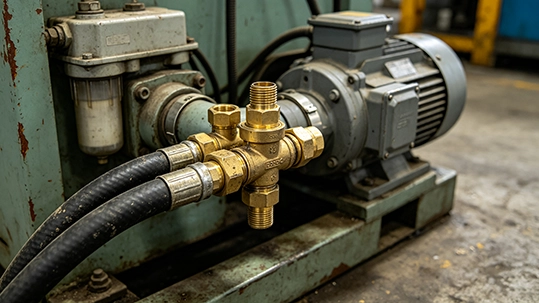
Brass Hose Fittings Used in Industrial Machinery
Latuna Hose Konektilo, Coupling and Adapter: How Do They Differ?
This is where procurement decisions often go wrong. The three terms sound interchangeable, but they serve different functions. Ordering the wrong one means the part sits on the shelf and the line stays down.
| Produkto | Ĉefa Funkcio | Plej bona Por |
|---|---|---|
| Hose Konektilo | Konekti hoson al ekipaĵo | General hose-to-machine connections |
| Hose Coupling | Connect two hoses together | Hose extension, ripari, and system expansion |
| Hose Adapter | Change thread type or size | Connecting different pipe standards (ekz., NPT al BSP) |
A practical rule of thumb: if you’re connecting a hose to a pump, valvo, or manifold, vi bezonas konektilon. If you’re joining two hoses, vi bezonas kupladon. If the threads on the two ends don’t match — say, one is NPT and the other is BSP — you need an adapter.
A quick note on NPT vs. BSP: these thread standards are not interchangeable. NPT threads have a 60° thread angle, while BSP uses 55°. Forcing them together damages both threads and creates leaks that no amount of tape will fix. If your system mixes standards, always use a dedicated adapter rather than trying to make mismatched threads work.

Latuna Hose Konektilo, Coupling and Adapter
Brass Hose Fittings vs. Other Materials
Choosing between brass, neoksidebla ŝtalo, and plastic isn’t about which is “best” in absolute terms. It’s about matching the material to the application. Here’s how they stack up:
| Faktoro | Latuno | Neoksidebla ŝtalo | Plastic |
|---|---|---|---|
| Fortikeco | ★★★★★ | ★★★★★ | ★★★ |
| Korodrezisto | ★★★★ | ★★★★★ | ★★★★ |
| Kosto | Meza | Alta | Malalta |
| Machinability | Bonega | Meza | Facila |
| Temperaturintervalo | -65°F to 250°F | -325°F to 800°F+ | -20°F to 150°F |
| Industrial use | Wide | Special environments | Limigita |
Neoksidebla ŝtalo wins on raw corrosion resistance and temperature range — no argument there. If you’re handling saltwater, strong acids, or extreme temperatures, stainless is the right call. But for the 80–90% of industrial hose connections that involve water, aero, and moderate pressures at normal temperatures, brass delivers equivalent performance at significantly lower cost and with far better machinability.
Plastic fittings are cost-effective for light-duty and disposable applications. They’re not designed for repeated connection cycles, alta premo, or UV exposure. For a permanent industrial installation, the upfront savings rarely justify the replacement frequency.

Brass Hose Fittings vs. Other Materials
How to Choose the Right Brass Hose Fittings?
Selecting the right fitting is mostly about knowing five things before you order. Miss any of them, and you’ll end up with a part that almost fits — which is the same as not fitting at all.
| Selection Factor | What to Consider |
|---|---|
| Hose Size | Match barb or connector size to hose inner diameter exactly |
| Tipo de Konekto | Fadeno (NPT/BSP), barb, aŭ rapida konekto |
| Labora Premo | Verify fitting rating exceeds system pressure with safety margin |
| Application Environment | Akvo, aero, kemiaĵoj, temperaturo gamo |
| Material Quality | Confirm brass grade; DZR for potable water |
| Thread Compatibility | Never mix NPT and BSP without an adapter |
A few practical notes from the field. Unue, wall thickness matters — cheaper cast fittings often have thin walls that crack under stress, while quality machined or forged fittings hold up to repeated tightening. Due, thread quality is a reliable indicator of overall manufacturing standards. Burrs or uneven threads mean the fitting will leak, period. Trie, when in doubt about size, remove an existing fitting from the line and measure it, or take a photo with a ruler next to the threads and compare before ordering.

Brass Hose Fittings Used in Water Systems
Oftaj Demandoj
Q1: What are brass hose fittings used for?
Brass hose fittings are used to connect hoses to equipment, join hose sections, and adapt between different thread types and sizes. They are commonly found in water supply systems, compressed air networks, fire suppression lines, agrikultura irigacio, and general industrial fluid handling.
Q2: Are brass hose fittings suitable for water applications?
Jes. Brass is inherently resistant to water corrosion and performs well in both cold and hot water systems. For potable water and hot water applications, specifu DZR (dezinkiĝo-rezistema) brass to avoid the risk of zinc leaching in aggressive water conditions.
Q3: Are brass hose fittings better than plastic fittings?
For industrial and commercial use, jes. Brass withstands pressure, repeated connection cycles, UV exposure, and temperature variation far better than plastic. Plastic fittings are adequate for light-duty, occasional-use applications where cost and weight are the primary considerations.
Q4: How long do brass hose fittings last?
Service life depends on the application environment and water chemistry. In clean, non-aggressive water systems with standard brass fittings, a service life of 10–15 years is common. In harsher conditions — high chloride, hot water, or aggressive chemicals — DZR brass or stainless steel will deliver longer service. Regular inspection and replacement of worn washers and clamps extends fitting life considerably.
Q5: What types of brass hose fittings are available?
The main categories are hose connectors (hose-to-equipment), hose couplings (hose-to-hose), hose adapters (thread or size conversion), and barbed fittings (inserted into hose ends and secured with clamps). Within each category, you’ll find straight, elbow, tee, and reducing configurations in a wide range of thread standards including NPT, BSP, and metric.

Brass Hose Fittings Used in Agricultural Equipment
Why Choose Our Brass Hose Fittings?
We manufacture latunaj hosaj garniĝoj in a range of configurations — connectors, kupladoj, adaptiloj, and barbed fittings — in both standard brass and DZR grades. Our production covers NPT, BSP, and metric threads, with both leaded and lead-free alloy options depending on the market requirement.
What sets us apart isn’t just the product range. It’s the attention to the details that cause problems in the field: consistent thread tolerances, verified wall thickness, and full traceability on material grade. Every batch goes through dimensional inspection and pressure testing before it leaves the factory.
We also offer OEM customization for buyers who need specific thread combinations, non-standard sizes, or private labeling. Whether you’re sourcing for a distribution network or specifying for a single facility, we can work with your drawings or samples to deliver fittings that match your requirements.
Kontaktu Luoyang Datang Energy Tech Co., Ltd for brass hose fittings specifications and customized solutions.
RELATAJ AFIŜOJ
Kiel Povas HDPE Pipe Fittings Revolucii Urba Akvo-Provizo Sistemoj?
Rekomendoj Pri Ekologiaj PVC-Pipaj Opcioj
Kiel instali HDPE-tubojn subterajn: Ŝlosilaj Paŝoj, Metodoj, kaj Plej bonaj Praktikoj
Ĉu Ĉi tiu Latuna Hosa Fitting Taŭgos Via Hoso? Grandeco kaj Fadena Kongruo Klarigita
