LUOYANG CAME ENERGY TECH CO., LTD

Objašnjene veličine šipki od mesinganog crijeva: Kako uskladiti veličinu šipke s ID-om crijeva
Your hose is labeled 1/2 inč. You find a 1/2-inch brass hose barb. It sounds like an obvious match — until you try to push the hose over the barb.
The hose won’t go on. Or it slides on too easily and leaks. Either way, something doesn’t add up.
Does the barb size have to be exactly the same as the hose ID?
Ne uvijek. And that’s where most buyers get stuck.
The relationship between hose ID and barb size is one of the most misunderstood topics in fluid fitting selection. Get it right, and you’ll have a leak-free connection that lasts for years. Shvati krivo, and you’ll deal with leaks, blow-offs, and damaged hoses.
This article breaks down exactly how to match a brass hose barb to your hose — without guesswork.
1. What Is a Hose Barb Size?
A hose barb size typically refers to the diameter and connection size of the barb section that enters the hose. But here’s the critical point that manufacturers rarely spell out clearly:
Barb size does NOT always equal hose ID.
1.1 What Is Hose ID?
ID = Inside Diameter. It’s the internal opening of the hose — the hole that fluid passes through.
A hose with a 1/2-inch ID has an internal diameter of approximately 0.500 inč. But here’s the catch: not every “1/2-inč” hose measures exactly 0.500″. Manufacturing tolerances, material composition, and reinforcement layers can all affect the actual ID.
Barb fittings are measured by tube ID, while push-quick fittings are measured by tube OD. This is a fundamental difference that causes countless selection errors.
1.2 What Is Barb OD?
OD = Outside Diameter. For a hose barb, you need to focus on the outside diameter of the barb where the hose fits.
The barb OD is the dimension that actually grips the hose. It’s always larger than the hose ID — typically 10-20% larger — to create the compression needed for a seal.
Here’s a concrete example: for 1/4″ (0.250″) ID tubing, the barbed fitting should have a barb OD of at least .270″ . To je 8% larger than the hose ID.
1.3 The Key Terms
| Termin | Značenje | Zašto je važno |
|---|---|---|
| ID crijeva | Inside diameter of hose | Determines opening size |
| Hose OD | Outside diameter of hose | Useful for clamp/application checks |
| Barb OD | Outside diameter of barb | Determines hose engagement |
| Barb length | Length of insertion area | Affects grip and sealing |
| Veličina niti | Threaded connection size | Connects fitting to equipment |
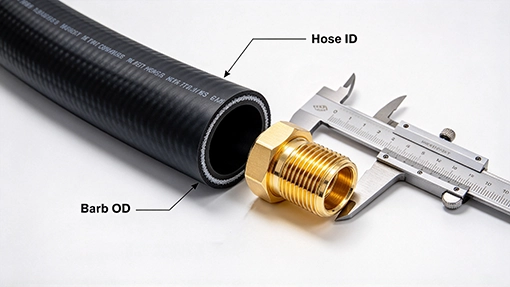
Hose ID vs Barb OD
2. Does Hose ID Have to Equal Barb Size?
No — and this is where most people go wrong.
If your hose has a 1/2″ ID, it does not mean the barb OD must be exactly 1/2″. In fact, to shouldn’t be exactly 1/2″.
The barb OD needs to be slightly larger than the hose ID to create compression. The hose material must stretch over the barb and then grip it tightly.
Here’s why the relationship is more complex than a simple 1:1 match:
- Hose flexibility — Soft rubber stretches easily; rigid PVC barely stretches at all
- Materijal crijeva — Different materials have different compression and recovery properties
- Barb profile — Tapered vs. beaded vs. ridged barbs grip differently
- Debljina stijenke — Two hoses with the same ID can have very different wall thicknesses
- Temperatura — Hot hoses soften; cold hoses stiffen
- Pritisak — Higher pressure requires more secure gripping
- Manufacturer design — There is no universal barb standard
3. Hose ID vs. Hose Barb Size: What Is the Correct Match?
The correct match follows this sequence:
Hose ID → Barb OD → Insertion → Grip → Seal → Clamp (if required)
| Hose Information | Barb Information | What to Check |
|---|---|---|
| 1/2″ ID | 1/2″ nominal barb | Actual barb OD |
| 3/4″ ID | 3/4″ nominal barb | Hose flexibility |
| 1″ ID | 1″ nominal barb | Barb profile |
| Soft hose | Matching barb | Compression/grip |
| Reinforced hose | Matching barb | Insertion force |
There is no universal formula that works for every hose and barb combination. The nominal size gets you close. The actual dimensions — and the manufacturer’s specification — get you to the right answer.
For a complete compatibility check, see our guide: Hoće li ovaj mesingani priključak za crijevo odgovarati vašem crijevu? Objašnjeno podudaranje veličine i niti.

Hose ID vs. Hose Barb Size
4. Brass Hose Barb Size Chart
| Nominal Barb Size | Common Hose Size Reference | Što potvrditi |
|---|---|---|
| 1/4″ | 1/4″ hose ID | Actual barb OD |
| 3/8″ | 3/8″ hose ID | Actual barb OD |
| 1/2″ | 1/2″ hose ID | Actual barb OD |
| 5/8″ | 5/8″ hose ID | Actual barb OD |
| 3/4″ | 3/4″ hose ID | Actual barb OD |
| 1″ | 1″ hose ID | Actual barb OD |
| 1-1/4″ | 1-1/4″ hose ID | Actual barb OD |
| 1-1/2″ | 1-1/2″ hose ID | Actual barb OD |
| 2″ | 2″ hose ID | Actual barb OD |
Važno: The “Common Hose Size Reference” column is a starting point, not a guaranteed match. Actual barb OD varies by manufacturer, barb design, and intended hose material.
5. What Size Barb Do You Need for a 1/2-Inch Hose?
This is the single most common question — and the answer is more nuanced than most people expect.
Prvi, potvrditi: Je “1/2 inch hose” referring to the hose ID?
Then verify:
- Actual hose ID — measure with a caliper
- Materijal crijeva — PVC, guma, silikon, reinforced
- Barb OD — not just the nominal size
- Barb design — tapered, beaded, or ridged
- Radni tlak — higher pressure needs more grip
- Clamp requirement — most pressurized applications need one
5.1 Primjer: 1/2-Inch Flexible PVC Hose
PVC hose is relatively stiff. A 1/2″ nominal barb will typically work, but insertion may require effort. The barb OD should be close to the nominal size — too large and you’ll split the hose.
5.2 Primjer: 1/2-Inch Rubber Hose
Rubber hose is more flexible and forgiving. A barb with a slightly larger OD may work well, creating a secure grip without excessive insertion force.
5.3 Primjer: 1/2-Inch Reinforced Hose
Reinforced hose has a braided layer that resists stretching. You may need a barb with a smaller OD or a different barb profile. Never force a barb into a reinforced hose — you risk damaging the reinforcement layer.
The same nominal hose size can behave differently depending on construction and flexibility.

Brass Hose Barb Size
6. What Size Barb for 3/4-Inch and 1-Inch Hose?
| ID crijeva | Common Barb Size Reference | Key Check |
|---|---|---|
| 1/4″ | 1/4″ | Actual barb OD |
| 3/8″ | 3/8″ | Hose flexibility |
| 1/2″ | 1/2″ | Actual ID + barb OD |
| 5/8″ | 5/8″ | Hose construction |
| 3/4″ | 3/4″ | Barb profile |
| 1″ | 1″ | Pritisak + stezaljka |
| 1-1/4″ | 1-1/4″ | Actual dimensions |
| 1-1/2″ | 1-1/2″ | Hose construction |
| 2″ | 2″ | Manufacturer specification |
The pattern holds: nominal size gets you in the right range; actual measurements and material compatibility determine the final fit.
7. How to Measure Hose ID Before Buying a Brass Hose Barb
Korak 1 — Remove the Hose
Don’t measure while the hose is installed on a fitting. The hose may be stretched or compressed, giving you a false reading.
Korak 2 — Measure the Inside Diameter
Use a Vernier caliper. Measure from inner wall to inner wall. Take readings at multiple points around the circumference — hoses aren’t always perfectly round.
Korak 3 — Measure the Existing Barb
If you have an old fitting, measure the barb OD at its widest point (the ridge). Compare it to your new barb’s specification.
Korak 4 — Check the Hose Material
Identify whether your hose is PVC, guma, silikon, poliuretan, or reinforced. Different materials require different barb designs.
Korak 5 — Check the Manufacturer’s Specification
The final authority is always the manufacturer’s dimensional drawing. Don’t rely on nominal size alone.
To measure a hose barb size, use a caliper or ruler to determine the outer diameter of the barb’s ridged section — and ensure you also measure the inner diameter of the hose for compatibility.

Measure Hose ID
8. Why the Same Hose ID Can Need Different Barb Designs
8.1 Hose Material
Soft materials compress easily; hard materials resist compression. A barb that works for soft rubber may not grip stiff PVC.
8.2 Debljina stijenke
Two hoses can both have a 1/2″ ID but completely different wall thicknesses. A thicker wall requires more insertion force and may need a different clamp.
8.3 Reinforcement
Braided or reinforced hose resists stretching. A barb designed for standard hose may not work — or may damage the reinforcement.
8.4 Temperatura
High temperatures soften hose materials, reducing grip. Low temperatures make hoses stiff, making insertion difficult and potentially causing cracks.
8.5 Radni tlak
Higher pressure demands more secure gripping, a better barb profile, and a properly positioned clamp.
9. Barb Size vs. Thread Size: Don’t Mix Them Up
Many brass hose barbs are labeled with two sizes, kao 1/2″ × 1/2″. This is where confusion often strikes.
The first number refers to the barb size (hose connection). The second number refers to the thread size (equipment connection).
| Specifikacija | What It Refers To |
|---|---|
| 1/2″ barb | Hose connection |
| 1/2″ NPT | Thread connection |
| 1/2″ BSP | Thread connection |
| 1/2″ hose | Hose ID reference |
| 1/2″ pipe | Nominal pipe size |
These are completely different dimensions. A 1/2″ barb × 1/2″ NPT fitting has a barb for a 1/2″ hose and a 1/2″ NPT thread for the equipment port. The “1/2 inč” means different things on each end.
For a deeper dive into this topic, see our article: What Does “1/2 inča” Actually Mean on a Brass Hose Fitting?

Barb Size vs. Thread Size
10. NPT vs. BSP on Brass Hose Barb Fittings
Barb size and thread standard are separate specifications. You can have:
- 1/2″ ivica × 1/2″ NPT
- 1/2″ barb × 1/2″ BSP
The barb may be identical. The threads are not.
NPT uses a 60° thread form; BSP uses a 55° Whitworth form. At 1/2″ size, both have 14 threads per inch — so a BSP male will start into an NPT female. But it will not seal.
For a complete comparison: NPT vs. BSP navoji: Koji navoj odabrati za mesingane spojnice?
11. Common Mistakes When Choosing a Brass Hose Barb
Pogreška 1: Only looking at “1/2 inč” on the hose label.
The actual ID may differ from the nominal size. Measure before you buy.
Pogreška 2: Assuming barb size = exact hose ID.
The barb OD should be larger than the hose ID, not equal to it.
Pogreška 3: Ignoring hose material.
PVC, guma, silikon, and reinforced hose all behave differently over the same barb.
Pogreška 4: Ignoring thread type.
A perfect barb connection is useless if the thread doesn’t match your equipment port.
Pogreška 5: Buying from the product title alone.
A product title tells you what the fitting is called. A dimensional drawing tells you whether it will fit.
Pogreška 6: Skipping pressure and temperature checks.
A fitting that works at room temperature and low pressure may fail at 160°F and 150 psi.
12. A Simple Brass Hose Barb Selection Process
Know your hose ID
↓
Measure the actual ID
↓
Identify hose material
↓
Select matching barb size
↓
Check actual barb OD
↓
Confirm thread type
↓
Check pressure & temperatura
↓
Confirm manufacturer drawing

NPT vs. BSP on Brass Hose Barb Fittings
13. Brass Hose Barb Size FAQ
P1: What size barb do I need for a 1/2-inch hose?
A 1/2″ hose typically calls for a 1/2″ nominal hose barb. But verify the actual hose ID and the barb’s actual OD — not just the nominal size. For 1/4″ ID tubing, the barb OD should be at least .270″.
Q2: Does hose barb size equal hose ID?
Ne. Barb size is a nominal designation for the hose ID it’s designed to fit. The actual barb OD is always larger than the hose ID — typically by 10-20% — to create the compression needed for a seal.
Q3: How do I measure hose ID for a barb fitting?
Remove the hose from any fitting. Use a Vernier caliper to measure from inner wall to inner wall. Take multiple readings to check for roundness. Then compare to the barb manufacturer’s specification.
Q4: What is the difference between hose barb size and thread size?
Barb size refers to the hose connection — the part that inserts into the hose. Thread size refers to the equipment connection — the threaded end that screws into a port. A 1/2″ barb × 1/2″ NPT fitting has both, but the “1/2 inč” means different things on each end.
P5: What size barb fits a 3/4-inch hose?
A 3/4″ nominal barb is the starting point. Verify the actual hose ID, hose material, barb OD, and working pressure before ordering.
P6: Can a 1/2-inch hose use a 1/2-inch brass barb?
Obično, yes — but “obično” is not a guarantee. The actual hose ID and barb OD must be compatible. A 1/2″ hose with an ID of 0.480″ and a barb with an OD of 0.520″ will work. A hose with an ID of 0.520″ and a barb with an OD of 0.490″ will leak.
14. Need Help Matching a Brass Hose Barb to Your Hose?
The right barb is not the one with the same number on the label. It’s the one that matches your hose’s actual dimensions, materijal, and operating conditions.
When requesting a quote, provide:
- ID crijeva
- Materijal crijeva
- Vrsta niti (NPT / BSP / GHT / other)
- Radni tlak
- Temperatura
- Mediji (voda, zrak, gorivo, ulje)
- Required quantity
Luoyang Datang Energy Tech Co., doo. can help you find the right brass hose barb — and help you avoid the most common sizing mistakes.
POVEZANE OBJAVE
Što se od sljedećeg odnosi na cjevovod koji povezuje sustav raspršivača s glavnim dovodom vode?
HDPE cijev naspram cijevi od nodularnog željeza: Što je bolje za projekte vodoopskrbe?
Pet glavnih prednosti PPR cijevi
Tri stupa modernih cjevovodnih sustava
HDPE električni vod u odnosu na tradicionalne zaštitne cijevi za kabele: Potpuni vodič za usporedbu