LUOYANG CAME ENERGY TECH CO.,LTD


Three Common Brass Hose Connection Parts: Connector, Adapter and Coupling
A purchasing manager once told me a story that still makes me wince. He needed 2,000 brass fittings for a water transfer project. The spec sheet said “brass hose connector.” He ordered what the supplier called a connector. Three weeks later, half the shipment sat in a warehouse because the threads wouldn’t mate with the equipment on site. The problem wasn’t the supplier. The problem was the word “connector.”
In the brass hose fittings world, connector, адаптер, жана бириктирүү are not interchangeable terms—even though they’re often used as if they were. Each refers to a specific function. Order the wrong one, and you’re looking at leaks, returns, and project delays.
This guide is written for buyers—the people who need to get the order right. We’ll walk through what each part does, when to use it, and how to avoid the mistakes that cost time and money.
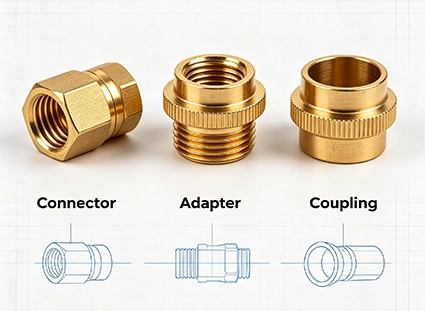
Three Common Brass Hose Connection Parts
What Are Brass Hose Connection Parts?
Brass hose connection parts are components used to join hoses, түтүктөр, клапандар, and equipment in fluid and pneumatic systems. They come in dozens of shapes and thread standards, but almost every one of them falls into three functional categories:
| Part | Main Purpose |
|---|---|
| Connector | Connect hose with another component (hose → pipe, hose → valve, hose → equipment) |
| Adapter | Change thread standard, өлчөмү, or connection type |
| Кошуу | Join two hose sections or two pipes together |
Brass is the material of choice for these parts because it resists corrosion, holds threads well, and handles a wide range of media—from potable water to compressed air to neutral chemicals. Standard brass screw-in fittings are typically rated for up to16 бар, and nickel-plated or high-pressure variants can go higher.
Now let’s look at each type in detail.
Жез түтүк туташтыргычы: The Basic Link Between Hose and Equipment
А жез түтүк туташтыргычы does exactly what its name suggests: it connects a hose to a pipe, a valve, a pump, or a piece of equipment. It’s the most straightforward category of brass hose fittings—and also the most commonly ordered.
Common Connector Types
| Type | Өзгөчөлүк | Типикалык колдонмо |
|---|---|---|
| Barb connector | Barbed end inserts into hose, secured with a clamp | Water lines, air systems, сугаруу |
| Threaded connector | Threaded end screws into a port or fitting | Pumps, клапандар, manifolds |
| Male connector | Тышкы жип | Equipment connection points |
| Female connector | Ички жип | Pipe or valve connection |
The barbed connector is the workhorse of flexible hose systems. The barb slides into the hose, and a worm-gear clamp or crimp ferrule locks it in place. This is the classic “hose → pipe” же “hose → valve” solution found in everything from a garden irrigation line to a factory air compressor.
Threaded connectors handle the other half of the equation: the equipment side. If your pump has a 1/2″ NPT female port, you need a male threaded connector with a barb on the hose end.
📖 Further Reading: For a deeper dive into barb sizes, thread options, and material grades, see our guide: Жез шланг туташтыргыч түрлөрү: Кантип туура тандоо керек?
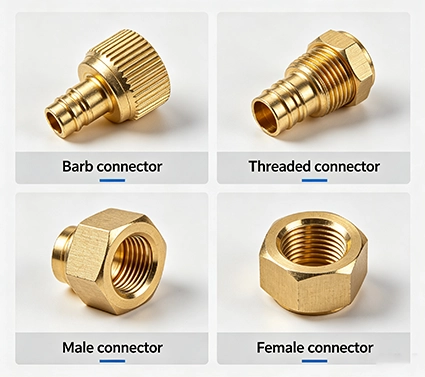
Common Connector Types
Brass Hose Adapter: When You Need to Change Connection Types
Here’s where things get interesting. Анадаптер doesn’t just connect—itconverts. If your hose has a BSP thread and your equipment has NPT, a connector won’t help. You need an adapter.
Think of it this way: a connector assumes both sides already speak the same language. An adapter is the translator.
What Adapters Actually Convert
| Conversion Type | Мисал |
|---|---|
| Жип стандарты | NPT to BSP, BSPT to BSPP |
| Өлчөмү | 1/2″ to 3/4″, M12 to G1/4 |
| Туташуу ыкмасы | Hose barb to threaded port, flare to pipe |
The NPT vs BSP distinction is the most common reason buyers need an adapter. NPT threads use a60-degree thread angle and are tapered; BSP threads use a55-degree angle, and BSPP variants are parallel (түз), not tapered. They are not interchangeable. Forcing a BSP male into an NPT female might let you thread one or two turns—and that’s exactly where the leak starts.
A brass hose adapter solves this cleanly. One end is machined to NPT spec, the other to BSP. The part does the translation so your system doesn’t have to.
📖 Further Reading: Confused about which thread standard you actually have? See: NPT vs BSP Threads: Жез арматуралар үчүн кайсы жипти тандоо керек?
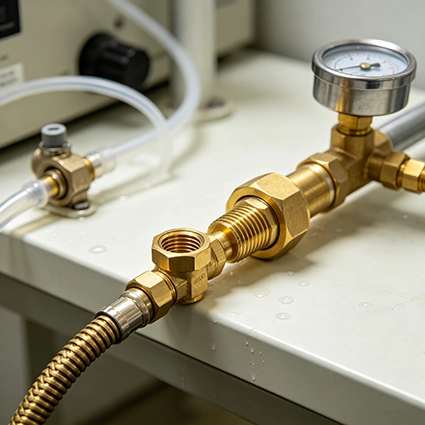
Brass Hose Adapter
Brass Hose Coupling: Connecting Two Hose Sections Together
If a connector links a hose to equipment, абириктирүү links a hose to another hose. Same principle, different application. Couplings are what you reach for when you need to extend a line, repair a damaged section, or join two pipe runs end-to-end.
Coupling Types at a Glance
| Coupling Type | Өзгөчөлүк | Best For |
|---|---|---|
| Straight coupling | Simple socket-to-socket connection | Extending hose length, permanent joins |
| Threaded coupling | Screw connection on both ends | Industrial piping runs |
| Quick coupling | Push-to-connect / quick-disconnect | Equipment that needs frequent changeover |
Straight couplings and threaded couplings are the go-to choice for permanent or semi-permanent connections. Quick couplings—sometimes called brass quick couplings or brass hose joiners—are a different animal. They’re designed for speed: connect and disconnect without tools, often with a built-in valve to shut off flow when disconnected.
Brass quick couplings are rated for working pressures from16 бар чейин35 бар depending on the design, with a safety factor typically of 4:1. They’re common in pneumatic manufacturing cells, water washdown stations, and anywhere operators need to swap attachments fast.
📖 Further Reading: For specialized coupling designs used in fuel and chemical transfer, биздин көр Жезден жасалган машинаны бириктирүү боюнча колдонмо.
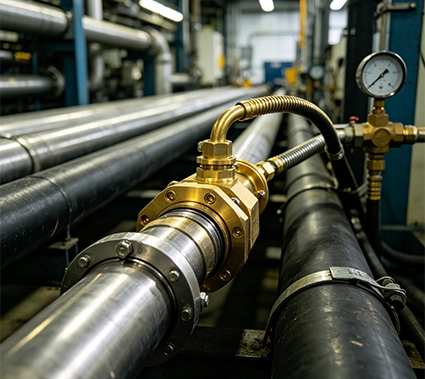
Brass Hose Coupling for Industrial piping runs
Connector vs Adapter vs Coupling: Quick Comparison
This is the table worth printing out and keeping next to your desk. It’s the fastest way to figure out which part you need.
| Өзгөчөлүк | Connector | Adapter | Кошуу |
|---|---|---|---|
| Main purpose | Connect hose to component | Change connection type | Join two hoses |
| Connection ends | Hose + жабдуулар | Different standards | Hose + шланг |
| Common design | Barb / жип | Thread conversion | Straight / quick |
| үчүн мыкты | Fixed connections | Compatibility problems | Extension / repair |
| Мисал | Hose to valve | NPT to BSP | Two hose sections |
If you remember nothing else from this article, remember this: Connector = connect. Adapter = convert. Coupling = join.
How to Choose the Right Brass Hose Connection Part
Here’s a four-step process that works for 90% of buying decisions.
Кадам 1: What are you connecting?
Start with the two endpoints. If it’s a hose and a piece of equipment →connector. If it’s two hoses →бириктирүү. If the two ends don’t match →адаптер.
Кадам 2: Check hose size
Measure the hoseinner diameter (ID), not the outer diameter. A hose with a 1/2″ ID needs a fitting with a 1/2″ тикенек. This sounds obvious, but it’s one of the most common ordering errors.
Кадам 3: Check thread standard
Identify whether your port is NPT, BSP (BSPP or BSPT), же метрикалык. Measure the outer diameter of male threads and the thread pitch, then compare against a thread chart. If the thread is tapered, it’s likely NPT or BSPT. If it’s parallel, it’s BSPP or metric parallel.
Кадам 4: Consider pressure and application
| Талап | Recommended Part |
|---|---|
| Connect hose to equipment | Connector |
| Change thread size or standard | Adapter |
| Extend hose length | Кошуу |
| Frequent connect/disconnect | Quick coupling |
Standard brass fittings handle up to 16 бар. If your system runs higher—say 25–35 bar—check the fitting’s rated working pressure. Жез is suitable for compressed air, суу, and neutral media; aggressive chemicals or high-temperature steam may require stainless steel or specialty seals.
📖 Further Reading: Need help measuring your hose and matching it to the right fitting? See: Бул жез түтүк сиздин шлангыңызга туура келеби?? Өлчөмү жана жиптин дал келүүсү түшүндүрүлгөн
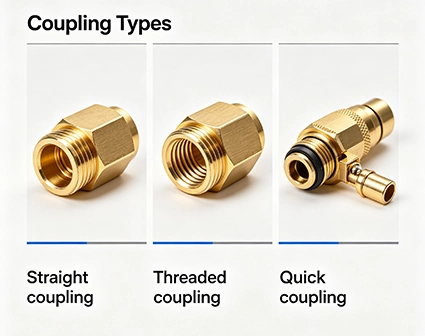
Coupling Types
Common Mistakes When Buying Brass Hose Connection Parts
These are the errors that show up in return requests and warehouse rejection reports. They’re avoidable.
| Ката | What Happens |
|---|---|
| Wrong hose size (ID vs OD) | Leakage; fitting won’t seat properly |
| Wrong thread standard (NPT vs BSP) | Cannot install; cross-threading; leaks under pressure |
| Assuming 3/4″ GHT and 3/4″ NPT are the same | They are not—GHT has a different pitch and thread count |
| Choosing adapter when connector is needed | Unnecessary complexity; potential weak point |
| Ignoring working pressure | Failure risk under load |
| Using wrong seal method (tape on flare fitting) | Leaks; improper sealing |
The GHT vs NPT confusion deserves special mention. Garden hose thread (GHT) and NPT thread both use 3/4″ nominal sizing, but GHT has a different thread pitch and thread count. They will not seal against each other. This single mistake accounts for a significant share of brass fitting returns in the US market.
Көп берилүүчү суроолор
Q1: What is the difference between a brass hose connector and a brass hose coupling?
А: A connector links a hose to equipment (pump, valve, түтүк). A coupling links two hoses together. If you’re extending a hose line or repairing a damaged section, you need a coupling. If you’re hooking up a hose to a machine, you need a connector.
Q2: Can a brass hose adapter connect different thread standards?
А: Yes—that’s exactly what it’s designed for. A brass hose adapter can convert NPT to BSP, BSPT to BSPP, or one size to another. Just make sure both ends are specified correctly when ordering.
Q3: Are brass hose couplings suitable for industrial applications?
А: Абсолюттук. Brass quick couplings rated for 16–35 bar are widely used in pneumatic systems, суу менен дарылоо, and equipment washdown. Brass resists corrosion and holds up well to repeated connect/disconnect cycles.
Q4: How do I choose the right brass hose fitting size?
А: Measure the hose inner diameter for the barb end, and measure the thread outer diameter and pitch for the threaded end. Then compare against a thread chart. Шек болгондо, send the existing fitting to your supplier or request a sample before placing a bulk order.
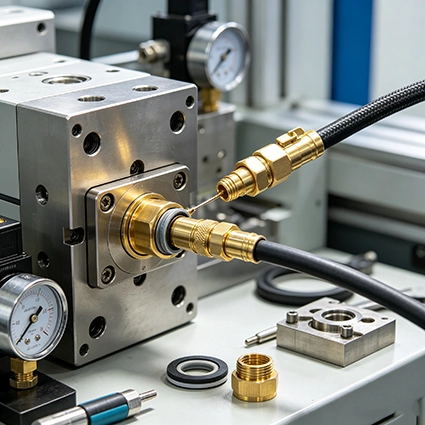
Quick coupling for Equipment that needs frequent changeover
Final Takeaway
The brass hose connection parts market rewards buyers who ask one extra question before hitting “submit order”: What exactly am I connecting to what?
If the answer is hose-to-equipment, order aconnector. If the two ends don’t speak the same thread language, order anадаптер. If it’s hose-to-hose, order aбириктирүү. Get those three straight, and you’ve eliminated the most expensive category of ordering errors in this product line.
Everything else—barb size, thread pitch, pressure rating—is detail work. Important detail work, yes, but detail work nonetheless. Start with the function. The rest follows. Understanding these differences helps buyers choose the right brass hose fitting, improve installation efficiency, and reduce unnecessary replacement costs.
For customized brass hose fittings, different thread standards, or industrial hose connection solutions, contact Luoyang Datang Energy Tech Co., Ltd for professional support.
БАЙЛАНЫШТУУ ПОСТТАР
Эмне үчүн PPR түтүктөрү жана фитингдери заманбап суу менен камсыздоо системалары үчүн эң сонун тандоо болуп саналат?

10 HDPE түтүгүнө буйрутма берүүдөн мурун инженерлер эске алышы керек факторлор
Өрткө каршы түтүктөр: Кантип туура түрүн тандоо керек

ПВХ түтүктөрү жана суу менен камсыздоо системалары үчүн арматуралар боюнча толук колдонмо