LUOYANG CAME ENERGY TECH CO., LTD


HDPE Pipe bestellen? 10 Detailer fir Är RFQ ze setzen
Don’t Send Only “I Need 5,000 Meters of HDPE Pipe”
“Please quote 5,000 meters of HDPE pipe.”
If you’ve been in the pipe trading business long enough, you’ve seen this message dozens of times. And every time, the supplier’s response is the same: a polite but frustrating series of follow-up questions.
What diameter? What SDR? What pressure rating? What material grade? Which standard? What length per piece? Where is it going?
The buyer waits. The supplier waits. The quotation gets delayed. Sometimes the deal falls apart — not because the price was wrong, but because nobody could figure out what was actually being ordered.
Here’s the thing: a complete RFQ gets you a more useful quotation faster. Not a lower price necessarily — a useful eent. One you can actually compare with other suppliers, present to your project team, and use to make a decision.
This article breaks down the 10 details every HDPE pipe RFQ should include. Whether you’re a procurement officer, a contractor, or a trading company sourcing on behalf of a client, this checklist will save you time, reduce back-and-forth emails, and help you get quotes that actually mean something.
Need an HDPE pipe quotation? Send us your basic requirements — application, Duerchmiesser, quantity, and destination — and we’ll help you fill in the gaps.

HDPE pipe RFQ and ordering requirements
What Is an HDPE Pipe RFQ?
RFQ stands for Request for Quotation. In the HDPE pipe industry, it’s the document (or email) that tells a supplier what you need so they can tell you what it costs.
Sounds simple. It rarely is.
The problem is that “HDPE Päif” covers an enormous range of products. A 32 mm SDR17 PE100 pipe for irrigation and a 630 mm SDR11 PE100 pipe for a municipal water main are both “HDPE Päif” — but they have almost nothing else in common. Different raw material consumption, different production lines, different logistics requirements, different price points.
An effective HDPE pipe RFQ should contain at least these ten elements:
| Information | Firwat Et Matters |
|---|---|
| Applikatioun | Determines suitable pipe type and certification requirements |
| Duerchmiesser | Determines pipe size and production capability |
| SDR | Determines wall thickness and pressure capacity |
| Drock Bewäertung | Confirms operating requirements match pipe design |
| Material Grad | Defines resin specification (PE80 vs PE100) |
| Standard | Determines compliance and testing requirements |
| Längt | Affects production scheduling and loading efficiency |
| Quantitéit | Affects unit price, MOQ, and production priority |
| Destination | Affects shipping cost and trade term selection |
| Delivery requirement | Affects quotation validity and lead time |
Think of this table as your master checklist. Every item below expands on one of these ten points.
10 Details to Put in Your HDPE Pipe RFQ
1. Tell the Supplier What the Pipe Will Be Used For
Don’t start with diameter. Start with the purpose.
What is the pipe for? Potable water supply? Bewässerung? Drainage? Ofwaasser? Gas distribution? Industriell Flëssegkeetstransfer?
This matters more than most buyers realize. Application determines the entire specification chain:
- Material requirements (potable water needs NSF/ANSI 61 or equivalent certification)
- Drock Ufuerderunge (gravity drainage vs. pressurized water supply are completely different)
- Applicable standards (ISO 4427 for water, ISO 4437 for gas, IN 12201 for European water projects)
- Pipe design (gas pipes require specific SDR ranges and testing protocols)
- Certification and documentation needs
| Applikatioun | Typical Information to Confirm |
|---|---|
| Waasserversuergung | Drock Bewäertung, Standard, potable-water certification |
| Bewässerung | Duerchmiesser, Drock, coil vs. straight length |
| Drainage | Gravity vs. pressure application, Ring Steifheit |
| Gas | Gas-pipe standard (ISO 4437 oder EN 1555), Zertifikatioun |
| Industriell | Fluid type, Temperatur, Drock, chemical exposure |
You don’t need to write an essay about your project. Just one line — “Applikatioun: potable water supply for municipal distribution” — immediately narrows down the supplier’s approach.
Have these specifications ready? [Ufro en Devis →]
2. Specify the Outside Diameter
This is the most basic parameter in any HDPE pipe inquiry — and also the most common source of confusion.
HDPE pipes are typically specified by outside diameter (VUN) in millimeters. Common metric sizes include 32 mm, 63 mm, 90 mm, 110 mm, 160 mm, 250 mm, 315 mm, 400 mm, an 630 mm. Larger diameters up to 1200 mm and beyond are available from specialized manufacturers.
Here’s the trap: don’t write only “6-inch HDPE pipe” if your project specification uses metric OD. A “6-Zoll” pipe in the imperial system (IPS) has a different outside diameter than a DN160 metric pipe. In some cases, the difference is small enough to cause installation problems but large enough that the pipes are not interchangeable.
Always provide the exact outside diameter in millimeters. If your project specification uses inches, note both — but confirm which system applies.
🔗 Related: [HDPE Pipe Gréissten an Dimensiounen Guide]
3. State the SDR or Wall Thickness
SDR steet fir Standard Dimension Ratio. It’s calculated as:
SDR = Aussenduerchmiesser ÷ Wanddicke
Eng méi niddereg SDR bedeit eng méi décker Mauer, which means higher pressure capacity. A higher SDR means a thinner wall and lower pressure rating.
This single number tells the manufacturer almost everything about the pipe’s strength and material consumption.
| Ufuerderung | What to Provide |
|---|---|
| SDR | SDR 11 / SDR 13.6 / SDR 17 / SDR21 / SDR26 |
| Wanddicke | mm (if project specifies directly) |
| Design requirement | Project specification or engineering calculation |
Don’t ask for “strong HDPE pipe.” That means nothing. Specify the SDR or the required pressure rating, and the wall thickness follows automatically.
Zum Beispill, a 160 mm HDPE pipe:
- SDR11 → 14.6 mm wall → PN16
- SDR17 → 9.5 mm wall → PN10
- SDR26 → 6.2 mm wall → PN6
The difference in material cost between SDR11 and SDR26 for the same diameter is significant. Getting this wrong affects both performance and budget.
🔗 Related: [SDR11 vs SDR17 HDPE Pipe]

HDPE pipe diameter SDR and wall thickness comparison
4. Specify the Pressure Rating
HDPE pipes are commonly rated in PN (Nominell Drock) Klassen:
| PN Rating | Typical SDR (PE 100) | Gemeinsam Uwendungen |
|---|---|---|
| PN 6 | SDR26 | Niddereg Drock Bewässerung, gravity-assisted systems |
| PN 8 | SDR21 | Light irrigation, Drainage |
| PN 10 | SDR 17 | Waasserversuergung, general irrigation |
| PN 12.5 | SDR 13.6 | Municipal water distribution |
| PN 16 | SDR 11 | High-pressure water mains, industriell |
| PN 20 | SDR9 | Specialized high-pressure applications |
| PN 25 | SDR7.4 | Demanding industrial use |
| Ufuerderung | Beispill |
|---|---|
| Nominellen Drock | PN 10 |
| Betribsdrock | 8 bar |
| Design pressure | 10 bar |
| Test pressure | Project-specific (often 1.5× design) |
Don’t confuse these concepts. Nominal pressure is the pipe’s rated capacity. Operating pressure is what your system actually runs at. Design pressure includes safety margins. Test pressure is what the pipe must withstand during commissioning.
If your project engineer has specified a pressure rating, provide it directly. If not, describe the operating conditions and let the supplier recommend a suitable PN class.
🔗 Related: [HDPE Pipe Pressure Bewäertung Guide: Wéi wielen ech PN10, PN 12.5, an PN16 Pipes]
5. Tell the Supplier the Material Grade
HDPE pipe is manufactured from polyethylene resin, and the two most common grades are:
- PE80: Minimum erfuerderlech Kraaft (MRS) vun 8.0 MPa. Widely used in older specifications and certain regional markets.
- PE 100: MRS of 10.0 MPa. The current industry standard for most new projects. Erlaabt dënn Mauere fir déiselwecht Drockbewäertung, which means more flow capacity and less material per meter.
Here’s a practical comparison: a 110 mm SDR11 pipe in PE80 has a pressure rating of PN12.5, while the same size in PE100 is rated PN16. Same diameter, same wall thickness — different material, different performance.
| Grad | MRS (MPa) | Common SDR11 Rating | Notizen |
|---|---|---|---|
| PE63 | 6.3 | PN 8 | Legacy grade, rarely specified today |
| PE80 | 8.0 | PN 12.5 | Still used in some markets |
| PE 100 | 10.0 | PN 16 | Industry standard for new projects |
In your RFQ, simply write: Material: PE 100. If your project requires specific resin certification or raw material documentation (z.B., from a named resin supplier), include that too.
Don’t write “high-quality polyethylene.” That’s not a specification — it’s a hope.
6. Specify the Required Standard
This section is critical — and frequently overlooked.
Different markets follow different standards:
| Standard | Regioun / Applikatioun |
|---|---|
| ISO 4427 | International — water supply and drainage under pressure |
| IN 12201 | European — polyethylene pipes for water supply |
| ASTM D3035 / F714 | US — polyethylene pipe based on outside diameter |
| AS/NZS 4130 | Australien / New Zealand — PE pipes for pressure applications |
| GB/T 13663 | China — PE pipes for water supply |
| ISO 4437 | International — PE pipes for gas supply |
A pipe that meets ISO 4427 is not automatically compliant with ASTM F714, even if the dimensions are similar. The testing protocols, marking requirements, and certification documentation all differ.
The supplier should not guess the required standard. If your project has a specification document, attach it. If the standard is referenced in your contract, quote it exactly. “HDPE Waasserleitung” without a standard is an invitation for mismatched expectations.
🔗 Related: [Wéi wielen ech HDPE Pipes fir Waasserversuergungsprojeten]
7. State Pipe Length and Delivery Format
HDPE pipes come in two primary delivery formats:
| Format | Suitable When | Typical Sizes |
|---|---|---|
| Riichtaus Päif | Large diameter (typically ≥63 mm), rigid installation | 5.8 m, 6 m, 11.8 m, 12 m |
| Coil | Smaller diameter, long continuous runs | 50 m, 100 m coils (bis zu 110 mm OD) |
Standard straight lengths vary by market: 5.8 m and 11.8 m are common in container-shipping contexts (designed to fit 20 ft and 40 ft containers efficiently). 6 m and 12 m are standard in many domestic markets.
Pipe length affects loading efficiency and logistics cost. A 12 m pipe doesn’t fit in a standard 20 ft container. A 5.8 m pipe fits neatly. If your project requires specific lengths for installation reasons, state them. If not, ask the supplier what lengths they recommend for efficient shipping to your destination.
🔗 Related: [10 Faktoren Ingenieuren solle berécksiichtegt ier Dir HDPE Pipe bestellen]
8. Give the Exact Quantity
“I need HDPE pipe” is not a quantity.
5,000 Meter is a quantity. 420 pieces × 12 m ass nach besser. 2 × 40′ containers is a valid way to express it if you’re optimizing logistics.
Here’s why precision matters: HDPE pipe pricing is tiered. The difference between 1,000 m and 10,000 m of the same specification can be 15–25% in unit price. Suppliers need to know your volume to quote accurately — not just to give you a better price, but to confirm they can produce it within your timeline.
| Quantity Format | When to Use |
|---|---|
| Total meters | Standard for comparison |
| Pieces × length | When length is fixed |
| Containers | When logistics optimization is primary |
Also mention if your quantity is firm oder estimated. A firm order of 5,000 m gets a different response than “we might need 5,000 m, maybe more, maybe less.”
9. Tell the Supplier Where the Pipe Is Going
This is where the inquiry shifts from technical to commercial.
Destination determines the trade term. FOB, CFR, CIF — each one shifts cost and risk between buyer and seller. A supplier quoting “factory price” without knowing the destination is giving you half a quotation.
Provide:
- Country and city (z.B., Los Angeles, USA)
- Port of discharge if known
- Jobsite location if the pipe needs inland delivery
| Trade Term | What It Includes | When to Use |
|---|---|---|
| FOB | Loading at origin port | You arrange shipping |
| CFR | Freight to destination port | Supplier arranges shipping, you handle insurance |
| CIF | Freight + insurance to destination port | Supplier handles everything to port |
| DDP | Delivered to your door | Full-service, highest cost |
If you’re not sure which term suits your situation, tell the supplier the destination and ask for a CIF quote — it’s the most complete starting point for comparison.
10. Include Special Requirements Before Asking for the Quote
The final layer of a complete RFQ covers everything that isn’t a core specification but still affects price, Lead Zäit, or acceptance:
| Ufuerderung | Beispill |
|---|---|
| Faarf | Black with blue stripes (Waasser), giel (gass) |
| Marking | Customer name, project ID, batch number |
| Zertifikatioun | ISO 9001, NSF/ANSI 61, third-party inspection |
| Inspektioun | Pre-shipment inspection, witness testing |
| Verpakung | Standard export packing, end caps, bundles |
| Dokumentatioun | Mill test certificates, material data sheets |
| Delivery deadline | “Within 30 days of order confirmation” |
These details don’t change the pipe itself, but they change the order. A supplier who knows about a third-party inspection requirement from the start can plan for it. One who finds out two weeks before shipment will charge you for the disruption — or miss the deadline entirely.
Ready to send your RFQ? Include these ten details and you’ll get a quotation you can actually use. [Ufro en Devis →]
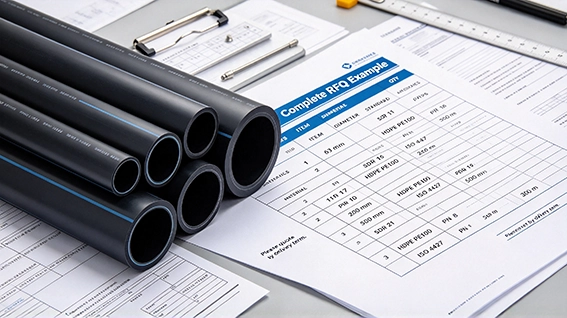
HDPE pipe quotation specification example
HDPE Pipe RFQ Example
Here’s what a complete RFQ looks like in practice:
| Artikel | Buyer Requirement |
|---|---|
| Applikatioun | Potable water supply |
| Material | PE 100 |
| Duerchmiesser | 160 mm (VUN) |
| SDR | SDR 17 |
| Drock Bewäertung | PN 10 |
| Standard | ISO 4427 |
| Längt | 12 m per piece |
| Quantitéit | 5,000 Meter (417 Stécker) |
| Faarf | Black with blue stripes |
| Marking | Project identification per buyer’s requirement |
| Destination | Los Angeles, USA |
| Trade Term | CIF Los Angeles |
| Required Delivery | Within 30 days of order confirmation |
| Zertifikatioun | ISO 9001, material test certificates required |
| Inspektioun | Third-party pre-shipment inspection |
Copy this table. Fill in your values. Send it. The difference in response quality — and speed — is immediate.
Incomplete RFQ vs. Complete RFQ
Let’s make this concrete.
Incomplete:
“Please quote 5,000 meters of HDPE pipe for water.”
Komplett:
“PE 100 / 160 mm OD / SDR 17 / PN 10 / ISO 4427 / 12 m per piece / 5,000 m / black with blue stripes / CIF Los Angeles / delivery within 30 Deeg / ISO 9001 certificate required.”
| Incomplete RFQ | Complete RFQ |
|---|---|
| More follow-up questions | Fewer questions |
| Slower quotation | Faster quotation |
| Unclear specification | Clear specification |
| Difficult price comparison | Easier supplier comparison |
| Higher risk of mismatch | Lower specification risk |
| Supplier guesses and you hope | Both sides know exactly what’s being quoted |
The complete RFQ doesn’t just save time. Et shifts the risk of misunderstanding from you to the specification. If the specification is correct and the supplier quotes against it, any mismatch is on them. If the specification is vague, any mismatch is on you.
What If You Don’t Know the Right HDPE Pipe Specification?
Not everyone sending an RFQ is a piping engineer. And that’s fine.
If you don’t know the SDR, the pressure rating, or the correct diameter for your application, here’s what to do: provide what you do know, and ask the supplier to help fill in the rest.
At minimum, tell the supplier:
- Applikatioun — what the pipe will carry
- Néideg Flux Taux — if known (m³/h or L/s)
- Betribsdrock — if known (bar or MPa)
- Approximate length — total meters needed
- Project location — country and city
- Quantitéit — even if estimated
With those six data points, a competent supplier or engineering team can recommend a suitable pipe configuration. This is where the value of working with a supplier who offers technesch Ënnerstëtzung becomes obvious — not just someone who sells pipes, but someone who helps you get the specification right the first time.
🔗 Related: [Complete Checklist for Specifying HDPE Pipe Fittings]
Questions to Ask Before Placing an HDPE Pipe Order
You’ve received the quotation. Before you commit, run through these five checks:
- Does the pipe meet the required standard? — Check the standard reference in the quotation matches your project specification. ISO 4427, ASTM F714, AS/NZS 4130 — they’re not interchangeable.
- Is the material grade confirmed? — PE100 or PE80? And can the supplier provide material test certificates?
- Are diameter, SDR, and pressure rating correct? — Cross-check these against your project requirements. A typo in SDR can mean a 40% difference in wall thickness.
- Is the quoted quantity based on meters, Stécker, or coils? - “5,000” means different things depending on the unit. Confirméieren.
- Does the quotation include the required delivery term? — FOB, CIF, DDP? And does it include the special requirements you specified — certification, Inspektioun, marking?
🔗 Related: [HDPE Pipe Fusion Schweess Methoden]
🔗 Related: [Wéi installéiere ech HDPE Pipes Underground]
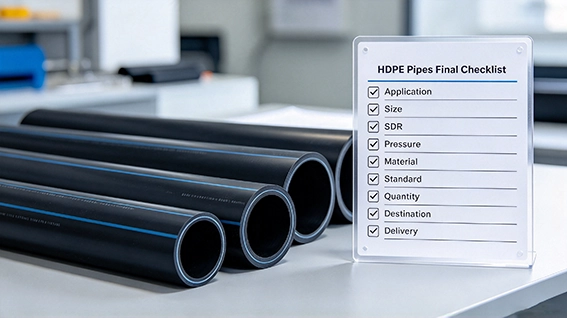
HDPE pipe ordering checklist for buyers
Need an HDPE Pipe Quotation?
Send us your HDPE pipe specifications, quantity, and destination. If some specifications are not yet confirmed, tell us your application and project requirements. Luoyang Datang Energy Tech Co., Ltd. can help check the suitable pipe configuration and prepare a quotation.
RELATED POSTS
Industriell Pipeline Korrosioun Präventioun: Komplett Guide fir Waasser Systemer
PVC Pipe Voll Analyse: New Ära vun Green, Corrosion Resistenz a Maart Opportunitéit
PPR Pipe VS Metal Pipe:5 Kär Virdeeler

Wéi wielen ech HDPE Pipes fir Waasserversuergungsprojeten