LUOYANG CAME ENERGY TECH CO., LTD


Hmotnosť HDPE potrubia na meter: Ako skontrolovať hmotnosť potrubia pred objednaním
You’ve just received two HDPE pipe quotations. The outer diameter looks the same. The SDR rating appears identical. Yet one supplier quotes a weight that’s 15% heavier than the other.
Which one do you trust?
Here’s the uncomfortable truth: HDPE potrubie weight per meter isn’t a single fixed number. It’s a calculated value that depends on outside diameter, hrúbka steny, material density, and — critically — which dimensional standard was used to produce the pipe. Two pipes can have the same nominal OD and SDR yet deliver materially different mass per meter if they follow different standards or manufacturing tolerances.
This guide will help you stop guessing. We’ll walk through the factors that drive HDPE pipe weight, show you how to calculate it yourself, provide a verified reference table, and give you a practical checklist for comparing supplier quotes. Whether you’re budgeting a water supply project or verifying a shipment of PE100 pipe, by the end you’ll know exactly what numbers to demand — and why.
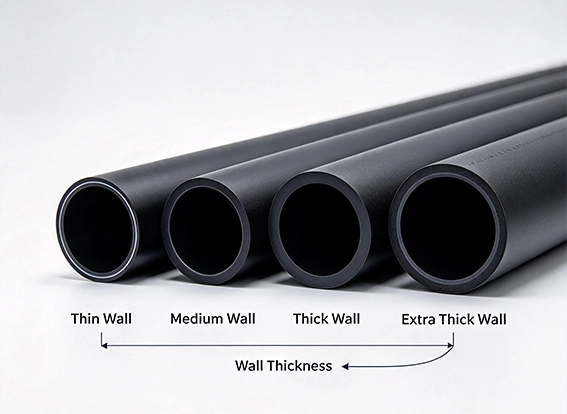
HDPE pipes with different wall thicknesses for weight comparison
Why Does HDPE Pipe Weight Matter When Ordering?
Most buyers focus on diameter and pressure rating when comparing quotes. Weight sits in the background — until it doesn’t. Here’s where HDPE pipe weight per meter becomes a critical decision variable:
- Quote verification. If two suppliers quote different kg/m figures for what appears to be the same product, the weight discrepancy often signals that the wall thickness, trieda materiálu, or dimensional standard differs. Weight itself doesn’t prove quality, but it’s a fast sanity check.
- Shipping budget. Multiply weight per meter by total length, and you get the theoretical mass of the pipe itself. This feeds directly into freight quotes, container loading calculations, and lifting plans.
- Handling and packaging. Coils, bundles, and palletized pipe add packaging weight that may not appear in the per-meter figure your supplier provided.
- Project material accounting. When the bill of materials lists pipe by weight (common in tender documents), a reliable kg/m figure lets you cross-check quantities before placing the order.
| Purchase Scenario | What Weight Data Tells You | What to Watch Out For |
|---|---|---|
| Comparing two quotes | Whether specs actually match | Confirm OD, SDR, trieda materiálu, and standard first |
| Calculating freight | Net pipe mass for shipping estimates | Balenie, pallets, and other cargo are additional |
| Verifying order quantity | Whether total weight aligns with expected volume | Per-pipe length and count must be confirmed |
| Receiving inspection | Comparing documents to physical goods | Account for tolerances and weighing method |
What Determines HDPE Pipe Weight per Meter?
The weight of any solid-wall HDPE pipe comes down to one thing: how much polyethylene is packed into each meter of pipe. That depends on four factors working together.
| Faktor | Effect on Weight per Meter | What to Confirm Before Ordering |
|---|---|---|
| Vonkajší priemer (OF) | Larger OD means more material per unit length, given the same wall thickness | Nominal OD and the dimensional standard used (ISO 4427, IN 12201, GB/T 13663) |
| Hrúbka steny | Thicker walls = more material = heavier pipe | Specified wall thickness and allowable tolerance |
| SDR | Lower SDR = thicker wall at the same OD = heavier pipe | hodnota SDR, corresponding wall thickness, and relevant pressure rating |
| Hustota materiálu | Higher-density compounds yield greater mass at identical geometry | Technical data sheet with density value used for calculation |
| PE grade / compound | Can influence density and design requirements | PE80 vs. PE100 designation and product specification |
| Manufacturing tolerances | Actual wall thickness may vary from the nominal value used in theoretical calculations | Standard tolerances (napr., ISO 4427-2 mass-per-meter tolerance of ±4%) and manufacturer data |
How Does Pipe Diameter Affect Weight?
Doubling the outside diameter doesn’t double the weight — it quadruples the cross-sectional area if wall thickness scales proportionally. This is why a DN110 pipe weighs exponentially more than a DN63 pipe, not linearly.
Why Does SDR Matter?
SDR (Štandardný pomer rozmerov) is the ratio of outside diameter to nominal wall thickness:SDR=tOD
At the same outside diameter, a nižšia SDR produces a thicker wall, which means more material per meter and therefore greater weight. SDR11 pipe at DN200, napríklad, weighs significantly more than SDR17 pipe at the same diameter.
One important caveat: don’t simply divide OD by SDR and treat the result as the precise standard-mandated wall thickness for every size and standard. For procurement purposes, always reference the dimensional table in the applicable standard and the manufacturer’s technical datasheet.
Does PE80 or PE100 Change Pipe Weight?
Not directly. PE80 and PE100 are material designations describing minimum required strength (PANI) — 8.0 MPa and 10.0 MPa respectively. They tell you about the resin’s long-term performance, not its weight.
Avšak, because PE100 compounds often have slightly different density than PE80 grades, a calculated theoretical weight at identical dimensions can differ. For procurement, the distinction matters more for pressure rating than for weight. If you’re comparing two suppliers, confirm both are quoting the same material grade — a “Rúrka PE100” quote and a “PE80 pipe” quote at the same OD and SDR are not directly comparable.
HDPE Pipe Weight Chart: How to Read It Correctly
Below is a reference table for Rúrka PE100 at common diameters and two widely used SDR values (SDR11/PN16 and SDR17/PN10). Data is sourced from manufacturer datasheets and standard dimension tables.
| Vonkajší priemer (mm) | SDR | Hrúbka steny (mm) | Hmotnosť (kg/m) | Reference |
|---|---|---|---|---|
| 32 | SDR11 | 3.0 | 0.28 | Manufacturer datasheet |
| 63 | SDR11 | 5.8 | 1.05 | Manufacturer datasheet |
| 110 | SDR11 | 10.0 | 3.14 | Manufacturer datasheet |
| 160 | SDR11 | 14.6 | 6.67 | Manufacturer datasheet |
| 200 | SDR11 | 18.2 | 10.40 | Manufacturer datasheet |
| 315 | SDR11 | 28.6 | 25.60 | Manufacturer datasheet |
| 500 | SDR11 | 45.4 | 64.30 | Manufacturer datasheet |
| 63 | SDR17 | 3.8 | 0.69 | Manufacturer datasheet |
| 110 | SDR17 | 6.6 | 2.19 | Manufacturer datasheet |
| 160 | SDR17 | 9.5 | 4.57 | Manufacturer datasheet |
| 200 | SDR17 | 11.9 | 7.12 | Manufacturer datasheet |
| 315 | SDR17 | 18.7 | 17.60 | Manufacturer datasheet |
How to read this table:
- Weight is expressed in kg per running meter of pipe — not per pipe length or per coil.
- All values are for PE100 material at 20°C, calculated using standard nominal dimensions.
- These are theoretical/reference values. Actual delivered weight may vary within the mass-per-meter tolerance specified by the governing standard (typically ±4% under ISO 4427-2:2019 a EN 12201-2).
- Values do nie include fittings, end caps, balenie, or pallets.
- Density assumptions for calculation typically fall in the 950–960 kg/m³ range for PE100 compounds.
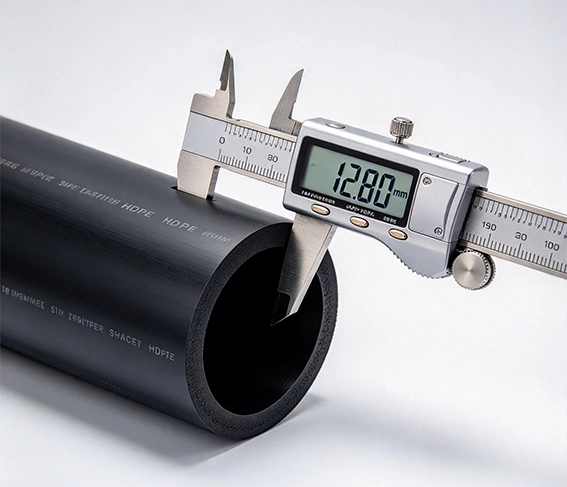
Measuring HDPE pipe wall thickness to verify weight specifications
If you need the complete dimensional breakdown for a wider range of diameters, pozri naše HDPE pipe sizes and wall thickness sprievodca.
How to Calculate HDPE Pipe Weight per Meter
The Basic Weight Formula
HDPE pipe is essentially a hollow cylinder. To calculate the theoretical mass per meter, you need three inputs: outside diameter, hrúbka steny, and material density.
For results in kg/m with OD and wall thickness in milimetrov:m=π⋅t⋅(D−t)⋅ρ×10−6
Where:
- m = theoretical mass per meter (kg/m)
- D = outside diameter (mm)
- t = wall thickness (mm)
- ρ = material density (kg/m³)
The formula is derived from the annular cross-sectional area of the pipe wall multiplied by density:m=4π[D2−(D−2t)2]⋅ρ
This method follows the approach described in PPI Technical Report TR-7, which is the industry-standard method for estimating nominal weight-per-foot (or per-meter) of solid-wall plastic pipe.
A Step-by-Step Calculation Example
Let’s calculate the weight per meter of a DN200 PE100 pipe with SDR11.
Krok 1 — Identify parameters:
- Vonkajší priemer (D): 200 mm
- Hrúbka steny (t): 18.2 mm
- Hustota materiálu (ρ): 958 kg/m³ (typical PE100 value)
Krok 2 — Apply the formula:m=π×18.2×(200−18.2)×958×10−6m=3.14159×18.2×181.8×958×10−6m=3.14159×3,308.76×958×10−6m=3.14159×3,170,993.6×10−6m≈9.96 kg/m
Krok 3 — Compare with the reference table.
The manufacturer datasheet lists 10.40 kg/m for this specification. The difference (approximately 4.2%) reflects the fact that manufacturers may use a slightly higher density assumption or include wall thickness at the upper tolerance limit. Both figures fall within acceptable tolerance ranges for procurement purposes.
Krok 4 — Document your calculation basis.
Always note which density value and wall thickness (nominal or upper-limit) you used. If you’re comparing supplier quotes, ask each supplier to state their calculation basis — this is one of the fastest ways to explain weight discrepancies.
Technical Accuracy Notes
- The formula produces a theoretical estimate based on nominal dimensions and assumed density.
- Actual pipe weight may differ due to wall thickness tolerances, ovality, and compound density variations.
- ISO 4427-2:2019 a IN 12201-2 specify a mass-per-meter tolerance of ±4% for PE100 pressure pipes.
- For contractual acceptance, freight settlement, or lifting operations, always refer to the governing standard, the manufacturer’s technical file, and actual weighing data.
How to Compare HDPE Pipe Weight Between Supplier Quotes
This is where technical knowledge meets commercial reality. When Supplier A quotes 10.4 kg/m and Supplier B quotes 9.1 kg/m for what looks like the same DN200 SDR11 PE100 pipe, someone may have made a mistake — or they may simply be using different calculation bases.
Here’s a structured comparison table you can use:
| Check Item | Supplier A | Supplier B | How to Verify |
|---|---|---|---|
| Vonkajší priemer | 200 mm | 200 mm | Confirm identical OD and dimensional standard |
| Stupeň materiálu | PE100 | PE80 | Different grades → different design basis |
| SDR / pressure class | SDR11 / PN16 | SDR11 / PN16 | Must match; verify against project spec |
| Hrúbka steny | 18.2 mm nominal | 17.5 mm nominal | Compare against standard dimension tables |
| Weight per meter | 10.4 kg/m | 9.1 kg/m | Ask: theoretical or manufacturer reference? |
| Density used | 958 kg/m³ | 940 kg/m³ | Lower density → lower calculated weight |
| Price basis | Per meter | Per kilogram | Normalize units before comparing |
| Delivery terms | FOB | CIF | Different incoterms → different landed cost |
Three questions to ask every supplier:
- “What density value did you use to calculate the weight per meter?” — If they can’t answer, the weight figure is unreliable.
- “Is this weight theoretical or from your technical datasheet?” — Neither is inherently wrong, but you need to know which one you’re comparing.
- “Which standard governs your dimensions?” — ISO 4427, IN 12201, GB/T 13663, and ASTM standards use different dimension tables. Cross-standard comparisons require normalization.
For a broader view of what drives HDPE pipe pricing beyond weight, see our analysis of HDPE pipe price factors.

HDPE pipe cross section showing outside diameter inside diameter and wall thickness
How to Estimate Total HDPE Pipe Weight for Shipping
Per-meter weight is the building block. Total shipping weight requires a few more inputs.
| Parameter | Example Value | Purpose |
|---|---|---|
| Unit pipe weight | 10.4 kg/m (confirmed) | Mass per running meter |
| Total pipe length | 1,200 m | Order quantity in meters |
| Number of coils / bundles | 12 coils × 100 m each | Packaging and handling configuration |
| Packaging weight | 15 kg per coil (estimated) | Adds to gross weight |
| Estimated gross weight | 12,480 kg + 180 kg = 12,660 kg | Preliminary shipping calculation |
Basic calculation:Pipe mass=Weight per meter×Total length
For the example above:10.4 kg/m×1,200 m=12,480 kg(net pipe weight)
Add packaging (coils, straps, pallets) to arrive at the estimated gross weight. Do not commit to container loading quantities or freight costs without actual packaging data from the supplier.

Bundled HDPE pipes prepared for shipment and weight estimation
What to Confirm Before Ordering HDPE Pipes
Use this checklist when preparing your RFQ or evaluating supplier responses:
- □ Vonkajší priemer and applicable dimensional standard (ISO 4427 / IN 12201 / GB/T 13663)
- □ PE grade (PE100 or PE80) and material specification
- □ SDR, hrúbka steny, and pressure requirements
- □ Required length per pipe or coil (6 m / 12 m / coil length)
- □ Total quantity and unit of measurement (metrov, kusov, or kilograms)
- □ Technical datasheet showing nominal dimensions and weight per meter
- □ Delivery destination and preferred shipping terms (FOB / CIF / DDP)
- □ Packaging and unloading requirements (coils, bundles, pallets)
For a full guide on preparing a complete purchase request, pozri naše HDPE pipe RFQ checklist.
Request an HDPE Pipe Quote
Need an HDPE pipe quote?
Comparing HDPE pipe weight and prices? Start with the correct specifications.
Share your required outside diameter, PE grade, SDR or wall thickness, množstvo, pipe length, and delivery destination. If available, include your project specification or an existing supplier quotation.
Our team reviews your requirements and coordinates with suppliers to clarify the specifications needed for a comparable quotation.
[Request a Quote for HDPE Pipes →]
Často kladené otázky
1. How much does HDPE pipe weigh per meter?
There is no single answer. Weight per meter depends on outside diameter, hrúbka steny, material density, and the dimensional standard used. A DN110 SDR11 PE100 pipe weighs approximately 3.14 kg/m, while a DN500 SDR11 PE100 pipe weighs approximately 64.3 kg/m.
2. How do you calculate HDPE pipe weight?
Use the hollow-cylinder formula: m=π⋅t⋅(D−t)⋅ρ×10−6, kde D is OD in mm, t is wall thickness in mm, a ρ is density in kg/m³. The result is kg/m. Always verify against the manufacturer’s datasheet.
3. Does SDR affect HDPE pipe weight?
áno. At the same outside diameter, a lower SDR means a thicker wall, which means more material and greater weight per meter. SDR11 pipe is heavier than SDR17 pipe at the same OD.
4. Is PE100 pipe heavier than PE80 pipe?
Not inherently. Weight is determined by geometry (OD and wall thickness) and material density. PE100 and PE80 are strength designations, not weight designations. If both are produced to the same dimensions with similar density, the theoretical weight will be comparable.
5. Is pipe weight the same as shipping weight?
Nie. Pipe weight per meter refers to the mass of the pipe itself. Shipping weight (gross weight) includes packaging, coils, pallets, and any other cargo in the shipment.
6. Can I compare HDPE pipe prices by weight alone?
Nie. Weight is one indicator, but price comparison requires normalizing outside diameter, hrúbka steny, trieda materiálu, applicable standard, price basis (per meter vs. per kg), and delivery terms. Weight discrepancies may simply reflect different calculation bases rather than actual product differences.
Have a project specification or a supplier quote you’d like us to review? Share your requirements with Luoyang Datang Energy Tech Co., Ltd. — we’ll help you clarify the specs before you commit.
SÚVISIACE PRÍSPEVKY
Potrubie PPR odolné voči korózii v chemickom potrubnom systéme

Akú veľkosť vodovodného potrubia potrebujem
Prečo si vybrať potrubia a armatúry PPR v zásobovaní vodou?
Výhľad globálneho dopytu 2026: Infraštruktúra, Olej & Plyn, a vysokovýkonné potrubné materiály podporujúce prechod energie

3/4″ GHT vs 3/4″ NPT: Prečo nie sú tieto mosadzné hadicové armatúry zameniteľné?