LUOYANG DATANG ENERGY TECH CO.,LTD


Brass Compression Fittings vs Threaded Fittings: Which Connection Is Better?
Choosing the right connection type is just as important as selecting the fitting material itself. When you’re sourcing brass pipe fittings for a plumbing project, an HVAC installation, or an industrial fluid system, the decision between compression and threaded connections will affect everything from installation time to long-term maintenance costs.
Some buyers assume compression fittings are “weaker” because they don’t rely on threads. Others believe threaded brass fittings are always the safer bet for high-pressure work. Both assumptions deserve a closer look.
This article compares brass compression fittings vs threaded fittings across installation, sealing performance, pressure capability, pangropéa, and real-world applications—so you can match the right connection to the right job.
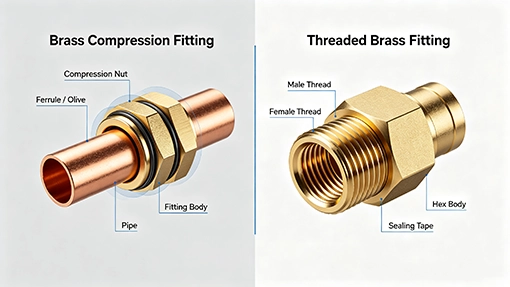
Brass compression fitting and threaded brass fitting
What Are Brass Compression Fittings?
A brass compression fitting creates a seal by mechanically compressing a soft metal ring—called a ferrule or olive—against the outer surface of a pipe. No soldering, no welding, no thread sealant required. The pipe simply slides into the fitting body, and tightening the nut deforms the ferrule around the pipe, gripping it securely and forming a watertight joint.
The compression fitting connection is elegant in its simplicity. Three components do all the work:
| komponén | Fungsi |
|---|---|
| Compression nut | Tightens the assembly |
| Ferrule / Olive | Deforms to create sealing force |
| Fitting body | Houses the pipe and provides sealing surface |
The working principle follows a direct sequence: pipe inserted → ferrule slides on → nut tightened → ferrule compressed → seal formed. The seal comes from the ferrule’s deformation, not from the threads. This distinction matters because it means the sealing quality depends on correct assembly rather than thread condition or sealant application.
Brass compression fittings are the standard choice for copper, kuningan, and plastic supply lines in residential and light commercial plumbing. They’re rated for pressures up to around 200–300 psi in typical configurations and temperatures up to 250°F (121°C).
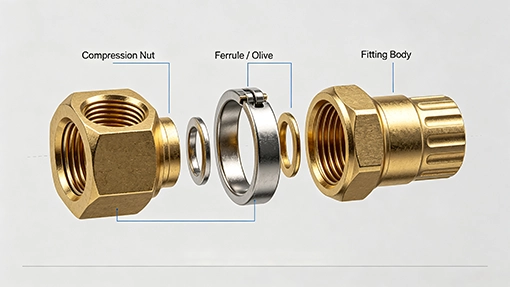
compression nut, ferrule, and fitting body
What Are Threaded Brass Fittings?
Threaded brass fittings rely on interlocking male and female threads to create a mechanical joint. As the tapered threads engage and tighten, the metal surfaces wedge together, and a thread sealant—PTFE tape or pipe dope—fills the microscopic gaps to complete the seal.
The critical difference from compression fittings: the threads themselves provide both the mechanical strength and the primary sealing surface. If the threads are damaged, cross-threaded, or improperly sealed, the connection will leak—no matter how tight you make it.
Thread standards matter enormously here. The two dominant systems are:
| Thread Type | Standar | Angle | Primary Region |
|---|---|---|---|
| NPT | ANSI / ASME B1.20.1 | 60° | North America |
| BSPT / BSPP | ISO 228 / ISO 7 | 55° | Europe, Asia, international |
NPT threads use a 60° angle and a 1.7898° taper per side, causing the threads to wedge together as they tighten. BSP threads use a 55° angle and may be parallel (BSPP) or tapered (BSPT).
For a deeper comparison of these two systems, see our guide on NPT vs BSP Threads.
Threaded brass fittings are the most common material in residential gas and water systems. High-pressure forged brass threaded fittings can handle pressures up to 3,000–6,000 psi depending on the model and size.

Close-up of male and female threaded brass fittings
Brass Compression Fittings vs Threaded Fittings: Bedana konci
| Fitur | Compression Fittings | Threaded Fittings |
|---|---|---|
| Métode sambungan | Ferrule compression seal | Thread engagement |
| Pamasangan | Simple tightening | Requires thread prep + sealant |
| Tools required | Two wrenches | Wrench + tape/sealant |
| Leak risk | Low if assembled correctly | Depends on sealant quality |
| Peunteun tekanan | ~200–300 psi typical | Up to 3,000+ psi |
| Pangropéa | Easy to disassemble | More difficult to rework |
| Reusability | Limited (ferrule deforms) | More reusable (new sealant needed) |
| Vibration resistance | Sedeng | Alus (mechanical lock) |
This table alone answers the most common question buyers ask: which connection is better? The honest answer is that neither is universally superior—each wins in specific conditions.
Pamasangan: Which One Is Easier?
Compression Installation Steps
- Cut the pipe squarely and deburr the end.
- Slide the compression nut, then the ferrule, onto the pipe.
- Insert the pipe fully into the fitting body.
- Tighten the nut by hand, then finish with a wrench—typically 1 to 1½ turns past finger-tight.
- Check for leaks under system pressure.
The entire process takes minutes. No heat, no chemicals, no thread preparation. This is why compression fittings dominate DIY repairs and confined-space work.
Threaded Installation Steps
- Clean and inspect the threads.
- Apply PTFE tape in the direction of thread rotation (2–3 wraps for small fittings).
- Hand-tighten the male into the female.
- Wrench-tighten to the appropriate engagement depth—too little and it leaks, too much and you risk cracking the fitting.
- Nguji dina tekenan.
The failure mode here is less forgiving. Overtightening a tapered thread can deform the fitting body or cause stress cracks, especially in smaller brass sizes. Under-tightening leaves a gap that sealant alone may not bridge.
| Installation Factor | Winner |
|---|---|
| DIY ease | Compression |
| Speed of assembly | Compression |
| Speed of disassembly | Compression |
| Repeat assembly tolerance | Utas |

Technical illustration comparing compression seal and threaded engagement
Sealing Performance and Leak Prevention
Compression fittings seal by deformation. The ferrule conforms to the pipe surface, creating a contact seal that actually improves as internal pressure increases—the pressure tends to expand the tube against the ferrule. The most common failure mode is not sealing weakness but installation error: over-tightening deforms the ferrule beyond recovery, or under-tightening leaves insufficient compression.
Threaded fittings seal by interlocking threads plus sealant. The sealant fills the helical gap between male and female threads. The problem is that tapered threads always provide a potential leak path—the root of the thread is never perfectly closed without sealant. Thread damage, insufficient sealant, or incompatible sealant for the fluid type all cause leaks.
| Leak Cause | Compression | Utas |
|---|---|---|
| Improper tightening | ✓ Common | ✓ Common |
| Sealant issue | — Not applicable | ✓ Common |
| Ferrule damage | ✓ Possible | — Not applicable |
| ruksakna thread | — Not applicable | ✓ Possible |
| Geter ngaléos | ✓ Moderate risk | Lower risk |
For critical gas and high-pressure applications, threaded connections are often preferred because their sealing mechanism is more predictable and inspectable. For water and low-pressure fluid lines, compression’s simpler assembly reduces the chance of human error.
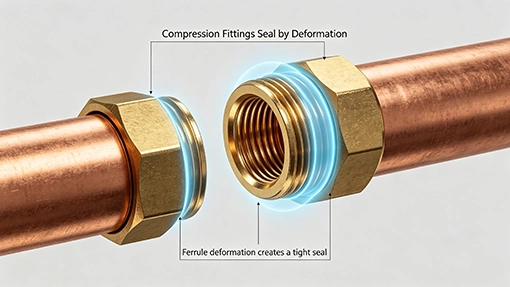
Compression fittings seal by deformation.
Pressure and Application Comparison
| Aplikasi | Tipe | Alesan |
|---|---|---|
| Household water lines | Compression | Fast, no soldering, perbaikan gampang |
| Refrigeration tubing | Compression | Small diameter, vibration-tolerant when properly set |
| HVAC control lines | Compression | Clean installation, no open flame |
| Gas piping | Utas | Regulatory preference, stronger mechanical lock |
| Industrial fluid systems | Utas | Higher pressure, larger sizes |
| Hydraulic lines | Utas | tekanan tinggi + geteran |
Brass pipe fittings in these applications serve different masters. A residential plumber values speed and clean work. An industrial engineer values pressure margin and inspectable connection integrity. The fitting type should follow the priority.
For a broader view of where brass fittings are used across industries, see our article on Kuningan Pipe fittings Aplikasi.
Kaunggulan jeung kalemahan
Brass Compression Fittings
| Kaunggulan | Limitations |
|---|---|
| No threading or soldering required | Lower pressure range (200–300 psi typical) |
| Fast installation | Ferrule deforms and may not reseal perfectly |
| Easy disassembly and inspection | Sensitive to over-tightening |
| Works in confined spaces | Requires reasonably round, scratch-free pipe |
Threaded Brass Fittings
| Kaunggulan | Limitations |
|---|---|
| Higher pressure capability | Requires thread prep and sealant |
| Strong mechanical joint | Thread damage can ruin the fitting |
| More reusable with new sealant | Installation takes longer |
| Broad standard compatibility | Overtightening risk in small brass sizes |

Compression fittings in HVAC control lines
Which Connection Should You Choose?
Choose compression fittings when: quick installation matters, pipe diameters are small (typically ≤ 1 inci), you need to disassemble for maintenance, or you’re working in a confined space without room for threading tools.
Choose threaded fittings when: system pressure exceeds 300 psi, vibration is present, the application involves gas or regulated fluids, or the connection will remain fixed for years without intervention.
Thebest fitting connection type is the one that matches your application’s pressure profile, installation constraints, and maintenance expectations. There’s no universal winner—only the right match for the job.
How to Select the Right Brass Fittings for Your Project
Before requesting a quote, work through this procurement checklist:
| Consideration | Questions to Answer |
|---|---|
| Pipe material | Tambaga, PEX, waja, or composite? |
| Pipe size | What OD or nominal size? |
| Tekanan | Operating pressure + safety margin? |
| Connection standard | NPT, BSPP, BSPT, or metric? |
| Aplikasi | Cai, gas, HVAC, hydraulic? |
| Environment | Indoor, outdoor, corrosive? |
| Quantity & lead time | One-off or repeat order? |
For precise sizing guidance, see our Ukuran Pipa Kuningan Dijelaskeun guide. For durability considerations, read Kumaha Kuat Siku Kuningan sareng Panyambung Selang.
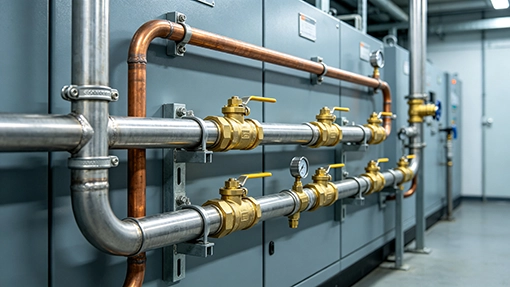
Compression fittings in Industrial fluid systems
FAQ
Q1: What is the difference between brass compression fittings and threaded fittings?
A: Brass compression fittings seal by compressing a ferrule around the pipe exterior; threaded fittings seal by interlocking tapered threads with sealant. Compression is faster to install and easier to disassemble. Threaded handles higher pressure and is preferred for gas and industrial applications.
Q2: Are brass compression fittings reliable?
A: Sumuhun, when installed correctly. The most common reliability issue is over-tightening, which deforms the ferrule and can cause leaks. Properly assembled compression fittings on clean, round pipe provide reliable service in water and low-pressure fluid systems.
Q3: Are threaded brass fittings stronger than compression fittings?
A: Threaded brass fittings generally have higher pressure ratings—up to 3,000 psi or more in forged configurations—compared to 200–300 psi for typical compression fittings. Sanajan kitu, “stronger” depends on the specific product and application. For high-vibration environments, threaded connections also resist loosening better.
Q4: Can compression fittings be reused?
A: The fitting body and nut can often be reused, but the ferrule typically should be replaced because it has already been deformed to match the specific pipe. Reusing a deformed ferrule on a different pipe section is a common cause of leaks. Replacement ferrules are widely available and inexpensive.
Q5: Which fitting is better for plumbing systems?
A: For residential water lines, compression is usually the practical choice—fast, clean, and repairable without special tools. For gas lines, high-pressure systems, or connections that will remain undisturbed for decades, threaded fittings are the standard. The right answer depends on pressure, sedeng, and maintenance expectations.
[Image: Residential plumbing and industrial piping scenes showing both connection types in use]
Need Help Choosing the Right Brass Fitting Connection?
Whether your project calls for brass compression fittings, threaded brass fittings, or a mix of both, the right supplier should help you match the connection to the application—not just fill an order.
We manufacture brass pipe fittings in both compression and threaded configurations, with support for NPT, BSPP, BSPT, and metric thread standards. Custom sizes, material compositions, and OEM specifications are available for distributors and project buyers.
Kontak Luoyang Datang Energy Tech Co., Ltd to discuss your application requirements and request samples for evaluation.
POST patali
Rekomendasi Dina Pilihan Pipa PVC anu ramah lingkungan
Kumaha carana ngawangun sistem pipa HDPE anti bocor?

Sakumaha Jero Pipa Pasokan Cai
Kualitas luhur PE100 & PE80 High Density Poliétilén Pipa Dina Supply Cai jeung Drainase System
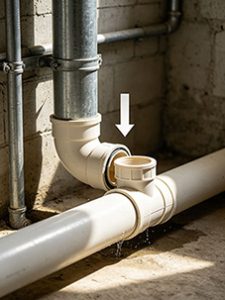
PVC Colokkeun Bend vs. Siku Standar: Nu Ngaheéat Langkung Pangropéa Sakit Kepala?