LUOYANG NA'E HA'U 'A E MALOHI 'O E TEKINOLIA CO.,LTD


Ko e hā ʻokú ne ngaohi ha Leak ʻo e Hose Palasa Fitting .? 7 Ngaahi Tupunga Angamaheni
You tighten the fitting. The hose looks secure. Everything seems fine — until you see a small drop of water forming at the connection, hear air hissing out of a pneumatic line, or catch the faint smell of fuel around a brass hose barb.
This happens more often than most people expect. And it almost never means the brass fitting itself is defective.
Here is the uncomfortable truth that Parker, BrassCraft and other manufacturers state clearly in their product specifications: a hose barb connection requires a clamp or crimped ferrule. Parker’s brass hose barb fittings are rated at 150 psi maximum working pressure, and the specification states in plain language — “Clamp or Crimped Ferrule Must Be Used with Fittings.”
So the real question is not “Is my brass fitting bad?” The real question is: which part of the connection is failing?
This article walks through the 7 most common causes of brass hose fitting leaks, how to identify which one is affecting your connection, and how to fix it.

a Brass Hose Fitting Leak
Ko e 7 Causes at a Glance
Before diving into details, here is a quick reference table to help you narrow down the problem.
| # | Common Cause | Typical Location | What to Check |
|---|---|---|---|
| 1 | Wrong hose or barb size | Hose/barb | ID 'o e Hose & barb size |
| 2 | Hose not fully seated | Barb connection | Hose insertion depth |
| 3 | Loose or incorrectly positioned clamp | Hose/barb | Clamp position & tension |
| 4 | Damaged or hardened hose | Hose end | Cracks, motuhi, fakafetongi |
| 5 | Wrong thread type or size | Threaded end | NPT/BSP/GHT/size |
| 6 | Poor thread sealing | Threaded end | Sealant, gasket, thread condition |
| 7 | Excessive pressure, temperature or movement | Whole connection | Working conditions |
Keep this table in mind. Now let’s go through each cause in detail.
1. The Hose and Barb Size Do Not Match
This is the single most common cause of brass hose fitting leaks — and the one most easily overlooked.
Why Hose ID Matters
Barb size is normally selected according to ID hose (taiamita ʻi loto), not hose OD (taiamita ʻi tuʻa) and not the thread size on the other end.
Hangē ko 'eni, ha 1/2″ hose ID typically calls for a 1/2″ nominal hose barb. But here’s the catch: the actual barb OD is not necessarily exactly 0.500″. Different manufacturers use different barb profiles and dimensions.
There is no universal consensus standard for barb dimensions to fit tubing IDs. In many cases, a barb may be used with a different ID tubing than what its nominal size suggests.
What Happens If the Barb Is Too Small?
If the barb OD is too small relative to the hose ID:
- Hose fits too loosely
- Insufficient grip
- Leakage
- Hose blow-off under pressure
A fitting that’s too small won’t create adequate seal contact. Leaks or disconnection can happen right away.
What Happens If the Barb Is Too Large?
If the barb OD is too large:
- Faingata'a hono fokotu'u .
- Hose damage during assembly
- Hose splitting
- Excessive stress on the hose wall
- Eventual leakage
If the coupling is too large, the fit might be all right initially, but the hose will stretch and lose integrity over time.
Tefito'i 'o e me'akai: A hose’s inner diameter must be slightly smaller than the barb’s outer diameter — typically by about 10% — to ensure the necessary material compression for a strong seal.
| Condition | Ola |
|---|---|
| Barb too small | Loose grip → leakage/blow-off |
| Correct size | Proper interference + fakamaʻu |
| Barb too large | Difficult installation → hose damage |
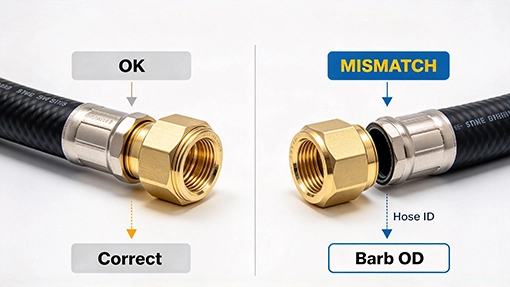
The Hose and Barb Size Do Not Match
2. The Hose Is Not Fully Seated on the Barb
Even with the correct barb size, a partially inserted hose will leak.
‘Oku ongo mahino ‘eni ., but it happens constantly in real-world installations — especially in tight spaces, with stiff hoses, or when the installer is in a hurry.
Why Partial Insertion Causes Leakage
When the hose is only pushed partway onto the barb:
- Sealing area is reduced
- Clamp may sit outside the effective sealing zone
- Hose can pull off under pressure
- Vibration can worsen the connection over time
Incorrect vs. Correct
Incorrect: The hose only covers the first part of the barb.
Correct: The hose extends fully over the barb profile according to the fitting design. Clamp sits over the barb-supported section.
A simple test: mark the hose with a marker before insertion at the depth you intend. After pushing it on, check that the mark is at or near the barb base. If the mark is still visible far from the fitting, the hose is not seated.

The Hose Is Not Fully Seated on the Barb
3. The Hose Clamp Is Loose or in the Wrong Position
This is where things get specific — and where many installations go wrong.
A Clamp Does More Than “Hold the Hose”
A hose clamp is not just a retention device. Its real job is to compress the hose wall against the barb, creating a mechanical seal at the hose-to-barb interface.
Parker’s specification for its brass hose barb fittings states plainly: “Clamp or Crimped Ferrule Must Be Used with Fittings.” The fittings are intended for use with Parker’s 97HC hose clamps, similar type clamps, or a crimped ferrule.
Where Should the Clamp Go?
The clamp should be installed so that it presses down on the indentation between the barbs in the center of the hose nipple.
This ensures the barbs bite into the hose, reducing the risk of disconnection or leakage.
Common Clamp Problems
| Palopalema | Ola |
|---|---|
| Too loose | Leakage |
| Too tight | Hose damage / fakafetongi |
| Positioned too far back | Insufficient compression over barb |
| Positioned past the barb | Kovi 'a e sila . |
| Corroded clamp | Loss of clamping force |
Overtightening can damage the outside or inside of the hose, possibly resulting in fluid leaking. Undertightening can also lead to fluid leaking or the hose becoming disconnected. Use a torque wrench to maintain consistent tightening force.
Multiple Clamps
For larger hose IDs or higher pressure applications, two clamps may be necessary. When using two clamps, they should be positioned in an offset pattern to prevent a leak path from forming.

The Hose Clamp Is Loose or in the Wrong Position
4. The Hose Is Damaged, Hardened or Incompatible
This is one of the most overlooked causes of brass hose fitting leaks — and one of the most common in older installations.
What to Check on the Hose End
Before installing or reinstalling a hose:
- Cracks
- Cuts
- Scratches
- Flattening
- Hardening
- Swelling
- Deformation
- Chemical degradation
Why an Old Hose Can Start Leaking
Hose materials lose elasticity over time. As a hose hardens, it loses the ability to compress against the barb and conform to the sealing surface.
Even if you tighten the clamp further, a hardened hose may not recover a good seal. The material has fundamentally changed — you can’t “tighten your way” back to a leak-free connection.
A practical rule: If the hose end feels stiff or shows visible cracks when you flex it, cut back to a fresh section (if enough length remains) or replace the hose entirely.
Chemical Incompatibility
Some chemicals can degrade the hose material from the inside. The hose may look fine on the outside but have degraded internal structure. If you’re handling aggressive fluids, verify hose material compatibility — not just the brass fitting compatibility.
5. The Thread Type or Thread Size Is Wrong
Many brass hose fittings have a barb on one end and a threaded connection on the other. If that threaded end is wrong, the fitting will leak — no matter how good the barb connection is.
Same Size Does Not Mean Same Thread
This is a surprisingly common mistake.
Consider 3/4″ GHT and 3/4″ NPT. They differ in major diameter by only 0.0125″ — less than a third of a millimeter — and both are called “three-quarter inch.” This is why they get mixed up constantly.
But they are not compatible:
| Fakamatala tefito | 3/4″ GHT | 3/4″ NPT |
|---|---|---|
| Fa'ahinga filo | Hangatonu | Fakasiʻisiʻi |
| Ngaahi filo ki he 'inisi | 11.5 | 14 |
| Seal method | Washer | Sila filo |
| Fe'unga | Garden hose only | Pipe systems |
Attempting to force a 3/4″ NPT male into a 3/4″ GHT female will damage the threads on one or both pieces — and even if it “fits,” the connection will almost certainly leak.
Before applying any sealant or tightening any fitting, verify the thread standard. GHT, NPT, BSPP, BSPT and metric threads are all different systems with different sealing methods.
Quick Thread Identification
| Filo | Seal Method | Ko e Tohi Kole Angamaheni |
|---|---|---|
| NPT | Sila filo | Pipe systems |
| BSPP | Washer | European plumbing |
| BSPT | Sila filo | European pipe systems |
| GHT | Washer | Garden hose |
| Metiki | Varies | Equipment ports |
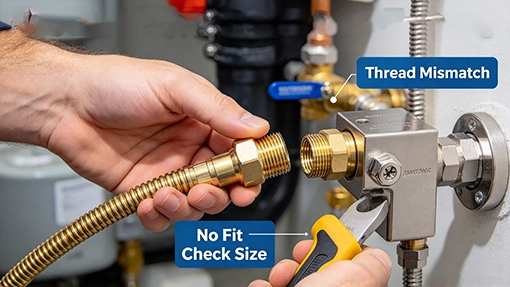
The Thread Type or Thread Size Is Wrong
6. The Thread Is Not Properly Sealed
Once you’ve confirmed the thread type and size are correct, the next question is: is it properly sealed?
Ngaahi Filo NPT Require Sealant
This is non-negotiable. Ngaahi filo NPT, regardless of material, are not designed to seal without a thread sealant. Think of them as a spiral path between what’s inside your pipe and the outside world — without a sealant, eventually you’re going to get a leak.
Ngāue'aki PTFE tape, faito'o paipa, or both on all NPT threads. Full-density PTFE tape by itself is fine for plumbing applications. A good quality anaerobic pipe thread sealant is a better choice for large pipe fittings.
Do All Brass Hose Fittings Need PTFE Tape?
ʻIkai.
Different connection types seal differently:
| Fehokotaki | Seal Method | PTFE Tape? |
|---|---|---|
| Tapered pipe thread (NPT/BSPT) | Sila filo | ʻIo |
| Straight thread (BSPP) | Washer/gasket | ʻIkai |
| GHT | Rubber washer | ʻIkai |
| O-ring connection | O-mama | ʻIkai |
| Hose barb | Fakamālohiʻi fakamīsini | ʻIkai |
Do not automatically put PTFE tape on every thread. The sealing method depends on the specific thread design and the manufacturer’s instructions.
The Mistake of Overtightening
Overtightening a brass fitting is a common mistake that can actually ngāue leaks rather than fix them.
Overtightening can:
- Damage threads
- Distort the sealing surface
- Crack the fitting
- Damage the hose or clamp
Start by hand tightening, then take it about 2-3 rotations with a wrench. Hili iá ., check for leaks and tighten more only if needed.
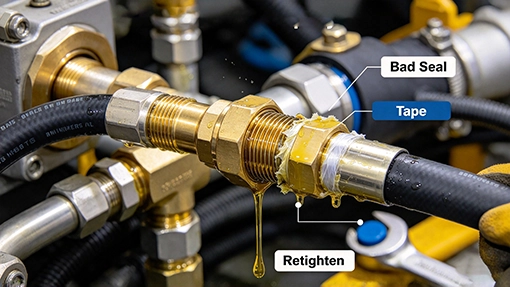
The Thread Is Not Properly Sealed
7. Fakamālohi, Temperature or Movement Is Beyond the Connection’s Capability
The connection might be assembled perfectly — and still leak — because the operating conditions exceed what the assembly can handle.
Fakamālohi
Ko e palasa 'oku malohi ., but “palasa” is not a pressure rating.
A small brass hose barb and a heavy-duty industrial fitting — both made of brass — may have completely different pressure ratings.
Parker’s brass hose barb fittings are rated at 150 psi (10 pā) maximum working pressure. This is a specific product rating, not a universal limit for all brass hose fittings.
If your working pressure exceeds the fitting’s rating, the connection will eventually leak — regardless of how well it was installed.
Fua mafana
Temperature affects every component in the connection:
- Hose may soften
- Seal properties may change
- Clamp load may change
- Material expansion changes
Parker’s brass hose barb fittings have a maximum operating temperature of 160°F (71°C). This is well below the brass body’s capability — the limit comes from the hose and seal.
Pressure and temperature should be evaluated together. A fitting that handles 150 psi at room temperature may have a much lower rating at elevated temperature.
Vibration and Movement
In applications involving pumps, compressors, engines, or mobile equipment, vibration creates repeated micro-movements at the hose-to-fitting junction. ʻI he ʻalu ʻa e taimí, this can:
- Loosen the clamp
- Deform the ferrule
- Cause micro-leaks that worsen over time
- Lead to metal fatigue
Vibration-induced fatigue and pressure spikes beyond the system’s rated capacity are among the leading causes of fitting failure in dynamic applications.

Fakamālohi, Temperature or Movement Is Beyond the Connection’s Capability
How to Find Where the Fakafe'unga'i 'o e Hose Palasa Is Leaking
Before you can fix a leak, you need to know where it’s coming from. Here’s a practical, step-by-step approach.
Sitepu 1 — Clean and Dry the Connection
Wipe away any residual fluid. A dry surface makes it much easier to spot the exact leak point.
Sitepu 2 — Pressurize the System Safely
Do not put your hand near a high-pressure leak point. Use a mirror, paper, or leak-detection fluid to identify the source.
Sitepu 3 — Identify the Leak Location
| Leak Location | First Things to Check |
|---|---|
| Hose end | ID 'o e Hose, barb size, insertion |
| Under clamp | Clamp position/tension |
| Threaded end | Fa'ahinga filo, seal, tightening |
| Fitting body | Crack/damage |
| O-ring area | O-ring condition |
Sitepu 4 — Inspect the Hose
Check for cracks, hardening, fakafetongi, or chemical damage at the hose end.
Sitepu 5 — Check the Barb Size
Verify that the barb size matches the hose ID. Use calipers if possible.
Sitepu 6 — Check the Clamp
Verify position, tension, and condition. Is the clamp over the barb-supported section? Is it tight enough — but not too tight?
Sitepu 7 — Check the Thread
Verify thread standard (NPT/BSP/GHT/metric), lahi 'o e filo, and sealing method.
Brass Hose Fitting Leak Troubleshooting Table
| Symptom | Likely Cause | What to Check |
|---|---|---|
| Leak at hose end | Wrong barb size | ID 'o e Hose + barb size |
| Hose slips off | Barb too small / clamp issue | Barb + fakamaʻu |
| Hose is difficult to install | Barb too large | Actual barb dimensions |
| Leak under clamp | Clamp loose/misplaced | Clamp position |
| Leak after months | Hose hardened | Hose condition |
| Leak at thread | Wrong thread/sealing | NPT/BSP/GHT + seal |
| Leak only under pressure | Pressure exceeds capability | Ko e tenge ngaue . |
| Leak after heating | Temperature/softening | Hose + fitting rating |
| Leak after vibration | Movement/fatigue | Poupou + fehokotaki |

Brass Hose Fitting Leak
How to Fix a Leaking Brass Hose Fitting
| Palopalema | Founga |
|---|---|
| Barb is wrong size | Replace fitting with correct size |
| Hose is damaged | Cut back to good hose or replace |
| Clamp is wrong | Reposition or replace clamp |
| Thread is wrong | Replace with correct thread/interface |
| Thread sealing is wrong | Use appropriate sealing method |
| Pressure is too high | Use a connection rated for the application |
How to Prevent Brass Hose Fitting Leaks
Before Ordering
- Know hose ID
- Know hose material
- Know fluid
- Know pressure
- Know temperature
- Know thread type
- Know thread size
- Confirm fitting specification
During Installation
- Inspect hose
- Push hose fully onto barb
- Position clamp correctly
- Tighten appropriately
- Seal threaded end if required
- Avoid cross-threading
- Pressure-test safely
7 Mistakes That Cause Brass Hose Fitting Leaks
- Choosing by hose OD instead of hose ID
- Assuming all “1/2-ʻinisi” fittings are the same
- Using the wrong thread standard
- Installing the hose only partially
- Using the wrong clamp
- Reusing damaged hose
- Ignoring pressure and temperature ratings

Fix a Leaking Brass Hose Fitting
FAQ
F1.: Why is my brass hose fitting leaking?
The most common causes are wrong hose/barb size, hose not fully seated, loose or misplaced clamp, damaged hose, wrong thread type, poor thread sealing, and excessive pressure or temperature. Identify the leak location first — hose end, clamp area, or threaded end — then check the most likely cause for that location.
F2.: Why is my hose barb fitting leaking under pressure?
A leak that only appears under pressure usually points to one of three things: the barb size is slightly too small, the clamp is not tight enough, or the working pressure exceeds the fitting’s rating. Parker’s brass hose barb fittings, Hangē ko 'eni, are rated at 150 psi maximum working pressure. Check your fitting’s specific pressure rating.
F3.: Can a wrong hose size cause a brass hose fitting to leak?
Yes — and it is the most common cause. If the barb is too small, the hose fits loosely and can leak or blow off. If the barb is too large, the hose is difficult to install and may be damaged during assembly.
F4.: Does a brass hose barb need a clamp?
For pressurized applications, ʻIo. Parker’s brass hose barb fittings explicitly state: “Clamp or Crimped Ferrule Must Be Used with Fittings.” For low-pressure gravity-fed water lines, a clamp may not always be required, but it is still recommended for reliability.
F5.: Should I use PTFE tape on a brass hose fitting?
It depends on the connection type. NPT and BSPT tapered pipe threads require thread sealant — NPT threads are not designed to seal without it. GHT and BSPP straight threads use a washer or gasket instead. Hose barb connections use mechanical compression and do not need PTFE tape.
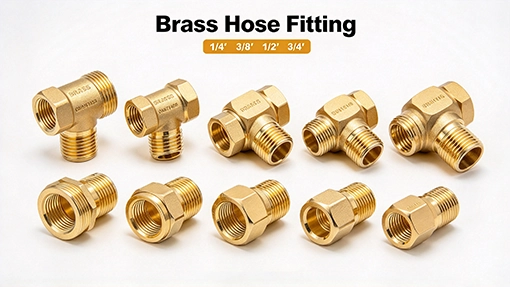
Fakafe'unga'i 'o e Hose Palasa
Need Help Finding the Right Brass Hose Fitting?
A leaking hose connection is often a specification or installation problem — not necessarily a material problem.
The key is not choosing a “lelei ange” fe'unga palasa. The key is choosing the right fitting, hose, fakamaʻu, and sealing method for your specific application.
When requesting a brass hose fitting, provide:
- ID 'o e Hose
- Naunau hose
- Fluid
- Ko e tenge ngaue .
- Fua mafana
- Barb size
- Fa'ahinga filo
Ko e Kautaha Tekinolosia ʻo e Malohi ʻo Luoyang Datang., Ltd. can help you identify the appropriate configuration — and help you avoid the leak before it starts.
NGAAHI POSI FETU'UTAKI
Founga ke Fili 'aki 'a e ngaahi paipa PPR?

Ko e Fakahinohino Kakato ki he Ngaahi Sisitemi Paipa Fakangaue'anga .: Ngaahi valve, Ngaahi paipa & Fittings ki he Tohi Kole kotoa pe .
PE Paipa Vai mo e Tekinolosia Fehokotaki'anga
Paipa PPR mo e paipa CPVC .: Ko e fē ʻoku lelei angé?
Founga ke langa ai ha sisitemi paipa HDPE 'oku 'ikai ke 'i ai ha 'uhinga .?