LUOYANG CAME ENERGY TECH CO., Ltd

Why Industries Are Switching to HDPE Piping Systems
From municipal water networks to mining slurry transportation, from farmland irrigation to chemical plant processing lines — high-density polyethylene (ایچ ڈی پی ای) piping systems are rapidly becoming the preferred solution across industries worldwide. The global HDPE pipe market was valued at USD 23.5 billion in 2024 and is projected to reach USD 34.2 billion by 2032, growing at a CAGR of 4.1%. What is driving this massive shift?
The answer lies in three words: سنکنرن مزاحمت, استحکام, and flexibility. ایچ ڈی پی ای پائپ do not rust, do not corrode, and do not scale. They can be bent to a radius 25 times the nominal pipe diameter, eliminating countless fittings and making them ideal for seismic zones and uneven terrain. Their heat-fused joints create a monolithic pipeline with virtually zero leakage. And with a service life estimated at 50 کو 100 سال, they dramatically reduce lifecycle costs compared to traditional metal pipes.
This article explores why industries are making the switch — and how HDPE piping systems are transforming water supply, agriculture, mining, اور صنعتی ایپلی کیشنز.
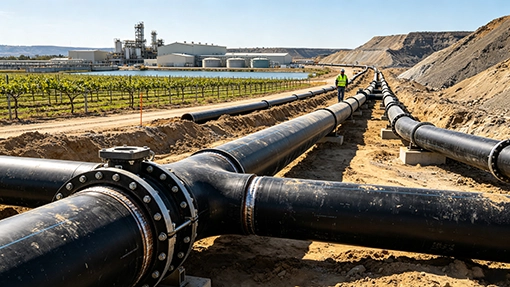
HDPE Piping Systems Serving Multiple Industries
1. Why Are Industries Moving Toward HDPE Piping Systems?
1.1 Superior Corrosion Resistance
Traditional piping materials — steel, ductile iron, and even PVC — face significant challenges from corrosion. Metal pipes rust from the outside in soil environments and from the inside due to water chemistry. پیویسی, while corrosion-resistant to some degree, can become brittle over time and is susceptible to chemical degradation.
HDPE is chemically inert. اسے زنگ نہیں لگتا, corrode, or rot. It resists galvanic and electrochemical corrosion because it is non-conducting. This makes HDPE pipes suitable for aggressive soil conditions, acidic or alkaline water, and chemical environments where metal pipes would fail within years. Unlike traditional metal pipe fittings, HDPE pipes do not rust, corrode or rot.
| Issue | Traditional Pipes | HDPE Solution |
|---|---|---|
| سنکنرن | High risk | Excellent resistance |
| Rust | Common | None |
| Chemical attack | Requires protection | Inherent resistance |
| Scale buildup | Frequent cleaning | Smooth bore |
1.2 Longer Service Life and Lower Maintenance
Perhaps the most compelling argument for HDPE is its longevity. The polyethylene pipe industry conservatively estimates a service life of 50 کو 100 years for HDPE pipe, depending on design, installation, and application. Modern PE4710 compounds are uniquely designed to withstand all major failure mechanisms for a 100+ year design life.
Compare this to ductile iron, which typically has a service life of around 60 سال, or mild steel at 30 سال. But the difference goes beyond years on paper. HDPE requires dramatically less maintenance over its lifetime. It does not need cathodic protection, internal linings, or regular inspection for corrosion damage.
| Factor | Traditional Materials | ایچ ڈی پی ای |
|---|---|---|
| Corrosion risk | اعلی | کم |
| Maintenance frequency | Frequent | Reduced |
| Cathodic protection | Required | Not needed |
| Expected service life | 30–60 years | 50–100+ years |
1.3 Flexibility for Complex Installations
HDPE’s flexibility is a game-changer for pipeline installation. HDPE pipe can be bent to a radius 25 times the nominal pipe diameter for mid-range pressure pipe, 20 times for heavy wall pipe, اور 30 times for low-pressure pipe. This eliminates many fittings required for directional changes in a piping system.
This flexibility makes HDPE ideal for:
- Seismic zones: HDPE acts as an excellent damper against geotechnical movements. It can deform without breaking, flexing like a spring in earthquake zones or areas with landslide risks.
- Uneven terrain: HDPE can be installed with bends over uneven terrain easily in continuous lengths without additional welds or couplings.
- Trenchless installation: HDPE pipe can be installed using a variety of trenchless and open-cut methods. Horizontal directional drilling (HDD) is particularly well-suited to HDPE due to its flexibility and fusion-welded joint integrity.
- Freezing conditions: HDPE retains flexibility for installation and operation in subfreezing conditions. Water can freeze inside HDPE pipes without causing harm or bursting — a property that PVC and metal pipes cannot match.
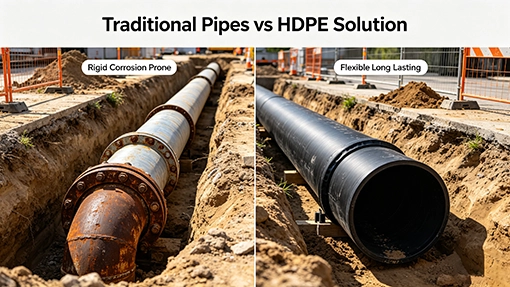
Traditional Pipes vs HDPE Solution
2. HDPE Pipes in Water Supply Systems
میونسپل پانی کی فراہمی remains the largest application segment for HDPE pipes. From drinking water transmission to distribution networks, HDPE has become the material of choice for water authorities worldwide.
Why Municipalities Choose HDPE
The core advantage is economics, not just engineering. HDPE pipe costs 20–40% more upfront than PVC or ductile iron, but municipalities save 15–30% on total lifecycle cost because HDPE doesn’t corrode, doesn’t scale, and practically eliminates joint failures. In a 50-year municipal infrastructure horizon, that equation always resolves in HDPE’s favor.
HDPE’s heat-fused joints create a leak-free system with zero leakage rate. In an era where water loss is a critical concern — some municipalities lose 20–30% of treated water to leaks in aging metal networks — this is a transformative advantage.
Key Applications
| درخواست | Why HDPE Works |
|---|---|
| Municipal water mains | Leak resistance, corrosion protection |
| Pressure pipelines | High pressure capability (up to PN25) |
| Underground networks | Corrosion resistance in all soil conditions |
| Drinking water systems | Chemically inert, no leaching |
HDPE has been used in drinking water pipe applications for almost 50 years and continues to gain approval from regulators worldwide. Its chemical inertness means it does not leach contaminants into the water supply, making it safe for potable water systems.
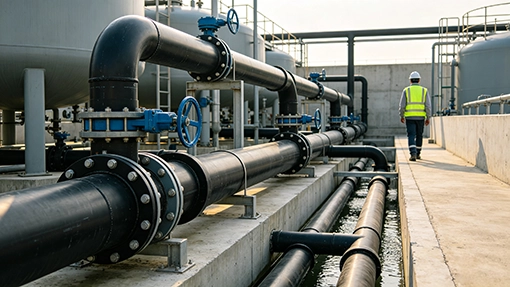
HDPE Pipes in Water Supply Systems
3. زرعی آبپاشی کے لیے HDPE پائپ
Modern agriculture demands efficient water delivery. With drip irrigation installations using HDPE tubing growing at 8–10% annually since 2020, farmers worldwide are recognizing the value of HDPE piping systems.
Why HDPE for Irrigation
HDPE pipe has become the top material of choice for irrigation and well water systems because it performs reliably below ground and above ground. It offers:
- پائیداری: With a design life of over 100 سال, HDPE irrigation systems last far longer than traditional piping.
- Leak prevention: Heat-fused joints eliminate leakage — a critical advantage when water conservation is paramount. A PVC system constructed with rubber gasket bell and spigot joints has many potential leakage points, and with ground movement, PVC joints can pull apart in ways that heat-fused HDPE simply will not.
- Freeze resistance: HDPE won’t break with freezing temperatures or ground movement. Water can freeze inside without causing harm.
- UV مزاحمت: Black HDPE pipe is protected indefinitely against UV degradation by well-dispersed carbon black content. Other plastic materials like PVC have minimal UV protection.
- Surge resistance: HDPE پائپ ہے 250 times more resistant to cyclic surge fatigue than PVC and can handle continuous surge pressures of 150% over its rated pressure.
Applications in Agriculture
| Requirement | HDPE Advantage |
|---|---|
| Large farmland coverage | Long coil lengths up to IPS 6 |
| Outdoor exposure | UV مزاحمت |
| Water efficiency | Reliable connections, zero leakage |
| Drip irrigation | لچک, easy relocation |
| Sub-irrigation | سنکنرن مزاحمت, لمبی زندگی |
HDPE irrigation systems improve agricultural water management by delivering water precisely and reliably — without the losses common in older canal or PVC-based systems. This is particularly critical in arid regions where water is a valuable commodity that must be conserved.
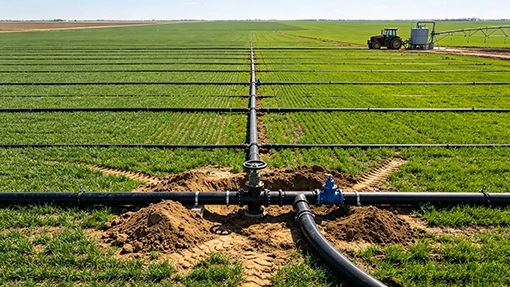
زرعی آبپاشی کے لیے HDPE پائپ
4. HDPE Pipes in Mining Applications
Mining operations present some of the harshest conditions for any piping system. Abrasive slurries, aggressive chemicals, remote locations, and extreme terrain — all demand a pipe that can withstand severe punishment. HDPE meets these challenges.
Abrasion Resistance: Abrasion resistance is the single most critical factor for mining slurry transport. SCGC’s PE-VHAR (Very High Abrasion Resistance) technology offers twice the abrasion resistance compared to conventional PE100 pipes. This innovation enables pipes to withstand severe abrasion from slurry transport, reducing replacement frequency, lowering maintenance costs, and minimizing downtime. It extends pipe lifespan while ensuring recyclability at end-of-life.
کیمیائی مزاحمت: Mining operations often involve aggressive chemicals — acids, alkalis, and various reagents used in mineral processing. HDPE’s chemical resistance makes it suitable for these environments where metal pipes would rapidly corrode.
Flexibility in Remote Locations: Mining sites are often in remote areas with difficult access. HDPE’s lightweight nature — approximately 30% the weight of ductile iron for the same bore — makes transportation and handling significantly easier. Its flexibility allows for installation over uneven terrain without excessive fittings.
| Mining Application | HDPE Benefit |
|---|---|
| Slurry transportation | Wear resistance |
| Mine water drainage | سنکنرن مزاحمت |
| Tailings lines | Abrasion + کیمیائی مزاحمت |
| Remote area pipelines | Easy transportation and installation |
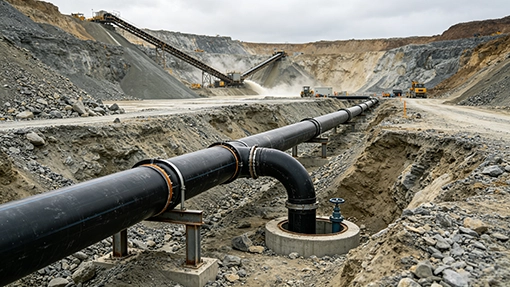
HDPE Pipes in Mining Applications
5. Industrial Applications of HDPE Piping Systems
Beyond water, agriculture, and mining, HDPE piping systems serve a wide range of industrial applications.
Chemical Processing
HDPE pipe is available for pressures up to 300 psi and constant service temperatures up to 140°F. It is used for transporting organic chemicals, inorganic chemicals, hazardous waste, گندا پانی, and process water. Typical applications include chemical processing, plating, potable water systems, water and waste water treatment, and other industrial applications involving corrosive and acidic fluid transfer.
Wastewater Treatment
HDPE piping systems are engineered to resist corrosion, prevent leakage, and reduce maintenance over time in wastewater infrastructure. With a pH range of 0–14 and operating temperatures from -40°C to +95°C, HDPE drainage systems handle chemically aggressive wastewater that would destroy metal pipes.
| Industry | HDPE Application |
|---|---|
| Chemical processing | Chemical pipelines |
| مینوفیکچرنگ | Process water |
| Wastewater treatment | Corrosion-resistant piping |
| Power generation | Cooling water, chemical feed |
| Pulp and paper | Chemical and effluent lines |
At the end of their long life cycle, HDPE components are recyclable, making them an environmentally responsible choice for sustainable industrial infrastructure.
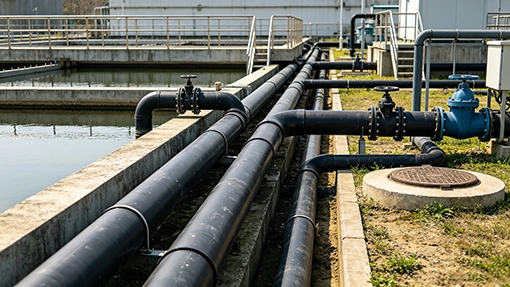
HDPE Pipes in Chemical and effluent lines
6. HDPE vs Traditional Piping Materials
When comparing HDPE to traditional materials like steel and ductile iron, the Total Cost of Ownership (ٹی سی او) tells the complete story.
Installed Cost
While HDPE pipe may have a higher price per metre than ductile iron on a price sheet, pipes are not sold by the tonne — they are specified by the kilometre and operated for fifty years. HDPE wins decisively on installed cost for trenched pipelines.
HDPE is also lighter — 30% the weight of ductile iron in the same bore — so handling, اٹھانا, and trench shoring requirements drop. The net result: HDPE installed cost is 5–25% lower than ductile iron in typical urban and rural scenarios.
Operating Cost
Independent utility studies consistently show HDPE main breaks at 1/10 کو 1/25 the rate of ductile iron or steel. Over a 50-year horizon, that single factor — fewer broken mains, less excavation, less treated water lost — turns a slight capital cost parity into a deep operating cost advantage.
Comparison Table
| فیچر | ایچ ڈی پی ای | Ductile Iron | Steel |
|---|---|---|---|
| سنکنرن مزاحمت | بہترین | Requires protection | Requires protection |
| وزن | ہلکا پھلکا | Heavy | Heavy |
| تنصیب | لچکدار | Complex | Complex |
| Joints | Fusion-welded, zero leakage | Mechanical, potential leaks | Welded or mechanical |
| دیکھ بھال | زیریں | اعلی | اعلی |
| سروس کی زندگی | 50–100+ years | ~60 years | ~30 years |
| 50-year TCO | 20–40% lower | Baseline | اعلی |

HDPE Pipes vs Ductile Iron vs Steel
7. The Future of HDPE Piping Systems
The future of HDPE piping systems is bright. Several trends are driving continued adoption.
Infrastructure Investment :Governments worldwide are investing heavily in infrastructure. In the United States, over USD 1.2 trillion will be spent between 2021 اور 2030 to modernize aging infrastructure. The Asia-Pacific region, accounting for over 44.1% of the global HDPE pipe market in 2025, continues to lead growth due to increasing investment in infrastructure improvement and development.
Sustainability :Environmental regulations favoring sustainable piping solutions are contributing to adoption. HDPE is theoretically 100% ری سائیکل, and at the end of their long life cycle, HDPE components can be recycled. This positions HDPE as an environmentally responsible choice for modern infrastructure.
Technological Advancements :Technological advancements in resin formulations are enabling higher pressure ratings and temperature resistance, broadening application potential across industries. From PE100 to PE100RC to PE112, innovations continue to enhance HDPE pipe strength, لچک, and resistance to high pressure and extreme conditions.
Growing Mining Demand :The growing mining industry, driven by demand for minerals in EV batteries and electronic devices, is creating new opportunities for HDPE piping systems. Abrasion-resistant innovations like PE-VHAR are positioning HDPE as a key solution for modern mining infrastructure.
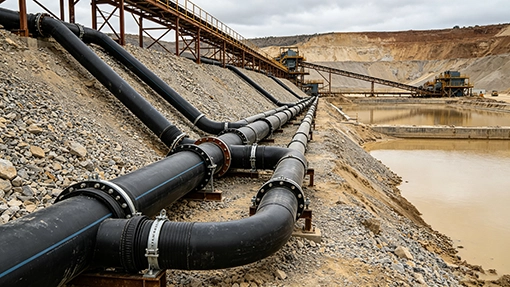
HDPE Pipes in Tailings lines
نتیجہ & Next Steps
Across municipal water networks, farmland irrigation systems, mining slurry lines, and industrial process plants — HDPE piping systems have consistently proven their worth. سنکنرن مزاحمت, 50–100 year service life, installation flexibility, and 15–30% lifecycle cost savings — the case is clear.
But knowingwhy HDPE wins is only half the equation. The other half is getting thespecification right — for your pressure rating, your terrain, your budget, and your timeline.
Ready to move forward? Choose your path:
📩 Get a Custom Quote — Tell us your pipe diameter, total length, PN rating, and delivery site. We‘ll return a transparent, competitive quote within 24 business hours.
📞Book a Free Technical Consultation — Facing abrasive slurries, rocky ground, or extreme temperatures? Our engineers will recommend the optimal HDPE grade (PE100/PE100RC/PE-VHAR) and advise on fusion procedures — 1-on-1, no obligation.
Whatever your project — a multi-kilometre water main, a large-scale irrigation system, or a high-wear mining line — Luoyang Datang Energy Tech Co., لمیٹڈ is ready to help you specify, source, and install a pipeline built for half a century of reliable service.
متعلقہ پوسٹس
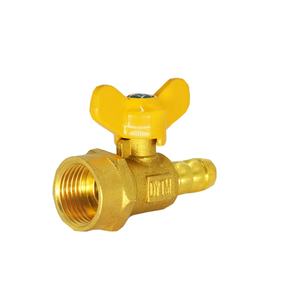
HVAC & پلمبنگ: ہیٹنگ پائپ فٹنگز کی مکمل فہرست
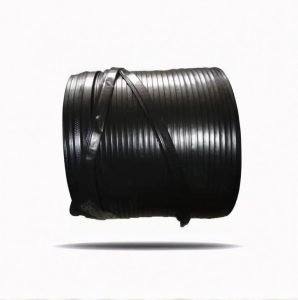
زرعی آبپاشی میں ایچ ڈی پی ای پائپ
پانی کی فراہمی کے لیے کون سا پائپ استعمال کیا جاتا ہے۔
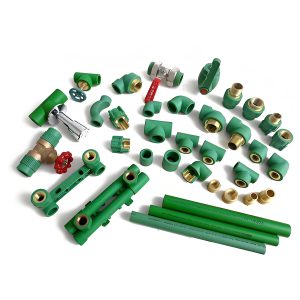
کیوں PPR پائپ اور فٹنگ مشرق وسطی میں اندرون ملک پانی کی فراہمی کے لیے مثالی انتخاب بنتے ہیں۔, افریقہ اور جنوب مشرقی ایشیا کے گرم علاقے?
🚀 پائپ لائن انڈسٹری کی تبدیلی: تیل سے بصیرت & گیس کمپریسر اور پائپ لائن ٹرانسپورٹیشن فورمز