CÔNG TY TNHH CÔNG NGHỆ NĂNG LƯỢNG LUOYANG CAME

Khuỷu tay và khớp nối ống bằng đồng thau mạnh đến mức nào? Hướng dẫn về Độ bền và Hiệu suất
Khi người mua đánh giá phụ kiện đường ống, cuộc trò chuyện thường bắt đầu bằng giá cả, kích cỡ, và kiểu kết nối. Đây là những cân nhắc quan trọng—nhưng chúng không kể toàn bộ câu chuyện. Trong hoạt động thực tế, the true cost of a fitting isn’t what you pay upfront; it’s how long it lasts, how reliably it performs under pressure, and how much maintenance it requires over its service life. That’s why seasoned engineers and procurement professionals look beyond the surface. They ask: Will this fitting hold up? Can it handle the pressure? Will it corrode after six months in a water system?
Brass elbows and hose couplings have earned their place as go-to components across plumbing, HVAC, công nghiệp, and agricultural applications precisely because they deliver what matters most: mechanical strength, chống ăn mòn, and reliable sealing performance over years of service.
In this guide, we’ll break down exactly how strong brass elbows and hose couplings really are—what makes them durable, what pressures they can handle, and why they outperform alternatives in demanding environments.
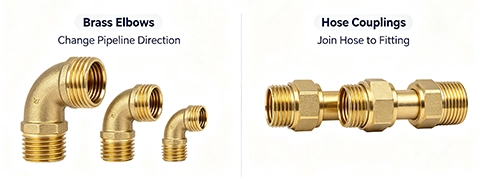
Brass Elbows vs Hose Couplings
What Makes Phụ kiện đồng thau Strong and Durable?
The strength of a brass fitting starts with its material. Brass is an alloy primarily composed of copper and zinc, and the specific composition determines its mechanical properties, chống ăn mòn, và khả năng gia công.
For plumbing and fluid handling fittings, common alloy designations include C37700 and C36000, which contain approximately 57–61% copper, 35–39% zinc, with small additions of lead (2.5–3.5%) to enhance machinability. This composition yields a material with tensile strength ranging from 330 ĐẾN 450 megapascals, depending on temper and processing.
Here’s how brass’s key properties translate into real-world performance:
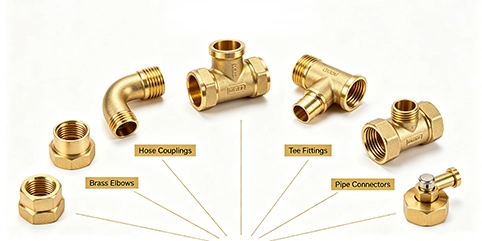
Phụ kiện đồng thau
How Durable Are Khuỷu tay bằng đồng?
Brass elbows are one of the most commonly used fittings in piping systems, and their durability comes down to three critical factors: mechanical strength, chống ăn mòn, and application suitability.
Mechanical Strength of Brass Elbows
A brass elbow must withstand multiple forces simultaneously: internal pressure from the fluid, vibration from connected equipment, thermal expansion and contraction from temperature changes, and mechanical stress from installation and maintenance.
The pressure ratings of brass elbows vary widely depending on size, độ dày của tường, alloy grade, and design. Here are some real-world examples:
- Forged brass street elbows (1/4″ NPT) can operate at working pressures lên đến 1200 PSI, with a temperature range of -65°F to 250°F (-53°C đến 121°C).
- Zurn PEX brass elbows are pressure rated at 160 PSI ở 73°F, 130 PSI at 120°F, 100 PSI at 180°F, Và 80 PSI at 200°F.
- Lớp học 125 lead-free brass elbows are rated at 125 PSI for steam and 200 PSI cho nước, dầu, và khí đốt (W.O.G.).
- Push-fit brass elbows (3/4″) have a max working pressure of 150 PSI (10 thanh), max resistant pressure of 350 PSI (25 thanh), and max endured pressure of 600 PSI (40 thanh).
Corrosion Resistance in Different Environments
One of brass’s greatest strengths is its resistance to corrosion. Brass resists corrosion from Nước, nhiệt, axit, khoáng sản, and peaty soils, making it suitable for hot and cold water distribution systems. The alloy forms a stable surface oxide layer that protects against further degradation.
Tuy nhiên, brass with higher zinc content may be susceptible todezincification—a selective leaching of zinc that leaves behind a porous, weakened copper structure. To address this, manufacturers now offerdezincification-resistant (DZR) brass alloys, sometimes called “DR brass,” which incorporate small amounts of arsenic or other elements to inhibit this process. These materials are specified for applications involving aggressive water chemistry or where long-term reliability is required.
Ứng dụng điển hình of Brass Elbows
Brass elbows are found in a wide spectrum of applications:
- Hệ thống ống nước dân dụng — Water supply lines, faucet connections
- Commercial water systems — Hot and cold water distribution
- hệ thống HVAC — Chilled water, condenser water, and refrigerant lines
- Pneumatic systems — Compressed air lines
- Thiết bị công nghiệp — Hydraulic and fluid power systems
- Phòng cháy chữa cháy — Fire sprinkler and standpipe systems

Brass Elbows in Fire protection
How Strong Are Brass Hose Couplings?
While elbows are about changing flow direction, hose couplings are aboutconnection strength, sealing performance, and repeated assembly. A hose coupling must maintain a leak-proof seal through countless connect/disconnect cycles, often under high pressure and in harsh environments.
Key Factors Affecting Hose Coupling Durability
Why Brass Hose Couplings Are Preferred
Brass hose couplings are the preferred choice across industries for several compelling reasons:
- ✅ Reliable connection — Precision-engineered threads and locking mechanisms ensure secure, kết nối chống rò rỉ
- ✅ Chống mài mòn tốt — Brass withstands the friction of repeated coupling and uncoupling without significant degradation
- ✅ Dễ dàng cài đặt — Threaded designs enable straightforward assembly with standard tools
- ✅ Tuổi thọ dài — Robust brass construction guarantees consistent performance over years of service, with excellent resistance to rust, mặc, and deformation
- ✅ Low lifecycle costs — Minimal maintenance requirements and extended service life reduce total cost of ownership
Real-world pressure ratings for brass hose couplings:
- Brass sand blast couplings (1-1/4″): Rated for 175 PSI working pressure at 70°F
- Brass quick couplings: Withstand pressures lên đến 600 PSI—20% higher than standard couplers
- GK brass hose couplings: Operating pressure from -0.95 ĐẾN 25 thanh (with KTW approval: lên đến 40 thanh)
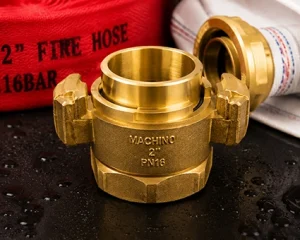
- Brass hose couplings (ISO 7-1 R / ISO 228-1, 2″): Maximum operating pressure of 16 thanh

Brass Hose Couplings in Industrial equipment
Brass Elbows and Hose Couplings Under Different Working Conditions
Brass fittings excel across a remarkable range of working conditions. Here’s how they perform in specific applications:
Brass’s versatility comes from its balanced property profile: it’s strong enough for high pressure, corrosion-resistant enough for water systems, and temperature-stable enough for both hot and cold applications.

Brass Elbows and Hose Couplings Under Different Working Conditions
Brass vs Plastic Fittings: Which Is More Durable?
This is one of the most common questions buyers ask, and the answer depends on the application. But when it comes todurability under demanding conditions, brass has clear advantages.
The bottom line: Plastic fittings have their place—they’re lightweight, chống ăn mòn, và dễ dàng cài đặt. But forhigh-pressure applications, high-temperature environments, systems with vibration, and installations where long-term reliability is critical, brass is the safer, more durable choice.
How to Extend the Service Life of Brass Fittings
Even the most durable fittings benefit from proper installation and maintenance. Here are practical tips to maximize the service life of your brass elbows and hose couplings:
- Choose the correct fitting size — Undersized fittings create stress points; oversized fittings compromise seal integrity.
- Select the proper thread standard — Match NPT, BSP, or other thread standards to your system requirements.
- Avoid excessive tightening — Over-tightening can damage threads or deform the fitting. Trước tiên hãy siết chặt tay, then use a wrench for an additional 2-1/2 turns past hand tight.
- Use suitable sealing materials — Thread sealant or PTFE tape applied correctly prevents leaks and reduces thread wear.
- Inspect connections regularly — Periodic visual inspection catches early signs of wear, ăn mòn, or leakage before they become problems.
- Consider DZR brass for aggressive water — In areas with aggressive water chemistry, specify dezincification-resistant brass alloys.
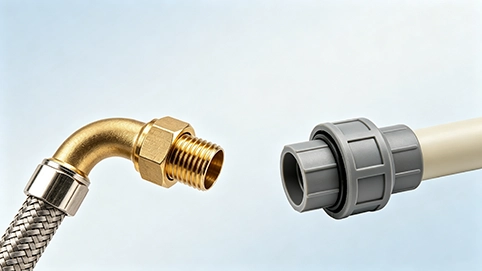
Brass vs Plastic Fittings
Frequently Asked Questions About Brass Fittings Durability
Q1: Are brass elbows strong enough for high-pressure applications?
MỘT: Yes—but it depends on the specific design. Forged brass elbows can handle working pressureslên đến 1200 PSI, while standard class 125 elbows are rated for 125 PSI (hơi nước) Và 200 PSI (Nước, dầu, khí đốt). Always check the pressure rating for your specific fitting and application.
Q2: How long do brass hose couplings last?
MỘT: With proper installation and maintenance, brass hose couplings can lastdecades—often outlasting the hoses they connect. Their resistance to rust, mặc, and deformation ensures minimal maintenance and low lifecycle costs.
Q3: Do brass fittings corrode?
MỘT: Brass is generally corrosion-resistant in water, HVAC, và ứng dụng công nghiệp. Tuy nhiên, in certain aggressive water conditions (soft waters with high chloride and pH > 8), dezincification can occur. This is whyDZR (dezincification-resistant) thau is recommended for demanding water applications.
Q4: Are brass fittings better than plastic fittings?
MỘT: Vìáp suất cao, nhiệt độ cao, or high-vibration applications, yes—brass offers superior strength, độ bền, and thread stability. For low-pressure, low-temperature, or weight-sensitive applications, plastic may be sufficient. The choice depends on your specific requirements.
Phần kết luận
Brass elbows and hose couplings have remained the industry standard for good reason. They deliver a combination of properties that few other materials can match:
- ✅ Sức mạnh — Withstanding pressures from 80 PSI to over 1200 PSI depending on design
- ✅ Chống ăn mòn — Protecting against water, nhiệt, axit, and minerals
- ✅ Độ tin cậy — Maintaining leak-proof seals through years of service and countless connection cycles
- ✅ Tuổi thọ dài — Often exceeding the life of the systems they serve
- ✅ Low lifecycle costs — Minimal maintenance and replacement requirements
Whether you’re specifying fittings for a residential plumbing system, an industrial facility, or a fire protection network, brass elbows and hose couplings offer the durability and performance that give youpeace of mind—because the true measure of a fitting isn’t how it looks on the shelf, but how it performsyear after year in the field.
If you are looking for reliable brass pipe fittings for your next project, liên hệ Công ty công nghệ năng lượng Lạc Dương Datang, Công ty TNHH for customized solutions tailored to your specific application requirements.
Related article: Phụ kiện đường ống đồng thau: 7 Các vấn đề thường gặp về hệ thống nước mà chúng giúp giải quyết
BÀI VIẾT LIÊN QUAN
Ống nhựa Dia12-1600mm - Ống Polyethylene mật độ cao
Ống PPR thân thiện với môi trường: Hướng dẫn của chuyên gia để tránh vật liệu giá rẻ & Thất bại

Đường ống cấp nước có được bảo hiểm theo hợp đồng bảo hiểm của chủ nhà không
Sự khác biệt giữa ống CPVC và ống UPVC?
Hướng dẫn ghép nối Machino bằng đồng thau: Kết nối vòi chữa cháy đáng tin cậy & Lựa chọn phụ kiện ống nước