CÔNG TY TNHH CÔNG NGHỆ NĂNG LƯỢNG LUOYANG CAME

Ống luồn dây điện HDPE và ống bảo vệ cáp truyền thống: Hướng dẫn so sánh hoàn chỉnh
Với sự phát triển nhanh chóng của mạng lưới điện ngầm, dự án năng lượng tái tạo, và cơ sở hạ tầng viễn thông, hệ thống bảo vệ cáp đáng tin cậy đã trở nên cần thiết cho xây dựng hiện đại.
Underground cables are often exposed to various external risks, including soil pressure, moisture, chemical corrosion, temperature changes, and accidental mechanical damage during construction. Choosing the right protection pipe directly affects the safety, service life, and maintenance cost of the entire electrical system.
Among various cable protection solutions, Ống luồn dây điện HDPE has become increasingly popular due to its excellent flexibility, chống va đập, chống ăn mòn, và tuổi thọ dài.
Tuy nhiên, traditional cable protection pipes such as PVC conduits, steel conduits, and concrete ducts are still widely used in many applications. This raises an important question:
Which is better for underground cable protection: HDPE Electrical Conduit or traditional cable protection pipes?
This article compares their materials, hiệu suất, ứng dụng, and installation advantages to help engineers, nhà thầu, and buyers make the right choice.
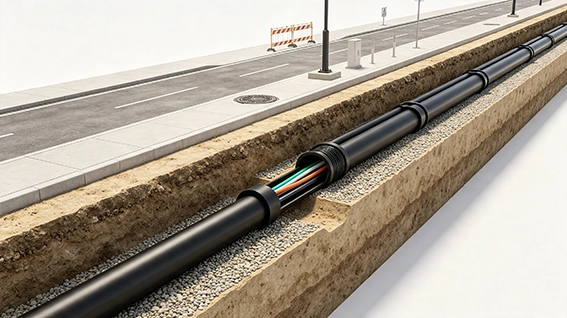
HDPE electrical conduit pipe for underground cable protection system
What Is HDPE Electrical Conduit Pipe?
HDPE Electrical Conduit Pipe is a protective pipe made from high-density polyethylene (HDPE) vật liệu, designed specifically for protecting underground electrical cables, communication cables, and fiber optic cables.
HDPE conduit is widely used in underground electrical conduit systems because it combines mechanical strength with excellent flexibility. Unlike rigid pipes, HDPE conduit can adapt to curved installation routes and challenging underground environments.
The unique molecular structure of HDPE provides excellent resistance against impact, hóa chất, và độ ẩm. This makes it suitable for demanding applications such as power transmission projects, solar farms, wind energy facilities, and telecommunication networks.
Key Features of HDPE Electrical Conduit
1. Excellent Impact Resistance
HDPE conduit absorbs impacts without cracking or breaking, making it ideal for environments where physical stresses—such as soil pressure, vehicle loads, or construction activities—are common. This toughness ensures long-term protection for the cables inside.
2. Chemical and Corrosion Resistance
HDPE is chemically inert and resistant to acids, chất kiềm, muối, and most organic solvents. Unlike steel conduits that rust or PVC that may degrade in certain soil conditions, HDPE maintains its integrity in aggressive underground environments.
3. Flexible Installation
HDPE conduit can be bent, coiled, and maneuvered around obstacles without special equipment. This flexibility enables trenchless installation methods such as horizontal directional drilling (ổ cứng) and plowing, which minimize surface disruption and reduce installation time.
4. Tuổi thọ dài
HDPE conduits are designed to last for decades—often exceeding 50 years—even in challenging outdoor conditions. This longevity significantly reduces replacement costs over the system’s lifecycle.
5. Bảo trì thấp
The smooth interior wall of HDPE conduit reduces friction during cable pulling, while its resistance to corrosion and chemical degradation minimizes maintenance requirements over time.
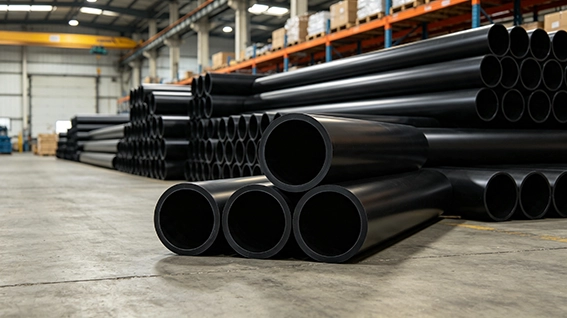
black HDPE electrical conduit pipe product for cable protection
What Are Traditional Cable Protection Pipes?
Traditional cable protection pipes refer to protective systems made from conventional materials such as PVC, thép, và bê tông. These pipes have been used for decades in electrical infrastructure projects to protect underground cables from external damage.
Although new materials such as Ống luồn dây điện HDPE have gained popularity, traditional cable protection pipes still have advantages in specific applications due to their material characteristics and availability.
The most common types of traditional cable protection pipes include:
- PVC Cable Conduit
- Steel Conduit
- Concrete Cable Ducts
Common Types of Cable Protection Pipes
PVC Cable Conduit
PVC (Polyvinyl clorua) conduit is one of the most widely used traditional options. It comes in two main varieties: PVC-U (PVC không hóa dẻo) for general electrical installations and PVC-C (PVC clo hóa) for higher-temperature applications.
- Thuận lợi: Low material cost, easy to cut and join with solvent cement, widely available
- Nhược điểm: Becomes brittle in cold conditions, prone to cracking under heavy impact, limited flexibility
Steel Conduit
Steel conduit offers maximum mechanical protection and is often specified for industrial environments, bridge crossings, and exposed locations where physical damage is a primary concern.
- Thuận lợi: Cường độ cao, fire resistance, provides natural grounding and EMI shielding
- Nhược điểm: Heavy and difficult to handle, prone to corrosion without protective coatings, requires specialized tools and skilled labor for installation
Concrete Cable Ducts
Concrete ducts are commonly used in large infrastructure projects and under roadways or high-load areas where maximum structural strength is required.
- Thuận lợi: Exceptional compressive strength, suitable for heavy-load applications
- Nhược điểm: Difficult and expensive to install, heavy, not flexible, high transportation costs
Ống luồn dây điện HDPE và ống bảo vệ cáp truyền thống: Key Differences
| Tính năng | HDPE Electrical Conduit HDPE | Traditional Pipes |
|---|---|---|
| Vật liệu | Polyethylene mật độ cao (HDPE) | PVC / Thép / Bê tông |
| Tính linh hoạt | Excellent — can be coiled and bent | Limited — rigid or semi-rigid |
| Chống va đập | High — absorbs impacts without cracking | Medium to High (depends on material) |
| Chống ăn mòn | Excellent — chemically inert | Depends — steel rusts, PVC may degrade |
| Installation Cost | Lower — lightweight, fewer joints, trenchless options | Higher — heavy, more joints, requires more labor |
| Cuộc sống phục vụ | 50+ năm | 20-50 năm (varies) |
| BẢO TRÌ | Low — corrosion-resistant, bền bỉ | Medium to High |
| Joint Integrity | Fusion-welded — leak-proof, hệ thống liên tục | Mechanical joints — potential weak points |
HDPE conduit is lighter than traditional materials such as steel pipes and cast iron pipes, significantly reducing the difficulty and cost of construction. Its flexibility allows installation along curved pathways without the need for multiple fittings, whereas traditional rigid materials require elbows and couplings for directional changes.

hdpe-electrical-conduit-vs-cable-protection-pipes-comparison
Advantages of HDPE Electrical Conduit for Underground Cable Protection
1. Superior Protection Against External Damage
HDPE conduit provides exceptional resistance to soil pressure, vehicle loads, and construction-related impacts. Unlike PVC, which can crack under heavy loads, or steel, which may corrode over time, HDPE maintains its structural integrity in the most demanding underground environments.
Industry data shows HDPE maintains integrity through 20+ years of UV exposure, compared to PVC’s significantly shorter outdoor lifespan. For underground applications where UV is less of a concern, HDPE’s resistance to ground movement and poor soil conditions becomes even more valuable.
2. Better Flexibility for Complex Installation Routes
The flexibility ofHDPE conduit enables installation in curved or uneven terrains without requiring many fittings. This is particularly advantageous for:
- Horizontal directional drilling (ổ cứng)
- Plowing installation
- Rocky terrain
- Areas with existing underground utilities
Long continuous lengths on reels can hold hundreds or even thousands of feet of conduit, minimizing joints and speeding up installation. This reduces potential leak points and installation time.
3. Excellent Resistance to Chemicals and Moisture
In underground environments, cables face constant exposure to moisture, hóa chất đất, and potentially corrosive substances.HDPE cable protection pipe is chemically inert and resistant to a wide range of acids, chất kiềm, và muối.
Unlike steel conduits that require protective coatings to prevent rust, HDPE’s corrosion resistance is inherent to the material itself. This eliminates the risk of coating failure and the associated maintenance costs.
4. Tuổi thọ dài hơn
HDPE conduits are engineered to deliver decades of performance, often exceeding 50 years of service life. This longevity translates into lower total lifecycle costs and reduced need for replacement or rehabilitation.
Traditional materials like steel may require periodic maintenance or replacement due to corrosion, while PVC can become brittle over time, especially in cold climates. HDPE maintains its ductility even at low temperatures.
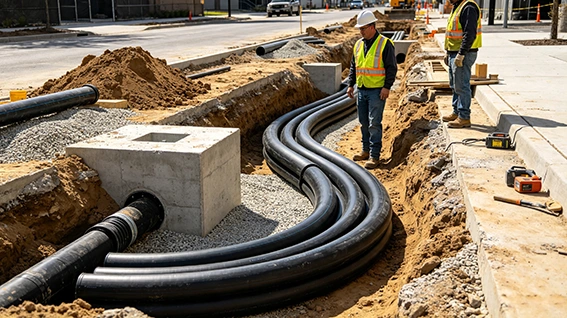
flexible HDPE conduit installation for underground cable system
Applications of HDPE Electrical Conduit
HDPE pipe for underground cable finds extensive applications across multiple industries and infrastructure sectors:
Underground Power Cable Protection
HDPE electrical conduit is the preferred choice for protecting underground power distribution cables, from low-voltage residential feeds to high-voltage transmission lines. It is commonly installed from transformer to transformer or as underground cables exiting substations.
Fiber Optic Communication Networks
Vìfiber optic cable protection pipe, HDPE conduit offers the ideal combination of flexibility, độ bền, and low friction. It protects sensitive fiber optic cables from mechanical damage, moisture, and environmental stress while allowing for easy cable pulls through its smooth interior.
Renewable Energy Projects
Solar farms, wind farms, and other renewable energy installations require extensive underground cabling. HDPE conduit’s flexibility and durability make it ideal for these applications, and the 2025 NEC update now favors HDPE for renewable energy installations due to UV stability and trenchless installation speed.
Industrial Electrical Systems
In industrial settings, HDPE conduits protect electrical and communication cables from chemicals, physical damage, and environmental stresses. This is especially important in chemical plants, cơ sở sản xuất, and processing plants.
Telecommunications Infrastructure
HDPE conduit is extensively used to protect telecommunications cables, including copper and fiber optic lines, in both underground and aerial installations. It provides reliable protection for SCADA systems, highway lighting, intelligent transportation systems (ITS), and broadband networks.
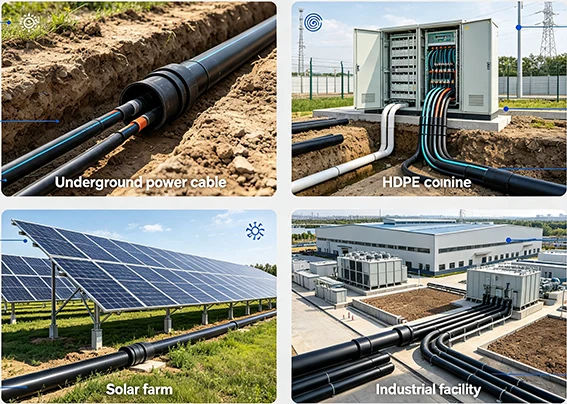
HDPE electrical conduit applications in power communication and renewable energy projects
HDPE Electrical Conduit vs PVC Conduit: Which One Should You Choose?
Among traditional cable protection pipes, PVC conduit is one of the most common alternatives to HDPE.
Both materials have advantages, but their performance differs significantly depending on project requirements.
| Tính năng | Ống luồn dây điện HDPE | Ống PVC |
| Tính linh hoạt | Xuất sắc | Limited |
| Chống va đập | Cao | Trung bình |
| Cold Temperature Performance | Better | Thấp hơn |
| Kháng hóa chất | Xuất sắc | Tốt |
| Cài đặt | Faster and easier | Simple but more rigid |
| Underground Adaptability | Xuất sắc | Vừa phải |
| Long-term Durability | Xuất sắc | Tốt |
When Should You Choose HDPE Electrical Conduit?
HDPE conduit is recommended when projects require:
- ✔ Flexible installation routes
- ✔ High impact resistance
- ✔ Long underground service life
- ✔ Resistance to moisture and chemicals
When Is PVC Conduit Suitable?
PVC conduit can be considered when:
- Budget is the main consideration
- Installation environment is simple
- Mechanical stress is limited
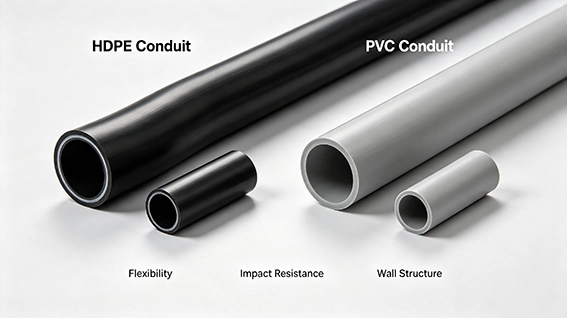
HDPE electrical conduit vs PVC conduit pipe comparison
How to Choose the Right HDPE Electrical Conduit?
Selecting the right HDPE electrical conduit for your project requires careful consideration of several factors:
1. Cable Size and Type
The conduit diameter must accommodate the cables it will protect, with sufficient space for easy pulling and future upgrades. Consider both the current cable requirements and potential future expansion.
2. Môi trường cài đặt
Evaluate soil conditions, expected loads, and environmental factors such as chemical exposure or temperature extremes. HDPE’s chemical resistance and flexibility make it suitable for most environments, but specific site conditions may influence the required wall thickness or SDR rating.
3. Load Requirements
Different applications require different levels of crush resistance. For installations under roadways or heavy traffic areas, a lower SDR (thicker wall) may be necessary. SDR (Tỷ lệ kích thước tiêu chuẩn) is the ratio of the conduit’s outer diameter to its wall thickness — the lower the SDR number, the thicker the wall and the stronger the conduit.
4. HDPE Conduit Pipe Sizes
HDPE conduit pipe sizes are available in a wide range of diameters and wall thicknesses to suit different applications. Common options include:
| Size Type | Sự miêu tả | Ứng dụng điển hình |
|---|---|---|
| Lịch trình 40 | Standard wall thickness | General underground installations |
| Lịch trình 80 | Thicker wall, sức mạnh cao hơn | Heavy-load areas, road crossings |
| SDR 11 | Thickest wall | Maximum protection, high-load applications |
| SDR 13.5 | Medium wall | Balanced strength and flexibility |
| SDR 9 | Ultra-thick wall | Extreme load conditions |
5. Standards Compliance
Ensure the HDPE conduit meets relevant industry standards for your application. Key standards include:
- ASTM F2160 — Solid wall HDPE conduit for power and fiber optic cables
- ASTM D3350 — Polyethylene plastics pipe specifications
- NEMA TC-7 — HDPE conduit for underground electrical cables
- UL 651 — Electrical conduit standards
- AASHTO M294 — HDPE corrugated pipe specifications

HDPE conduit pipe sizes wall thickness and SDR specifications
HDPE Electrical Conduit Specifications and Standards
Understanding the technical specifications of HDPE electrical conduit is essential for proper selection and specification:
Diameter Range
HDPE electrical conduit is typically available from ½ inch to 12 đường kính inch, with larger sizes available for specialized applications. Sizing follows Iron Pipe Size (IPS) tiêu chuẩn.
Wall Thickness Ratings
| Đánh giá | SDR Value | Độ dày của tường | Ứng dụng |
|---|---|---|---|
| Lịch trình 40 | Varies by diameter | Tiêu chuẩn | General use |
| Lịch trình 80 | Varies by diameter | Dày | Heavy-duty |
| SDR 9 | 9 | Rất dày | Extreme loads |
| SDR 11 | 11 | Dày | High loads 高 |
| SDR 13.5 | 13.5 | Trung bình | Standard underground |
Material Properties
Typical material properties for HDPE conduit include:
- Tỉ trọng: 0.953 g/cc
- Flexural Modulus: 168,000 psi
- Độ bền kéo: 3,900 psi (yield)
- Melt Index: 0.25 g/10 phút
Installation Methods
HDPE conduit is compatible with multiple installation methods:
- Open trench
- Direct burial
- Plowing
- Horizontal directional drilling (ổ cứng)
- Aerial installations (with concrete encasement for above-ground applications)
Why Choose HDPE Electrical Conduit for Modern Infrastructure?
Modern infrastructure projects demand cable protection solutions that balance durability, tính linh hoạt, and cost efficiency. HDPE electrical conduit delivers on all three fronts:
- Độ bền: With a service life exceeding 50 years and excellent resistance to corrosion, impact, và hóa chất, HDPE conduit provides decades of reliable cable protection.
- Tính linh hoạt: The ability to navigate complex routes, adapt to ground movement, and enable trenchless installation makes HDPE the most versatile conduit material available.
- Hiệu quả chi phí: While the initial material cost may be higher than PVC, lower installation costs, reduced maintenance requirements, and longer service life result in lower total lifecycle costs.
- Sustainability: HDPE conduit is fully recyclable at the end of its service life, and trenchless installation methods minimize environmental disruption.
As underground power networks, renewable energy installations, and telecommunication infrastructure continue to expand, the demand for reliable cable protection solutions will only grow. HDPE electrical conduit, with its proven track record and superior performance characteristics, is well-positioned to meet these challenges.
Ống luồn dây điện HDPE: A Reliable Solution for Underground Cable Protection
With the increasing demand for reliable underground power networks, communication systems, and renewable energy infrastructure, selecting the right cable protection pipe has become more important than ever.
Compared with traditional cable protection pipes, Ống luồn dây điện HDPE offers outstanding advantages in flexibility, chống va đập, chống ăn mòn, and installation efficiency.
For projects requiring durable and reliable underground cable protection pipes, HDPE conduit provides a practical solution suitable for modern infrastructure applications.

HDPE electrical conduit manufacturer production facility
Phần kết luận
Choosing between HDPE Electrical Conduit and traditional cable protection pipes depends on project conditions, installation environment, and performance requirements.
Traditional materials such as PVC, thép, and concrete still have their own applications. Tuy nhiên, for underground projects requiring flexibility, độ bền, chống ăn mòn, and long-term reliability, HDPE conduit has become an increasingly preferred option.
Whether for power cable protection, fiber optic networks, dự án năng lượng tái tạo, or industrial infrastructure, HDPE Electrical Conduit Pipe provides an efficient and dependable cable protection solution.
Request HDPE Electrical Conduit Solution
Looking for reliable HDPE electrical conduit solutions for your underground cable protection projects?
Liên hệ Công ty công nghệ năng lượng Lạc Dương Datang, Công ty TNHH để biết thông số kỹ thuật của sản phẩm, available sizes, and customized solutions based on your project requirements.
BÀI VIẾT LIÊN QUAN
Cách chế tạo một thiết bị làm mềm nước bằng điện quấn quanh đường ống cấp
Ứng dụng của ống và phụ kiện PPR trong hệ thống cấp nước trong nhà
PVC cắm uốn cong vs. Khuỷu tay tiêu chuẩn: Tiết kiệm nhiều hơn những cơn đau đầu khi bảo trì?
Hướng dẫn hoàn chỉnh về hệ thống đường ống phòng cháy chữa cháy: Ống, Van & Phụ kiện có rãnh
Loại ống nước nào có thể được sử dụng khi gắn vào nguồn cấp nước thành phố