LUOYANG CAME ENERGY TECH CO., LTD


מעש קישקע פיטינג ווס מעש רער פּאַסן: וואָס איז די חילוק?
איר דאַרפֿן אַ מעש פּאַסן. איר זוכן אָנליין. You find hundreds of results — מעש קישקע פיטינגז, מעש רער פיטינגז, brass adapters — and half of them look almost identical in the product photos. So which one do you actually need?
That is exactly the question this guide is built to answer. By the end, you will know the difference between a brass hose fitting and a brass pipe fitting, when each one is the right call, and how to avoid the three most expensive buying mistakes we see every single week.
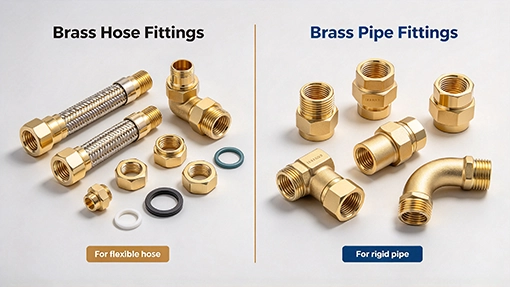
Brass hose fitting vs brass pipe fitting comparison
What Is a Brass Hose Fitting?
A brass hose fitting is designed to connect flexible hoses. The defining feature is a barbed end — a series of raised ridges that slide into the inside of a hose and grip it tight. You secure it with a worm-gear clamp or a crimp-on ferrule.
טראַכטן פון עס דעם וועג: the barb lives inside די קישקע, and the clamp does the work of keeping it there. No threading is involved on the hose side, which is why installation is fast and forgiving.
| שטריך | באַשרייַבונג |
|---|---|
| קשר אופֿן | Barbed end + קישקע קלאַמערן / crimp ferrule; the other end may be threaded, flared, or quick-connect |
| Main use | Flexible hoses — rubber, פּווק, reinforced, synthetic |
| אַפּפּליקאַטיאָנס | Water transfer, קאַמפּרעסט לופט, ברענוואַרג שורות, hydraulic return lines, garden irrigation, wash-down |
| אַרבעט דרוק | Typically 150–300 PSI depending on hose and clamp type |
| טעמפּעראַטור קייט | -40°F to +160°F (-40°C to +71°C) |
Brass hose fittings are everywhere in daily life. The garden hose connector on your outdoor spigot? מעש קישקע פּאַסן. The quick-coupler on an industrial air hose? מעש קישקע פּאַסן. The fuel line adapter on a marine engine? You guessed it.

Various brass hose connectors, adapters and couplings.
What Is a Brass Pipe Fitting?
A brass pipe fitting is built for rigid pipe systems. Instead of gripping the inside of a hose, it threads onto the outside of a pipe using NPT (National Pipe Tapered) or BSP (בריטיש סטאַנדאַרד רער) פֿעדעם. The seal happens on the threads themselves — the tapered thread compresses as you tighten, creating a metal-to-metal seal that you reinforce with PTFE tape or pipe dope.
| שטריך | באַשרייַבונג |
|---|---|
| קשר אופֿן | NPT / BSP threaded, compression, אָדער פלאַנגעד |
| Main use | Rigid pipe systems — copper, מעש, שטאָל, PEX |
| אַפּפּליקאַטיאָנס | גערער, HVAC, גאַז שורות, וואַסער פאַרשפּרייטונג, hydronic heating |
| Pressure class | קלאַס 125 (low pressure) or Class 250 (medium pressure) |
| נאָרמאַל | ASME B1.20.1 (NPT), יסאָ 7-1 / יסאָ 228-1 (BSP) |
Here is the thing that trips people up most: a “1/2 inch” NPT fitting does not measure half an inch anywhere on the part. Its actual outside diameter is 0.840 אינטשעס. And a “3/4 inch” garden hose fitting uses a completely different thread system from a “3/4 inch” pipe fitting. GHT is straight with a 1.0625″ major diameter at 11.5 threads per inch, while 3/4″ NPT is tapered with a 1.050″ OD at 14 TPI. They are not interchangeable — not even close.

מעש עלבאָוז, טיז, reducers and threaded fittings.
Key Differences: The Comparison That Matters
This is the section buyers bookmark. Pin it, save it, screenshot it.
The one-line summary :
Hose fittings grip from the inside and are built for things that move. Pipe fittings thread from the outside and are built for things that stay put.
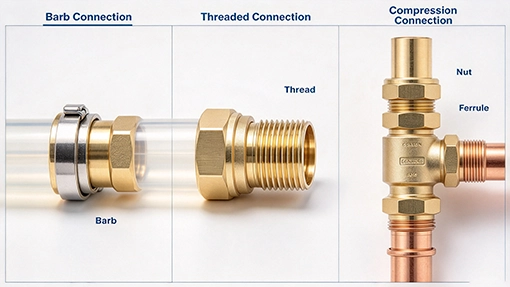
Brass fitting connection methods comparison
When Should You Choose Brass Hose Fittings?
Choose a hose fitting when flexibility and portability matter.
Garden and outdoor water use
Your garden hose needs to connect to a spigot, a sprinkler, or a pressure washer. You want to disconnect it and move it around. A brass hose fitting — usually with GHT (גאָרטן קישקע פאָדעם) — is the answer. Parker’s garden hose fittings are specifically designed for water lines, wash-down lines, and mobile water tanks.
Industrial hose systems
Compressed air lines, wash-down stations, fuel transfer, and hydraulic return lines all use flexible hoses. A brass barbed fitting with a hose clamp gives you a reliable connection that absorbs vibration and thermal expansion — something a rigid pipe joint simply cannot do.
Water transfer and irrigation
From farm irrigation to construction site water supply, brass hose fittings handle the job. They resist corrosion, tolerate temperature swings from -40°F to 160°F, and work with rubber, פּווק, and reinforced hoses alike.
Fire hose connections
NST/NH fire hose thread is a straight, gasket-sealed thread deliberately designed to be non-interchangeable with pipe thread. If you are sourcing fire hose fittings, this is a separate thread system entirely.

Brass Hose Fittings in Garden and outdoor water use
When Should You Choose Brass Pipe Fittings?
Choose a pipe fitting when permanence, higher pressure, and code compliance are the priorities.
Plumbing and water distribution
Hot and cold water lines in residential and commercial buildings. Water heater connections. Hydronic heating loops. Brass pipe fittings are the standard here — and for potable water, you need lead-free brass compliant with NSF/ANSI 61 און NSF/ANSI 372.
HVAC סיסטעמען
Brass pipe fittings handle the temperature cycling in HVAC systems — from hot-water heating loops to chilled water distribution. The brass resists corrosion and maintains its sealing integrity across thousands of thermal cycles.
גאַז שורות
Indoor gas piping for natural gas and propane. Threaded brass fittings are used extensively in smaller-diameter gas lines in non-critical applications. The key advantage: brass does not spark, which is a critical safety consideration in gas service.
קאַמפּרעסט לופט פּייפּינג
When air lines are permanently installed in a workshop or factory, brass pipe fittings provide the rigid, leak-free connections that a flexible hose cannot match.

Brass Pipe Fittings in Gas lines
Common Mistakes Buyers Make
This section alone has saved our customers thousands of dollars. Read it carefully.
טעות 1: Assuming all “1/2 inch” fittings are the same
A “1/2 inch” NPT fitting has an outside diameter of 0.840 אינטשעס. A “1/2 inch” BSP fitting has different thread pitch and a 55° thread angle. They will start to thread together — just enough to fool you — but they will never seal properly.
At 1/2″ and 3/4″, BSP and NPT share the same 14 TPI. That is precisely why those two sizes assemble far enough to fool an installer — and then leak.
Takeaway: Always specify “1/2″ NPT” or “1/2″ BSP” on your purchase order. Never write just “1/2 inch.”
Related reading : NPT ווס BSP פֿעדעם: The Complete Comparison Guide
טעות 2: Confusing garden hose thread with pipe thread
This is the single most expensive mistake in the brass fitting trade. A 3/4″ GHT male fitting will not enter a 3/4″ NPT female port without breaking one or both pieces. The GHT is straight, the NPT is tapered, and their thread pitches differ (11.5 TPI vs 14 TPI).
If you need to connect a garden hose to a pipe thread, you need a crossover adapter — a fitting with GHT on one end and NPT on the other. Do not try to force it.
Related reading: וועט דעם מעש קישקע פּאַסן דיין קישקע?
טעות 3: Ignoring the hose inner diameter
A hose barb marked “3/8 inch” refers to the inside diameter of the hose it fits, not the thread on the other end. If you measure the barb itself, it will not be 3/8 אינטש. If you order based on the thread size alone, you will get the wrong fitting nearly every time.
Related reading: מעש רער פיטינגז סיזעס דערקלערט

Brass Hose Fittings in Water transfer and irrigation
How to Select the Right Fitting: A 5-Step Process
שריט 1: Identify hose or pipe
פלעקסאַבאַל קישקע? → Hose fitting. Rigid pipe? → Pipe fitting. If you need to connect one to the other, you need an adapter.
שריט 2: Check the size
For hose: measure the hose I.D. For pipe: determine the nominal pipe size and verify against the actual thread dimensions.
שריט 3: Confirm the פאָדעם נאָרמאַל
NPT? BSP? GHT? SAE flare? This is where most mistakes happen. Write the standard name, not just the size.
שריט 4: Choose the material
For potable water: lead-free brass, NSF/ANSI 61 certified. For general industrial use: standard C36000 brass. For aggressive water conditions: specify DZR (dezincification-resistant) מעש.
שריט 5: Verify pressure and temperature ratings
Hose fittings: typically 150–300 PSI at 70°F. רער פיטינגז: קלאַס 125 or Class 250 depending on the system. Always check that both the fitting and the hose/pipe are rated for your working conditions.
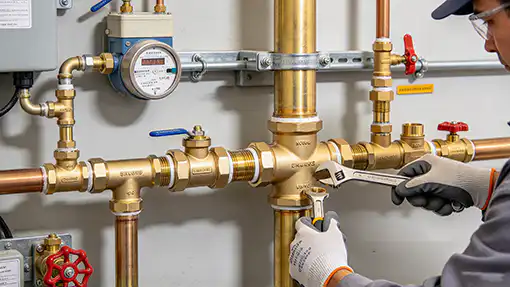
Brass Pipe Fittings in Plumbing and water distribution
FAQ
ק1: Can brass hose fittings be used with pipes?
Not directly. A hose fitting’s barbed end is designed to grip the inside of a flexible hose. If you need to connect a hose to a pipe, use a hose-to-pipe adapter — a fitting with a barbed end on one side and NPT or BSP threads on the other. א- א- 2622 covers exactly this type of adapter for air, ייל, גאַז, and water applications.
ק2: Are brass fittings better than plastic fittings?
For durability, heat resistance, and pressure capacity — yes. Brass tolerates higher temperatures (up to 160°F+ for hose fittings, higher for pipe fittings), resists UV degradation, and will not become brittle over time. Plastic fittings are lighter and cheaper, but they are not a substitute for brass in industrial, HVAC, or hot-water applications.
Q3: How do I measure a brass hose fitting?
Measure the hose I.D. for the barbed end, and use a thread gauge or caliper for the threaded end. Do not measure the barb itself — a “3/8 inch” barb fits a 3/8-inch I.D. קישקע, but the barb’s outer dimension is larger than 3/8 אינטש.
ק4: What thread standards are used for brass fittings?
Five main systems in the US market: NPT (tapered pipe thread, ASME B1.20.1), NPSM/NPSH (straight pipe thread, gasket-sealed), GHT/NH (גאָרטן קישקע פאָדעם, ASME B1.20.7), NST/NH (fire hose thread), און סאַע 45 ° פלער (UNF threads per SAE J512/J513). In Europe and Asia, BSP (יסאָ 7-1 / יסאָ 228-1) is the standard. They are all different and not interchangeable.
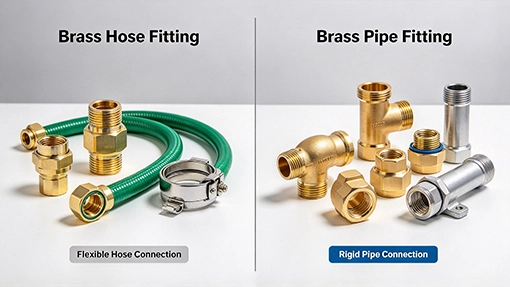
מעש קישקע פיטינג ווס מעש רער פּאַסן
The Bottom Line
Here is the simplest way to remember it:
- Hose fitting = barbed end + קלאַמערן + flexible hose. Built for movement.
- Pipe fitting = threaded end + PTFE טייפּ + rigid pipe. Built for permanence.
ווען אין צווייפל, look at what you are connecting. If it bends, it is a hose. If it does not, it is a pipe. That single question will steer you to the right fitting 95% of the time.
The remaining 5%? That is what thread gauges, size charts, and a supplier who actually knows the difference are for.
Need help identifying the right brass fitting for your application? Luoyang Datang Energy Tech Co., לטד handles NPT, BSP, GHT, and SAE thread systems daily. Send us your specification — or a photo of the fitting you need to replace — and we will tell you exactly what to order.
פֿאַרבונדענע הודעות

פּווק ונטערערד דריינאַדזש רער: Benefits, אַפּפּליקאַטיאָנס & ייַנמאָנטירונג
דו זאלסט נישט פאַרפירן די גרויס געלעגנהייט צו לערנען וועגן פּע פּייפּס און לאָזן פּע פּייפּס טרעפן דיין גאַז רערנ - ליניע סיסטעם.
PPR פּייפּס & פיטינגז:דער בעסטער פּייפּינג סאַלושאַנז אין סאַודי אַראַביאַ מאַרקעט
פארוואס ינדוסטריעס באַשטימען צו HDPE פּייפּינג סיסטעמען
וואָס זענען די 5 טייפּס פון פּייפּס?