लुओयांग केम एनर्जी टेक कंपनी, लिमिटेड


क्या यह पीतल की नली की फिटिंग आपकी नली में फिट होगी? आकार और धागे का मिलान समझाया गया
Ordering a brass hose fitting is not simply about choosing the right connector. एक फिटिंग जो सही दिखती है वह नली के आकार के बावजूद भी विफल हो सकती है, कंटिया व्यास, or thread standard does not match. Every year, countless buyers open a package, thread a fitting onto a hose, and watch water or air leak from a joint that “looked right” on the screen. The problem is almost never the quality of the brass itself. It is a mismatch between what the hose actually measures and what the fitting is designed to connect.
This article walks through the exact measurements, thread standards, and selection logic you need before you place an order. No guesswork. No returns.
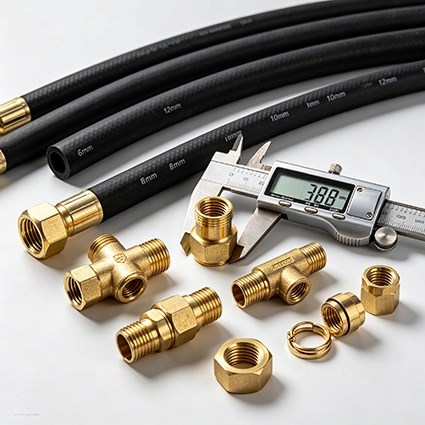
पीतल की नली फिटिंग
Why Choosing the Correct Brass Hose Fitting Size Matters
A brass hose fitting that is one size off will not “sort of work.” Brass does not compress, flex, or forgive. A fitting that is slightly too large will not seat. A fitting that is slightly too small will cut into the hose wall or slide under pressure.
पीतल की नली फिटिंग आकार is the single most important variable in the entire selection process.
Here is what happens when the size is wrong:
| Problem | कारण |
|---|---|
| रिसाव | Fitting OD does not match hose ID |
| Difficult installation | Barb too large or too small for the hose wall |
| Reduced flow | Internal diameter restriction at the fitting |
| Connection failure | Thread does not engage properly or backs out under vibration |
Purchase reminder:Never select a fitting based only on how the hose looks on the outside. The outer diameter tells you almost nothing about the size fitting you need. Measure the inside diameter first, then match the fitting to that number.

Brass Hose Fitting in Plumbing
Understand Hose Size Before Selecting a Brass Hose Fitting
There are three measurements you need. Most buyers skip one of them, and that is where the mismatch begins.
1. Hose ID (Inside Diameter)
This is the number that matters most. The barb of a brass hose fitting is sized to the hose ID, not the OD. ए 1/2″ hose barb goes into a hose with a 1/2″ व्यास के अंदर. ए 1/2″ hose from one manufacturer may have a different outside diameter than a 1/2″ hose from another, but the inside diameter is the standard the fitting is built around.
2. Hose OD (Outside Diameter)
The OD matters for clamp selection, not fitting selection. A hose clamp needs to sit flush around the outside of the hose after the barb is inserted. If the OD is measured incorrectly, the clamp will either not close or crush the hose.
3. Fitting Connection Size
This is the size printed on the fitting itself. It refers to the hose ID the barb is designed for, or the धागे का आकार of the threaded end. A fitting labeled “1/2″ barb × 1/2″ NPT” has a barb that fits a 1/2″ ID hose and a 1/2″ NPT male thread on the other end.
Here is a reference table to orient yourself. Always verify against the actual hose in hand — manufacturer tolerances vary.
| Hose ID | विशिष्ट अनुप्रयोग | Common Brass Fitting Size |
|---|---|---|
| 1/4″ | Small air lines, ईंधन लाइनें | 1/4″ कंटिया |
| 3/8″ | पानी की लाइनें, pneumatic systems | 3/8″ फिटिंग |
| 1/2″ | General hose connection | 1/2″ पीतल की फिटिंग |
| 3/4″ | Industrial water hose | 3/4″ फिटिंग |
| 1″ | Heavy-duty applications | 1″ hose fitting |
The barb-to-hose-ID relationship is where most sizing errors happen. A 3/8″ barb will not seal in a 1/2″ नली, no matter how tight the clamp is. The brass will not deform to fill the gap. The hose will not shrink to close the space. The only outcome is a leak.

how to measure hose size for brass hose fitting
Brass Hose Fitting Types and How They Match Different Hoses
Not every hose connection is the same, and not every fitting is designed for the same job. The three main categories you will encounter are barb fittings, threaded fittings, और कपलिंग.
1. पीतल बार्ब फिटिंग
एbrass barb fitting slides into the hose and grips the inner wall. The angled ridges on the barb create resistance against pull-out, and a hose clamp compresses the hose wall against those ridges to complete the seal.
| विशेषता | विवरण |
|---|---|
| कनेक्शन विधि | Hose barb + पाइप बंद करने का कीलक |
| के लिए सर्वोत्तम | लचीली नली, rubber hose, PVC hose |
| इंस्टालेशन | Push-in, क्लैंप, done |
| हटाने योग्य | हाँ, with clamp removal |
| Typical pressure range | Low to medium |
Barb fittings are the workhorses of water, वायु, and fuel hose systems because they are fast, भरोसेमंद, and require no special tools beyond a screwdriver or clamp pliers.
2. Threaded Brass Hose Fittings
A threaded fitting does not grip the hose directly. Instead, one end connects to the hose via a barb or compression mechanism, and the other end threads into a port, अनुकूलक, or another fitting.
Threaded connections are the choice when the system needs to be disassembled for maintenance, when the connection point is a rigid port on a pump or valve, or when the hose must be replaced without cutting into a permanent assembly.
3. Brass Hose Couplings
एbrass hose coupling connects two hoses together, or connects a hose to a threaded port, using a quick-connect or threaded interface. The defining feature is that a coupling joins two elements rather than terminating a single hose.
A garden hose coupling joins two lengths of garden hose. A pneumatic coupling joins an air hose to a tool. एbrass hose connector is the broader category term that covers any fitting that makes a hose-to-something connection.
Internal Link: For a deeper look at coupling types and configurations, हमारा देखें पीतल मशीनी युग्मन गाइड.

Brass Hose Fitting Types
How to Choose the Right धागा for Brass Hose Fittings
If the barb side of the fitting is about hose ID, the threaded side is abouthose fitting thread मानकों. Get this wrong, and the fitting will not thread in. It may look like it starts, because some thread standards are visually similar, but forcing it will damage both the fitting and the port.
Three thread families dominate the brass hose fitting world:
| धागे का प्रकार | Primary Region | प्रमुख विशेषता |
|---|---|---|
| एनपीटी (राष्ट्रीय पाइप टेपर) | उत्तरी अमेरिका (U.S., कनाडा) | 60° धागा कोण, पतला, flat crests |
| बसपा (ब्रिटिश मानक पाइप) | यूरोप, एशिया, अफ़्रीका, ऑस्ट्रेलिया | 55° धागा कोण, rounded crests |
| Metric | यूरोप, machinery, ऑटोमोटिव | Measured in millimeters, parallel or tapered |
NPT is the default in the United States and Canada. BSP is the default in most of the rest of the world. A brass hose fitting made for the North American market will almost certainly have NPT threads. A fitting sourced from Europe or Asia will likely carry BSP threads unless it was specifically manufactured for export to North America.
This is not a quality difference. It is a regional standard difference, and it is the single most common reason buyers end up with fittings that will not install.
एनपीटी बनाम बीएसपी: Which Thread Should You Choose?
The question is not which is “better.” The question is which standard the existing port or mating fitting uses.
| एनपीटी | बसपा | |
|---|---|---|
| मानक | American (एएनएसआई बी1.20.1) | British (आईएसओ 7/1, आईएसओ 228/1) |
| धागे का कोण | 60° | 55° |
| Crest and root | Flat | Rounded |
| Taper | Tapered by default (एनपीटी) | Straight by default (बी एस पी पी); tapered is BSPT |
| Primary market | USA, कनाडा | यूरोप, एशिया, most of the world |
| प्रति इंच धागे (1/4″) | 18 | 19 |
| विनिमय करने योग्य? | नहीं | नहीं |
The 60° versus 55° difference is not cosmetic. An NPT male thread will not seat properly in a BSP female port. It may start by hand for a turn or two, which is exactly what makes this mistake so dangerous. Forcing it further damages the threads on both sides. The connection will never seal, and the port may be ruined.
Internal Link: For the complete technical comparison, including thread pitch charts and sealing methods, पढ़ना एनपीटी बनाम बीएसपी थ्रेड्स: पीतल की फिटिंग के लिए आपको कौन सा धागा चुनना चाहिए??

NPT and BSP thread comparison for brass hose fittings
Brass Hose Fitting Selection by Application
Different applications demand different fittings. A fitting that works flawlessly in a garden hose system may fail in a pneumatic line, not because the brass is different, but because the pressure, media, and connection requirements are different.
| आवेदन | Recommended Fitting Type | Key Consideration |
|---|---|---|
| Garden hose | Brass connector / युग्मन | संक्षारण प्रतिरोध, ease of hand-tightening |
| Air hose | Barb or threaded fitting | दाब मूल्यांकन, vibration resistance |
| Water system | Brass hose adapter | Lead-free compliance, thread seal compatibility |
| Industrial equipment | Heavy-duty brass coupling | दाब मूल्यांकन, तापमान की रेंज |
| पाइपलाइन | Threaded brass fitting | NPT or BSP match, sealing method |
Industrial hose fittings औरwater hose fittings are not the same product category even when they share a thread standard. An industrial fitting is built for higher pressure cycles and often for a specific media. A water hose fitting is built for potable water compatibility and corrosion resistance over years of exposure.
Air hose fittings sit in a middle ground. They need to handle pressure spikes and vibration without loosening. A barb fitting with a properly sized clamp handles air well in low-pressure systems. A threaded fitting with thread sealant is the better choice when the connection point is a rigid port.

Brass Hose Fitting in Garden hose
Common Mistakes When Buying Brass Hose Fittings
These are the mistakes that generate returns, leak complaints, and wasted project time. Each one is avoidable with a measurement and a standard check.
| गलती | Result |
|---|---|
| Ignoring hose ID | Poor connection, leak at the barb |
| Choosing wrong thread standard | स्थापित नहीं किया जा सकता, damaged threads |
| Mixing NPT and BSP | रिसाव, stripped threads |
| Ignoring pressure rating | Safety risk, fitting failure under load |
| Measuring hose OD instead of ID | Wrong barb size ordered |
| Not accounting for hose material | Barb does not grip correctly |
The hose material matters more than most buyers expect. A barb fitting that grips a soft PVC hose firmly may struggle to insert into a reinforced rubber hose with a thick wall. A fitting designed for a rigid hose may not compress enough to seal against a flexible one.
Always match the fitting to both the hose dimensions and the hose material.

Brass Hose Fitting in Air Hose
A Simple Checklist Before Ordering Brass Hose Fittings
Run through this before you add anything to a cart. It takes two minutes and prevents the entire cycle of wrong-part delivery and return.
| Check Item | पुष्टि करना |
|---|---|
| Hose inner diameter | ________ |
| Hose material | ________ |
| Connection type | कंटिया / धागा / युग्मन |
| धागा मानक | एनपीटी / बसपा / Metric |
| Thread size | ________ |
| कार्य का दबाव | ________ |
| मिडिया (पानी / वायु / ईंधन) | ________ |
| मात्रा | ________ |
If you can fill every line, you can order with confidence. If any line is blank, stop and measure before proceeding.

Brass Hose Fitting in Water System
अक्सर पूछे जाने वाले प्रश्न
Q1: How do I know what size brass hose fitting I need?
Measure the inside diameter of the hose first. That number tells you the barb size. Then determine the thread size and standard on the connection point. A fitting is defined by both ends, not just one.Brass hose fitting size is always a two-part answer: hose end size + thread end size.
Q2: Are NPT and BSP brass hose fittings interchangeable?
नहीं. NPT uses a 60° thread angle with flat crests. BSP uses a 55° thread angle with rounded crests. The pitch differs in most sizes as well. They may start by hand for a turn or two, but they will not seal and will damage threads if forced. There is no adapter that makes them “work” without a proper conversion fitting.
Q3: What is the difference between a brass hose connector and coupling?
एbrass hose connector is a broad term for any fitting that connects a hose to something. A coupling is a specific type of connector that joins two hoses or a hose to a port. In practice, the terms overlap, but when a supplier lists both, the connector is the general category and the coupling is the specific joining component.
Q4: Can brass hose fittings be used for high-pressure applications?
पीतल एक मजबूत पदार्थ है, but the pressure rating depends on the fitting design, नली, and the connection method. A barb fitting with a clamp typically handles low to medium pressure. Threaded fittings with proper sealant can handle higher pressures. Always check the manufacturer’s pressure rating and never exceed it. For very high pressure, stainless steel or specialty fittings are the safer choice.
Q5: How do I measure a hose before ordering fittings?
Use calipers or a hose ID gauge. Do not measure the outside. Insert the gauge into the hose end and read the inside diameter. If the hose end is distorted from previous clamping, cut a clean section and measure that. For thread measurement, use a thread pitch gauge and a caliper, or compare against a known thread sample.

Brass Hose Fitting in Industrial Equipment
Need the Right Brass Hose Fitting for Your Project?
Tell us four things:
- Hose size (व्यास के अंदर)
- धागा मानक (एनपीटी, बसपा, या मीट्रिक)
- आवेदन (पानी, वायु, ईंधन, औद्योगिक)
- मात्रा
लुओयांग डेटांग एनर्जी टेक कंपनी, लिमिटेड can help recommend suitable पीतल की नली फिटिंग for your exact setup. No guessing, no wrong parts.
हमसे संपर्क करें with your specifications and we will match the fitting to your hose.
संबंधित पोस्ट

पानी के लिए सही गेट वाल्व कैसे चुनें, तेल & औद्योगिक पाइपलाइन सिस्टम
अंतर और संबंधित लक्षण:पीवीसी पाइप बनाम पीपीआर पाइप

तितली वाल्व चयन गाइड: सही वेफर कैसे चुनें, पीछे पीछे फिरना, डबल ऑफसेट और ट्रिपल ऑफसेट बटरफ्लाई वाल्व
कौन सा बहतर है? पीवीसी पाइप बनाम PEX पाइप बनाम PPR पाइप
पानी के लिए आपूर्ति पाइप कैसे स्थापित करें