VIS tech Luoyang accessit CO.,LTD

Papilio Valve Electio Guide: Quam eligere ius Wafer, Lug, Duplex cinguli et Triplex cinguli Gloria Valvae
Butterfly valves are widely used in industrial flow control systems because of their compact design, leve structurae et certa clausis-off perficientur.
tamen, choosing the right butterfly valve is not only about selecting a valve size. Different applications require different valve structures, sealing materials and operating methods.
Exempli gratia:
- Water treatment systems often use soft seal wafer butterfly valves.
- Chemical and power industries may require metal seated offset butterfly valves.
- Automated pipelines commonly use electric or pneumatic actuated butterfly valves.
This butterfly valve selection guide explains the main butterfly valve types and helps you choose the right solution based on pressure, temperatus, media and application requirements.
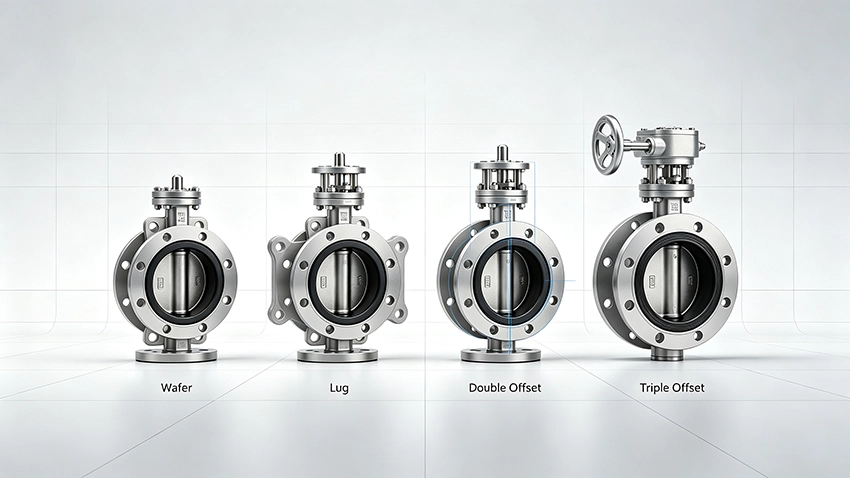
Four types of butterfly valve comparison
Quid est Papilio Valve??
A butterfly valve is a quarter-turn rotary valve that uses a rotating disc to regulate, recludet, or throttle fluid flow within a piping system. When the disc is parallel to the flow, the valve is fully open; when turned perpendicular, it blocks the passage and stops flow. The quarter-turn operation (90 degrees from fully open to fully closed) makes butterfly valves ideal for applications requiring quick shut-off and compact installation.
Before diving into specific types, it is essential to understand the three key factors that drive butterfly valve selection:
- Connection Type — How the valve is installed in the pipeline (wafer, lug, or flanged)
- Offset Design — The disc and seat geometry (concentric/zero offset, double offset, or triple offset)
- Sedes Material — The sealing material (soft seal or metal seal)
Connection Type: Wafer vs Lug vs Flanged
Butterfly valves are available in three primary body configurations for installation between flanges: wafer type, lug type, etflanged type. The choice between them depends on whether the valve must support dead-end (one-sided) service, how often the downstream piping will be disconnected, and the project’s cost constraints.
Wafer Papilio Valve
A laganum papilio valvae is the most compact and cost-effective design. It is sandwiched between two flanges using long through-bolts that pass through the entire valve body and flanges. The body has no bolt holes of its own and relies entirely on the flanges for support. Wafer valves are lighter, cheaper, and ideal for low-to-medium pressure applications.
Key Considerationes:
- ✅ Lightweight and economical
- ✅ Ideal for low-to-medium pressure applications
- ❌ Cannot isolate one side of the pipeline
- ❌ Removal requires shutting down the entire system
- ❌ Cannot support pipeline weight
optimus For: aqua distributio, HVAC systemata, irrigation pipelines, permanent inline isolation
Lug Papilio Valve
A lug papilio valvae features threaded inserts (lugs) on the valve body, allowing it to be bolted directly to flanges on either side without through-bolts passing through the entire assembly. Hoc consilio dat dead-end service — the downstream flange can be removed while the valve holds pressure on the upstream side. Lug valves are somewhat more forgiving during installation because each flange bolts independently.
Key Considerationes:
- ✅ Supports single-side isolation
- ✅ Easier maintenance — downstream piping can be removed independently
- ✅ Supports pipeline weight
- ❌ 20-40% more expensive than wafer
- ❌ Heavier than wafer type
optimus For: Mortuus finem muneris, process piping, chemica plantae, applications requiring regular maintenance
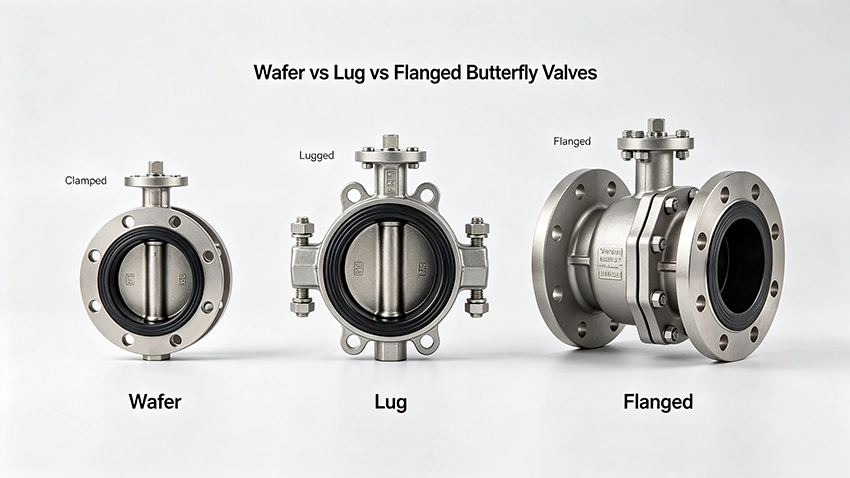
Wafer vs lug vs flanged butterfly valve body configuration comparison
Flanged Gloria Valve
A flanged papilio valvae has integral flanges on the valve body that bolt directly to pipe flanges using standard flange gaskets and bolts. This is the strongest and most robust design, ideal for large-diameter pipelines, high-pressure applications, and systems where the valve must support heavy piping. Flanged valves provide the most secure connection and are easiest to align and install.
Key Considerationes:
- ✅ Strongest and most durable connection
- ✅ Easy to align, install, and maintain
- ✅ Ideal for high-pressure systems
- ✅ Supports heavy piping
- ❌ Heavier and more expensive
- ❌ Larger face-to-face dimensions
- ❌ Most expensive of the three types
optimus For: Municipal water and wastewater, oleum & Gas transmissio, high-performance industrial systems, large-diameter pipelines, high-pressure applications
Connection Type Comparison Table
| Feature | Wafer | Lug | Flanged |
| Institutionem | Sandwiched between flanges | Bolted independently | Bolted directly to pipe flanges |
| Pipe Isolation | No | Ita (one side) | Ita (both sides) |
| Dead-End Service | No | Ita | Ita |
| Pipeline Support | No | Limited | Ita |
| Pressura Rating | Low–Medium | Medium–High | Summus |
| Pretium | Lowest | Medium | altissimum |
| Face-to-Face Length | Shortest | Short | Longest |
| Communia Amplitudo | DN50-DN600 / 2-24″ | DN50–DN900 / 2″-36″ | DN80–DN2000+ / 3″-80″+ |
| Best Application | HVAC, aqua distribution | Process piping, chemica plantae | Aquae municipales, oleum & gas / |
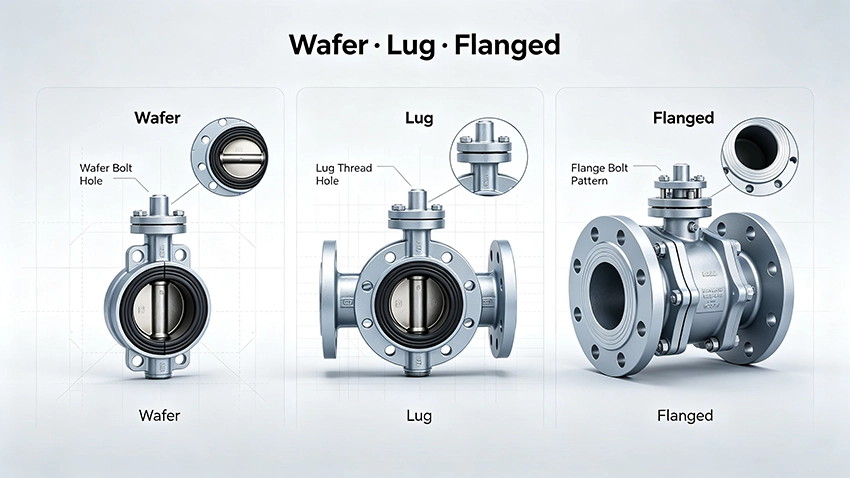
Wafer vs lug vs flanged butterfly valve body configuration comparison
Offset Design: Concentric vs Double Offset vs Triple Offset
Concentric (Zero Offset) Papilio Valve
Aconcentric butterfly valve (also called zero offset) has the stem centered on the disc and the disc centered in the pipe bore. The disc contacts the seat throughout the entire rotation, creating friction and wear. These valves typically use soft rubber seats and are limited to low-pressure applications up to 200 PSI.
optimus For: Low-pressure water, air, and mild chemical applications
Double Offset Butterfly Valve
A double offset butterfly valve features two distinct offsets: the shaft center is offset from the disc sealing surface, and the shaft center is offset from the valve body centerline. This design ensures the disc separates from the seat immediately upon opening and engages only at the final moment of closing — significantly reducing friction and wear. Double offset valves can withstand pressures up to 1440 PSI and extreme temperatures up to 650°C.
Key Characteres:
- ✅ Reduced friction and wear
- ✅ Medium-to-high pressure capability
- ✅ Wide temperature range
- ✅ Available with soft or metal seats
- ❌ Higher cost than concentric designs
optimus For: HVAC, potentia generation, eget processus, steam service, high-temperature applications
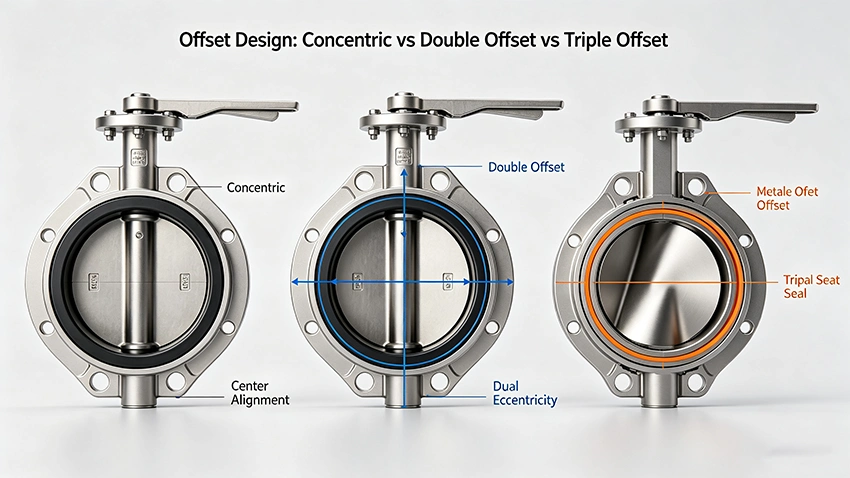
Concentric vs Double Offset vs Triple Offset comparison
Triple Offset Butterfly Valve
A triple offset butterfly valve includes the same two offsets as the double offset valve — but adds a third one: the sealing surface is angled in a conical shape, and the disc edge matches this profile. This design enables true metal-to-metal sealing with frictionless operation. Triple offset valves have replaced gate valves and plug valves in many high-temperature and high-pressure applications because they are lighter, more compact, and require lower actuator torque.
Key Characteres:
- ✅ True metal-to-metal sealing
- ✅ Frictionless operation
- ✅ Ultra-tight shut-off
- ✅ Highest pressure and temperature capability
- ✅ Longest service life
- ❌ Highest cost
- ❌ Most complex design
optimus For: High-temperature steam, cryogenic services, gravi servitio, oleum & gas, high-pressure applications
Offset Design Comparison Table
| Feature | Concentric | Double Offset | Triple Offset |
| Friction | Summus | low | Nullus |
| Pressure capability | low (~200 PSI) | Medium-High (1440 PSI) | altissimum (Classis 600+) |
| Temperatus range | low | Wide (up to 650°C) | Extreme (-196°C to 800°C) |
| Seal type | Soft seal only | Soft or metal | Metal only |
| ultrices | Zero (soft seal) | Zero (soft) / low (metallicum) | Ultra-tight (metallicum) |
| Pretium | Lowest | Medium | altissimum |
| Sustentationem frequency | Medium | Medium | inferiora |
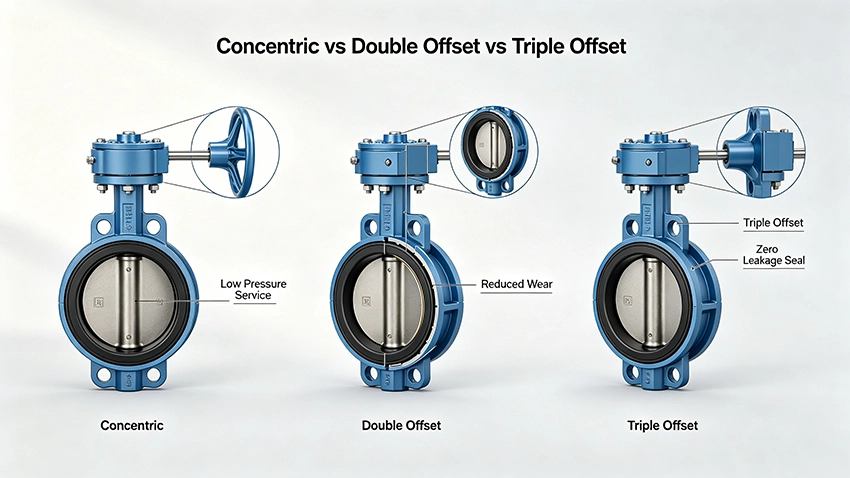
Concentric vs Double Offset vs Triple Offset comparison
Sedes Material: Soft Seal vs Metal Seated
The seat material determines the valve’s sealing performance, temperatus range, and media compatibility.
Soft Seal Butterfly Valve
A soft seal butterfly valve uses elastic non-metallic materials such as EPDM, NBR, PTFE, or Viton for the seat. Soft seals provide nulla ultrices (bubble-tight) shut-off at lower cost, making them ideal for clean media applications.
Key Characteres:
- ✅Nulla ultrices (Class VI)
- ✅ Lower cost
- ✅ Easier seat replacement
- ❌ Limited temperature range (-50°C to 200°C)
- ❌ Not suitable for high temperatures or abrasive media
- ❌ Shorter service life in demanding conditions
optimus For: Aquae, wastewater, air, mitis chemicals, HVAC, low-temperature applications
Metal Seated Butterfly Valve
A metal seated butterfly valve uses metal-to-metal sealing surfaces (typically 13Cr or Stellite hardfaced). Metal seals are designed for extreme temperatures from -196°C to 600°C+ and provide superior resistance to particles, erosion, and wear. While they may have slightly higher leakage rates than soft seals (10⁻³ mbar·L/s), they offer unmatched durability in severe service conditions.
Key Characteres:
- ✅ Extreme temperature capability
- ✅ Excellent wear and erosion resistance
- ✅ Long service life
- ❌ Higher cost
- ❌ Higher repair costs
- ❌ Slightly higher leakage than soft seals
optimus For: High-temperature steam, cryogenic services, abrasive media, oleum & gas, potentia generation
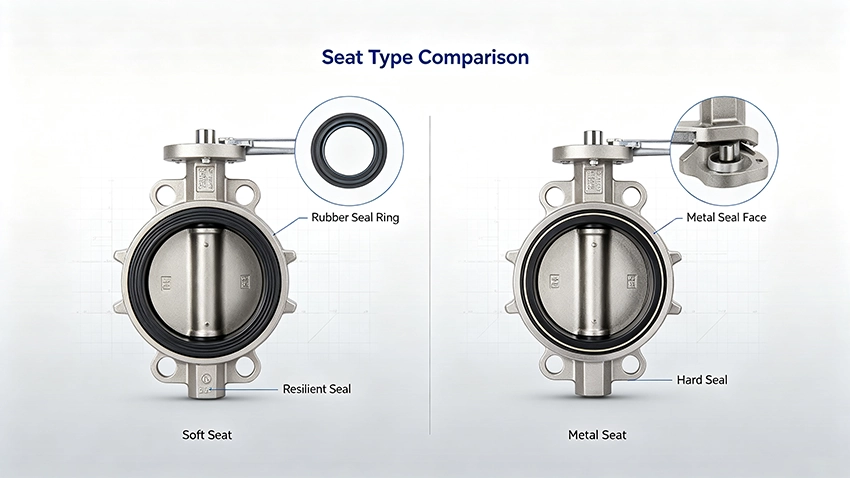
Soft seal vs metal seated butterfly valve seat comparison
Step-by-Step Butterfly Valve Selection Guide
Gradus 1: Define Your System Requirements
| Parameter | Question | Your Answer |
| Pressura | What is the maximum operating pressure? | ___ |
| Temperature | What is the minimum and maximum temperature? | ___ |
| Media | What fluid is being controlled? Is it corrosive or abrasive? | ___ |
| Institutionem | Horizontalis vel verticalis? Space constraints? | ___ |
| Tutela | Will downstream piping need to be disconnected regularly? | ___ |
| Control | On/off or modulating control? Manual or automated? | ___ |
Gradus 2: Select the Connection Type
| If You Need… | Choose… |
| Low-cost, permanent installation, no need for single-side isolation | Wafer butterfly valve |
| Mortuus finem muneris, regular maintenance, single-side isolation | Lug butterfly valve |
| Highest strength, large diameters, high-pressure systems | Flanged butterfly valve |
Gradus 3: Select the Offset Design
| If Your System Is… | Choose… |
| Humilis pressura, clean media, standard temperature | Concentric (zero offset) papilio valvae |
| Medium-high pressure, wide temperature range, some control required | Double offset butterfly valve |
| Princeps pressura, high temperature, gravi servitio, zero leakage required | Triple offset butterfly valve |
Gradus 4: Select the Seat Material
| If Your Media Is… | Choose… |
| Clean water, air, mitis chemicals, standard temperature | Soft seal (EPDM/NBR/PTFE) |
| High-temperature steam, abrasive media, extreme conditions | Metal seated |

Soft seal vs metal seated butterfly valve seat comparison
Application-Specific Recommendations
| Applicationem | Recommended Valve | Quid? |
| Aquae & Wastewater Curatio | Wafer or Lug + Sigillum mollis | Sumptus efficens, nulla ultrices, corrosio repugnans |
| HVAC Systems | Wafer + EPDM Sedes | Compact, humilis sumptus, handles chilled/hot water |
| Processing chemica | Lug + PTFE Seat or Metal Seated | Resistentia chemica, maintenance flexibility |
| Oleum & Gas Pipelines | Triple Offset + Metallum Sedet | Princeps pressura, high temperature, nulla ultrices |
| Potentia Generationis | Double Offset or Triple Offset + Metallum Sedet | High temperature, steam service, vita longa |
| Food & Beverage | Lug + PTFE Seat | Sanitary, corrosio repugnans, easy maintenance |
FAQ
1. What is the most overlooked parameter in butterfly valve selection?
Flow velocity. Many engineers focus only on pressure and temperature while ignoring pipe flow velocity. Excessive velocity causes vibration and noise, accelerating seat wear, while too-low velocity prevents full disc opening, causing chattering. Rule of thumb: keep velocity below 10 fps (3 m/s*), cum 7 fps (2.1 m/s*) as a safer target.
2. Should I oversize or undersize the valve?
Neither. Oversizing prevents full disc opening, causing chattering and premature failure. Undersizing creates excessive pressure drop and wastes pumping energy. The correct approach is sizing based on actual flow conditions, not just pipe size. Consult the manufacturer’s flow coefficient (Cv) tables to match actual flow requirements.
3. When can a lug butterfly valve replace a flanged butterfly valve?
A lug valve can replace a flanged valve when: working pressure ≤150LB (Classis 150), pipe size ≤24 inches, dead-end service is required, and budget is limited. For high-pressure (≥Class 300) or large-diameter (≥36 inches) applications, flanged valves remain the safer choice.
4. Which direction should the disc face when installing a butterfly valve?
Butterfly valves can be installed at any angle, but industry best practice is horizontal disc shaft installation (shaft horizontal, disc hanging vertically when open). This reduces particle deposition in the stem bearings, extending service life. Vertical installation (shaft vertical) positions the disc horizontally, making it more prone to debris accumulation.
5. How do I know when the valve seat needs replacement?
Three signs: Primum, visible leakage after closure (soft seat with continuous dripping). Secundus, significantly increased operating torque (seat aging and sticking). tertia, abnormal noise or vibration during closure (seat deformation causing uneven sealing). Regular inspection is recommended — EPDM seats typically last 5-8 years in water applications; PTFE seats last approximately 3-5 years in chemical applications, depending on media corrosiveness.

Butterfly valve installed on industrial pipeline system
Quid elige nostrum Gloria Valvulae?
At Luoyang Datang Energy Tech Co., Ltd, we supply a comprehensive range of butterfly valves for industrial applications. Our product portfolio includes:
- ✅Wafer Butterfly Valves — Compact, cost-effective, DN50-DN600
- ✅Lug Butterfly Valves — Dead-end service capable, DN50-DN600
- ✅Double Offset Butterfly Valves — Metal seated, high temperature, 2″-80″
- ✅Soft Seal Butterfly Valves — EPDM/PTFE seats, nulla ultrices
- ✅Metal Seated Butterfly Valves — 13Cr/Stellite hardfaced, extreme temperature
- ✅Multiple materials — Cast iron, ductile ferrum, immaculatam ferro, PVC
- ✅100% factory tested — Guaranteed quality and reliability
- ✅Competitive pricing — Factory-direct supply with OEM/ODM support
Contact us hodie for expert butterfly valve selection advice, Product specifications, and competitive quotes.
AGNATUS POSTS
Quomodo figere fractus latrina aqua Supple Pipe Trailer?
2 Via Motorised Ball Valvae vs. Solenoid Valvae: Quod vincit in Automated Limbis Systems?
Princeps Gradus Industrial HDPE Pipes Applications

PVC Underground INCILE Pipe: Beneficia, Applications & Institutionem
PPR Pipeline Application For Construction and Industrial System