LUOYANG HAERE ENERGY TECH CO.,LTD


He Aratohu Whiriwhiri Waa Purerehua mo te Wai Ahumahi & Nga punaha HVAC
I roto i te maimoatanga wai ahumahi me nga punaha HVAC, Ko te whakahaere rere ehara i te mea whiriwhiri—he mea nui. Ahakoa kei te whakahaere koe i tetahi whare rongoa wai a te taone nui, he whatunga whakamatao rohe, or a commercial building’s chilled water system, the ability to regulate, isolate, and throttle fluid flow directly impacts system efficiency, energy consumption, and operational reliability. Among the many valve types available, tebutterfly valve stands out as one of the most versatile and cost-effective solutions for industrial flow control.
But with so many options—wafer, lug, flanged, manual, electric, pneumatic—how do you choose the rightindustrial butterfly valve for your specific application? This guide provides a practical, step-by-step framework for selecting butterfly valves for water treatment and HVAC systems.
What Is a Butterfly Valve?
A butterfly valve is a quarter-turn rotational valve used to regulate or isolate flow in a pipeline.
It is widely used in:
- Water treatment systems
- HVAC pipelines
- Industrial automation systems
- Chemical and process industries
I roto industrial water treatment a Nga punaha HVAC, butterfly valves are indispensable because they offer:
- Low pressure drop when fully open
- Quick operation (quarter-turn = full open/close)
- Hoahoa mama compared to gate or globe valves
- Excellent throttling capability for flow modulation
- Lower installation cost due to compact face-to-face dimensions
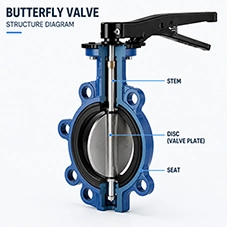
wafer butterfly valve industrial flow control DN100 cast iron
Working Principle of Butterfly Valve
The valve uses a rotating disc mounted on a shaft. When the disc rotates, it controls flow by opening or blocking the pipeline.
✔ 90° rotation = Full open / close
✔ Partial rotation = Flow regulation
Types of Butterfly Valves for Water & HVAC Applications
Wafer Butterfly Valve
Ko te wafer butterfly valve is the most economical and widely used type. It is designed to fit between two pipe flanges using long bolts that pass through the valve body and both flanges. Key characteristics:
| Āhuahira | Whakatakotoranga |
| Tāutatanga | Between two flanges, no separate bolting |
| Taumaha | Lightest among all types |
| Utu | Most cost-effective |
| Whakatauranga pehanga | Typically PN10/PN16 (up to PN25) |
| Size range | DN40 – DN1200 |
| Te mea pai mo | HVAC, water distribution, general industrial |
Nga herenga: Cannot be used as an end-of-line valve; both sides must be flanged.

wafer butterfly valve DN200 PN16 EPDM seat hand lever industrial
Rererere Rerehua Lug
Ko te lug butterfly valve features threaded lugs (ears) around the body perimeter, allowing each side to be bolted independently. This design enables:
- Dead-end service — one side can be disconnected while the other remains pressurized
- Easy maintenance — no need to drain the entire system
- Higher structural integrity for critical applications
| Āhuahira | Whakatakotoranga |
| Tāutatanga | Independent bolting on each side |
| Taumaha | Whakaōrite (heavier than wafer) |
| Utu | 15–25% higher than wafer type |
| Whakatauranga pehanga | PN10/PN16/PN25, ANSI 150/300 |
| Size range | DN50 – DN600 |
| Te mea pai mo | Water treatment, pump isolation, end-of-line |
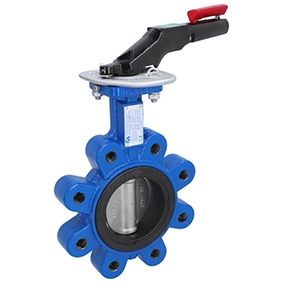
lug butterfly valve DN100 CF8M stainless steel PN16 industrial
Takirere Pūrerehua Flanged
Ko te flanged butterfly valve comes with integral flanges that bolt directly to mating flanges on the pipeline. This type is preferred for:
- High-pressure applications (PN25, PN40, ANSI 300+)
- Nga paipa nui-diamita (DN300 – DN3000+)
- Critical isolation where zero leakage is required
- Double/triple eccentric designs for metal-to-metal sealing
| Āhuahira | Whakatakotoranga |
| Tāutatanga | Direct bolt-on to pipe flanges |
| Taumaha | Heaviest |
| Utu | Te teitei |
| Whakatauranga pehanga | PN10–PN40, ANSI 150–600 |
| Size range | DN80 – DN3000+ |
| Te mea pai mo | Power plants, matū, large HVAC |

flanged butterfly valve double eccentric industrial water flow control DN500
Rererere Rerehua Hiko
He electric butterfly valve integrates an electric actuator with the valve body, enabling remote and automated operation. It is the preferred choice for:
HVAC building automation systems (BAS/BMS integration)
Water treatment plants requiring SCADA control
Processes with frequent cycling or precise positioning needs
| Momo Whakaoho | Taupānga |
| On/Off (2-position) | Simple open/close, isolation |
| Whakatauira (4-20mA) | Precise flow control, throttling |
| Smart/Bus (Modbus/Profibus) | Full automation, feedback |
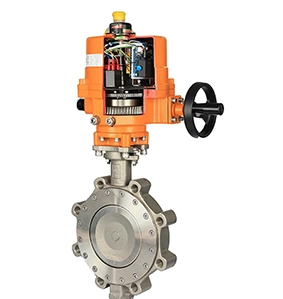
electric butterfly valve actuator HVAC system temperature control automation
How to Select the Right Butterfly Valve for Your Application
Hipanga 1 — Define Your Application Requirements
Before selecting a butterfly valve for HVAC system ranei butterfly valve for water treatment, answer these critical questions:
- What is the fluid medium? — Water, wai para, matū, mamaoa?
- What is the operating pressure and temperature? — This determines body material and seat type
- What is the required flow characteristic? — On/off, throttling, or precise modulation?
- What is the pipe size? — Common sizes: DN50, DN100, DN150, DN200, DN300
- Is automation required? — Manual, pneumatic, ranei electric actuator butterfly valve system?
Hipanga 2 — Choose the Right Body & Rauemi Kōpae
| Rauemi | Taupānga | Nga painga |
| Maka rino (GG25) | Wai, HVAC, low-pressure | Utu-whai hua, easy to machine |
| Te rino ductile (GGG40) | Higher pressure water | Better strength, parenga paanga |
| Waro maitai (WCB) | Maamaa, hinuhinu, hau | High temperature/pressure rated |
| Kowiri tira (CF8/CF8M) | Corrosive media, food/pharma | Corrosion resistant, hygienic |
| Aluminum Bronze | Wai moana, moana | He pai te aukati waikura |
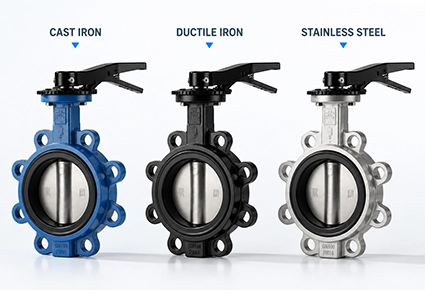
Cast iron ductile iron stainless steel butterfly valve material comparison
Hipanga 3 — Select the Seat Material
The seat material is critical for sealing performance and service life:
| Seat Material | Awhe Pawera | Pai Mo | Nga herenga |
| EPDM | -40°C to +120°C | Wai, HVAC, ozone | Not for oils/greases |
| NBR (Nitrile) | -30°C ki +100°C | Oils, wahie, mild chemicals | Poor ozone resistance |
| PTFE (Teflon) | -40°C ki +200°C | Matū, kai, rongoā | Lower mechanical strength |
| Viton (FKM) | -20°C ki +200°C | Hydrocarbons, high temp | Higher cost |
| Te whakarewa (SS/Ti) | Up to +600°C | Maamaa, high temp, severe service | Higher torque, utu |
Hipanga 4 — Determine Connection Type & Size
Mo industrial pipeline valve solutions, the connection type must match your piping standard:
| Hononga | Paerewa | Common Sizes |
| Wafer | ISO 5752, API 609 | DN50–DN1200 |
| Rug | ISO 5752, MSS SP-67 | DN50–DN600 |
| Karekau | IN 1092-1, ASME B16.5 | DN80–DN3000+ |
Size selection tip: For water and HVAC, size the valve to match the pipe ID. Oversizing causes poor throttling; undersizing creates excessive pressure drop.

butterfly valve for water treatment wastewater pipeline industrial flow control
Butterfly Valve Nga tono in Water Treatment & HVAC
Water Treatment Plants
I roto maimoatanga wai facilities, butterfly valves are used for:
- Raw water intake — Large-diameter flanged butterfly valves (DN500–DN2000)
- Chemical dosing lines — DN50 DN100 butterfly valves with PTFE seats
- Sludge handling — Lug butterfly valves for easy maintenance isolation
- Filtration systems — Electric butterfly valves for automated backwash cycles
- Discharge control — High-performance double-eccentric valves
Nga punaha HVAC
Mo butterfly valve for HVAC system tono:
- Chilled water loops — Wafer butterfly valves with EPDM seats (DN100–DN400)
- Hot water distribution — Lug butterfly valves for pump isolation
- Cooling towers — Electric actuator butterfly valve systems for BAS integration
- Air handling units (AHU) — Compact wafer valves for space-constrained installations
- Heat exchangers — High-performance valves with precise modulating actuators
Common Mistakes in Butterfly Valve Selection
| Pohehe | Why It’s Wrong | Correct Approach |
| Ignoring cavitation risk | Damages disc and seat | Size properly, use anti-cavitation trim |
| Wrong seat for media | Premature failure, turuturu | Match seat material to fluid compatibility |
| Undersizing actuator | Valve won’t fully close | Calculate torque including safety factor |
| Forgetting about end-of-line | Wafer valve cannot isolate | Whakamahi lug butterfly valve for dead-end |
| Neglecting insulation | Condensation, waikura | Specify extended neck for insulation |
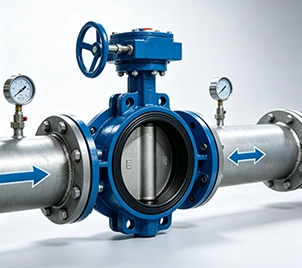
butterfly valve for water treatment wastewater pipeline industrial flow control
Pātai Auau
Q1: What is the difference between wafer and lug butterfly valves?
A: Wafer valves are sandwiched between flanges with through-bolts passing through the entire assembly. They cannot isolate flow from one side. Lug valves have threaded inserts that allow each flange to bolt independently, enabling dead-end service (one-side isolation).
Q2: Which butterfly valve is best for HVAC chilled water systems?
A: For most HVAC chilled water applications, awafer-type concentric butterfly valve with anEPDM seat is the most cost-effective and reliable choice. For automated control, pair it with anelectric actuator with 4-20mA or 0-10V modulating control.
Q3: Can butterfly valves be used for throttling (whakaritenga rere) mana whakahaere?
A: Ae. Butterfly valves offer excellent control and throttling range for pipes larger than 2.5″ (6.4 cm). All butterfly valves exhibit equal percentage characteristics from 0° to 60° rotation. For precise flow modulation, double-offset or triple-offset designs are preferred.
Q4: What pressure rating do I need for water treatment applications?
A: Municipal water systems typically use PN10 or PN16 (10-16 pae / 145-232 PSI). Industrial applications or high-rise buildings may require PN25 or higher. Always select a valve that meets or exceeds your system’s maximum working pressure.
Q5: What standards should a quality industrial butterfly valve comply with?
A: Quality butterfly valves should comply withAPI 609 (design and testing for butterfly valves), ISO 5752 (face-to-face dimensions), ISO 5211 (actuator mounting), aAPI 607 (fire-safe testing). Look for suppliers withISO 9001 certification and CE/PED compliance.
Why Choose Our Butterfly Valves?
ILuoyang Datang Energy Tech Co., Ltd. , we are a professionalbutterfly valve supplier dedicated to providing reliableindustrial flow control valve solutions for water treatment, HVAC, tiaki ahi, me nga punaha paipa ahumahi puta noa i te ao. Our butterfly valves are manufactured to international standards with certifications including UL/FM, CE, me te ISO 9001.
Our Product Advantages:
✔ Stable sealing performance
✔ Wide size range availability
✔ OEM & ODM customization
✔ Compatible with electric actuators
✔ Strict quality inspection before shipment
Whakapā mai to get a quote now!
NGA WHAKAPUTANGA
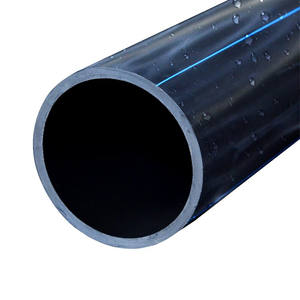
Nga tono paipa HDPE Ahumahi Ahumahi Nui

Te Maramatanga ki nga Waapa Parahi: Momo, Ngā āhuatanga, me nga tono
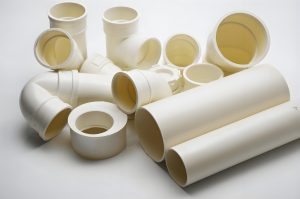
He Mahi Nui nga Paipa PVC ki te Whakapaipa, Whakaheke wai & Te maimoatanga parakaingaki.

HDPE Pipe Pressure Whakatauranga Aratohu: Me pehea te whiriwhiri PN10, PN12.5, me nga Paipa PN16
PPR Pipes vs Cast Iron Pipes: Whakataurite me te Tātari