LUOYANG VEIO ENERGY TECH CO., LTD

O que é melhor?Tubos HDPE vs tubos PE.
No campo da engenharia de tubos, polietileno (Educação Física) O tubo tornou-se uma alternativa ideal ao tubo de metal tradicional devido às suas características como leveza, resistência à corrosão e longa vida. No entanto, muitos usuários costumam ficar confusos sobre a diferença entre “Tubo HDPE” e “Tubo PE” na hora de escolher e comprar. Na verdade, PEAD (polietileno de alta densidade) é um importante ramo da educação física, e os dois têm pontos em comum e diferenças.
HDPE vs PE: Quick Answer
HDPE is not a separate material from PE. It is a type of PE. The useful comparison is HDPE vs ordinary PE, such as LDPE and MDPE.
- Choose PEAD for high pressure, buried water mains, linhas de gás, dutos industriais, mineração, and long-life projects.
- Choose ordinary PE for low-pressure irrigation, cable protection, and budget jobs where pressure and temperature are not demanding.
If pressure, força, and service life matter, HDPE is usually the better choice. If the job is low-pressure and cost-sensitive, ordinary PE can be enough.
| Recurso | PEAD | Ordinary PE (LDPE/MDPE) |
|---|---|---|
| Densidade | 0.941–0.965 g/cm³ | 0.910–0.940 g/cm³ |
| Pressure grade | PN10–PN25 | PN6–PN16 |
| Working temperature | -60°C to 60°C, short-term 80°C | Usually up to 40°C |
| Stress cracking resistance | Excelente | Moderado |
| Design life | 50+ anos | About 30 anos |
| Typical use | Water mains, gás, industrial, mineração | Irrigação, cable protection, low-pressure water |
| Upfront cost | Mais alto | Mais baixo |
Primeiro, PEAD e PE: a natureza material da diferença
1. Classificação familiar do polietileno (Educação Física)
Polietileno (Educação Física) é um termoplástico polimerizado a partir de etileno, que é dividido principalmente em três categorias de acordo com a densidade e estrutura da cadeia molecular:
- Polietileno de baixa densidade (PEBD) : forte flexibilidade, mas fraca resistência à pressão, mais utilizado em filmes para embalagens.
- Polietileno de média densidade (PEMD) : equilibra flexibilidade e rigidez, e é frequentemente usado em gasodutos.
- Polietileno de alta densidade (PEAD) : Estrutura de cadeia molecular compacta, alta densidade, com excelentes propriedades de compressão e resistência química.
2. The particularity of HDPE pipe and fitting
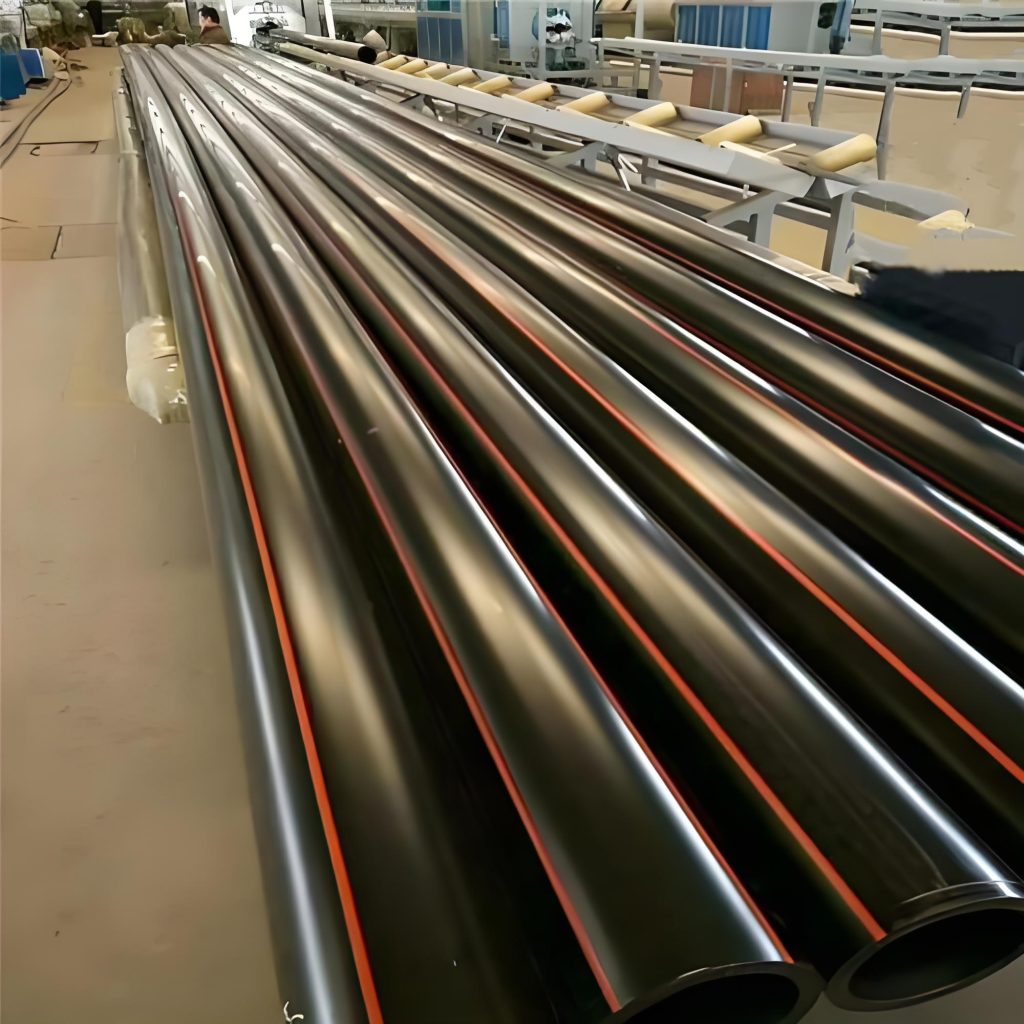
O gasoduto HDPE pertence à categoria high-end de gasoduto PE. Através de processo especial de polimerização e tecnologia de aditivos, é significativamente melhor do que o gasoduto PE comum em resistência, resistência à temperatura e resistência à fissuração por tensão ambiental. Resumidamente, HDPE é uma versão atualizada do PE, projetado para condições de trabalho severas.
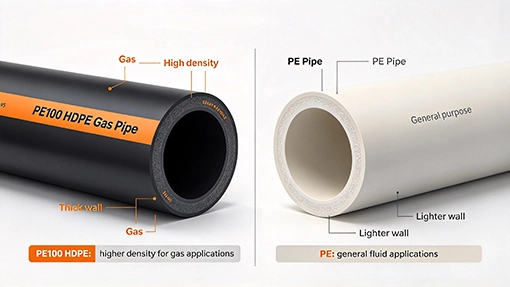
PE100 HDPE gas pipe and PE pipe comparison
PE80 versus PE100: Qual é a diferença?
PE80 and PE100 are grades of polyethylene resin. PE100 has higher minimum required strength and better resistance to slow crack growth. Most HDPE water and gas pipes today use PE100 resin. PE80 is older and still used in some low-pressure or repair applications.
When a supplier says “PE100 HDPE pipe,” it means the pipe is made from high-density polyethylene using PE100 grade material. It is not a different type of plastic from HDPE.
Segundo, comparação de desempenho: a principal diferença entre HDPE e tubos PE comuns
1. Resistência à compressão e resistência ao impacto
- Tubo HDPE: densidade até 0.941-0.965 g/cm³, alta cristalização de cadeia molecular, a resistência à compressão pode atingir mais de 2 tempos de PE comum, pode suportar maior pressão (grau de pressão comum PN10-PN25).
- Tubos PE comuns (como MDPE) : menor densidade (0.926-0.940 g/cm³), fraca resistência à compressão, usually used in low-pressure scenarios (such as PN6-PN16).
2. Resistência à temperatura
- HDPE pipeline: wide operating temperature range (-60 °C a 60 °C), short-term can withstand 80 ° C high temperature, suitable for areas with large temperature difference.
- Ordinary PE pipe: the upper limit of temperature resistance is low (usually not more than 40 °C), and long-term high temperature is easy to cause deformation.
3. Resistência à corrosão química
Both of them have good corrosion resistance to acid, alkali, salt and other media, but the molecular structure of HDPE is denser, can resist the erosion of strong oxidants (such as concentrated sulfuric acid) e solventes orgânicos, suitable for chemical industry, sewage treatment and other corrosive environment.
4. Resistance to environmental stress cracking (ESCR)
HDPE by optimizing the molecular chain arrangement and adding anti-cracking agents, its ESCR performance is far superior to ordinary PE, and it is more difficult to break when buried for a long time or squeezed by external force.
5. Life and maintenance cost
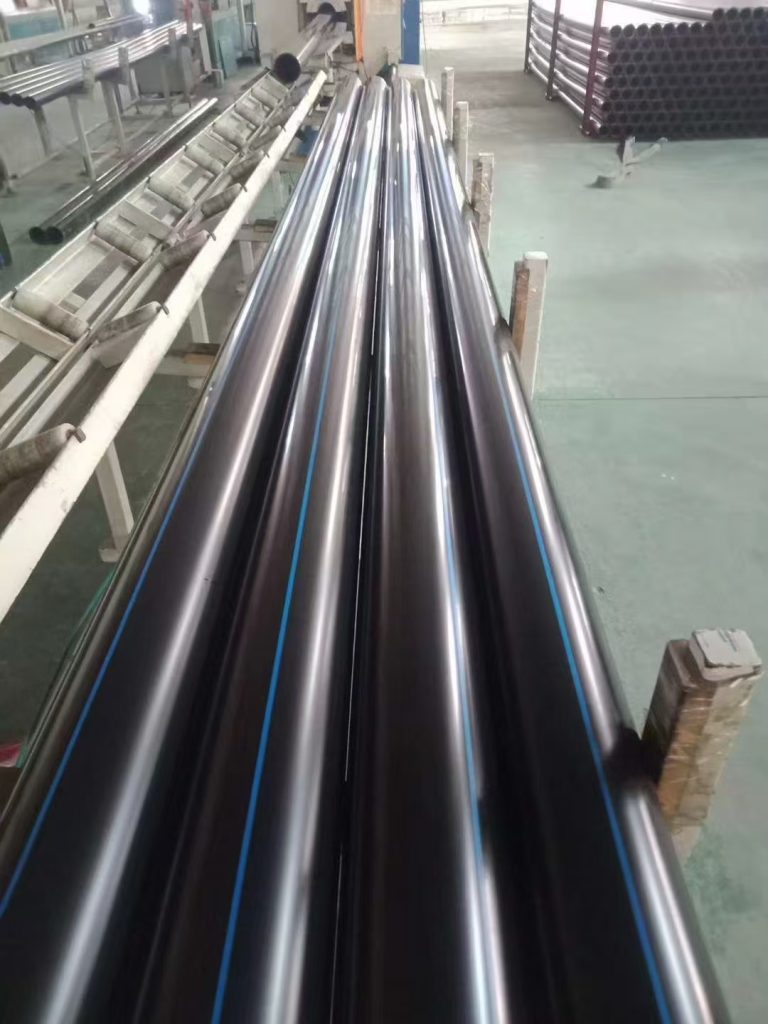
Tubo HDPE design life can reach mais do que 50 anos, e no anti-corrosion coating;
The life of ordinary PE pipes é sobre 30 anos, and regular maintenance is required in high pressure or corrosive environments.
Terceiro, Cenário de aplicação: HDPE pipe and PE pipe application field
1. The core advantage scenario of HDPE pipe e adequado
- Municipal water supply and drainage system: resistant to high pressure and ground settlement, suitable for long-distance water transmission.
- Industrial pipeline: plantas químicas, sewage treatment plants for corrosive media transport.
- Transmissão de gás: high-density structure effectively prevents gas penetration, higher safety.
- Marine engineering: resistant to salt spray corrosion, used in seawater desalination or submarine pipelines.
2. Economic application scenario of ordinary PE pipe e adequado
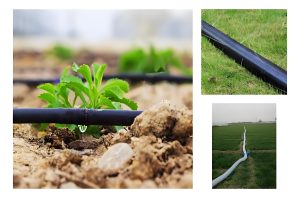
- Irrigação agrícola: low-pressure water transmission, low cost and easy to install.
- Abastecimento doméstico de água: hot and cold water pipes (need to choose a temperature resistant model).
- Cable protection sleeve: good flexibility, suitable for non-pressurized environment.
Quarto, installation and construction: the difference point of two kinds of pipelines
1. Método de conexão
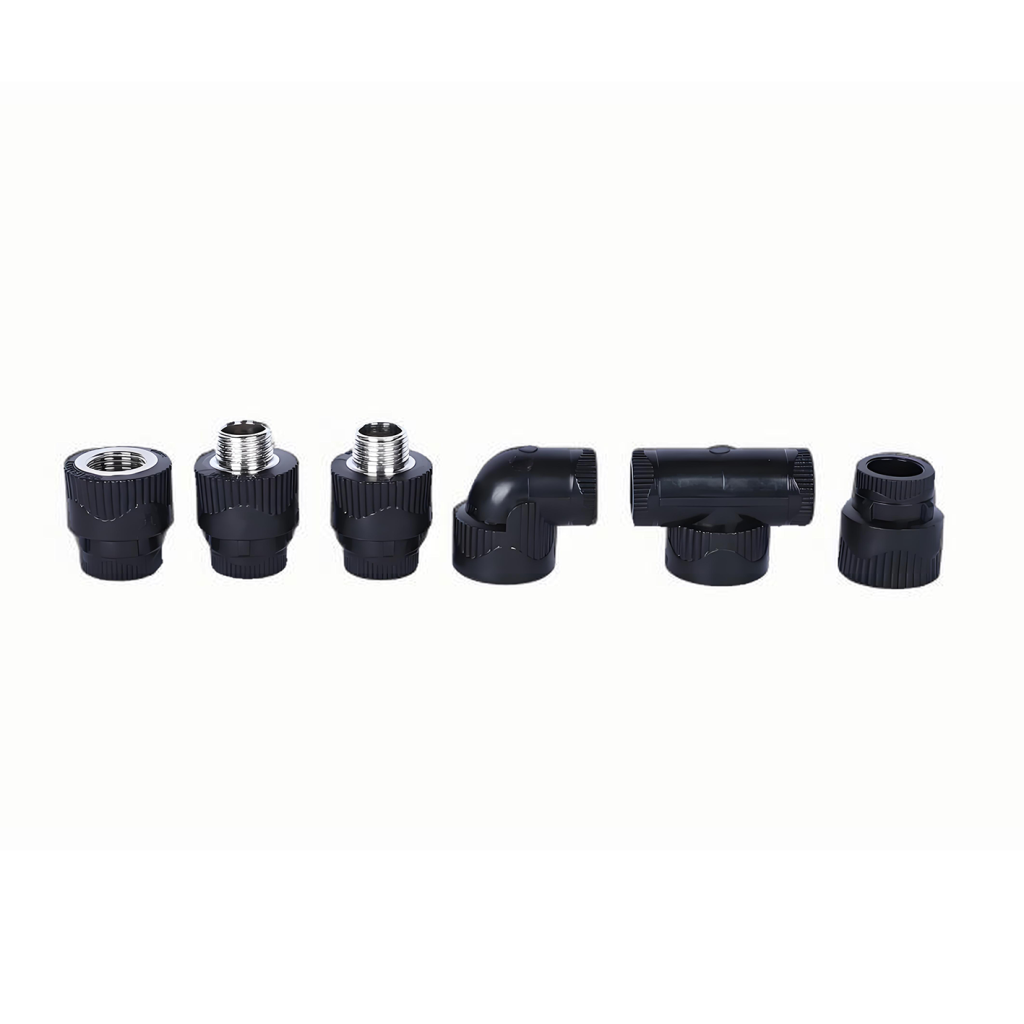
- HDPE pipeline: The use of hot melt butt or electric fusion connection, the interface strength can reach more than 90% of the pipe body, to ensure zero leakage.
- Ordinary PE pipeline: some low-pressure models can be mechanically connected, but the sealing is slightly worse than the hot melt process.
2. Flexibility and laying efficiency
- Tubo HDPE: high stiffness, long distance laying needs more support, but can be adapted to trenchless construction (such as pipe jacking).
- Ordinary PE pipe: better flexibility, suitable for difficult terrain areas, but limited pressure resistance.
Quinto, cost analysis: one-time investment vs long-term value
- Initial cost: HDPE pipe price is 20%-30% higher than ordinary PE, mainly from raw materials and production process costs.
- Long-term benefits: HDPE has a long life, low maintenance costs and higher comprehensive cost efficiency. Based on a 50-year cycle, the total cost of HDPE is more than 40% lower than that of PE.
Sixth,Comparison of environmental protection
Both are recyclable materials, but the recycling rate of HDPE is higher (até 95%), and the carbon emission in the production process is 50% inferior ao dos tubos metálicos, in line with the green building trend.
Seven, how to choose? Key decision factors
- 1. Working condition requirements: alta pressão, high temperature or strong corrosion environment must choose HDPE;
- 2. Budget constraints: short-term projects or low-voltage scenarios can consider ordinary PE;
- 3. Life expectancy: long cycle projects prioritize HDPE to reduce the total cost.
HDPE and ordinary PE pipes have their own advantages, and the core of choice is to accurately match the engineering needs. As a professional pipe manufacturer, nós oferecemos a full range of PE/HDPE pipe solutions.
Common Buying Mistakes
- Treating HDPE and PE as two completely different materials. HDPE is a type of PE.
- Choosing by price only. Check pressure rating, DES, and application first.
- Using ordinary PE for high-pressure water mains.
- Ignoring the resin grade. PE100 is not the same as PE80.
- Confusing SDR with pressure class. Lower SDR means thicker wall and higher pressure.
- Forgetting that wall thickness changes the inside diameter.
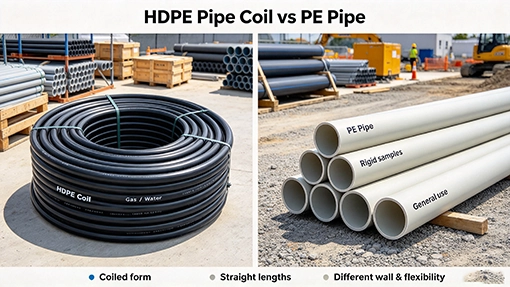
HDPE pipe and PE pipe comparison for water supply and gas transmission.
HDPE vs PE Pipe FAQ
P: Is HDPE the same as PE?
HDPE is a type of PE. PE also includes LDPE and MDPE. HDPE has a denser molecular structure, higher strength, and better pressure resistance.
P: O que é melhor, HDPE or PE pipe?
It depends on the job. HDPE is better for high pressure, gás, rede de água, industrial use, e longa vida útil. Ordinary PE is often enough for low-pressure irrigation and cable protection.
P: What is the difference between PE80 and PE100?
PE100 is a higher-grade polyethylene resin. It offers higher strength and better resistance to slow crack growth than PE80. Most modern HDPE water and gas pipes use PE100.
P: Can HDPE pipe be used for drinking water?
Sim. HDPE pipe is non-toxic, resistente à corrosão, and widely used for potable water. Confirm that the pipe meets the drinking water standard required in your market.
P: How do I choose between HDPE and ordinary PE pipe?
Check four things: pressão de trabalho, temperatura, chemical exposure, and project life. If any of them is demanding, choose HDPE. If the job is low-pressure and short-term, ordinary PE may be enough.
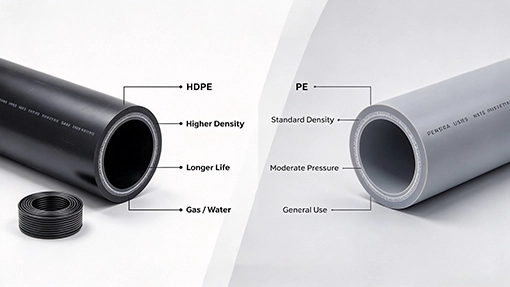
HDPE vs PE
Fornecedor
Luoyang Datang Energia Tech Co., Ltda. é um fabricante e fornecedor profissional de tubos e conexões. Oferecemos tubos PPR, Tubos de PVC, Tubos PE, e tubos e acessórios para aquecimento de piso para todos os tipos de tubos, com alta qualidade e preços competitivos. Se você tiver alguma dúvida sobre tubos e conexões, por favor não hesite em contactar-nos. You can click on the product to get in touch with us.
POSTS RELACIONADOS
Por que mais pessoas escolhem PP-RCT
PPR vs HDPE vs PVC:Comparação de tubos de abastecimento de água industrial
Por que os tubos HDPE são a melhor escolha?
Preciso usar Pipe Dope O. Linha de abastecimento de aquecedor de água
Tubos HDPE VS tubos de PVC para água potável