LUOYANG VEIO ENERGY TECH CO., LTD


Acessórios para tubos de latão: 7 Problemas comuns de encanamento que eles ajudam a resolver
Plumbing systems are the “blood vessels” of modern buildings and industrial facilities. Whether it is residential water supply, commercial HVAC, or factory fluid conveyance, the reliability of pipe connections directly affects the safety and efficiency of the entire system. In practice, no entanto, engineers and procurement professionals frequently encounter a series of stubborn issues: vazamento, corrosão, manutenção frequente, wrong fitting selection, poor hose connections, inadequate pressure/temperature tolerance, and the lack of a long‑term dependable solution.
Acessórios para tubos de latão have become the preferred answer to these challenges, thanks to their outstanding corrosion resistance, força, and durability. According to QYResearch, the global brass pipe fittings market was valued at approximately USD 5.815 billion in 2025 and is projected to reach USD 7.725 billion by 2032, with a compound annual growth rate of 4.2%. This steady upward trend confirms that the value of brass fittings in plumbing systems is being recognised by more and more professionals.
This article examines seven of the most common plumbing problems and explains in detail how brass pipe fittings solve each one, while also providing a practical selection guide for buyers and engineers.

brass pipe fittings for plumbing systems
Why Are Brass Pipe Fittings Widely Used in Plumbing Systems?
Before diving into specific problems, it is essential to understand the core advantages of brass pipe fittings.
Brass is a copper‑zinc alloy that combines the corrosion resistance of copper with the strength of zinc. This unique material composition gives brass fittings irreplaceable benefits:
| Vantagem | Descrição | Practical Value |
|---|---|---|
| Resistência à corrosão | Resists water, aquecer, ácidos, minerais, and soil | Extends system life, reduces replacement frequency |
| Durabilidade | Vida útil de 30 a 50 anos | One installation, decades of trouble‑free operation |
| Usinabilidade | Easy to cast and precision‑machine to tight tolerances | Accurate connections, vedação confiável |
| Temperature Resistance | Operating range –65°F to 250°F (–54°C to 121°C) | Suitable for hot/cold water and many industrial fluids |
| Wide Compatibility | Compatible with copper, aço inoxidável, PVC, CPVC, e mais | Extremely broad application scope |
Brass fittings are suitable for water, óleos, combustíveis, GLP, gás natural, refrigeration, instrumentation, and hydraulic systems. These attributes make brass plumbing fittings an ideal choice for residential, comercial, and industrial piping.

Brass Pipe Fittings Widely Used in Plumbing Systems
7 Common Plumbing Problems and How Brass Pipe Fittings Solve Them
Problem 1: Pipe Leakage Caused by Poor Connections
Pipe leakage is the most common and most frustrating plumbing issue. The main causes include:
- Poor sealing
- Low‑quality fittings leading to connection failure
- Incorrect installation
- Damaged or imprecisely machined threads
A small leak can waste water, cause water damage, and in severe cases, lead to structural damage and safety hazards.
How Brass Pipe Fittings Solve It
Acessórios para tubos de latão effectively address leakage through the following mechanisms:
| Leakage Cause | How Brass Fittings Help |
|---|---|
| Loose connection | Precision machining ensures perfect thread fit |
| Thread damage | High‑strength brass resists wear; threads remain intact after multiple assemblies |
| Poor sealing | The natural ductility of brass allows the sealing face to deform slightly under pressure, enhancing leak resistance |
| Vibration loosening | Brass fittings have good vibration resistance and maintain stable connections |
Threaded brass fittings ensure leak‑tight connections in low‑temperature and low‑pressure systems. For higher reliability, compression and push‑fit fittings also offer solder‑free, leak‑proof solutions.

Pipe Leakage Caused by Poor Connections
Problem 2: Corrosion and Material Failure
Corrosion is a “silent killer” of piping systems. Different materials exhibit vastly different corrosion resistance when exposed to water, produtos químicos, or specific environments over time:
| Material | Resistência à corrosão | Main Drawback |
|---|---|---|
| Plástico | Bom | Limited temperature tolerance; UV degradation |
| Aço | Moderado | Prone to rust; requires protective coatings |
| Latão | Excelente | Resists water, aquecer, ácidos, minerais, and soil corrosion |
A particular concern isdezincification – a form of corrosion that selectively leaches zinc from brass alloys, leaving the fitting porous and brittle.
How Brass Fittings Solve It
Modern brass fitting technology has effectively addressed dezincification.DZR (Dezincification‑Resistant) latão is specifically engineered to resist this type of corrosion. DZR brass fittings deliver outstanding corrosion performance in plumbing and heating systems.
Studies show that in hot‑water systems, ordinary plastic fittings may begin to degrade after only 8 anos, while brass fittings installed at the same time remain virtually intact. For drinking‑water systems, brass fittings certified toNSF/ANSI 61 eNSF/ANSI 372 (low‑lead) are approved for potable water supply.
Problem 3: Frequent Maintenance and Replacement
Low‑quality fittings do not just save money upfront – they create a long‑term maintenance nightmare. Frequent inspections, repairs, and replacements consume labour and materials, cause system downtime, and disrupt normal operations.
How Brass Fittings Solve It
Acessórios para tubos de latão drastically reduce maintenance frequency and lifetime costs because of their exceptional durability:
| Tipo de adaptação | Maintenance Frequency | Vida útil | Long‑Term Cost |
|---|---|---|---|
| Low‑quality fittings | Alto | 5–10 years | Alto (frequent replacement + downtime) |
| Acessórios de latão | Baixo | 30–50 years | Baixo (one‑time investment, decades of benefit) |
Brass fittings retain thread integrity even after multiple assembly/disassembly cycles, ensuring lower long‑term maintenance costs. As one experienced plumber put it: “Brass fittings may seem more expensive at first, but honestly, every penny is worth it in the long run.”
Among theadvantages of brass pipe fittings, low maintenance cost and high cost‑effectiveness are consistently cited as top concerns for purchasers.
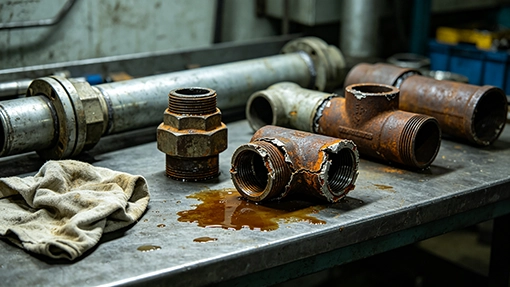
Corrosion and Material Failure
Problem 4: Choosing the Wrong Fitting Type
Piping systems involve a wide variety of fitting types, and selecting the wrong one is a frequent cause of system failure. Different applications require different fittings – using the wrong elbow angle, confusing a connector with a coupling, or mismatching thread standards can all lead to installation failure or leakage.
How Brass Fittings Solve It
Understanding the types and functions of commonacessórios de latão is the first step to correct selection:
| Tipo de adaptação | Função Primária | Aplicações Típicas |
|---|---|---|
| Cotovelo de latão | Changes pipe direction (90°, 45°, etc.) | Plumbing systems, AVAC |
| Conector de mangueira de latão | Connects hose to pipe | Irrigação de jardim, industrial hose connections |
| Acoplamento de mangueira de latão | Joins two hose sections | Hose extension, pipe repair |
| Adaptador de latão | Converts between different threads or connection types | Transition between different pipe materials or thread standards |
Cotovelos de latão perform exceptionally well in high‑temperature hot water, corrosive fluids, high‑pressure piping, and high‑stress industrial applications.Brass hose fittings are widely used in garden hoses, industrial hoses, e sistemas de água.
Critical selection tip: The most common mistake is confusing thread standards. A 3/4″ garden hose thread (GHT) isnot interchangeable with a 3/4″ NPT thread. Always verify the thread standard when purchasing brass fittings.
Problem 5: Poor Hose Connection Performance
Hose connections are a frequent weak point in piping systems. Loose connections, poor sealing, and inferior materials are particularly common in garden irrigation and industrial fluid transfer applications.
How Brass Fittings Solve It
Brass hose fittings are the ideal solution for hose connection issues. High‑qualitybrass hose connectors ebrass hose couplings offer the following features:
- Corrosion‑ and wear‑resistant, suitable for wet and chemical‑handling environments
- Able to withstand pressure while maintaining leak‑tight connections
- Resistant to thermal shock and mechanical stress
- Suitable for air, água, gás, fuel oil, and many other media
Brass hose fittings are widely used in:
- Garden hoses – irrigation, limpeza
- Industrial hoses – fluid transfer, equipment connections
- Water systems – supply and drainage
For outdoor applications like irrigation, brass connectors excel in abrasion resistance and UV resistance. Some products feature quick‑coupling designs for rapid tool‑free connection and disconnection.
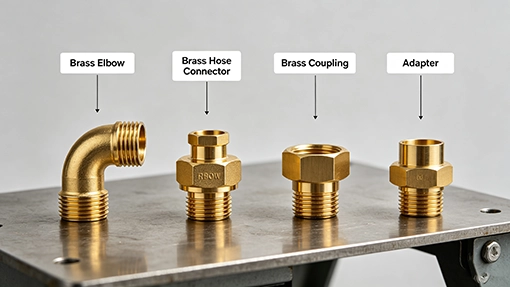
types of brass pipe fittings including brass elbow and hose coupling
Problem 6: Pressure and Temperature Challenges
Piping systems often face the combined challenge of high pressure and high temperature. In hot‑water supply, AVAC, and industrial steam applications, fittings must withstand elevated temperatures while maintaining pressure integrity. Plastic fittings soften and deform at high temperatures, while ordinary metal fittings may loosen due to thermal expansion.
How Brass Fittings Solve It
Acessórios de latão exhibit excellent temperature and pressure performance:
| Aplicativo | Faixa de temperatura | Pressure Range | Brass Performance |
|---|---|---|---|
| Encanamento residencial | Ambient to hot water | 150–300 PSI | Excelente |
| Sistemas HVAC | Up to 120°C | 16–25 bar | Excelente |
| Aplicações industriais | Up to 225°C | 16 bar | Bom |
| Low/medium pressure | –65°F to 250°F | Up to 1200 PSI | Outstanding |
Brass fittings are suitable for water systems, AVAC, e aplicações industriais. For hot‑water systems, the thermal conductivity of brass (19–21 W/m·K) is much lower than that of plastic (por exemplo, PVC: 54 S/m·K), which means brass fittings maintain better dimensional stability at elevated temperatures.
Brass fittings applications span from residential heating to industrial process control.
Problem 7: Finding Reliable and Long‑Term Solutions
For purchasers and engineers, the biggest challenge is often not finding a fitting, but finding one that istruly reliable and proven over time. In a price‑driven market, low‑quality products are everywhere. How do you distinguish trustworthy products and suppliers?
How Brass Fittings Solve It
Choosingacessórios para tubos de latão is itself an investment in long‑term reliability. No entanto, to be certain, consider the following points:
- Quality materials – Choose brass alloys that meet ASTM standards; prefer DZR brass for corrosive environments.
- Precision manufacturing – Forged or precision‑CNC‑machined products have higher density and strength than cast products.
- Certificações – For drinking‑water systems, look for NSF/ANSI 61 e NSF/ANSI 372 certificação.
- Supplier support – Choose a supplier that can provide full mill certificates and professional selection advice.
Leading global brass fitting manufacturers include Viega, Mid‑America Fittings, MeritBrass, e outros. These brands are known for consistent quality control and performance assurance.

Brass hose fittings are used in Garden hoses
Types of Brass Pipe Fittings for Different Applications
Understanding the product categories ofacessórios para tubos de latão é essencial para uma seleção adequada. Below are the most common types:
| Tipo | Função Primária | Aplicações Típicas |
|---|---|---|
| Cotovelo de latão | Changes direction (90°, 45°, etc.) | Encanamento, AVAC |
| Camiseta de latão | T‑shaped branch connection | Pipe branching, distribuição de água |
| Acoplamento de latão | Joins two pipes of the same diameter | Pipe repair, extension |
| Brass Connector | Transition connection | Hose‑to‑pipe connection |
| Adaptador de latão | Thread conversion | Transition between different pipe materials or thread standards |
| Brass Union | Removable connection | Locations requiring periodic maintenance |
Cotovelos de latão e brass hose couplings are among the most frequently used types in both plumbing and industrial settings.
Where Are Brass Pipe Fittings Used?
Brass pipe fittings applications cover an extremely wide range – from homes to heavy industry:
| Indústria | Specific Application | Key Requirements |
|---|---|---|
| Residential Plumbing | Fornecimento de água, drenagem, water heater connections | Low‑lead certification, durabilidade |
| Edifícios Comerciais | AVAC, fire protection, fornecimento de água | Pressure/temperature rating, confiabilidade |
| Agriculture | Sistemas de irrigação | Resistência à corrosão, Resistência UV |
| Industrial Systems | Fluid connections, pneumatic systems | High pressure, resistência química |
| Gas Distribution | Natural gas, LPG pipelines | Segurança, leak‑tightness |
| Marinho | Shipboard piping systems | Saltwater corrosion resistance |
Brass fittings are compatible with water, óleos, combustíveis, GLP, gás natural, refrigeration, instrumentation, and hydraulic media. This broad compatibility makes them the “multi‑tool” of piping engineering.
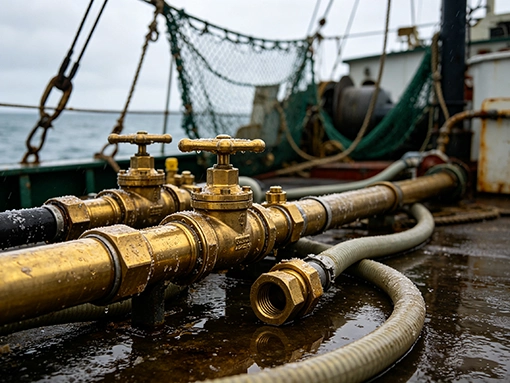
Brass Pipe Fittings Used in Marine
How to Choose the Right Brass Pipe Fittings?
Selecionando o correto acessórios para tubos de latão requires a systematic evaluation of several factors:
| Selection Factor | What to Consider |
|---|---|
| Tamanho | Nominal pipe diameter (NPS or DN) |
| Tipo de conexão | Rosqueado / Compression / Push‑fit / Solder |
| Material Quality | Brass grade, DZR or not, lead‑free or not |
| Aplicativo | Água / gás / óleo, temperatura, pressão |
| Classificação de pressão | System working pressure |
| Certificação | NSF/ANSI 61, ASTM, etc.. |
Thread standard special note: In the U.S. mercado, there are five major thread systems – NPT, NPSM/NPSH, GHT/NH, NST/NH, and SAE 45° flare. Always confirm the correct thread standard before purchase –NPT and GHT are not interchangeable.
Pressure‑temperature caution: At elevated temperatures, the pressure rating of fittings decreases. Por exemplo, a fitting rated for 300 PSI at 21°C may only be safe for 150–200 PSI at 93°C.
Brass Pipe Fittings vs Other Materials
To assist decision‑making, here is a comparative overview of brass, plástico, e aço:
| Recurso | Latão | Plástico | Aço |
|---|---|---|---|
| Durabilidade | Alto (30–50 years) | Médio (10–25 years) | Alto |
| Resistência à corrosão | Excelente | Bom | Moderado (needs coating) |
| Temperature Resistance | Excelente (–65°F to 250°F) | Limitado | Bom |
| Pressure Resistance | Alto (até 1200 PSI) | Médio | Alto |
| Installation Ease | Easy | Easiest | Difficult |
| Custo | Médio | Baixo | Alto |
| Manutenção | Baixo | Médio | Medium to High |
Brass strikes the best overall balance among durability, resistência à corrosão, and temperature resistance – which is precisely why it remains the top choice in the plumbing industry.
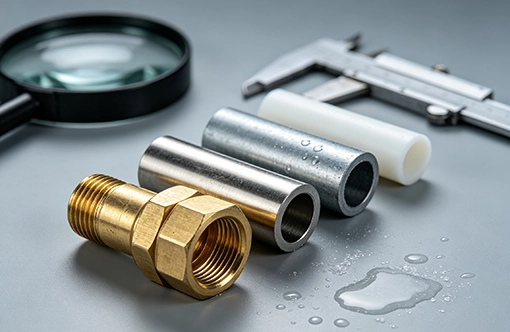
Brass Pipe Fittings vs Other Materials
Conclusão
The reliability of a piping system depends on the quality of every single connection. From residential plumbing to industrial piping, frombrass elbows parabrass hose fittings, brass pipe fittings have proven themselves as the key to solving seven common plumbing problems.
Acessórios para tubos de latão help solve:
- ✅ Vazamento – precision machining ensures reliable sealing
- ✅ Corrosão – DZR brass effectively resists dezincification
- ✅ Frequent maintenance – 30–50 years of service life dramatically reduces upkeep
- ✅ Wrong selection – a broad product range meets every need
- ✅ Poor hose connections – strong, corrosion‑resistant hose fittings
- ✅ Pressure/temperature inadequacy – wide range from –65°F to 250°F
- ✅ Lack of long‑term solutions – quality materials + certificações + professional suppliers
Remember three key points when purchasing: choose the correct thread standard, look for low‑lead certification (for drinking water), and match the application scenario.
Looking for reliable brass fittings for your plumbing projects? Choose Luoyang Datang Energia Tech Co., Ltda.
POSTS RELACIONADOS
Como instalar tubos HDPE no subsolo: Etapas principais, Métodos, e Melhores Práticas
Acessórios para tubos de latão explicados: Cotovelo de latão, Conector de mangueira & Acoplamento de mangueira

Como escolher acessórios para tubos PP-R para tubos de decoração doméstica
Qual das alternativas a seguir se refere à tubulação que conecta o sistema de sprinklers ao abastecimento principal de água?
Quais são os 5 Tipos de tubos?