LUOYANG VEIO ENERGY TECH CO., LTD


Tamanhos de acessórios para tubos de latão explicados: Tópicos, Dimensões e Guia de Seleção
Escolher a conexão de latão certa não é tão simples quanto combinar dois números. Um encaixe marcado 1/2 polegada does not necessarily have a 1/2-inch thread diameter, and a fitting with a similar measured diameter may still use a completely different thread standard.
Entendimento brass pipe fittings sizes, thread dimensions, tamanho nominal do tubo, and thread standards is essential when selecting brass elbows, camisetas, acoplamentos, adaptadores, hose connectors, and other threaded fittings.
This guide explains the most common brass fitting sizes, NPT and BSP threads, how to measure a brass fitting, and how to specify the correct size when ordering.
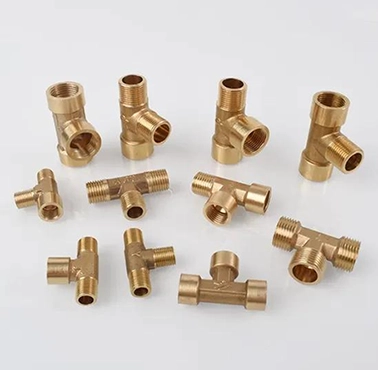
Encaixe de tubo de latão
What Does “Encaixe de tubo de latão Size” Actually Mean?
When suppliers or buyers refer to a brass fitting size, they are usually referring to the nominal connection size, not the actual physical diameter of the fitting.
Several different measurements may be involved:
| Medição | What It Means |
|---|---|
| Nominal Size | Standardized size designation, such as 1/2″ or 1″ |
| DE do tubo | Actual outside diameter of the pipe |
| Thread Major Diameter | Largest diameter across an external thread |
| Thread Minor Diameter | Smallest diameter of the thread profile |
| Thread Pitch | Distance between adjacent threads |
| TPI | Fios por polegada |
| Fitting Body OD | Outside diameter of the fitting body |
Por exemplo, um 1/2″ NPT brass fitting has a nominal size of 1/2 polegada, but its external thread major diameter is approximately 0.840 polegada (21.34 milímetros).
This is why simply measuring a fitting with a caliper is not enough to identify its size.
Nominal Size vs. Actual Diameter
The nominal size is a standardized designation used to describe the pipe or connection. It should not automatically be interpreted as the actual thread diameter or pipe outside diameter.
For accurate identification, check the following together:
- Nominal fitting size
- Padrão de rosca
- Male or female thread
- Thread major or internal diameter
- TPI or thread pitch
- Thread profile
Important: The dimensions in the following tables are standard reference dimensions for thread identification. Actual product dimensions can vary according to the applicable standard, tolerance, fitting design, and manufacturer.

Nominal Size vs. Actual Diameter
Encaixe de tubo de latão Size Chart
The most common brass pipe fittings are available in sizes ranging from small plumbing connections to larger industrial piping systems.
The following table provides common reference sizes for BSP threads:
| Nominal Size | BSP Thread Major Diameter | TPI |
|---|---|---|
| 1/8″ | 9.728 milímetros | 28 |
| 1/4″ | 13.157 milímetros | 19 |
| 3/8″ | 16.662 milímetros | 19 |
| 1/2″ | 20.955 milímetros | 14 |
| 3/4″ | 26.441 milímetros | 14 |
| 1″ | 33.249 milímetros | 11 |
| 1-1/4″ | 41.910 milímetros | 11 |
| 1-1/2″ | 47.803 milímetros | 11 |
| 2″ | 59.614 milímetros | 11 |
These dimensions refer to the fio, not the overall outside diameter of the brass fitting.
Por exemplo, um 1/2″ BSP threaded fitting has a thread major diameter of about 20.955 milímetros. The body of the elbow, camiseta, or coupling will normally be larger.
Common Brass Fitting Sizes
For plumbing, AVAC, água, gás, and general industrial applications, commonly requested brass fitting sizes include:
- 1/8″
- 1/4″
- 3/8″
- 1/2″
- 3/4″
- 1″
- 1-1/4″
- 1-1/2″
- 2″
Smaller sizes are common in instrumentation, small water lines, and hose connections, while larger sizes are frequently used in industrial and commercial piping.
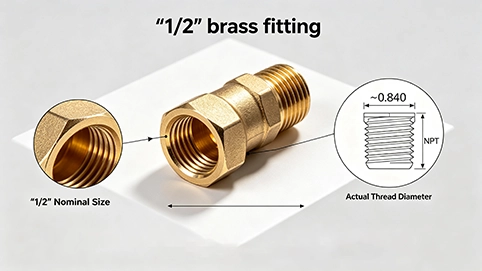
1/2″ Encaixe de latão
NPT Brass Fitting Sizes
TNP (Conicidade Nacional de Tubos) is one of the most widely used inch-based pipe thread standards, particularly in North America.
NPT threads are tapered and use a 60-degree thread form. The thread dimensions are standardized under ASME B1.20.1.
A typical NPT brass fitting size chart is:
| Nominal NPT Size | Approx. External Thread Diameter | TPI |
|---|---|---|
| 1/8″ | 0.405″ (10.29 milímetros) | 27 |
| 1/4″ | 0.540″ (13.72 milímetros) | 18 |
| 3/8″ | 0.675″ (17.15 milímetros) | 18 |
| 1/2″ | 0.840″ (21.34 milímetros) | 14 |
| 3/4″ | 1.050″ (26.67 milímetros) | 14 |
| 1″ | 1.315″ (33.40 milímetros) | 11.5 |
| 1-1/4″ | 1.660″ (42.16 milímetros) | 11.5 |
| 1-1/2″ | 1.900″ (48.26 milímetros) | 11.5 |
| 2″ | 2.375″ (60.33 milímetros) | 11.5 |
These are thread reference dimensions, not the overall dimensions of the fitting.
Por exemplo, if you measure approximately 21.3 mm across the external thread of a fitting, it may be a 1/2″ Rosca NPT. No entanto, diameter alone does not prove that identification. TPI and thread profile should also be checked.
Why NPT Size Can Be Confusing
A common mistake is assuming:
1/2″ NPT = 1/2″ thread diameter
It does not.
O 1/2″ designation refers to the nominal pipe size, while the external thread diameter is approximately 0.840 polegada.
This difference is normal for pipe thread sizing and is one of the main reasons buyers should specify the complete thread standard when ordering brass fittings.
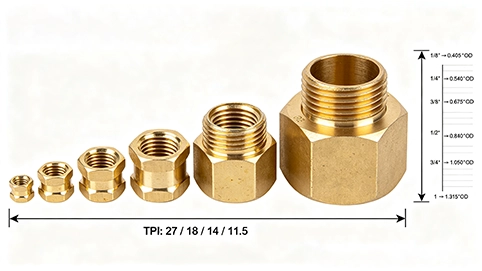
NPT Brass Fitting Sizes
BSP Brass Fitting Sizes
BSPP (Paralelo) e BSPT (Cônico)
BSP—British Standard Pipe—is the dominant thread family in the UK, Europa, and many Commonwealth markets. Unlike NPT, BSP comes in two distinct forms:
BSPP (G thread, ISO 228-1): Parallel threads. They do not seal on the threads themselves. A separate sealing surface—usually a bonded washer, O-ring, or gasket—provides the seal.
BSPT (R/Rp thread, ISO 7-1): Tapered threads. Like NPT, BSPT seals by thread compression. No entanto, the thread angle is 55 graus (Whitworth form), não 60 graus.
Common BSP Sizes
| BSP Size | Approx. Major OD | TPI |
|---|---|---|
| 1/8″ | 9.728 milímetros | 28 |
| 1/4″ | 13.157 milímetros | 19 |
| 3/8″ | 16.662 milímetros | 19 |
| 1/2″ | 20.955 milímetros | 14 |
| 3/4″ | 26.441 milímetros | 14 |
| 1″ | 33.249 milímetros | 11 |
| 1-1/4″ | 41.910 milímetros | 11 |
| 1-1/2″ | 47.803 milímetros | 11 |
| 2″ | 59.614 milímetros | 11 |
Thread dimensions per ISO 228-1 (BSPP) e ISO 7-1 (BSPT). Ângulo da rosca: 55° (Whitworth form). BSPP is parallel; BSPT is tapered at 1:16.
A common field observation: A thread measuring roughly 1/2 polegada (12.7 milímetros) across the outside is likely a1/4″ BSP thread, not a 1/2″ BSP. O 1/2″ BSP thread actually measures20.955 milímetros across its major diameter. This “quarter-inch larger” rule of thumb holds approximately for BSP sizes up to about 1″, but always verify with a thread gauge rather than relying on visual estimation alone.

BSP Brass Fitting Sizes
TNP x BSP: Why the Same Size May Not Fit
This is not a deep comparison—there is a dedicated article coming on that topic. But you need to know the essentials:
| Recurso | TNP | BSP |
|---|---|---|
| Primary Market | América do Norte | Reino Unido, Europa, Commonwealth |
| Ângulo da Rosca | 60° | 55° |
| Tipos comuns | TNP (cônico) | BSPP (paralelo), BSPT (cônico) |
| Seal Method | Thread compression + sealant | BSPP: gasket/washer; BSPT: thread compression |
| Intercambiável? | Não | Não |
Never specify a brass fitting only as “1/2 inch.” Always confirm the thread standard.
Even when nominal sizes match—for example, both are labeled 1/2″—NPT (60° ângulo da rosca) and BSP (55° Whitworth) will not thread together properly. The 5° angle difference causes cross-threading and guarantees leaks. Forcing them together damages both threads.
How to Measure a Brass Pipe Fitting
When you have an unmarked fitting in hand, five measurements will identify it:
Etapa 1: Check the Fitting Type
Cotovelo, camiseta, acoplamento, adaptador, or connector? The type tells you what the fitting does, but not its size.
Etapa 2: Measure the Thread Diameter
Use a vernier caliper. For male threads, measure across the outside diameter at the widest point. For female threads, measure the inside diameter.
Etapa 3: Count the Threads (TPI)
Use a thread pitch gauge or place a ruler along the thread and count how many complete threads fit within one inch. This is the TPI.
Etapa 4: Identify the Thread Profile
Tapered or parallel? NPT and BSPT taper; BSPP and metric threads are parallel. Roll the fitting on a flat surface—a tapered thread will wobble visibly.
Etapa 5: Check Male or Female
| Tipo | Descrição |
|---|---|
| Macho | Rosca externa |
| Fêmea | Rosca interna |
| Male × Male | External threads on both ends |
| Female × Female | Internal threads on both ends |
| Male × Female | Mixed thread ends |
A thread identification kit containing pitch gauges, a caliper, and reference profiles is worth the investment if you regularly handle mixed-standard fittings.

Measure a Brass Pipe Fitting
How to Choose the Right Brass Fitting Size
Once you understand what the size number actually means, selection becomes systematic. Run through these seven checks before placing an order:
| Check | Question to Ask |
|---|---|
| Pipe Size | What is the pipe nominal size? |
| Padrão de rosca | TNP, BSPP, BSPT, ou métrica? |
| Conexão | Macho ou fêmea? |
| Pressão | What working pressure is required? |
| Temperatura | What operating temperature? |
| Aplicativo | Água, AVAC, gás, or industrial fluid? |
| Material | What brass grade is required? |
Common brass grades for fittings include CW617N (CuZn40Pb2) for general-purpose plumbing and CW602N (CuZn36Pb2As) for dezincification-resistant applications in aggressive water conditions.

Brass Fittings in industrial applications
Common Mistakes When Choosing Brass Fitting Sizes
Erro 1: Treating Nominal Size as Actual Diameter
Um 1/2″ fitting does not necessarily have a 1/2-inch thread diameter.
Erro 2: Measuring Only the Fitting Body
The body diameter does not identify the thread size.
Erro 3: Ignoring NPT vs. BSP
A similar diameter does not mean the threads are compatible.
Erro 4: Confusing BSPP and BSPT
Both belong to the BSP family, but one is parallel and the other is tapered.
Erro 5: Ignoring Male/Female Configuration
A correct thread size is not enough if the connection gender is wrong.
Erro 6: Selecting by Diameter Without Checking TPI
Two threads can have similar diameters but different pitches or TPI.
Encaixe de latão Size vs Pipe Size: Are They the Same?
No—and this is where the confusion peaks.
| Especificação | Refers To |
|---|---|
| Fitting nominal size | Standard connection size label |
| DE do tubo | Outside diameter of the pipe |
| Pipe ID | Inside diameter of the pipe |
| Thread OD | Actual measured thread diameter |
A fitting marked 1/2″ does not have a 12.7 mm thread OD. In NPT, the 1/2″ size has a 0.840″ thread OD. In BSP, the 1/2″ size has a 20.955 mm major diameter. The nominal size is a matching reference, not a physical dimension.
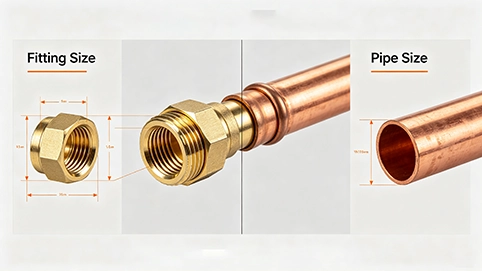
Brass Fitting Size vs Pipe Size
Need Acessórios para tubos de latão for Your Project?
Need brass pipe fittings in specific sizes, padrões de rosca, or connection types? Share your required fitting type, nominal size, padrão de rosca, material, and application with our team. Luoyang Datang Energia Tech Co., Ltda will confirm the appropriate specification and provide a quote.
POSTS RELACIONADOS
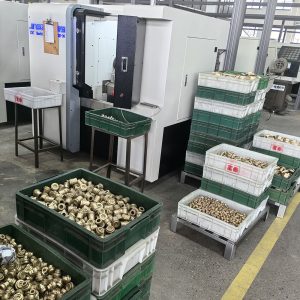
Coletores de encanamento de latão:O núcleo durável dos sistemas de tubulação modernos
Tubos PPR de alta qualidade:Segurança & Proteção Ambiental
Tubos PPR de copolímero aleatório de polipropileno:Sistema de abastecimento de água doméstico
Guia de tamanhos e dimensões de tubos HDPE: Diâmetro, DES, Classificação de pressão e dicas de seleção
Quem é o responsável pela tubulação de abastecimento de água