LUOYANG TLA ENERGY TECH CO.,LTD

Why Are HDPE Pipe Prices Different? A Buyer’s Guide to Cost Factors
You send the same inquiry to three HDPE pipe suppliers. Same DN110, same PE100, same HDPE pipe. You get back three quotes — and they’re hundreds of dollars apart.
This is the single most common frustration in HDPE pipe procurement. And it’s the moment most buyers make their first expensive mistake: they compare the “$/metara” numbers and pick the cheapest one.
Here’s the problem. An Pipe ea HDPE price is shaped by at least ten interlocking variables — raw material grade, bophara, botenya ba lebota, tekanyo ea khatello, standards compliance, order quantity, color requirements, lisebelisoa, shipping terms, and supplier capability. Change one, and the price moves. Change three, and you’re looking at two completely different products.
A cheaper quote isn’t necessarily a better deal. Sometimes it’s a thinner wall. Sometimes it’s recycled regrind. Sometimes it’s simply a supplier who didn’t read your spec carefully.
This guide breaks down every factor that drives HDPE pipe cost — with real data, reference tables, and a comparison framework you can use the next time quotes land on your desk. Whether you’re a distributor sourcing for resale, a contractor buying for a municipal project, or an engineer locking down specifications, by the end you’ll know exactly which questions to ask and which numbers to double-check.
And if you haven’t finalized your inquiry yet, start with our guide on HDPE pipe ordering requirements to make sure your RFQ captures everything suppliers need.
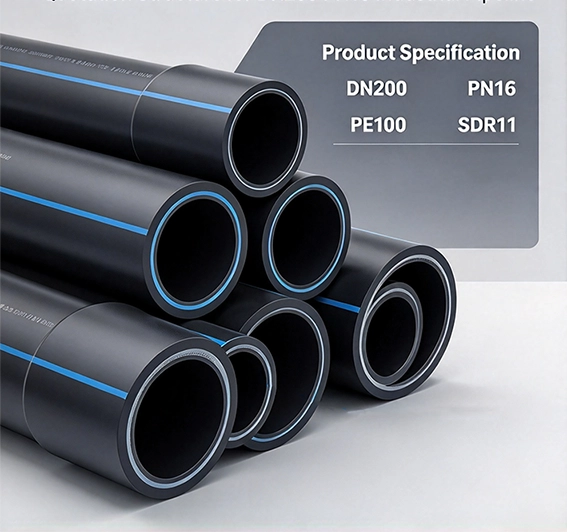
Factors affecting HDPE pipe price
1. Raw Material Grade: The First Factor Behind HDPE Pipe Price
Before you look at diameter or wall thickness, know what the pipe is made of. The polyethylene resin inside an HDPE pipe accounts for roughly 60–75% of the total product cost — it’s the single largest line item in any quotation.
HDPE pressure pipe comes in three main grades. The number after “PE” refers to the Minimum Required Strength (MOF) — a classification earned through long-term hydrostatic testing to ISO 9080 and assigned under ISO 12162.
| Kereiti ea lintho tse bonahalang | MOF (MPa) | Design Stress (MPa) | Litšobotsi | Price Impact |
|---|---|---|---|---|
| PE80 | 8.0 | 6.3 | Second generation; lower-pressure water, drainage, nosetso | Tlase |
| PE100 | 10.0 | 8.0 | Third generation; the modern infrastructure default | E phahameng |
| PE100-RC | 10.0 | 8.0 | Same MRS as PE100, but dramatically higher resistance to slow crack growth | Phahameng ka ho fetisisa |
PE100 isn’t just “stronger.” At the same outside diameter and wall thickness, a PE100 pipe carries roughly 25% more pressure than a PE80 pipe. Flip that around: for the same pressure duty, PE100 lets you use a thinner wall — which means less resin per metre, lighter pipe, and fewer trucks on the road.
Ke ka lebaka lena PE100 now accounts for over 90% of new HDPE water mains worldwide — it does more with less material.
PE100-RC (“Resistant to Crack”) uses a specially formulated resin that survives far longer in the slow-crack-growth notch test. It carries the same pressure rating and wall thickness as standard PE100, but typically commands a 15–25% price premium. On trenchless installation projects or pipelines laid in stony backfill, that premium often pays for itself through reduced sand-bedding and repair costs. On clean, open-cut rural water schemes, it’s dead money.
One more thing buyers often miss: pressure pipe must be made from virgin PE100 resin. Recycled or post-consumer regrind has unknown long-term strength and cannot guarantee the PN rating or 50-year design life. A suspiciously cheap quote often hides regrind content.
🔗 Related: Boleng bo phahameng PE100 & PE80 High Density Polyethylene Pipe

PE100 HDPE pipe material grade comparison
2. Pipe Diameter: Why Larger HDPE Pipes Cost More
Diameter is the most visible cost factor — and the most intuitive. Bigger pipe means more material, nako.
But the relationship isn’t linear. Pipe mass scales roughly with diameter multiplied by wall thickness. For a fixed SDR, the weight per metre — and therefore the price per metre — rises closer to quadratically as outside diameter grows. A DN630 pipe isn’t just twice the price of a DN315; it’s substantially more.
| Diameter Range | Tšebeliso e Tloaelehileng |
|---|---|
| 20–63 mm | Small water supply, building plumbing connections, irrigation laterals |
| 90–250 mm | Kabo ea metsi ka masepala, medium-duty industrial pipelines |
| 315 mm+ | Large-scale water mains, merero ea indasteri, trunk lines |
For large-diameter pipes, the cost equation shifts. The main cost isn’t just the plastic — it’s also the “moea” you ship. Efficient nesting during container loading can dramatically increase the metres of pipe per container and cut freight cost per metre. We’ll cover that in the shipping section.
🔗 Related: Tataiso ea boholo le boholo ba Pipe ea HDPE
3. SDR and Wall Thickness: The Hidden Reason Behind Price Differences
This is where most procurement mistakes happen.
SDR stands for Tekanyetso e Tloaelehileng — the ratio of outside diameter to wall thickness:
SDR = Outside Diameter ÷ Wall Thickness
It’s an inverse relationship: the lower the SDR, the thicker the wall, and the higher the pressure rating. A DN110 pipe in SDR17 has a 6.7 mm wall; the same DN110 in SDR11 has a 10.4 mm wall — 55% more material in the same pipe.
| SDR | Botenya ba Lerako (DN110) | Sehlopha sa Khatello (PE100) | Relative Cost |
|---|---|---|---|
| SDR17 | 6.7 mm | PN10 | Tlase |
| SDR13.6 | 8.1 mm | PN12.5 | Mahareng |
| SDR11 | 10.4 mm | PN16 | E phahameng |
Here’s the scenario that plays out in procurement offices every week:
Supplier A quotes you DN110 SDR17 at Xpermetre.SupplkeerBquotes∗∗DN110SDR11∗∗atY per metre. You look at the numbers, see that A is cheaper, and wonder why B is “overpriced.”
They are not the same product. Dropping from SDR17 to SDR11 at the same diameter adds roughly half as much polymer again per metre. If two quotes for the “same” pipe differ sharply, check the SDR and weight per metre before anything else — you may be comparing PN10 against PN16.
🔗 Related: SDR11 vs SDR17 HDPE Pipe: U Lokela ho Khetha Kelo efe ea Khatello?
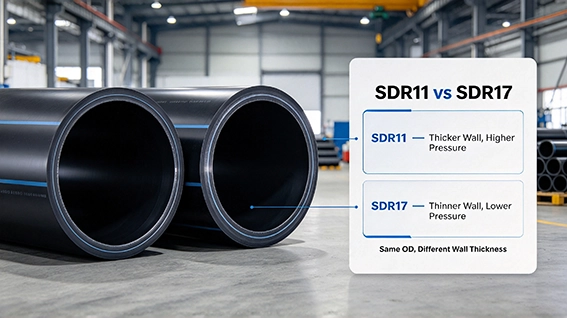
SDR11 and SDR17 HDPE pipe wall thickness comparison
4. Khatello Rating: PN10, PN12.5 and PN16 Affect Cost
Pressure rating and SDR are two sides of the same coin. The PN (Khatello ea Lebitso) class tells you the maximum operating pressure the pipe is designed to handle at 20°C.
| Sehlopha sa Khatello | Kopo | SDR e tloaelehileng (PE100) |
|---|---|---|
| PN10 | Phepelo ea metsi ka kakaretso, low-pressure distribution | SDR17 |
| PN12.5 | Medium-pressure municipal systems | SDR13.6 |
| PN16 | Higher-pressure systems, lisebelisoa tsa indasteri | SDR11 |
To achieve a higher pressure rating, the pipe needs a thicker wall — which means a SDR e tlase and more resin per metre.
The weight difference is substantial. In a comparative study of DN355 HDPE water pipelines, moving from PN10 to PN16 increased pipe mass from 27.3 kg/m to 42.1 kg/m — a 54.2% increase. That weight translates directly into cost: more resin, more freight, heavier handling equipment.
The takeaway: Don’t over-specify. If your system operates at 8 bar, a PN10 pipe is sufficient. Ordering PN16 “just to be safe” can add 40–50% to your material cost for capacity you’ll never use.
🔗 Related: Tataiso ea Tekanyetso ea Khatello ea Pipe ea HDPE
5. Pipe Standards and Certifications
Different markets require different standards. And compliance isn’t free — it adds testing, production controls, and documentation costs that show up in the final price.
| Standard | Market | Scope |
|---|---|---|
| ISO 4427 | Machaba | PE pipes for water supply; max operating pressure up to 25 mocheso oa mocheso oa 20 ° C |
| IN 12201 | Europe | Harmonized with ISO 4427, with additional regional regulatory requirements for potable water safety |
| ASTM F714 / D3035 | amerika e leboea | Imperial-dimension PE pipe; referenced alongside AWWA C906 for water distribution |
A pipe certified to ISO 4427 has been pressure-tested to ISO 1167, analyzed by regression to ISO 9080, and extrapolated to a 50-year design life at 20°C. That testing chain costs money.
When you see a quote that’s significantly below market for a “PE100” phala, ask: Which standard does this pipe actually conform to? If the answer is vague, the certification probably is too.
🔗 Related: HDPE Pipe Standards Explained: ISO, IN, ASTM
6. Order Quantity: Why Bulk Buyers Get Better Prices
This one is straightforward but worth understanding the mechanics.
| Order Quantity | Price Impact |
|---|---|
| Small order (< 1 container) | Higher unit cost; setup and handling costs spread over fewer metres |
| Container order (FCL) | Better unit price; optimized loading reduces freight per metre |
| Long-term supply agreement | Most stable pricing; resin cost fluctuations shared between buyer and supplier |
Pipe ea HDPE is extruded in continuous runs. A supplier running 10,000 metres of DN110 is far more efficient than one running 500 metres — the machine setup, quality testing, and packaging costs are amortized across a much larger output.
For international buyers, the container threshold matters most. Nesting — inserting smaller-diameter pipes inside larger ones — can dramatically increase the metres per container and cut freight cost per metre. A supplier who knows how to nest properly can save you 30–40% on ocean freight for large-diameter orders.
🔗 Related: HDPE Pipe Supplier Selection Guide

PN10, PN12.5 and PN16 comparison
7. Pipe Color and Application Requirements
HDPE pipe color isn’t decorative — it’s a safety and identification system. And colored compounds cost more than standard black.
| Mmala | Kopo |
|---|---|
| Ntsho | Phepelo ea metsi ka kakaretso, drainage, indasteri |
| Black with blue stripes | Potable water identification |
| Bosehla | Natural gas distribution |
| Botala | Sewer and drain lines |
| Purple | Reclaimed water, nosetso |
The cost difference comes from the masterbatch additives and the co-extrusion process. A yellow gas pipe requires UV-stabilized yellow compound and typically undergoes stricter quality control than a standard black water pipe — those requirements carry a price.
🔗 Related: Pipe ea Khase ea PE e mosehla: Mebala ea Khoutu e Bolokang Bophelo
8. Fittings and Accessories: The Cost Beyond Pipe
Many buyers focus entirely on the pipe price and forget that the pipe is only part of the system.
| Ntho | Cost Impact |
|---|---|
| Pipe only | Basic material cost |
| Pipe + lisebelisoa (electrofusion, butt-fusion) | Higher upfront, but simplifies installation |
| Complete system (phala + lisebelisoa + li-valve + transition pieces) | Highest upfront, but lowest total installed cost and fewest site delays |
If you’re comparing quotes from two suppliers, check whether fittings are included. A supplier quoting $2.50/m for pipe alone may look cheaper than one quoting $2.80/m with a fittings package — until you price the fittings separately and realize the “cheaper” option costs more in total.
A practical tip: Ask for a complete BOM (Bill of Materials) with every quote. This forces suppliers to quote the same scope and eliminates the hidden-cost surprise.
🔗 Related: Lethathamo le Felletseng la ho Hlalosa Lisebelisoa tsa Pipe ea HDPE

Green HDPE pipe in Sewer and drain lines
9. Shipping and Delivery Terms
For international procurement, the Incoterms and freight strategy can swing your landed cost by 20–40%.
| Ntlha | Tšusumetso |
|---|---|
| Distance & route | Freight cost scales with shipping distance and route complexity |
| Port handling | Loading/unloading fees vary significantly by port |
| Pipe length | 6 m vs 12 m lengths affect container utilization |
| Nesting strategy | Well-nested loads can cut freight per metre by 30–40% |
As of mid-2026, spot freight rates for 40-foot containers on the Asia-Europe route carrying water pipes climbed to $8,200 — a 38% month-on-month surge. In this environment, the difference between FOB and CIF quotes becomes material.
Always compare quotes on the same Incoterm basis. A CIF quote includes freight and insurance; an FOB quote doesn’t. The FOB number will always look lower — but that’s not the number that hits your bank account.
🔗 Related: Buying HDPE Pipe Internationally: Incoterms & Container Loading
10. Mofani oa Bokhoni: Why the Cheapest Quote Is Not Always the Best
This is the factor that doesn’t appear on any price sheet — but it determines whether your project stays on schedule.
A low price can come from legitimate efficiency (large-scale production, optimized logistics) or from cutting corners:
| Risk Area | Seo U ka se Hlahlobang |
|---|---|
| Material certificate | Does the supplier provide ISO 9080 regression data for the resin batch? |
| Inspection report | Third-party or in-house dimensional and pressure test results |
| Bokhoni ba tlhahiso | Can they deliver the full order on schedule, or will they subcontract? |
| Roundness and wall consistency | Consistent OD and even wall around the circumference — no obvious ovality |
| Color uniformity | Even color, no streaks, spots, or grey patches that suggest regrind |
A supplier who can’t provide a material certificate le a test report isn’t offering you a better price — they’re offering you a different product.
🔗 Related: How to Verify HDPE Pipe Supplier Quality

Yellow HDPE pipe in Natural gas distribution
How to Compare Two HDPE Pipe Prices Correctly
Here’s the framework. Use this table every time you compare quotes:
| Hlahloba Ntho | Supplier A | Supplier B |
|---|---|---|
| Kereiti ea lintho tse bonahalang | PE100 | PE100 |
| Diameter | DN110 | DN110 |
| SDR | SDR17 | SDR11 |
| Khatello Rating | PN10 | PN16 |
| Standard | ISO 4427 | ISO 4427 |
| Botenya ba Lerako | 6.7 mm | 10.4 mm |
| Weight per metre | ~1.63 kg/m | ~2.53 kg/m |
| Incoterm | FOB | CIF |
| Fittings included? | Che | Ee |
| Material certificate? | Ee | Ee |
| Price per metre | ? | ? |
If the SDR, tekanyo ea khatello, or weight per metre differ, you are not comparing the same product. Full stop.
The cleanest sanity-check for any large-diameter quote is to price it as resin cost per kilogram × theoretical weight per metre. This gives you a baseline that strips out logistics and margin, and reveals whether a quote is genuinely competitive or suspiciously thin.
LBH
Q1: Why are HDPE pipe prices different?
HDPE pipe prices vary because of at least ten interlocking factors: raw material grade (PE80 vs PE100 vs PE100-RC), bophara, botenya ba lebota (SDR), tekanyo ea khatello (PN), standards compliance, order quantity, color requirements, fittings scope, shipping terms, and supplier capability. Two quotes for “the same” pipe can differ by 40% or more if the SDR or pressure class isn’t identical. The single largest cost driver is the polyethylene resin itself, which accounts for 60–75% of the total product cost.
Q2: How is HDPE pipe price calculated?
The fundamental cost equation is resin cost per kilogram × pipe weight per metre + conversion cost + certification/testing + freight + margin. Pipe weight scales roughly with diameter multiplied by wall thickness, so for a fixed SDR, the weight — and price — rises closer to quadratically as diameter increases. A reliable sanity-check for any quote is to calculate the theoretical weight per metre and compare the implied resin cost against current market resin prices.
Q3: Is PE100 HDPE pipe more expensive?
Ee, PE100 resin costs more per kilogram than PE80. Leha ho le joalo, because PE100 has a higher minimum required strength (MOF 10.0 MPa vs 8.0 MPa), it can achieve the same pressure rating with a thinner wall — which means less material per metre and often a lower total installed cost for the same duty. This is why PE100 has become the global default for pressure pipe applications.
Q4: Does larger diameter always mean higher cost?
For the same SDR and material, yes — larger diameter always means more material and higher cost per metre. The relationship is not linear; it’s closer to quadratic. Leha ho le joalo, the cost per metre per unit of flow capacity may actually decrease at larger diameters due to reduced friction loss. Hape, for very large diameters, efficient nesting during container loading can partially offset the higher material cost by reducing freight per metre.
Q5: Why does SDR affect HDPE pipe price?
SDR is the ratio of outside diameter to wall thickness. A lower SDR means a thicker wall, which requires more resin per metre of pipe. Moving from SDR17 to SDR11 at the same diameter adds roughly 50% more polymer per metre. Since resin is the dominant cost component, this wall thickness difference translates directly into a significant price difference — often the single biggest reason two quotes for the “same” pipe don’t match.
Q6: What information should I provide to get an accurate HDPE pipe price?
To receive a comparable, accurate quote, provide: (1) boemo ba thepa (PE80, PE100, or PE100-RC), (2) nominal outside diameter in mm, (3) SDR or pressure rating (PN), (4) maemo a sebetsang (ISO 4427, IN 12201, ASTM), (5) required quantity in metres, (6) pipe length per piece (6 m, 12 m, or custom), (7) color and stripe requirements, (8) fittings scope if applicable, le (9) delivery destination and preferred Incoterm. Including all nine items in your RFQ eliminates the back-and-forth and ensures every supplier quotes the same specification.

Purple HDPE pipe in Reclaimed water
Qetello
HDPE pipe prices aren’t random. Every dollar difference between two quotes traces back to a specific variable — material grade, botenya ba lebota, tekanyo ea khatello, setifikeiti, bongata, logistics, or supplier capability.
The next time you receive quotes that look wildly different, don’t reach for the cheapest number. Reach for the specification sheet. Check the SDR. Check the pressure rating. Check the material certificate.
The cheapest pipe is the one that meets your specification at the lowest total installed cost — not the one with the lowest price per metre.
Ready to get a quote you can actually compare? Send Luoyang Datang Energy Tech Co., Ltd. your full specification — grade, bophara, SDR, maemo, bongata, and delivery terms — and we’ll come back with a transparent, itemized quotation within 24 lihora.
EKETSEHILENG PHATALA

Tataiso e Feletseng ea Liphaephe tsa PVC le Lisebelisoa tsa Metsi a Phepelo ea Metsi
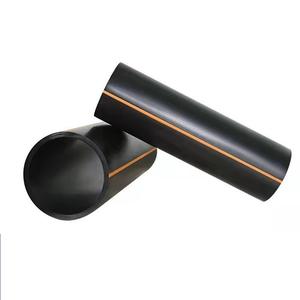
🚀 Phetoho ea Indasteri ea Liphaephe: Lintlha tse tsoang ho Oli & Liforamu tsa Lipalangoang tsa Compressor le Pipeline
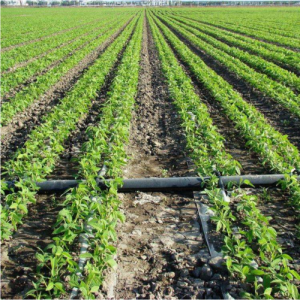
Pipe ea PE ho Nosetso ea Temo & Sistimi ea ho nosetsa ka marotholi
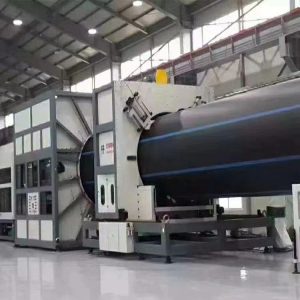
Liphaephe tsa HDPE & Liphaephe tsa PVC ka Ente le Sistimi ea ho tsamaisa
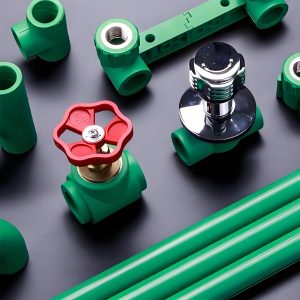
Ke mekhoa efe ea ho hokahanya liphaephe tsa PPR?