LUOYANG CAME ENERGY TECH CO., LTD


Hur man väljer HDPE-rör för vattenförsörjningsprojekt
Att välja rätt HDPE-rör for a water supply project involves more than picking a diameter off a spec sheet. Engineers and procurement teams routinely face a stack of variables—flow demand, operating pressure, begravningsdjup, jointing method, and local standards—that all feed into one decision: what exactly goes into the ground? This guide walks through the key factors you should weigh when specifying HDPE pipes for water supply systems, from initial project requirements through to the final purchase order.

HDPE pipes for water supply project
What Should You Consider When Choosing an HDPE Pipe?
Before diving into calculations, step back and look at the full picture. Most specification errors happen not because someone got the math wrong, but because they treated pressure, diameter, and installation as separate problems instead of one integrated system.
Quick Selection Overview
| Urvalsfaktor | Varför det spelar roll |
|---|---|
| Ansökan | Defines basic pipe requirements and material expectations |
| Water Pressure | Determines the required pressure rating (PN/SDR) |
| Flow Rate | Directly drives diameter selection |
| SDR / Väggtjocklek | Governs pressure capacity and structural strength |
| Temperatur | Can reduce allowable working pressure |
| Installation | Dictates jointing method and handling requirements |
| Beslag | Must form a compatible system with the pipe |
| Standards | Ensures compliance with project and regulatory requirements |
The most important factors are tryck, diameter, SDR, installationsförhållanden, and applicable standards. Get those five right, and the rest usually falls into place.
1. Understand the Water Supply Project Requirements
Every project starts with a simple question: what is this pipeline actually doing? A municipal distribution network and an agricultural irrigation main have completely different load profiles, design lives, and risk tolerances. Misidentify the application early, and you will either over-specify (wasting budget) or under-specify (creating liability).
Identify the Application
| Ansökan | Typical Considerations |
|---|---|
| Kommunal vattenförsörjning | Pressure zoning, lång livslängd, strict standards compliance |
| Residential distribution | Moderate pressure, smaller diameters, cost sensitivity |
| Industrial water supply | Higher pressures, temperature extremes, chemical compatibility |
| Jordbruksbevattning | High flow rates, seasonal operation, UV exposure if above ground |
| Long-distance transmission | Pressure loss over distance, pump station spacing, joint reliability |
| Underground pipelines | Soil loading, groundwater, trench conditions, fusion access |
Till exempel, a long-distance HDPE water transmission line running 15 km between a treatment plant and a storage reservoir will prioritize pressure class and joint integrity over everything else. A residential estate developer, å andra sidan, is usually optimizing for installed cost per meter while still meeting the local water authority’s minimum pressure requirements.
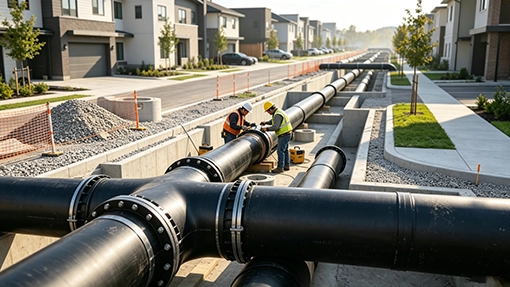
HDPE pipe in Residential distribution
2. Choose the Right HDPE Pipe Material
Not all polyethylene is created equal. For pressure water applications, the conversation almost always centers on material grade.
Materialklass: PE100
| Material / Kvalitet | Key Consideration |
|---|---|
| PE100 | High long-term strength; the default choice for pressure water supply systems |
| PE80 | Lower MRS; sometimes used for lower-pressure or non-critical applications |
| Other grades | Project-specific; always verify against the design specification |
PE100 HDPE pipes are widely specified for pressure water supply systems where long-term strength and reliability matter. De “100” refers to the Minimum Required Strength (FRU) av 10.0 MPa, which translates directly into higher allowable operating pressures and thinner walls for the same pressure class compared to lower grades.
Som sagt, do not assume PE100 is automatically the right call for every job. If the project specification explicitly calls for PE80, or if you are dealing with a gravity-fed irrigation line where pressure never exceeds 4 bar, PE100 might be unnecessary over-engineering. Always check the tender documents.
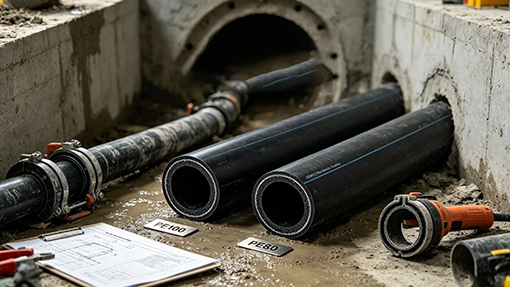
PE100 vs PE80
3. Determine the Required Pressure Rating
This is where specifications get won—or lost. Pressure rating is not just about the number on the pump curve.
Start with the Operating Pressure
You need to look at three numbers, not one:
- Normal operating pressure – The steady-state pressure during typical demand.
- Maximum operating pressure – The highest pressure the system will see under normal control (till exempel, at night with no draw-off).
- Transient conditions – Pressure surges, vatten hammare, and pump stop/start events.
A pipe rated for 10 bar static pressure might see 16 bar for a fraction of a second during a pump trip. That fraction of a second matters. HDPE handles water hammer better than brittle materials like PVC, but you still need to account for it in your PN/SDR selection.
Match Pressure Rating to Project Requirements
| Project Requirement | Vad ska kontrolleras |
|---|---|
| Normal pressure | Operating pressure at design flow |
| Peak pressure | Maximum system pressure (static + pump head) |
| Pump systems | Pressure fluctuations across the duty cycle |
| Long pipelines | Pressure surge potential from rapid valve closure |
| Variable operation | Transient conditions and fatigue risk |
The selected pipe should have a pressure rating suitable for the actual operating and transient conditions of the pipeline—not just the nominal design pressure. If your system runs a PN16 pump but experiences regular surges above that, you need to either select a higher pressure class or install surge protection.
Related Reading: For a deeper breakdown of pressure classes, see our guide on [HDPE Pipe Pressure Rating: Hur man väljer PN10, PN12,5, och PN16 rör].
4. Select the Correct HDPE Pipe Diameter
Diameter is not just “what fits in the trench.” It is a balance between flow capacity, velocity limits, pressure loss, and future-proofing.
Flow Rate and Pipe Diameter
The relationship is straightforward but often misunderstood:
- Higher flow requirement → larger diameter needed
- Larger diameter → lower flow velocity → lower friction loss → lower pumping cost
But there is a ceiling. Most water supply designs keep velocity between 0.9 m/s and 2.5 m/s. Go too low, and you risk sediment settling in low-flow zones. Go too high, and you generate excessive head loss and noise. For HDPE water supply pipes, engineers typically target the 1.0–1.5 m/s range for economic operation.
Consider Future Capacity
Here is a mistake we see on job sites regularly: sizing the pipe for today’s demand only. Municipal and industrial projects often have 20- to 50-year design horizons. If future expansion is expected, the pipe diameter should include additional capacity now—because you cannot easily upsize a buried HDPE line later without excavating the whole run.
| Faktor | Effect on Diameter Selection |
|---|---|
| Flow rate | Higher flow generally requires larger diameter |
| Pipeline length | Longer runs amplify pressure-loss sensitivity |
| Pump capacity | Sets the available pressure budget for the system |
| Future expansion | May justify one or two nominal size increases |
Related Reading: See our [HDPE-rörstorlekar och måttguide] for standard OD and ID tables.
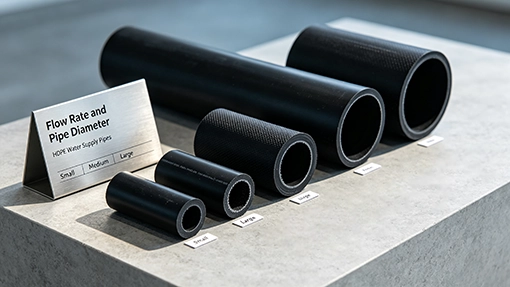
Flow Rate and Pipe Diameter
5. Choose the Appropriate SDR and Wall Thickness
If pressure rating tells you how much the pipe can take, SDR (Standardmåttförhållande) explains why it can take it. SDR is the ratio of outside diameter to wall thickness. It is the single most useful number for linking pipe geometry to pressure capacity.
What Does SDR Mean in Practice?
A lower SDR means a thicker wall relative to the diameter. A higher SDR means a thinner wall. It is that simple.
| SDR | Relative Wall Thickness | Typical Use Case |
|---|---|---|
| SDR 9 | Very thick | High-pressure industrial or pump discharge lines |
| SDR 11 | Thick | Högtrycksvattenförsörjning (PN16) |
| SDR 17 | Måttlig | Medium-pressure distribution (PN10) |
| SDR 21 | Thinner | Low-pressure or gravity applications |
SDR and Pressure Rating Work Together
SDR should not be selected independently from the project’s pressure requirements. A contractor once told us they ordered SDR17 because it was “easier to handle in the trench,” only to discover the system ran at 12 bar. That is a costly error.
For water supply projects, SDR11 and SDR17 are the most commonly specified ratios. SDR11 gives you higher pressure capacity and better resistance to external loads (jord, traffic), while SDR17 offers a lighter, more economical option where pressure demands are lower.
Related Reading: Compare the two most common options in [SDR11 vs SDR17 HDPE-rör: Vilken tryckklassning ska du välja?].
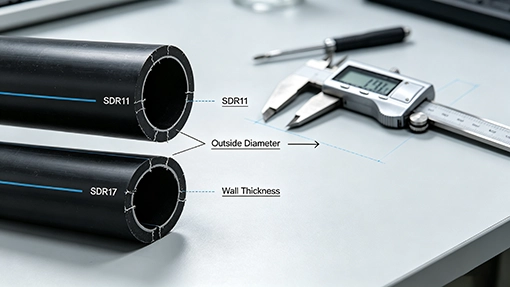
HDPE pipe SDR and wall thickness comparison
6. Consider Water Temperature and Operating Conditions
This is a factor that many buyers overlook—and it can have serious consequences.
Temperature Affects:
- Allowable working pressure – the PN rating assumes 20°C
- Material performance – PE loses strength as temperature rises
- Long-term service life – higher temperatures accelerate creep
The Derating Principle
The PN stamped on an HDPE pipe is a20°C rating. Run the same pipe at 40°C and it effectively becomes a lower-rated pipe; at 60°C, it is down to about half its marked rating.
| Temperatur | Derating Factor (PE100) | Effective Pressure for PN16 |
|---|---|---|
| 20°C | 1.00 | 16.0 bar |
| 25°C | 0.92 | 14.7 bar |
| 30°C | 0.85 | 13.6 bar |
| 40°C | 0.73 | 11.7 bar |
Viktig: Pressure ratings must be evaluated under the actual temperature and service conditions specified for the project. A PN16 pipe at 40°C behaves like a PN12 pipe.
What to Consider
- Vattentemperatur – is the source water warm (till exempel, industrial cooling water)?
- Ambient temperature – is the pipe exposed to sunlight or installed in hot climates?
- Installationsmiljö – black pipe in direct sun can get much hotter than the water inside.
7. Choose the Right Installation Method
The way you join the pipe should influence the pipe you select. Not because HDPE itself changes, but because the installation environment—trench width, access, presence of existing utilities—dictates what is feasible.
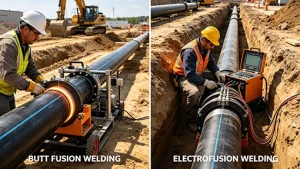
Butt Fusion
Best suited for:
- Lång, continuous pipeline sections
- Rör med stor diameter (typically ≥ 90 mm OD)
- Permanent systems where joint strength must equal pipe strength
Butt fusion creates a homogeneous joint. When done correctly, the weld zone is indistinguishable from the parent material in terms of strength. It requires access to both sides of the pipe and several meters of working space.
Elektrofusion
Best suited for:
- Restricted installation areas (tight trenches, congested utility corridors)
- Connections requiring fittings (armbågar, tees, reducers)
- Repair, modification, or tie-in situations
| Method | Best Suited For | Joint Characteristic |
|---|---|---|
| Butt Fusion | Long continuous pipelines, large diameters | Homogeneous, full-strength weld |
| Elektrofusion | Beslag, confined spaces, repair work | Fitting-integrated heating element |
The installation method should be considered when selecting the pipe och fittings together. There is no point specifying SDR11 pipe if your electrofusion fittings inventory only covers SDR17.
Related Reading: Review fusion techniques in [HDPE Pipe Fusion Svetsmetoder] and installation best practices in [How to Install HDPE Pipes Underground].

HDPE pipe installation and fusion welding for water supply
8. Select Compatible HDPE Pipe Fittings
Pipes and fittings are a system. Mixing incompatible components is one of the fastest ways to create a failure point.
Fittings Must Match the Pipe System
Before you order, verify compatibility across:
- Rördiameter – Nominal size must align exactly.
- SDR – An SDR11 fitting on an SDR17 pipe creates a step and a stress riser.
- Tryckklassificering – Fittings must meet or exceed the pipe’s PN class.
- Anslutningsmetod – Butt fusion, elektrofusion, or mechanical.
- Materialkvalitet – PE100 fittings with PE100 pipe.
- Project standards – Potable water approval, if required.
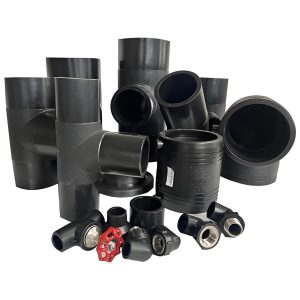
Typical fittings for water supply systems include elbows (45° and 90°), equal and reducing tees, concentric reducers, stub ends with backing flanges, kopplingar, and isolation valves. Each one needs to be specified as part of the same system, not picked from a generic catalog.
Related Reading: See [Den kompletta checklistan för att specificera HDPE-rörkopplingar].
9. Check Applicable Standards and Project Requirements
Before placing an order, confirm that the pipe meets all relevant standards.
Key Standards for HDPE Water Supply Pipes
| Standard | Scope |
|---|---|
| ISO 4427 | International standard for PE pipes for water supply |
| I 12201 | European standard for PE pipes for water supply |
| ASTM F714 | US standard for PE pipe (OD-controlled) |
| ASTM D3035 | US standard for smaller diameter PE pipes |
| GB/T 13663 | Chinese standard for PE pipes for water supply |
Pre-Order Confirmation Checklist
Innan du beställer, confirm:
- Required product standard (ISO 4427, I 12201, ASTM, etc.)
- Pipe dimensions (ytterdiameter, väggtjocklek)
- Pressure class (PN-betyg)
- Materialkvalitet (PE100 minimum)
- Testing and certification requirements
- Överensstämmelse med dricksvatten (om tillämpligt)
- Local project specifications and regulatory requirements
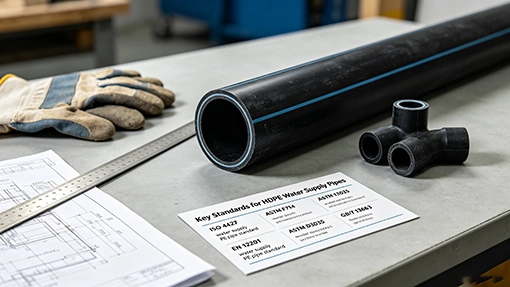
HDPE vattenförsörjningsrör
Need Help Choosing the Right HDPE Pipe?
If you have a water supply project and need support narrowing down the specification, our team can help. Provide us with:
- Ansökan – What is the pipeline for?
- Rördiameter – Required nominal size, if known
- Required pressure – Operating and maximum pressure
- SDR / PN – If already specified in the project documents
- Quantity – Total length required
- Installation conditions – Underground, above ground, trench conditions
- Project location – Relevant standards and delivery requirements
Kontakta Luoyang Datang Energy Tech Co., Ltd with these details, and we will help confirm the suitable HDPE pipe specification for your project.
RELATERADE INLÄGG
PVC Plug Bend vs. Standard armbåge: Vilket sparar mer underhållshuvudvärk?
Fördelarna och tillämpningarna med slumpmässiga rör av polyeten i VVS
HDPE Pipeline Skapar vattenbesparande jordbruksmirakel?
HDPE Pipe Fusion Svetsmetoder: Butt Fusion vs Electrofusion för pipelineinstallation
Varför välja PVC-rör med stor diameter?