LUOYANG CAME ENERGY TECH CO., LTD

Матеріали протипожежних труб: Вибір & Додатки
Надійний система протипожежного захисту залежить від високоякісних матеріалів трубопроводів, які можуть швидко та безпечно доставляти воду в надзвичайних ситуаціях. Вибір відповідних матеріалів вогнезахисних труб безпосередньо впливає на продуктивність системи, довговічність, вимоги до обслуговування, і довгострокові експлуатаційні витрати.
Вогнезахисні труби повинні витримувати постійний тиск, різкі зміни тиску, вплив навколишнього середовища, і роки безвідмовної служби. тому, такі фактори, як ефективність потоку води, продуктивність тиску, стійкість до корозії, термін служби, Перед вибором матеріалу для труб слід ретельно розглянути вимоги до обслуговування.
Для різних застосувань потрібні різні матеріали труб. Труби з вуглецевої сталі широко використовуються в промислових і комерційних системах протипожежного захисту завдяки своїй міцності та економічності. Труби з нержавіючої сталі забезпечують чудову стійкість до корозії для вимогливих умов. Інші матеріали також можуть бути обрані для конкретних підземних або легких застосувань.
У цьому посібнику описано найпоширеніші матеріали протипожежних труб, їх переваги, обмеження, і відповідні програми для допомоги інженерам, підрядники, і покупці приймають кращі рішення.
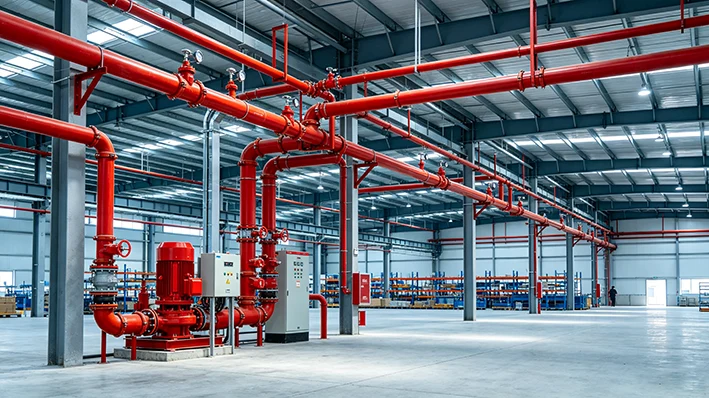
Система протипожежних труб, встановлена в промисловій будівлі зі спринклерними трубами
Що таке вогнезахисні труби?
Вогнезахисні труби | Вогнегасні труби | Пожежні спринклерні труби
Вогнезахисні труби - це системи трубопроводів, призначені для транспортування води або засобів пожежогасіння:
- Пожежні спринклерні системи – Автоматичне гасіння пожежі в будівлях
- Пожежні гідрантні системи – Зовнішнє та внутрішнє протипожежне водопостачання
- Системи пожежогасіння – Спеціалізовані системи промислових небезпек
Ці труби встановлюються на різноманітних об’єктах:
| Тип програми | Приклади |
| Комерційні будівлі | Офісні будівлі, торгові центри, готелі, лікарні |
| Промислові об'єкти | Заводи, складські приміщення, виробничі підприємства |
| Інфраструктурні проекти | Аеропорти, підземні споруди, великі громадські будівлі |
Пов'язана стаття:
Повний посібник із систем протипожежного трубопроводу: Труби, Клапани & Пазові фітинги

Схема протипожежної системи трубопроводів із спринклерними та гідрантними трубами
Ключові фактори для вибору матеріалів протипожежних труб
Перш ніж порівнювати конкретні матеріали, важливо розуміти ключові фактори, які фахівці із закупівель, інженерів, і покупці проекту враховують при виборі матеріалів вогнезахисних труб.
Номінальний тиск і механічна міцність
Системи протипожежного захисту повинні витримувати як стабільний робочий тиск, так і різкі зміни тиску під час роботи. Матеріал труби повинен відповідати:
- Ємність робочого тиску – Здатність зберігати цілісність у нормальних умовах експлуатації
- Ударостійкість – Захист від механічних пошкоджень під час монтажу та обслуговування
- Довгострокова надійність – Стабільна продуктивність протягом очікуваного терміну служби системи
Труби з вуглецевої сталі, наприклад, відповідно до ASTM A795 для протипожежного використання в розмірах від NPS ½ дюйма до NPS 10 дюйм (DN 15 до ДН 250), з товщиною стінок, яка забезпечує необхідну міцність для різних вимог тиску.
Стійкість до корозії
Вогнезахисні труби встановлюються в дуже різних середовищах, кожен представляє унікальні проблеми з корозією:
- Внутрішні сухі приміщення – Низький ризик корозії, але все ще піддається впливу вологості
- Зовнішнє середовище – Вплив погодних умов, температурні коливання, та УФ-випромінювання
- Підземний монтаж – Грунтові умови, вологи, і блукаючі електричні струми
- Хімічні середовища – Промислові об’єкти з агресивною атмосферою
Стійкість матеріалу до корозії безпосередньо впливає на інтервали технічного обслуговування та загальну довговічність системи. Такі фактори, як розчинений кисень, pH levels, and ion concentrations—including chlorides—contribute to the corrosive environment in piping. High chloride levels can cause pitting corrosion, leading to small but critical failures.
Середовище встановлення
Different installation environments demand different material considerations:
| Environment | Recommended Consideration |
| Комерційні будівлі | Cost-effectiveness and reliability |
| Промислові заводи | Strength and durability |
| Marine/coastal areas | Superior corrosion resistance |
| Underground systems | Protection against external corrosion and soil conditions |
NFPA standards provide guidance on material selection for different applications. For instance, NFPA 24 addresses suction pipe materials and specifies the use of certain types of iron, сталь, бетон, пластик, and copper for underground fire piping.
Maintenance Cost and Service Life
Initial material cost is only one piece of the puzzle. A comprehensive evaluation must consider:
- Replacement frequency – How often will the system need to be replaced?
- Maintenance requirements – What ongoing inspection and upkeep are needed?
- Total lifecycle cost – The sum of initial cost, установка, обслуговування, and replacement over the system’s life
Steel pipe, for instance, needs to be internally inspected every five years under NFPA 25: Standard for the Inspection, Testing and Maintenance of Water-Based Fire Protection Systems. Materials with superior corrosion resistance may reduce or eliminate this requirement.
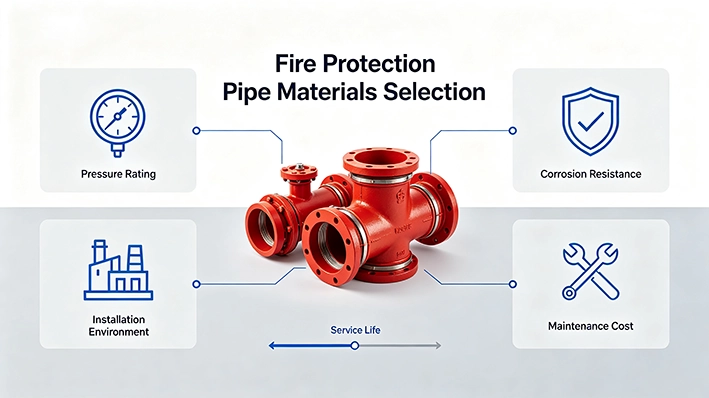
Key factors for selecting fire protection pipe materials infographic
Carbon Steel Pipes for Fire Protection Systems
Труби з вуглецевої сталі are one of the most commonly used materials in fire protection piping systems due to their excellent mechanical strength, довговічність, and cost efficiency.
For decades, carbon steel fire pipes have been widely installed in commercial buildings, industrial facilities, складські приміщення, and large infrastructure projects where reliable water transportation is required.
Their ability to withstand high pressure and provide stable performance makes them a preferred choice for many fire sprinkler and fire hydrant systems.
Advantages of Carbon Steel Fire Pipes
High Mechanical Strength
Carbon steel pipe provides excellent mechanical strength, making it suitable for:
- High-pressure fire protection systems
- Трубопроводи великого діаметру
- Systems requiring threaded or grooved connections
- ASTM A795 pipe is suitable for joining by rolled groove, зварювання, різьблення, and fittings for plain end pipe.
Cost-Effectiveness
Compared to stainless steel, carbon steel offers:
- Менша вартість матеріалу
- Wide availability from multiple suppliers
- Established supply chains and manufacturing capacity
Wide Industrial Application
Carbon steel fire pipes are the standard choice for:
- Factories and industrial facilities
- Warehouses and distribution centers
- Commercial buildings and offices
- Fire hydrant and standpipe systems
Limitations of Carbon Steel Pipes
While carbon steel is highly versatile, it has limitations that must be addressed:
- Corrosion vulnerability – Black steel pipe has little to no protective coating and will rust from the inside in wet systems
- Coating requirements – Galvanizing or other protective coatings are often necessary
- Maintenance in humid environments – Regular inspection and corrosion management are required
For wet pipe systems, NFPA 13 requires galvanized pipe. The pipe may be bent, but it is not intended for bending where the inside diameter of the bend is less than twelve times the outside diameter.
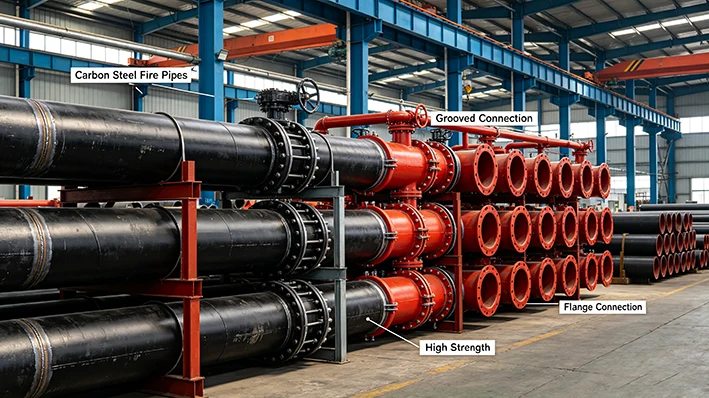
Carbon steel fire protection pipes used in industrial sprinkler systems
Stainless Steel Pipes for Fire Protection Applications
Труби з нержавіючої сталі provide excellent corrosion resistance, довговічність, і довгострокову надійність, making them suitable for specialized fire protection applications.
Unlike traditional carbon steel pipes, stainless steel fire pipes perform better in environments where moisture, хімічні речовини, or aggressive conditions may affect piping performance.
For projects requiring higher durability and reduced maintenance, stainless steel is often considered a premium piping solution.
Advantages of Stainless Steel Fire Pipes
Чудова стійкість до корозії
Stainless steel’s corrosion resistance is its defining advantage. When exposed to oxidants, stainless steel passivates and forms a protective film on the surface that prevents further oxidation. This makes it ideal for:
- Coastal and marine environments
- Chemical processing facilities
- Food processing plants
- Areas with aggressive water conditions
Тривалий термін служби
The superior corrosion resistance translates directly to:
- Reduced replacement frequency
- Minimal maintenance requirements
- Lower lifecycle costs despite higher initial investment
High Tensile Strength
The tensile strength of 304 stainless steel pipe is approximately two times that of carbon steel pipe and eight to ten times that of plastic pipe. It also offers good ductility and toughness, allowing it to withstand vibration, impact, and thermal expansion and contraction.
Clean and Professional Appearance
Stainless steel’s attractive appearance makes it suitable for:
- Visible piping systems in high-end facilities
- Architectural applications where aesthetics matter
Limitations of Stainless Steel Pipes
Higher Material Cost
The primary limitation is cost:
- Higher material cost than carbon steel
- Higher initial investment required
Corrosion Considerations
While stainless steel is highly corrosion-resistant, it is not immune to corrosion. In some cases, unexpected corrosion failures in austenitic stainless steel systems have been observed after only a few weeks to a few years of use. Most corrosion damage is associated with weld nuggets or heat-affected zones of girth site welds. Proper root shielding is especially important when welding pipes for fire protection systems.
In stagnant water conditions—common in firewater systems—the corrosion resistance of stainless steel diminishes. Microbially induced corrosion (MIC) can also increase the risk of corrosion damage.
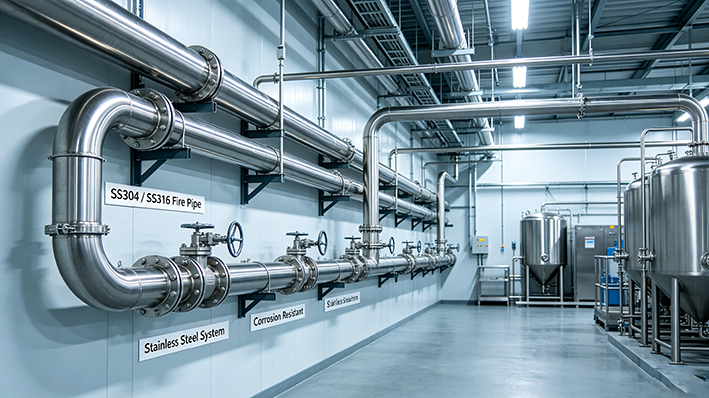
Stainless steel fire protection pipe with corrosion resistant surface
HDPE Pipes in Fire Protection Systems
HDPE (Поліетилен високої щільності) труби are lightweight piping solutions that may be used in certain fire protection applications, especially underground installations.
У порівнянні з металевими трубами, HDPE pipes offer excellent corrosion resistance and easier installation.
Проте, the suitability of HDPE pipes depends on project requirements, pressure ratings, and local fire protection standards.
Advantages of HDPE Pipes
- Стійкість до корозії – HDPE pipes are highly resistant to corrosion, an essential feature in fire fighting environments
- Легкий – Easier to transport and install than metal pipes
- Гнучкість – Can accommodate ground movement and settlement
- Економічно вигідний – Lower material and installation costs for large-diameter underground systems
Considerations and Limitations
- Above-ground limitations – When used above ground, fire resistance may be an issue. HDPE starts to melt at approximately 235°F (115°C)
- Application restrictions – HDPE is generally only allowed for underground use to avoid UV aging
- Вимоги до тиску – Must meet specific pressure ratings for fire protection service
- Local standards – Must comply with local fire protection codes and NFPA requirements
NFPA 24 permits the use of plastic piping for underground installations, provided it is listed for such use. Проте, some local authorities prohibit certain plastic piping for fire underground service.
Рекомендація
HDPE is best suited for underground fire mains where corrosion resistance and flexibility are priorities. For above-ground applications, metallic piping remains the standard choice.
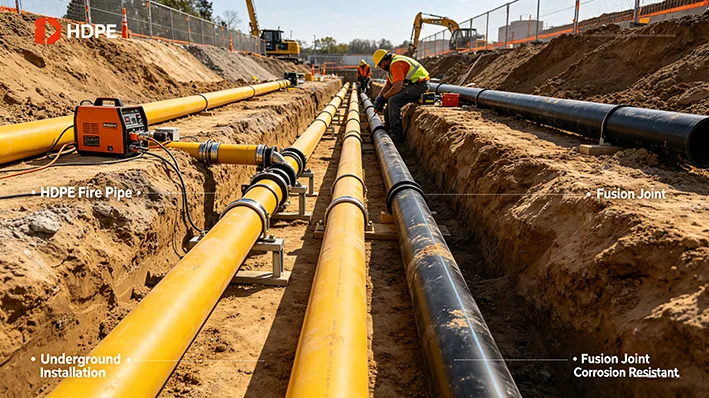
HDPE underground fire protection pipe installation project
Fire Protection Pipe Materials Comparison
| Особливість | Вуглецева сталь | Нержавіюча сталь | HDPE |
| Сила | Чудово | Чудово | добре |
| Стійкість до корозії | Середній (requires coating) | Чудово | Чудово |
| Initial Cost | Нижній | Вища | Середній |
| Вимоги до технічного обслуговування | Середній | Низький | Низький |
| Temperature Resistance | Чудово | Чудово | Limited (melts at ~235°F) |
| Типове застосування | Індустріальний & комерційний | Corrosive environments | Underground systems |
| Key Standard | ASTM A795 | ASTM A312 / GB/T 12771 | Various |

Comparison of carbon steel stainless steel and HDPE fire protection pipes
Recommended Applications for Different Fire Protection Pipe Materials
Choosing the right fire protection pipe material depends largely on the project environment, system requirements, and long-term operating conditions.
There is no single material that is suitable for every application. Вуглецева сталь, нержавіюча сталь, and HDPE pipes each have their own advantages in different scenarios.
Комерційні будівлі (Офіси, Hotels, Shopping Centers)
Рекомендовано: Вуглецева сталь
Reasons:
- Cost-effective for large-scale installations
- Easy sourcing and established supply chains
- Reliable performance in indoor environments
- Meets NFPA 13 requirements for commercial occupancies
Промислові об'єкти
Рекомендовано: Carbon Steel or Stainless Steel (depending on environment)
| Environment | Recommended Material |
| General industrial (dry) | Вуглецева сталь |
| Corrosive environments | Нержавіюча сталь |
| High-temperature areas | Carbon Steel or Stainless Steel |
| Обробка харчових продуктів | Нержавіюча сталь |
Chemical and Coastal Applications
Рекомендовано: Нержавіюча сталь
Reasons:
- High corrosion resistance in aggressive environments
- Longer service life reduces replacement frequency
- Withstands saltwater exposure and chemical atmospheres
A demonstration project at the Chimu-Wan tank farms on Okinawa Island—one of the most corrosive locations in the world for steel infrastructure—successfully replaced highly corroded carbon steel pipes with stainless steel.
Underground Fire Protection Systems
Рекомендовано: HDPE or Coated Carbon Steel (depending on design requirements)
| Consideration | Recommended Material |
| Corrosive soil conditions | HDPE or coated steel |
| High traffic/loading areas | Ductile iron or steel |
| Budget-constrained projects | HDPE |
| Strict local codes | Coated carbon steel or ductile iron |
NFPA 24 provides guidance on underground fire piping materials, including ductile iron, бетон, пластик, мідь, and stainless steel.

Fire protection pipe applications in commercial industrial and underground systems
How to Choose the Right Fire Protection Pipe Material
Selecting the right fire protection pipe material requires a systematic evaluation of multiple factors. Here is a practical decision framework:
1. Assess System Pressure Requirements
- Determine working pressure and potential surge pressures
- Verify that the chosen material meets or exceeds requirements
- Consider future expansion or system modifications
2. Evaluate the Installation Environment
- Indoor or outdoor?
- Above ground or underground?
- Coastal, промислові, or chemical environment?
- What are the temperature extremes?
3. Analyze Corrosion Risk
- What is the water quality (pH, chloride content, dissolved oxygen)?
- Is the system wet or dry?
- What is the expected service life?
- Consider microbiologically induced corrosion (MIC) risk
Приклади:
| Environment | Recommended Material |
| Standard commercial buildings | Вуглецева сталь |
| Промислове застосування | Вуглецева сталь / Нержавіюча сталь |
| Хімічні середовища | Нержавіюча сталь |
| Underground systems | HDPE / Protected Steel |
4. Consider Budget and Lifecycle Costs
- Initial material cost
- Вартість монтажу
- Maintenance requirements and frequency
- Expected replacement interval
- Total cost of ownership over system life
5. Verify Local Standards and Regulations
- NFPA 13, NFPA 14, and NFPA 24 вимоги
- Local building codes and fire marshal requirements
- ASTM specifications (A795 for carbon steel, тощо)
- UL/FM approvals where required
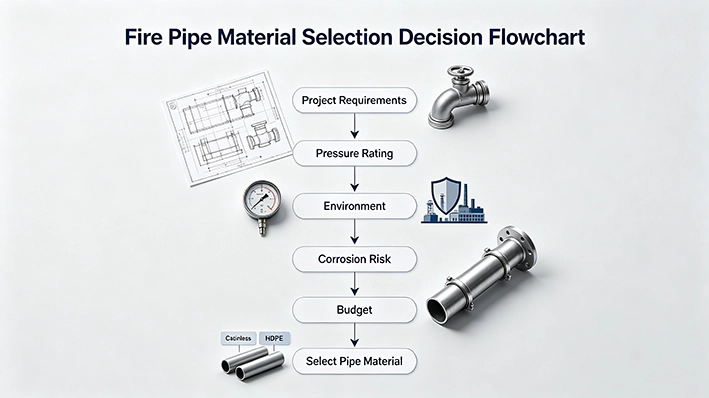
Fire protection pipe material selection decision making flowchart
Why Choose Us for Fire Protection Pipe Solutions
LUOYANG CAME ENERGY TECH CO., LTD provides comprehensive fire protection piping solutions for projects worldwide.
Our Product Range
- Вогнезахисні труби – Carbon steel (ASTM A795, A53, A135) and stainless steel
- Industrial valves – For fire protection and general industrial applications
- Трубопровідна арматура – Complete range for fire sprinkler and hydrant systems
- Complete piping solutions – Engineered to meet your specific requirements
Наші переваги
- Виробничий досвід – Years of expertise in pipe production and supply
- Export capability – Global shipping and logistics support
- Multiple material options – Carbon steel, нержавіюча сталь, and more
- Customized solutions – Tailored to your project specifications
- Quality assurance – Products meet ASTM, NFPA, and international standards
Ready to discuss your fire protection piping needs?
Contact our team today for expert guidance and competitive quotes. Our engineers will assist you in selecting the most suitable specifications for your project.
ПОВ’ЯЗАНІ ПУБЛІКАЦІЇ
Як використовувати PPR трубу та фітинг, PEX труби та фітинги, і ПВХ труби та фітинги для створення ефективних систем
7 Революційні переваги PPR трубопроводу в сучасному водопостачанні & Дренажна система
Поглиблений аналіз промислових труб PEX-AL-PEX
Чому PPR труби є першим вибором для сучасних будинків?

Не купуйте латунні трубні крани лише за ціною! 3 “Скорочення витрат” Секрети 90% покупців міс.