LUOYANG DATANG ENERGY TECH CO.,LTD


What Buyers Need to Know Before Ordering Brass Elbow Fittings
Many buyers assume brass elbow fittings are simple connection components. After all, an elbow is just a curved piece of metal that changes flow direction, right? Not quite. In real-world procurement, a single wrong thread standard, an incorrect size, or an unsuitable alloy can lead to leakage, installation failures, and costly project delays.
Brass elbow fittings are widely used in plumbing, HVAC, water supply, and industrial piping systems. But the gap between “ordering one” and “ordering the right one” is where most problems live. This guide walks through the key decisions every buyer should nail down before placing an order — from application analysis and material selection to thread standards, sizing, common mistakes, and supplier evaluation.
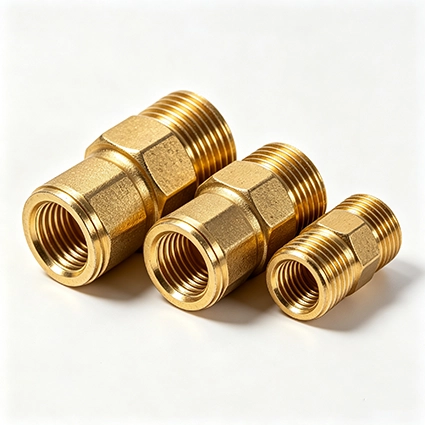
Brass Elbow Fittings
1. Understand Your Application Before Ordering Brass Elbow Fittings
The biggest mistake buyers make? Picking a product before understanding the application. Brass pipe fittings are not one-size-fits-all. A fitting that works perfectly in a residential plumbing line may fail miserably in a gas application or a high-temperature HVAC system.
| Application | Key Requirements | Recommended Considerations |
|---|---|---|
| Plumbing Systems | Leak prevention, corrosion resistance | Material grade and thread accuracy |
| HVAC Systems | Reliable connection, temperature resistance | Size matching and pressure rating |
| Water Systems | Safety and durability | Lead-free requirements (NSF/61, WRAS) |
| Gas Applications | Sealing performance | Thread standard and pressure testing |
For potable water systems, lead-free brass is not optional — it’s a regulatory requirement in most developed markets. For gas lines, the sealing performance of the threaded connection becomes the single most critical factor. Understanding these differences upfront saves you from expensive returns and reputation damage.

Brass Elbow Fittings in Plumbing Systems
2. Confirm the Right Brass Material and Quality Requirements
Not all brass is created equal. The alloy you choose directly affects corrosion resistance, machinability, thread accuracy, and long-term performance.
Common brass alloys used in elbow fittings include:
| Alloy | Composition | Typical Use |
|---|---|---|
| C36000 (Free-Cutting Brass) | ~61.5% Cu, ~3% Pb | General plumbing, high machinability |
| C37700 (Forging Brass) | ~59% Cu, ~2% Pb | Forged fittings, good strength |
| Lead-Free Brass (e.g., C69300, C3771) | <0.25% Pb | Potable water, regulated markets |
Brass fittings should contain a minimum of 58% copper content (CuZn39Pb3 or better). Lower copper content leads to premature cracking and thread stripping, a problem that often only surfaces after installation when the fitting is under pressure.
| Material Factor | Why It Matters |
|---|---|
| Corrosion resistance | Longer service life, especially in humid or chemical environments |
| Machinability | Better thread accuracy, cleaner surface finish |
| Strength | Reliable performance under rated pressure |
| Compliance | Meets market-specific regulations (NSF, WRAS, RoHS) |
One thing many buyers overlook: “lead-free” doesn’t mean completely void of lead. It typically means the lead content is below the regulatory threshold (usually 0.25%). Always ask your brass elbow manufacturer for material certificates and composition test reports.

Common brass alloys used in elbow fittings
3. Choose the Correct Brass Elbow Type for Your Project
This isn’t a textbook exercise in “types of elbows.” It’s a procurement decision. Each type serves a specific installation scenario, and choosing wrong means rework.
| Type | Typical Use | Buyer Consideration |
|---|---|---|
| 90° Brass Elbow | Direction change in limited space | Most common plumbing choice; confirm male/female ends |
| 45° Brass Elbow | Smooth flow transition | Used where lower pressure loss is needed |
| Street Elbow | Compact installation | One end male, one end female — check connection orientation |
| Reducing Elbow | Connecting different pipe sizes | Confirm inlet and outlet dimensions separately |
The 90-degree brass elbow is the workhorse of plumbing systems — you’ll find it in nearly every residential and commercial installation. The 45-degree version is less common but valuable in systems where pressure drop matters. Reducing elbows are where mistakes happen most often: buyers confirm one end’s size and assume the other, leading to mismatched connections.
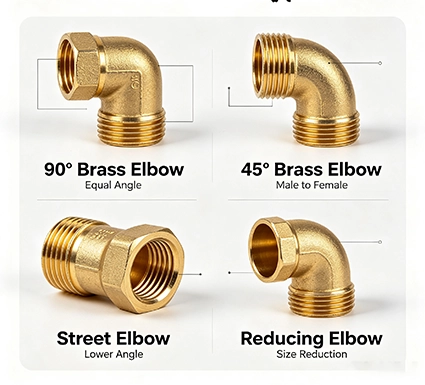
Brass Elbow Types
4. Check Thread Standards Before Placing an Order
This is the section that saves projects. Thread standard mismatches are the number one cause of installation failures in cross-border brass fitting procurement.
| Thread Type | Common Market | Key Features |
|---|---|---|
| NPT (National Pipe Taper) | North America | 60° thread angle, tapered, flattened peaks |
| BSP (British Standard Pipe) | Europe, Asia, many global markets | 55° thread angle, parallel (BSPP) or tapered (BSPT) |
| Metric Thread | Some industrial applications | Measured in millimeters |
Here’s the critical fact: NPT and BSP threads have different thread angles (60° vs 55°), different thread forms, and in most cases different threads per inch. They will not mate to form a reliable pressure joint — and no amount of thread sealant or Teflon tape changes that. NPT threads are flattened at the peaks and valleys, while BSP threads are rounded.
Before ordering threaded brass elbows, confirm these four things with your supplier:
- Thread type — NPT, BSPP, BSPT, or Metric
- Male or female thread — and which end carries which
- Thread size — 1/4″, 3/8″, 1/2″, 3/4″, 1″
- Tolerance — especially for critical sealing applications
5. Size and Specification Details Buyers Should Confirm
“1/2 inch elbow” is not a specification. It’s a starting point. A complete specification includes the following:
| Specification | Example |
|---|---|
| Nominal Size | 1/4″, 3/8″, 1/2″, 3/4″, 1″ |
| Connection | Male × Female, Female × Female, Male × Male |
| Angle | 45° / 90° |
| Working Pressure | According to application (e.g., 250 PSI CWP) |
| Temperature Range | e.g., -20°C to 120°C |
| Material | C36000 / C37700 / Lead-Free Brass |
| Surface Treatment | Natural / Nickel-plated |
Brass elbow fittings for instrumentation applications, for example, can be rated up to 3,500 psi, while standard plumbing elbows typically handle 160–250 psi depending on temperature. If you only specify the nominal size, you’re leaving the door open for the wrong product to arrive.

Thread Type:NPT,BSP,Metric Thread
6. Common Mistakes Buyers Make When Purchasing Brass Elbow Fittings
Let’s be honest — most procurement mistakes aren’t exotic. They’re predictable. Here are the ones that come up again and again:
| Mistake | Possible Result | Solution |
|---|---|---|
| Ignoring thread standards | Installation failure, leaks | Confirm NPT/BSP before ordering |
| Choosing only by price | Quality issues, high return rate | Evaluate supplier capability, not just unit cost |
| Not confirming drawings | Wrong dimensions | Provide or request detailed drawings |
| Ignoring application conditions | Reduced service life | Match product specs to actual operating conditions |
| Skipping sample testing | Batch quality surprises | Order and test samples before mass production |
A particularly sneaky trap: inferior brass fittings with material adulteration or uncleaned burrs, sand holes, and poor thread accuracy that doesn’t match standard NPT/BSP specifications. These defects are often invisible at delivery but show up months later as seal failures or accelerated corrosion.
7. How to Evaluate a Reliable Brass Elbow Supplier
This is where the real due diligence happens. Price matters, but supplier capability determines whether your order arrives on time, within spec, and without surprises.
| Supplier Capability | What Buyers Should Check |
|---|---|
| Manufacturing experience | Years in business, product range, export track record |
| Machining capability | CNC equipment, thread accuracy, surface finish quality |
| Quality control | Incoming material testing, in-process inspection, final pressure testing |
| Customization | OEM sizes, drawings, special thread types, private labeling |
| Documentation | Material certificates (EN 10204 3.1), test reports, compliance docs |
On-time delivery rate is a telling metric — suppliers with ≥98% consistency are typically well-organized operations. But don’t just take their word for it. Request samples, test thread fit, check weight consistency, and inspect surface finish before committing to a production run.

Brass Elbow Fittings in HVAC Systems
8. Why Work with a Professional Brass Fittings Manufacturer?
There’s a meaningful difference between a trading company that sources brass fittings and a manufacturer that actually machines them. When you work directly with a brass elbow manufacturer, you get:
- Direct access to production control — you know exactly what machine, what material, what tolerance
- Faster customization turnaround — OEM sizes, custom drawings, and special thread types without middleman delays
- Full quality documentation — material certificates, dimensional inspection reports, pressure test records
- Export experience — understanding of destination market requirements (NSF, WRAS, RoHS, etc.)
A manufacturer with in-house CNC machining centers can hold thread tolerances that generic suppliers simply can’t match. That’s the difference between a fitting that installs smoothly and one that leaks on day one.
FAQ
Q1: What information should I provide when ordering brass elbow fittings?
Provide your application details (plumbing, HVAC, gas, etc.), required size, thread standard (NPT/BSP/Metric), connection type (male/female), quantity, and any relevant drawings or samples. The more specific you are, the fewer surprises you’ll face.
Q2: What thread standards are available for brass elbows?
The most common are NPT (North America), BSP/BSPT (Europe and international), and Metric threads for specific industrial applications. Always confirm the thread standard your installation requires — mixing NPT and BSP is a recipe for failure.
Q3: Are brass elbow fittings suitable for HVAC systems?
Yes. Brass elbow fittings are widely used in HVAC for refrigerant lines and drainage. Key considerations include temperature resistance, pressure rating, and proper thread sealing. For refrigerant applications, nickel-plated brass may offer additional corrosion protection.
Q4: How can I choose the correct brass elbow size?
Start with your pipe or tube dimensions. Confirm the nominal size, connection type (male/female), and thread standard. If you’re connecting different pipe sizes, a reducing elbow may be needed. When in doubt, send a sample or detailed drawing to your supplier.
Q5: Can manufacturers provide custom brass elbow fittings?
Yes. Most professional brass fittings manufacturers offer OEM and ODM services, including custom sizes, thread types, surface finishes, and private labeling. Custom brass fittings typically require a drawing or sample, and lead times vary based on complexity.
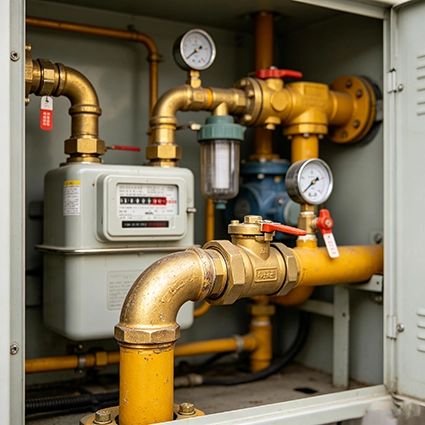
Brass Elbow Fittings in Gas Application
Need Brass Elbow Fittings for Your Project?
Luoyang Datang Energy Tech Co., Ltd manufacture brass elbow fittings in standard and custom configurations — NPT, BSP, and metric threads; 90° and 45° angles; lead-free brass for potable water.
To get an accurate quote, simply provide:
- Size requirements
- Thread standards
- Drawings or samples (if available)
- Application details
RELATED POSTS
Global Pipeline Demand Outlook 2026: Infrastructure, Oil & Gas, and Energy Transition Driving High-Performance Pipe Materials
High-Performance Materials Substitution Trends in the Pipe Industry
Why Choose Large Diameter PVC Pipe?
Industrial Pipe Fittings Guide: Types, Materials, Standards & Applications
The Advantages and Applications of Polyethylene Random Pipes in Home Plumbing