LUOYANG CAME ENERGY TECH CO.,LTD


HDPE түтүктөрүн жер астына кантип орнотуу керек: Негизги кадамдар, Методдор, жана мыкты тажрыйбалар
Жогорку тыгыздыктагы полиэтилен (HDPE) түтүктөр мыкты коррозияга туруктуулугунан улам жер астындагы түтүк системалары үчүн артыкчылыктуу чечим болуп калды, ийкемдүүлүк, жеңил структура, жана узак кызмат мөөнөтү. Алар муниципалдык суу менен камсыздоодо кеңири колдонулат, айыл чарба сугат, тоо-кен шламын ташуу, өнөр жай суюктук системалары, жана башка талап кылынган колдонмолор.
Бирок, HDPE куурунун иштеши жана кызмат мөөнөтү түтүктүн сапатына гана көз каранды эмес. Туура HDPE түтүктөрүн орнотуу агып кетпей иштешин камсыз кылууда бирдей маанилуу роль ойнойт, структуралык туруктуулук, жана узак мөөнөттүү ишенимдүүлүк.
Начар орнотулган жер астындагы куурда биргелешкен иштен чыгуу сыяктуу көйгөйлөр пайда болушу мүмкүн, түтүк деформациясы, ашыкча стресс, же кыскартылган басым аткаруу. Ошондуктан, туура түшүнүү жер астындагы HDPE түтүктөрүн орнотуу процесс инженерлер үчүн абдан маанилүү, подрядчылар, жана долбоордун ээлери.
Бул колдонмо HDPE түтүгүн орнотуунун толук жол-жобосун түшүндүрөт, анын ичинде сайтты даярдоо, окоп казуу, түтүктөрдү бириктирүү ыкмалары, кайра толтуруу, жалпы каталар, жана жер астындагы түтүктөрдү ийгиликтүү ишке ашыруу боюнча мыкты тажрыйбалар.
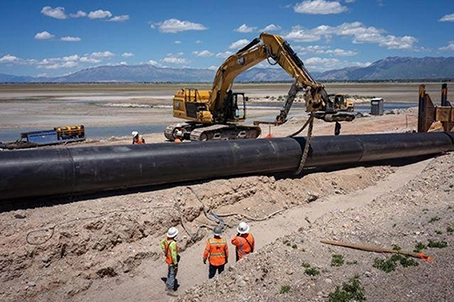
Жер астындагы HDPE түтүктөрүн орнотуу процесси терүү ширетүү жана траншея куруу
Эмне үчүн туура жер астындагы HDPE түтүктөрүн орнотуу маанилүү
сапаты жер астындагы HDPE түтүктөрүн орнотуу бүт түтүк системасынын кызмат мөөнөтүн жана натыйжалуулугун түздөн-түз аныктайт. Жер үстүндөгү түтүктөрдөн айырмаланып, жер астындагы түтүкчөлөр кайра толтурулгандан кийин көрүнбөйт, бул кемчиликтерди табуу жана оңдоону кыйын жана кымбат кылат.
| Орнотуу фактору | Потенциалдуу натыйжа |
|---|---|
| Туура эмес казуу | Түтүктөрдүн деформациясы жана стресстин концентрациясы |
| Начар биригүү | Ашып кетүү коркунучу жана биргелешкен иштен чыгуу |
| Туура эмес басым/SDR тандоо | Кыскартылган кызмат мөөнөтү жана жарылуу коркунучу |
| Туура эмес толтуруу | Тышкы зыян жана чекит жүктөө |
| Төшөктөрдүн жетишсиздиги | Бир калыпта эмес колдоо жана түтүктүн солкулдашы |
Негизги алып кетүү: ИйгиликтууHDPE түтүктөрүн орнотуу ар бир этапта кылдаттык менен көңүл бурууну талап кылат - материалды тандоодон акыркы ныктоого чейин.
HDPE түтүктөрүн жер астына орнотуудан мурун даярдоо
1. Туура HDPE түтүгүн тандаңыз
HDPE түтүктүн туура спецификациясын тандоо ийгиликтүү орнотуунун негизи болуп саналат. Төмөнкү факторлорду баалоо керек:
| Фактор | Description | Common Options |
|---|---|---|
| Түтүк диаметри | агымынын кубаттуулугун аныктайт | DN20 - DN1200+ |
| Басым рейтинги (PN) | Максималдуу иштөө басымы | PN6, PN10, PN16, PN25 |
| SDR рейтинги | Стандарттык өлчөм катышы | SDR11, SDR17, SDR21, SDR26 |
| Материалдык даража | PE80 же PE100 чайыр | PE80, PE100 |
| Түс коду | Колдонмонун идентификациясы | Кара (суу), Көк (ичүүгө жарактуу), Сары (газ) |
Негизги ойлор:
- PE100 жогорку күч сунуш кылат жана бирдей басым рейтинги үчүн ичке дубалдарды берет, салмагын жана наркын азайтуу.
- SDR11 жогорку басым колдонмолор үчүн ылайыктуу болуп саналат, ал эми SDR17 көбүнчө тартылуу-агым системалары үчүн колдонулат.
- Ар дайым түтүк жана арматуралар таанылган стандарттарга ылайык жасалганын текшериңиз (ISO 4427, IN 12201, же ASTM D3035).
Ички шилтеме: Биздин гиддерди караңыз SDR11 vs SDR17 HDPE түтүгү жана HDPE түтүк басымынын рейтинги боюнча колдонмо for detailed selection criteria.

HDPE pipes used in municipal water supply and industrial pipeline systems
2. Inspect Pipes and Fittings Before Installation
Before any pipe is lowered into the trench, thorough inspection is mandatory. Pipe damage prior to completion of the project shall be repaired or replaced by the contractor.
| Inspection Item | Талап |
|---|---|
| Pipe surface | No cracks, cuts, or gouges — cuts deeper than 10% of wall thickness must be cut out |
| Pipe ends | Таза, smooth, square-cut, free from fins and burrs |
| Арматуралар | Correct specification, no damage, таза |
| Ovality | Pipe should be round — excessive ovality affects fusion quality |
Storage tip: Store pipes at the job site in manufacturer-provided packaging. Protect from direct sunlight by covering with opaque material while allowing air circulation.
Step-by-Step HDPE Pipe Underground Installation Procedure
Кадам 1: Site Preparation and Trenching
Proper trenching is critical for HDPE pipe performance. The trench must provide adequate space for pipe placement, jointing, and backfilling while protecting the pipe from external damage.
| Trench Parameter | Recommendation |
|---|---|
| Trench width | Түтүк OD + 400mm minimum (allows access for fusion equipment) |
| Trench depth | Design depth + 150mm for bedding layer |
| Bottom condition | Level, free of rocks, тамырлар, and sharp objects |
| Side walls | Stable and properly sloped per soil conditions |
| Groundwater | Dewatered during installation |
Trench Depth Guidelines:
- Water supply pipes: Minimum 0.8m to 1.2m below ground level (varies by climate and local codes)
- Sewer pipes: Sufficient depth to maintain gravity flow gradients
- Under roads: Typically 1.2m to 1.5m to avoid traffic loads
Mark the route clearly and check for conflicts with existing utilities. Use non-destructive locating methods where underground services are suspected.
Кадам 2: Prepare Pipe Bedding
The bedding surface for the pipe shall provide a firm foundation of uniform density throughout the entire length of the pipe. Proper bedding prevents point loading and distributes the weight of the pipe and overburden evenly.
Bedding material options:
Soil classes for bedding (ASTM D2321):
- Class I: Crushed rock with little or no fines
- Class II: Таза, coarse-grained gravel or sand (GW, GP, SW, SP soils)
- III класс: Coarse-grained soil with fines (GM, GC, SM, SC, some CL and ML)
- IV класс: Fine-grained soils (CL and ML with ≥30% fines) — generally unsuitable
- Class V: Unsuitable fines (MH, CH, OL, OH, PT) — must not be used
Bedding thickness: Minimum bedding thickness shall be 4 дюйм (100 мм) for 4″–24″ diameter pipes and 6 дюйм (150 мм) for 30″–60″ diameter pipes.
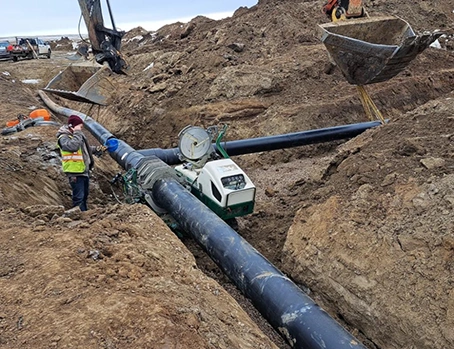
Underground HDPE pipe installation
Кадам 3: HDPE Pipe Joining and Fusion
This is the most critical step in the entireHDPE pipe installation procedure. The integrity of every joint determines the reliability of the entire pipeline.
All HDPE pipe shall be joined to itself by the heat fusion process, which produces homogeneous, sealed, leak-tight joints. Personnel performing butt fusion of HDPE pipe shall be certified in the procedure.
Butt Fusion Welding
Butt fusion is the primaryHDPE pipe connection method for large diameter pipes. The welded joint is produced with the help of a heated plate.
Butt fusion procedure:
- Кысгыч: Pipe sections are clamped into an axial press to hold them in alignment and prevent ovality
- Face: Pipe ends are faced (scraped) to ensure clean, parallel surfaces
- Heat: Heating plate at 400–450°F (204–232°C) is placed between pipe ends
- Fuse: Plate removed, ends pressed together under controlled pressure
- Cool: Joint cools under pressure — do not disturb during cooling
Quality check: The first fusion of each day shall be a trial fusion in the presence of the engineer. Inspect for continuity of “beads” from melted material to prevent “cold joints”.
| Butt Fusion Feature | Description |
|---|---|
| Колдонмо | Чоң диаметрдеги түтүктөр (адатта >110мм) |
| Артыкчылык | Strong joint, full pipe strength |
| Талап | Professional equipment, certified operators |
| Joint type | Homogeneous, no fittings required |
Electrofusion Welding
Electrofusion is ideal for repairs and restricted spaces. A fitting device (fusion coupler) with a built-in copper coil is used. When current is applied, the coil generates heat to create the weld.
Ички шилтеме: See our detailed article on HDPE түтүктөрүн ширетүү ыкмалары for complete procedures and equipment requirements.
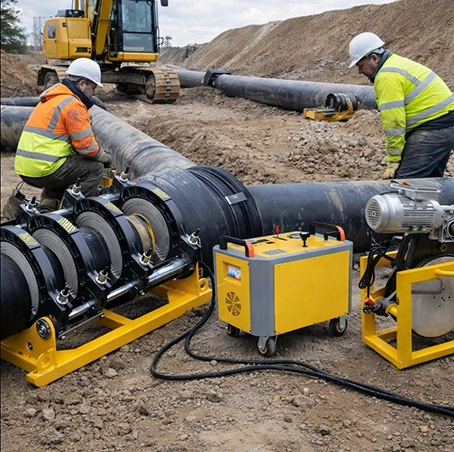
HDPE pipe butt fusion and electrofusion welding methods
Кадам 4: Pipe Placement and Alignment
Once joints are completed, the pipe must be carefully placed in the trench.
Key considerations:
- Avoid excessive bending: The centerline of the pipe shall not deviate from a straight line by more than 1/16 inch per foot of length.
- Maintain alignment: Proper facilities shall be provided for lowering sections of pipe into trenches. Under no circumstances shall pipe be dropped or dumped into trenches.
- Check joint quality: Inspect all fused joints before backfilling.
- Thermal movement: HDPE expands and contracts significantly with temperature changes. Install with excess length between anchor points so that contraction from temperature drops can be accommodated.
Кадам 5: Backfilling and Compaction
ТуураHDPE pipe backfilling is essential to protect the pipe and ensure long-term performance. Backfill selection and placement procedures are critical to achieve long-term system performance.
Backfilling stages:
Compaction requirements:
- Class I and II materials: 85% Standard Proctor Density minimum
- Class III and IV materials: 90% Standard Proctor Density minimum
Lift thickness:
- Class I materials: 12-inch lifts maximum
- Class II materials: 8-inch lifts maximum
- Class III and IVa materials: 6-inch lifts maximum
Critical requirements:
- Backfill to a height of 600 mm above the top of the pipe shall be made with material free from stones larger than 37.5 мм
- For HDPE pipe, avoid Class IV or V materials according to ASTM D2321
- Care shall be taken to avoid contact between the pipe and compaction equipment
- All damaged pipes shall be removed and replaced at no additional cost
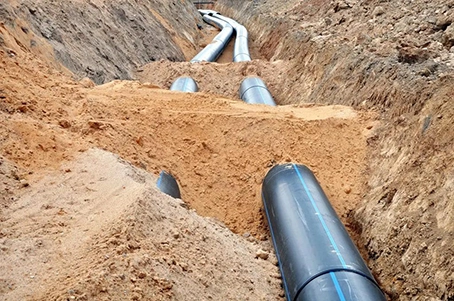
HDPE pipe underground backfilling and compaction process
Common HDPE Pipe Installation Methods
Different project conditions call for differentHDPE pipe installation methods. Here are the four most common approaches.
Open Trench remains the most common method. A trench is excavated, the HDPE pipe is laid in a sand bed (or directly on screened native backfill if using PE100-RC), then covered.
Horizontal Directional Drilling (HDD) bores a curved tunnel from an entry pit to an exit pit, then pulls the pre-welded HDPE string through. Typical municipal HDD is DN200–DN500 over 50–400 m at depths of 3–15 m.
Best Practices for Underground HDPE Pipe Installation
Following these best practices will significantly improve the quality and longevity of yourжер астындагы HDPE түтүктөрүн орнотуу.
Pressure Testing Protocol:
- Fill the pipeline with water and vent all air.
- Pressurize to 1.5× operating pressure (or per design specification).
- Hold pressure for minimum 1 hour.
- Acceptable leakage: ≤0.1 L per hour per km per mm of pipe diameter.
- Document results and obtain sign-off before backfilling.
Additional recommendations:
- UV коргоо: Protect HDPE pipe from direct sunlight during storage
- Handling: Use proper slings and pipe stands. Never drag pipes across sharp or rocky ground
- Documentation: Record all fusion parameters, inspection results, and test data for quality assurance
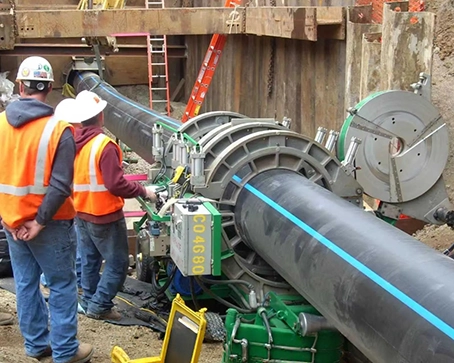
Underground HDPE pipe installation
Common Mistakes During HDPE Pipe Installation
Learning from others’ mistakes saves time and money. Here are the most frequent errors:
| Ката | Consequence | Алдын алуу |
|---|---|---|
| Wrong pipe size selected | Poor flow performance, ашыкча басымдын төмөндөшү | Calculate flow requirements accurately; consult hydraulic tables |
| Incorrect fusion temperature | Cold joints (underheated) or degraded material (overheated) | Calibrate equipment; verify plate temperature with pyrometer |
| Insufficient trench preparation | Pipe deformation, stress cracking | Inspect trench bottom; remove all sharp objects and rocks |
| Improper backfill with large rocks | Point loading, pipe puncture, stress concentrators | Screen backfill material; use sand bedding |
| Skipping pressure testing | Undetected leaks, costly excavation later | Always test before backfilling; document results |
| Ignoring minimum bend radius | Kinking, reduced flow, weak spots | Use 25× OD minimum; use fittings for tighter turns |
| Installing in frozen ground | Poor compaction, settlement, pipe damage | Wait for thaw; use non-frozen backfill material |
One particularly costly mistake is rushing the cooling phase of fusion joints. Operators sometimes move pipes before the joint has fully cooled, creating internal voids and weak spots that may not fail immediately but will leak under pressure over time.
Underground HDPE Pipe Installation Applications
HDPE pipes serve diverse industries due to their versatility and durability:
| Колдонмо | Why HDPE Excels |
|---|---|
| Муниципалдык суу менен камсыздоо | Коррозияга туруктуулук, leak-free fusion joints, 50+ year life |
| Айыл чарба сугаты | Flexibility for uneven terrain, UV каршылык, chemical compatibility with fertilizers |
| Тоо-кен шламын ташуу | Абрага каршылык, жогорку таасир күчү, handles coarse solids |
| Өнөр жай суу системалары | Chemical resistance to acids and alkalis, high temperature tolerance |
| Wastewater and drainage | Жылмакай тешик (low friction), root infiltration resistance, leak-tight |
| Landfill leachate collection | Химиялык каршылык, flexibility for settlement areas, узак кызмат мөөнөтү |
In municipal applications, HDPE is increasingly replacing ductile iron and PVC for water mains because fusion-welded joints eliminate the leakage rates (адатта 15-30%) associated with mechanical joints in aging infrastructure.
Ички шилтеме: Learn more in our comprehensive article on HDPE Pipes Applications.
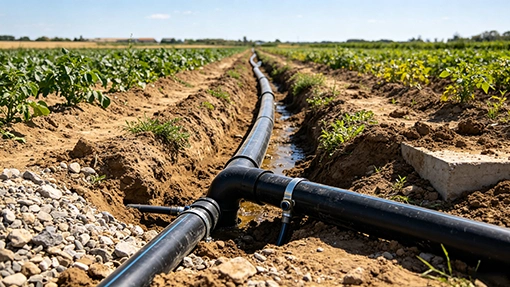
HDPE Pipe Installation in Agricultural irrigation
Көп берилүүчү суроолор
Q1: How deep should HDPE pipes be buried underground?
Safe burial depths vary and should be calculated. In lieu of calculations, HDPE pipes with DRs ranging from 7.3 чейин 21 can be safely buried from 2 ft to 25 ft where no traffic load is present, and from 3 ft to 25 ft where live load is present. Under roads with AASHTO H20 loading, a depth of cover of 3 ft is generally acceptable.
Q2: Can HDPE pipes be installed underground without concrete protection?
Ооба. HDPE pipes are designed for direct burial without concrete encasement. The fused pipe system is fully restrained and does not require thrust blocks. Бирок, proper bedding and backfilling according to ASTM D2321 are essential.
Q3: What is the best joining method for HDPE pipes?
Butt fusion is the preferred method for most applications, especially large diameter pipes, as it creates a joint as strong as the pipe itself. Electrofusion is recommended for repairs, small diameters, and restricted spaces. Both methods produce leak-tight, homogeneous joints when performed correctly.
Q4: How long does underground HDPE pipe installation take?
Installation time varies widely based on pipe diameter, узундугу, site conditions, and installation method. A typical open-trench project might install 100–200 meters per day, while HDD projects require more planning but can install long sections in a single pull. Always factor in curing time for fusion joints and pressure testing.
Q5: What equipment is needed for HDPE pipe installation?
Essential equipment includes: термоядролук машиналар (butt fusion or electrofusion), heating plates, түтүк кыскычтары, facing tools, excavation equipment (backhoe or trencher), compaction equipment (tampers or rollers), and pressure testing equipment. For HDD, additional directional drilling equipment is required.
Q6: Can HDPE pipes handle freezing conditions?
Ооба. PE pipes can be used in temperatures ranging from -40°C to 60°C. HDPE’s flexibility allows it to accommodate frost heave better than rigid pipes. Бирок, pipes should be buried below the frost line to prevent freezing of contents, and thermal movement must be accounted for in design.
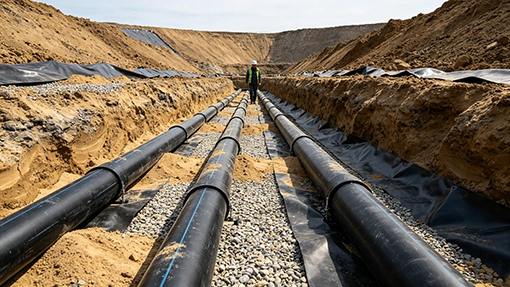
HDPE Pipe Installation in Landfill leachate collection
Корутунду: Build a Pipeline That Lasts Decades
Тууражер астындагы HDPE түтүктөрүн орнотуу requires careful attention to every phase of the project — from material selection and trench preparation to fusion welding, placement, and backfilling. By following the step-by-step procedures, using the rightHDPE pipe connection methods, and avoiding common mistakes, you can ensure a pipeline that delivers reliable service for decades.
Whether you are installing a municipal water main, an agricultural irrigation system, or an industrial pipeline, the principles outlined in this guide apply. But even the best installation practices cannot compensate for substandard materials or mismatched fittings. That’s why choosing a trusted supplier is just as critical as choosing the right installation method.
Ready to Source High-Quality HDPE Pipes for Your Next Project?
Luoyang Datang Energy Tech Co., Ltd offer factory-direct HDPE pipes (PE80 & PE100) in SDR11, SDR17, and custom ratings, along with a full range of butt fusion and electrofusion fittings to match every jointing requirement. Every batch is pressure-tested and certified to ISO standards. We also provide fast delivery, competitive bulk pricing, жана free engineering consultation – from specification to on-site support.
Don’t leave your underground pipeline to chance. Contact our engineering team for acompetitive quote, аfree technical consultation, or torequest our complete product catalog and fusion welding procedure guides.
We look forward to partnering with you on your next successful HDPE pipeline installation.
БАЙЛАНЫШТУУ ПОСТТАР

Өнөр жай агымын башкаруу тутумдары үчүн жогорку басымдагы көмүртек болоттон жасалган гидравликалык шарик клапанды кантип тандоо керек
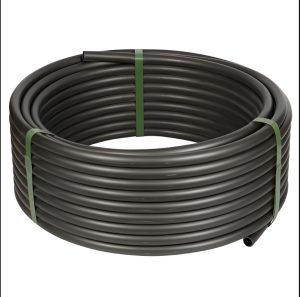
PE түтүктөрүнүн дүйнөсүн изилдеңиз: Жогорку тыгыздыктагы PE түтүктөрү, PE100, жана түтүк инженериясындагы колдонмолор.
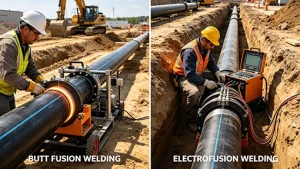
HDPE түтүктөрүн ширетүү ыкмалары: Түтүктөрдү орнотуу үчүн Butt Fusion vs Electrofusion
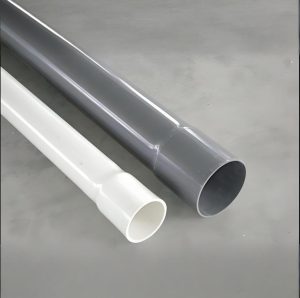
CPVC түтүгү менен UPVC түтүгүнүн ортосунда кандай айырма бар?
Суу менен камсыз кылуу үчүн кайсы түтүк жакшы