PVC (Polyvinyl Chloride) Explained: Structure, Properties, Manufacturing & Global Applications (2026 Guide)


1. What is PVC? Understanding the Molecular Structure
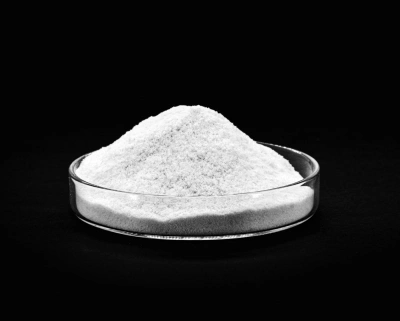
PVC (Polyvinyl Chloride) is a thermoplastic polymer produced by polymerizing vinyl chloride monomer (VCM).
- Chemical structure: –CH₂–CHCl–
- Chlorine content: ~56.8%
- Hom: Polar polymer
Key Technical Insight:
The presence of chlorine atoms gives PVC:
- Zoo heev flame retardancy
- Strong kev tiv taus tshuaj
- High mechanical rigidity
Txawm li cas los xij, pure PVC is brittle → requires additives (plasticizers, stabilizers).
2. PVC Manufacturing Process (Industrial Perspective)
There are three main production methods:
| Process | PIAV QHIA | Qhov zoo | Applications |
|---|---|---|---|
| Suspension (S-PVC) | Most common method | Balanced properties | Cov yeeb nkab, cables |
| Emulsion (E-PVC) | Fine particles | Flexible applications | Coatings, gloves |
| Bulk Polymerization | High purity | Eco-friendly | Specialty products |
Typical Process Flow (Suspension PVC):
- VCM compression
- Polymerization (40–70°C)
- Degassing (remove residual VCM)
- Drying
- Final resin output
Industry Trends:
- Ultra-low residual VCM (<1 ppm)
- Mercury-free catalysts
- Continuous production systems
3. Key Properties of PVC (Engineering Data)
| Property | Value Range | Significance |
|---|---|---|
| Ceev | 1.3–1.45 g/cm³ | Heavier than PE/PP |
| Tensile Strength | 40–60 MPa | Structural use |
| Glass Transition Temp | 75–85°C | Heat resistance |
| Flame Retardancy | UL94 V-0 | Self-extinguishing |
| Electrical Insulation | Zoo heev | Cable applications |
👉 Conclusion:
PVC offers an optimal balance of strength + cost + kev nyab xeeb
4. Rigid PVC vs Flexible PVC

| Hom | Nta | Additives | Applications |
|---|---|---|---|
| Rigid PVC (uPVC) | Strong, ruaj khov | No plasticizer | Cov yeeb nkab, windows |
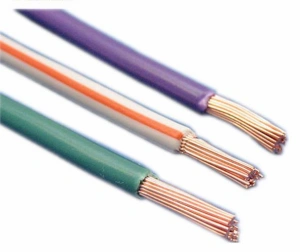
| Flexible PVC | Soft, bendable | Plasticizers added | Cables, films |
👉 Core Difference: Plasticizer content determines flexibility.
5. Major Applications of PVC Worldwide
1. Construction (60%+ demand)
- Water supply pipes
- Drainage systems
- Window profiles
2. Electrical Industry
- Cable insulation
- Conduits
3. Medical Sector
- Blood bags
- Tubing
4. Renewable Energy (Hot Trend)
- Solar cable insulation
- Energy storage wiring
👉 PVC is becoming critical in solar + energy storage systems
6. PVC vs PE vs PP (Material Comparison)
| Khoom siv | Cost | Strength | Corrosion Resist | Flame Retardancy |
|---|---|---|---|---|
| PVC | Nruab nrab | High | High | Zoo heev |
| PE | Low | Nruab nrab | Zoo heev | Poor |
| PP | Low | Nruab nrab | Good | Poor |
👉 PVC stands out in fire safety + structural strength
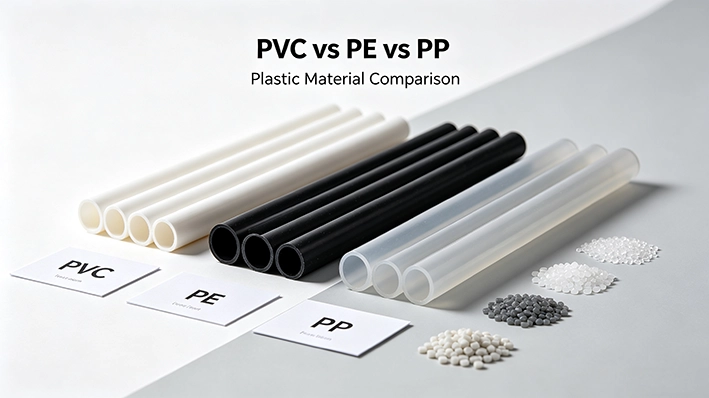
PVC PE PP pipe material performance comparison
7. Environmental Challenges & Solutions
Challenges:
- Plasticizer restrictions (phthalates)
- Chlorine-related concerns
Solutions:
- Bio-based plasticizers
- Lead-free stabilizers
- Recycling technologies
👉 EU regulations (REACH) are shaping the future of PVC
8. Why PVC Still Dominates the Market
- Txuag nqi (20–30% cheaper than alternatives)
- Highly customizable
- Wide industrial applications
👉 PVC is not just plastic — it’s an engineering platform material
9.PVC Types: PVC, uPVC, and CPVC Differences
Although PVC is a general material category, different modification methods create different PVC types for specific applications. Understanding these differences is essential for selecting the right pipe material.
| Hom | Lub npe tag nrho | Main Characteristics | Common Applications |
|---|---|---|---|
| PVC | Polyvinyl Chloride | Basic PVC material | General plastic products |
| uPVC | Unplasticized PVC | Rigid, strong, chemical resistant | Water pipes, drainage pipes, windows |
| CPVC | Chlorinated PVC | Higher temperature resistance | Hot water pipes, industrial piping |
uPVC (Unplasticized PVC)
uPVC is rigid PVC that contains no plasticizers. This makes it stronger, more durable, and more chemically resistant than plasticized PVC. uPVC is the most widely used material for cold water supply and drainage systems due to its excellent mechanical properties and long service life.
Key Characteristics:
- ✅ No plasticizers added
- ✅ Higher rigidity and strength
- ✅ Excellent chemical resistance
- ✅ Long service life (50+ years)
- ✅ Suitable for cold water and drainage
- ❌ Not suitable for hot water (temperature limit ~60°C)
CPVC (Chlorinated PVC)
CPVC is produced by chlorinating PVC resin, which increases the chlorine content and enhances the material’s heat resistance. CPVC can handle temperatures up to 93°C (200°F), making it suitable for hot water distribution and industrial piping systems where higher temperatures are encountered.
Key Characteristics:
- ✅ Higher chlorine content
- ✅ Better heat resistance (up to 93°C/200°F)
- ✅ Suitable for hot water applications
- ✅ Excellent chemical resistance
- ✅ Good fire resistance properties
- ❌ Higher cost than uPVC
Key Takeaway: For piping systems, uPVC thiabCPVC are the most important PVC derivatives. uPVC is the standard choice for cold water and drainage; CPVC is required for hot water and high-temperature industrial applications.
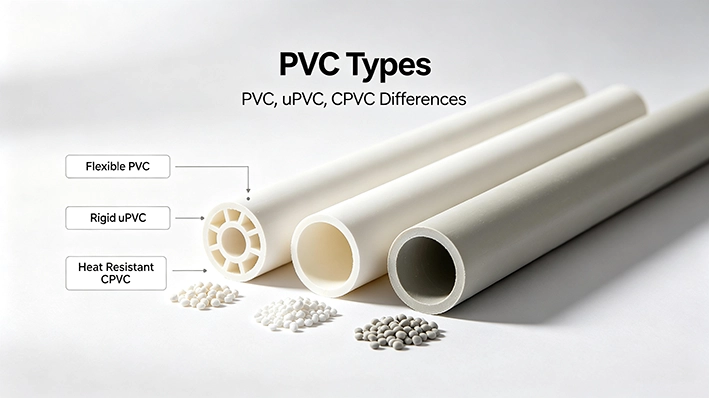
PVC uPVC CPVC plastic pipe type difference comparison
10.PVC Yeeb Nkab Standards and Quality Requirements
PVC pipes used in engineering projects must meet international standards to ensure safety, kev ntseeg tau, and interoperability. Different standards apply to different regions and applications.
Common International Standards:
| Standard | Region | Kev siv |
|---|---|---|
| ASTM D1785 | USA | PVC pressure pipes |
| ASTM D2665 | USA | Drainage and waste pipes |
| ISO 1452 | International | PVC water supply pipes |
| DIN 8062 | Europe | PVC-U pipes |
| BS 3505 | UK | PVC pressure pipes |
| GB/T 10002.1 | China | PVC-U water supply pipes |
Key Quality Parameters
1. Pressure Rating
PVC pipes are classified according to pressure capability, with common ratings including PN6, PN10, and PN16. Higher PN ratings indicate stronger pressure resistance. Selecting the correct pressure rating is essential for system safety and longevity.
| Rating | Pressure (MPa) | Typical Application |
|---|---|---|
| PN6 | 0.6 | Low-pressure irrigation |
| PN10 | 1.0 | Standard water supply |
| PN16 | 1.6 | High-pressure mains |
2. Phab Ntsa Tuab
Thicker pipe walls provide higher pressure resistance, better impact strength, and longer service life. Wall thickness is specified by the pipe’s Schedule (SCH) s (Standard Dimension Ratio) rating.
3. Tshuaj lom neeg tsis kam
PVC pipes perform well in water treatment, chemical transportation, and industrial drainage applications due to their excellent resistance to a wide range of chemicals, including acids, Alkalis, t.
11.PVC Pipe Manufacturing Process
PVC pipes are manufactured through extrusion technology, a continuous process that produces pipes of consistent quality and dimensional accuracy. Understanding the manufacturing process helps buyers evaluate product quality and supplier capabilities.
Typical Production Steps
Kauj ruam 1: PVC Resin Mixing
PVC resin is blended with stabilizers, lubricants, processing additives, and impact modifiers to create a homogeneous compound. The formulation determines the pipe’s final properties, including strength, flexibility, and UV resistance.
Kauj ruam 2: Extrusion
The compounded material is heated and pushed through an extrusion die that shapes the pipe. The extruder melts the PVC compound and forces it through the die, forming a continuous pipe of the desired diameter and wall thickness.
Kauj ruam 3: Cooling and Sizing
The extruded pipe passes through vacuum calibration tanks where it is cooled and sized to achieve accurate dimensions. This step ensures the pipe meets the required tolerances for diameter, wall thickness, and roundness.
Kauj ruam 4: Cutting and Testing
Finished pipes are cut to standard lengths and tested for diameter accuracy, tiv taus siab, impact strength, and appearance quality. Testing is performed according to the applicable international standards.
Kauj ruam 5: Packaging
Pipes are packed according to diameter and project requirements, typically in bundles with end caps or protective wrapping to prevent damage during transport and storage.

PVC plastic pipe production flow chart with raw material and finished pipes
12.Advantages of PVC Pipes in Modern Piping Systems
PVC pipes remain one of the most widely used plastic piping solutions because of several distinct advantages over traditional materials like steel, copper, thiab pob zeb nplaum.
PVC pipes remain one of the most widely used plastic piping solutions because of several advantages:
Lightweight Installation
PVC pipes are much lighter than metal alternatives:
- Easier transportation
- Kev teeb tsa sai dua
- Lower labor costs
Corrosion Resist
Unlike steel pipes, PVC does not rust or corrode.
It is suitable for:
- Kev muab dej
- Wastewater
- Chemical systems
Low Maintenance
PVC piping systems require minimal maintenance due to:
- Smooth inner surface
- Reduced scaling
- Ntev kev pab lub neej
Cost Efficiency
PVC provides excellent performance at a lower cost compared with:
- Copper pipes
- Stainless steel pipes
- Carbon steel pipes

UPVC PVC pipes and fittings diagram for modern plumbing piping system
13.PVC Pipe Applications in Different Industries
Cov txheej txheem muab dej
PVC yeeb nkab are widely used for:
- Drinking water distribution
- Municipal pipelines
- Building water systems
Agriculture Irrigation
PVC irrigation pipes provide:
- Stable water flow
- Resistance to fertilizers
- Long outdoor service life
Drainage and Sewer Systems
PVC pipes are preferred because of:
- Smooth flow characteristics
- Corrosion resistance
- Yooj yim nruab
Kev Siv Hauv Kev Lag Luam
PVC piping is used for:
- Chemical processing
- Wastewater treatment
- Industrial fluid transportation
14.PVC Sustainability and Recycling
Modern PVC production focuses increasingly on environmental performance. The industry has made significant progress in reducing environmental impact through improved formulations and recycling technologies.
Lead-Free Stabilizers
The PVC industry is replacing traditional stabilizers with safer alternatives, eliminating lead and other heavy metals from PVC formulations. This makes modern PVC pipes safer for drinking water applications and environmentally friendly.
PVC Recycling
PVC can be recycled through mechanical recycling and material recovery processes. Recycled PVC is used in the production of new pipes, fittings, and other products, reducing the demand for virgin material and minimizing landfill waste.
Longer Service Life
Long-lasting PVC products reduce replacement frequency, resource consumption, and maintenance requirements. A properly installed PVC pipe system can last 50 xyoo los sis ntau dua, making it a sustainable choice for infrastructure projects.
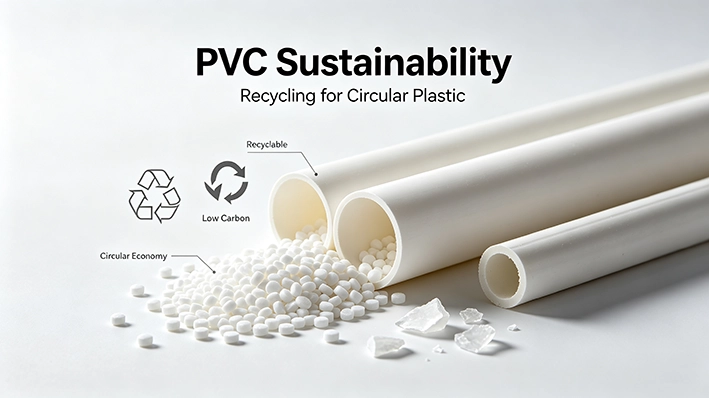
PVC plastic pipe sustainability recycling diagram with recycle icon
15.How to Choose the Right PVC Pipe System
When selecting PVC piping systems, consider several key factors to ensure optimal performance and long-term reliability.
Kev siv
Determine whether the system is for water supply, drainage, irrigation, or industrial use. This determines the type of PVC required — uPVC for cold water and drainage, CPVC for hot water applications.
Kev Yuav Tsum Muaj Siab Siab
Choose pipe pressure rating according to operating pressure, temperature, and safety margin. Higher pressure ratings (PN16) are required for main supply lines; lower ratings (PN6) may suffice for gravity drainage systems.
Temperature Conditions
PVC has temperature limitations. For cold water systems, uPVC is suitable. For higher temperatures (above 60°C), CPVC may be more appropriate. Always check the temperature rating of the pipe material.
Connection Method
Common joining methods for PVC pipes include solvent cement welding, threaded connections, and mechanical fittings. Solvent cement is the most common method for uPVC and CPVC pipes, creating a permanent, l.
Local Standards
Always confirm compliance with ASTM, ISO, DIN, or local regulations. Different countries and regions may have specific requirements for PVC pipes used in public infrastructure projects.
16.PVC Market Outlook and Future Trends (2026)
The global PVC industry continues to grow due to demand from infrastructure development, water management projects, urbanization, and renewable energy systems.
Smart Manufacturing
PVC production is becoming more automated, more energy efficient, and more environmentally controlled. Kev Lag Luam 4.0 technologies are being integrated into PVC pipe manufacturing, improving quality control and reducing waste.
Sustainable Additives
The industry is moving toward bio-based additives, low-impact formulations, and improved recycling technologies. These developments reduce the environmental footprint of PVC production and make PVC pipes an even more sustainable choice.
Growing Infrastructure Demand
PVC remains an important material for water networks, sewer systems, and building construction. As urbanization continues and aging infrastructure requires replacement, demand for PVC pipes is expected to grow steadily. The global PVC pipes market is projected to expand at a CAGR of 5-6% through 2030, driven by water and wastewater infrastructure investments worldwide.
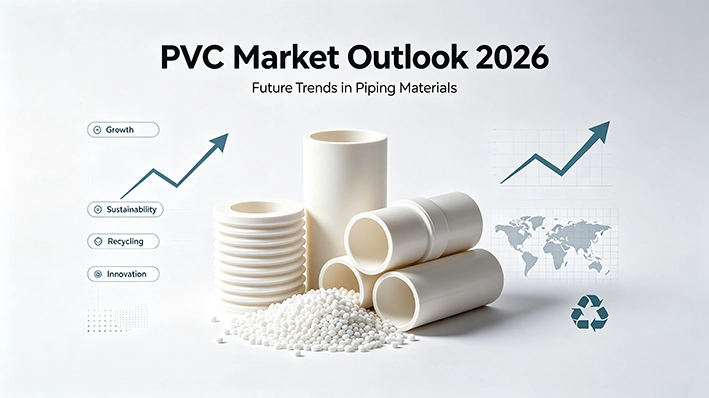
2026 PVC industry market trend chart with plastic pipe products
Frequently Asked Questions
1. What is the difference between PVC, uPVC, thiab CPVC?
PVC is the base polyvinyl chloride material. uPVC (unplasticized PVC) contains no plasticizers, making it harder and stronger, suitable for cold water and drainage systems. CPVC (chlorinated PVC) is chlorinated for higher heat resistance, suitable for hot water applications. uPVC and CPVC are the two most commonly used PVC types for piping systems.
2. What is the difference between PN6, PN10, and PN16 pressure ratings for PVC pipes?
PN ratings indicate the maximum allowable working pressure at 20°C (in MPa). PN6 is 0.6 MPa, suitable for low-pressure irrigation. PN10 is 1.0 MPa, suitable for standard water supply. PN16 is 1.6 MPa, suitable for high-pressure mains. Selecting the correct pressure rating is essential for system safety.
3. Can PVC pipes be used for hot water?
Standard uPVC pipes are not suitable for hot water (temperature limit approximately 60°C). For hot water applications (up to 93°C), CPVC pipes should be used. CPVC is chlorinated to improve heat resistance and is specifically designed for hot water distribution and high-temperature industrial applications.
4. What are the main connection methods for PVC pipes?
The most common method is solvent cement welding — clean the pipe end and fitting socket, apply solvent cement, push the pipe into the fitting and hold until set. Other methods include threaded connections (small diameters) and mechanical fittings (for easy disassembly).
5. How long do PVC pipes last?
A properly installed PVC pipe system can last 50 xyoo los sis ntau dua. PVC’s corrosion resistance, Du puab phab ntsa, and aging resistance ensure long-term reliable performance, making PVC a sustainable choice for infrastructure projects.
Why Choose Our PVC Pipes?
Luoyang Datang Energy Tech Co. Ltd yog cov chaw tsim khoom lag luam hauv Suav tshwj xeeb hauv cov yeeb nkab yas zoo thiab fittings. Nruab nrog lub xeev-of-the-art tsis siv neeg ntau lawm kab thiab txhawb nqa los ntawm pab pawg ntawm 200 Cov Kws Tshaj Lij, Peb muab cov khoom lag luam loj dav dav suav nrog dhau 150 hom yas yeeb nkab thiab fittings tsim rau cov dej xa dej thiab cov kav dej, roj xa mus, thiab cov tshuab cua sov hauv pem teb. Peb cov khoom tseem ceeb suav nrog PVC Cov Yeeb Nkab thiab Fittings, PE (HDPE) Cov Kav Dej thiab Fittings, PPR Yeeb Nkab thiab Fittings, thiab PEX Pem Teb Cua Sov Cov Yeeb Nkab.
Our products feature:
- ✅Complete range — uPVC, CPVC, and specialized PVC pipes
- ✅Multiple pressure ratings — PN6, PN10, PN16
- ✅Wide size range — 20mm to 630mm
- ✅International standards — ASTM, ISO, DIN, GB compliant
- ✅100% quality tested — Guaranteed reliability
- ✅Competitive pricing — Factory-direct supply with OEM/ODM support
Contact us today for expert selection advice, product specifications, and competitive quotes.
RELATED POSTS

Vim li cas HDPE yeeb nkab tus nqi sib txawv? Phau ntawv qhia rau tus neeg yuav txog tus nqi

Npauj Npaim Valve Xaiv Daim Ntawv Qhia: Yuav Ua Li Cas Xaiv Txoj Cai Wafer, Lug, Ob Chav Offset thiab Triple Offset Npauj Npaim Valve
PPR fittings & tooj dag fittings,Yuav ua li cas xaiv qhov yog?
Yuav Ua Li Cas Xaiv PPR Yeeb Nkab?

Complete Guide to PVC Pipes and Fittings for Water Supply Systems