LUOYANG DATANG ENERGY TECH CO.,LTD


Check Valve Selection Guide for Pump Systems: Types, Applications & Sizing (Water, HVAC & Industrial)
Every pump system shares a common vulnerability: when the pump stops, the water column in the discharge pipeline doesn’t stop instantly. It continues moving due to inertia, creating a reverse flow that can spin pumps backward at destructive speeds, generate water hammer pressure surges that burst pipes, and allow contaminated water to flow back into the clean water source. The solution is a pump system check valve — a non-return valve that automatically prevents reverse flow without operator intervention.
This industrial check valve selection guide covers everything you need to know about choosing the right non-return valve for pump systems in water, HVAC, and industrial applications. We will compare the three most common check valve types — swing check, spring loaded silent check, and dual plate check — and provide a practical selection framework to help you protect your pumps and pipelines.
Why Every Pump System Needs a Non-Return Valve
A non-return valve for pump systems is not optional — it is essential. When a pump stops, the column of water in the discharge pipeline does not stop instantly. It continues moving due to inertia, creating a reverse flow that can:
- Spin the pump backward at speeds exceeding normal operation, damaging the pump and motor
- Create water hammer pressure surges that can burst pipes and damage fittings
- Allow contaminated water to flow back into the clean water source
- Cause pump impellers to unscrew or suffer mechanical damage
A check valve opens when the pump runs and closes automatically when the pump stops, ensuring that water only flows in the intended direction. The key to successful performance is industrial check valve selection — choosing the right type, size, and specification for your specific application.

Pump system check valve installed on discharge pipeline
Three Check Valve Types for Pump Systems — A Side-by-Side Comparison
1. Swing Check Valve
A swing check valve uses a disc that swings on a hinge pin. Forward flow pushes the disc open; when flow stops or reverses, the disc swings back onto the seat by gravity. Swing checks are the workhorse for horizontal piping lines NPS 2″ and above.
Key Characteristics:
✅ Low pressure drop — Minimum pressure drop of approximately 0.5 psi when fully open
✅ Simple design — Fewer moving parts, lower maintenance
✅ Ideal for large diameters — Common choice for NPS 2″ and above
✅ Best for water and other liquids
❌ Horizontal installation required — Must be installed in horizontal lines
❌ Slower closing response — Can lead to water hammer in systems with rapid flow reversals

Cast iron swing check valve for pump discharge
2. Spring Loaded Silent Check Valve
A spring loaded silent check valve uses a spring-assisted disc that closes the instant forward flow ceases — before reverse flow can occur. The spring force ensures positive seating regardless of pipe orientation, making it ideal for vertical installations and systems where water hammer must be minimized.
Key Characteristics:
✅ Instant closure — Closes before flow reversal, eliminating water hammer
✅ Any orientation — Works in horizontal, vertical, or any angle
✅ Silent operation — No slamming noise
✅ Low cracking pressure — Opens with minimal upstream pressure
❌ Higher pressure drop — Higher than swing check valves

Spring loaded silent check valve for pump protection
3. Dual Plate Check Valve
A dual plate check valve (also called double door or wafer check valve) uses two spring-loaded semi-circular plates hinged at the center. It is the go-to choice when weight and space matter. The compact wafer design saves significant installation space and reduces pipeline weight.
Key Characteristics:
✅ Compact design — Wafer type saves space
✅ Lightweight — 60-80% lighter than conventional swing check valves
✅ Fast closing — Spring-assisted plates close quickly
✅ Low pressure drop — Streamlined flow path
✅ Ideal for pump outlets — Preferred on pump discharge lines
❌ Not for reciprocating pumps — Not recommended for pulsating flow
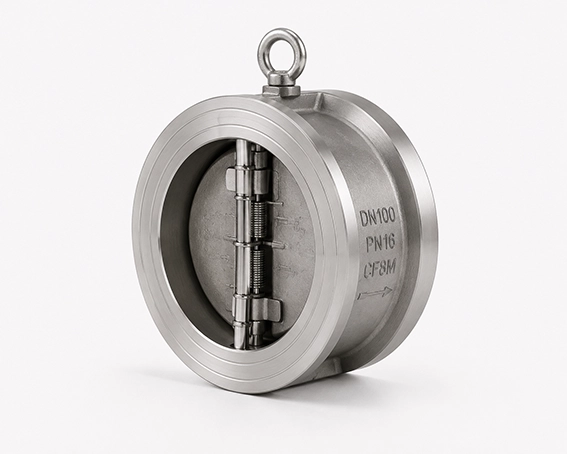
Dual plate wafer check valve for compact installations
Comparison Table — Swing vs Spring Loaded vs Dual Plate
| Feature | Swing Check | Spring Loaded Silent | Dual Plate |
| Closing speed | Slow | Instant | Fast |
| Water hammer risk | High | None | Low |
| Installation orientation | Horizontal only | Any | Horizontal |
| Pressure drop | Low (~0.5 psi) | Moderate | Low |
| Space required | Large | Small | Smallest |
| Weight | Heavy | Light | Lightest |
| Best for | Large horizontal lines | Vertical lines, low-pressure systems | Pump outlets, tight spaces |
| Typical size range | 2″-24″ | 1/4″-2″ | 2″-48″ |
How to Select the Right Industrial Check Valve for Your Pump System
Step 1: Define Your Installation Orientation
Horizontal piping: Swing check valve or dual plate check valve
Vertical piping: Spring loaded silent check valve (or lift check valve)
Tight spaces: Dual plate check valve (wafer type)
Step 2: Consider Water Hammer Risk
If your pump system experiences rapid flow reversals, frequent starts and stops, or long discharge pipelines, water hammer is a real concern. Spring loaded silent check valves are specifically designed to eliminate water hammer. For high-flow applications with moderate risk, dual plate check valves offer faster closing than swing checks.
Step 3: Size the Valve Correctly
Proper pump system check valve sizing is essential. A valve that is too large will not open fully, causing chattering and premature wear. A valve that is too small creates excessive pressure drop.
Sizing Guidelines:
Rule of thumb: Minimum pressure drop for swing check valves is 0.5 psi; for lift checks, 2.0 psi
Flow velocity: Should not exceed 10 feet per second (fps); 7 fps is a conservative target
Match to actual flow conditions: Size the valve to fit the actual flow, not just the line size
Step 4: Consider Media and Temperature
Water, wastewater, mild chemicals: Cast iron swing check valve with EPDM seal (0°C to +80°C)
Corrosive media, high-temperature: Stainless steel spring loaded silent check valve (-40°C to +210°C)
Steam, high-temperature process: Metal-seated options available

industrial check valve applications water hvac pipeline system
Application-Specific Recommendations
| Application | Recommended Valve | Why |
| Municipal water supply | Swing Check Valve | Low pressure drop, large diameters |
| Booster pump stations | Dual Plate Check Valve | Compact, fast closing, low weight |
| High-rise building risers | Spring Loaded Silent Check Valve | Vertical installation, water hammer prevention |
| Wastewater treatment | Swing Check Valve | Durable, handles solids, long service life |
| Chemical dosing systems | Spring Loaded Silent Check Valve | Low cracking pressure, corrosion-resistant |
| HVAC chilled water | Dual Plate Check Valve | Compact design, low pressure drop |
| Fire protection systems | Swing Check Valve | Reliable, large sizes available |
| Industrial process lines | Depends on conditions | Consult selection matrix above |
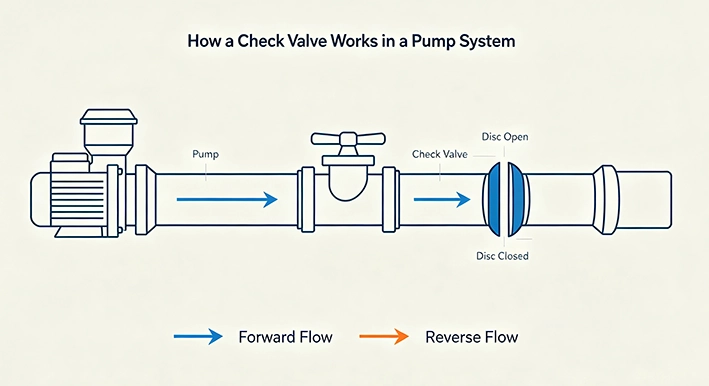
pump system check valve working principle diagram
Frequently Asked Questions
Q1: What is the difference between a swing check valve and a spring loaded silent check valve?
A: A swing check valve uses a hinged disc that swings open and closes by gravity. It must be installed horizontally and has a slower closing response, which can cause water hammer. A spring loaded silent check valve uses a spring-assisted disc that closes instantly when flow stops, eliminating water hammer and working in any orientation.
Q2: How do I prevent water hammer in my pump system?
A: Choose a check valve with fast closing response — spring loaded silent check valves are specifically designed for this purpose. Dual plate check valves also close faster than swing checks. Ensure the valve is properly sized for your flow conditions.
Q3: Which check valve is best for vertical installation?
A: For vertical-up flow, use a spring loaded silent check valve. Unlike swing check valves, spring-loaded designs do not rely on gravity for closure and work reliably in vertical piping.
Q4: How do I size a check valve for my pump system?
A: Size the valve based on actual flow conditions, not just line size. Ensure the valve remains fully open at normal operating conditions. Follow manufacturer pressure drop guidelines: 0.5 psi minimum for swing check valves. Keep flow velocities below 10 fps (7 fps recommended).
Q5: Can I use a swing check valve in a vertical pipeline?
A: No. Swing check valves rely on gravity to close the disc and must be installed horizontally. For vertical pipelines, use a spring loaded silent check valve or a lift check valve.
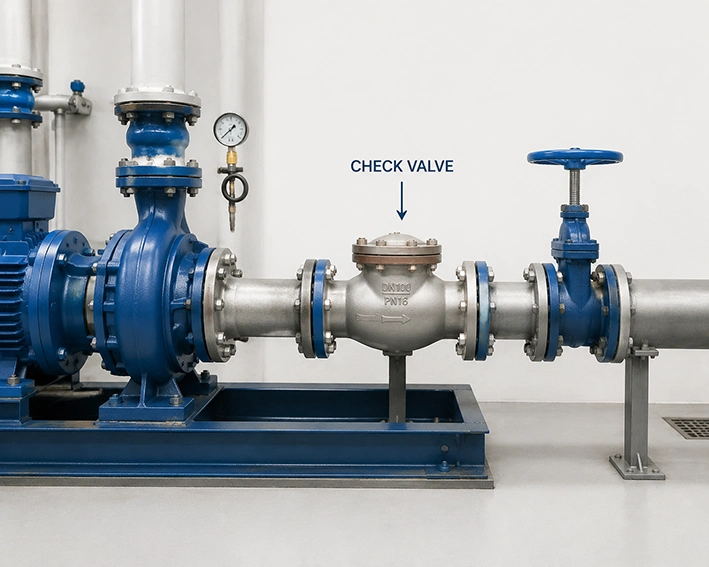
Check valve installed on pump system pipeline
Why Choose Our Check Valves?
At Luoyang Datang Energy Tech Co., Ltd, we supply high-quality check valves for pump protection and industrial piping systems. Our products feature:
- ✅ Cast Iron Swing Check Valve — PN10/PN16, 2″-24″, flanged ends, BS EN 12334. Ideal for water, wastewater, and industrial applications. Low pressure drop, durable cast iron construction, FBE coated.
- ✅ Spring Loaded Silent Check Valve — 1/4″ NPT, vertical mount, CE certified. Stainless steel construction, instant closure, eliminates water hammer. Perfect for low-pressure and sensitive systems.
- ✅ Dual Plate Check Valve — Compact wafer design, lightweight, fast closing. Ideal for pump outlets and space-constrained installations.
- ✅ Multiple materials — Cast iron, ductile iron, stainless steel
- ✅ Multiple connection options — Flanged, threaded, wafer
- ✅ CE and ISO 9001 certified
Contact us today for expert check valve selection advice, product specifications, and competitive quotes.
RELATED POSTS
HDPE Pipes Build An Efficient Water-Saving Irrigation System
PPR Pipes: Innovative Solutions for Modern Plumbing Systems
Corrosion Resistant PPR Pipe in Chemical Pipeline System

How to Specify Brass Hose Fittings for a Purchase Order
Brass Pipe Fittings Sizes Explained: Threads, Dimensions and Selection Guide