LUOYANG DATANG ENERGY TECH CO.,LTD


3/4″ GHT vs 3/4″ NPT: Why Are These Brass Hose Fittings Not Interchangeable?
You have a 3/4-inch brass fitting in your hand. The other connection is also marked “3/4 inch.” So why won’t they screw together?
If you’ve ever stood in a workshop holding two brass fittings that look almost identical but refuse to mate, you’re not alone. This is one of the most common frustrations in hose and pipe connections — and it all comes down to one deceptively simple fact:
3/4″ GHT and 3/4″ NPT are different thread systems.
They differ in thread pitch, thread form, sealing method, and intended application. They are not directly interchangeable. Connecting them requires a specific adapter.
Let’s break down exactly why — and more importantly, how to get the right connection every time.

3/4 GHT vs 3/4 NPT brass hose fittings
What Is 3/4″ GHT?
What Does GHT Stand For?
GHT stands for Garden Hose Thread. In the United States, this is the standard thread used on garden hoses, outdoor faucets, and hose accessories. You’ll also see it referred to by other abbreviations:
- NH — National Hose
- MHT — Male Hose Thread
- FHT — Female Hose Thread
- NH — National Hose
- MHT — Male Hose Thread
- FHT — Female Hose Thread
These designations all refer to the same thread standard. When a supplier lists “3/4-11.5 NH,” they’re describing the same thing as “3/4 GHT.”
3/4″ GHT Thread Specifications
| Specification | 3/4″ GHT |
|---|---|
| Common name | Garden Hose Thread |
| Designation | 3/4″-11.5 NH |
| Thread type | Straight / parallel |
| Threads per inch (TPI) | 11.5 |
| Major outside diameter | 1.0625″ (approx. 27 mm) |
| Typical connection | Garden and water hose connections |
| Sealing method | Flat washer / gasket |
| Common material | Brass, stainless steel, plastic |
The key point here: GHT is a straight thread (not tapered), and it relies on a rubber washer or gasket at the face of the connection to create the seal — not on the threads themselves.
That’s why when you look inside a female garden hose fitting, you’ll almost always see a black rubber washer sitting at the bottom. That washer is doing the actual sealing work.
GHT is not only for garden hoses. It also appears on washdown stations, RV water systems, and boat deck fittings. If you’re choosing between a connector, an adapter, or a coupling for those setups, our guide to brass hose connector types breaks down the differences.
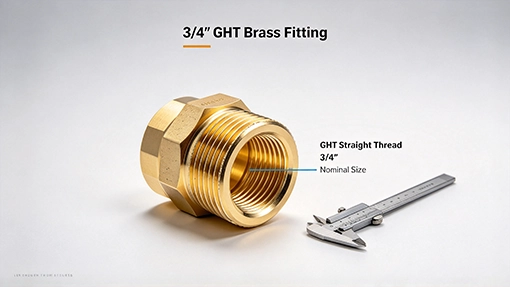
3/4″ GHT
What Is 3/4″ NPT?
What Does NPT Stand For?
NPT stands for National Pipe Taper (sometimes written as National Pipe Tapered). It’s the standard thread used throughout North American plumbing, valves, pumps, and industrial piping systems.
3/4″ NPT Thread Specifications
| Specification | 3/4″ NPT |
|---|---|
| Full name | National Pipe Taper |
| Thread designation | 3/4″-14 NPT |
| Thread type | Tapered |
| Threads per inch (TPI) | 14 |
| Major outside diameter | Approx. 1.050″ |
| Taper rate | 1:16 (3/4″ per foot) |
| Typical applications | Pipe, plumbing, valves, equipment |
| Sealing method | Thread interference + sealant |
| Common material | Brass, steel, stainless steel |
A critical detail that trips up many buyers: the “3/4” in 3/4″ NPT does not mean the outside diameter is 3/4 inch. It refers to the nominal pipe size. The actual major outside diameter of a 3/4″ NPT male thread is approximately 1.050 inches.
NPT threads are designed to seal through metal-to-metal interference as the tapered male thread wedges into the female thread. A thread sealant (PTFE tape or pipe dope) is then applied to fill the micro-gaps and complete the pressure-tight seal.
NPT is not the only pipe thread standard you’ll encounter. If your project uses BSP instead of NPT, see our comparison of NPT vs BSP threads before you specify a brass fitting.
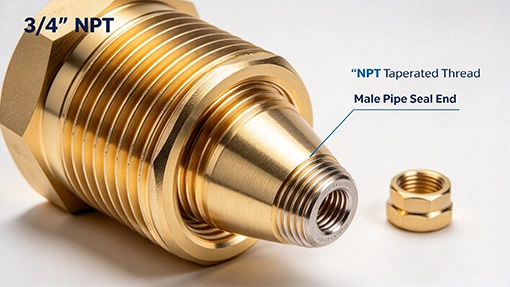
3/4″ NPT
3/4″ GHT vs 3/4″ NPT: What Is the Difference?
Here is the table you’ll want to bookmark. This is the visual center of this entire article:
| Feature | 3/4″ GHT | 3/4″ NPT |
|---|---|---|
| Full name | Garden Hose Thread | National Pipe Taper |
| Standard designation | 3/4″-11.5 NH | 3/4″-14 NPT |
| Thread form | Straight | Tapered |
| TPI | 11.5 | 14 |
| Major OD | 1.0625″ | ~1.050″ |
| Typical use | Hose connections | Pipe/fitting connections |
| Sealing method | Washer / gasket | Thread interference + sealant |
| Common connection | Hose / faucet / hose accessories | Pipe / valve / equipment |
| Directly interchangeable? | No | No |
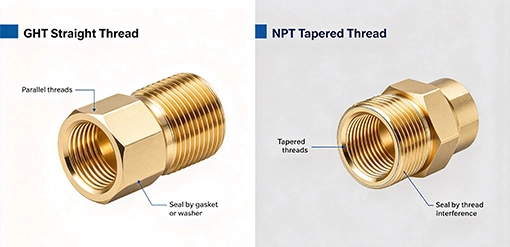
GHT straight thread vs NPT tapered thread
Why Do They Look So Similar?
This is the question that causes 90% of the confusion.
Both are nominally 3/4 inch. Both use a 60° thread angle — the same basic thread profile that traces its roots to the original American National thread standard. And their actual outside diameters are remarkably close: 1.0625 inches versus approximately 1.050 inches. That’s a difference of roughly 0.3 mm — barely visible to the naked eye.
So when a maintenance technician picks up a brass fitting, the initial impression is: “These should fit.” And sometimes, a GHT male thread will actually start to engage an NPT female port for a turn or two. That partial engagement is misleading — it does not mean the connection is correct.
The differences lie beneath the surface: thread pitch, taper, and sealing principle. These are the details that determine whether a connection holds at pressure or fails.
The 4 Differences That Make GHT and NPT Incompatible
1. Thread Pitch
This is the most immediately measurable difference.
- 3/4″ GHT: 11.5 threads per inch
- 3/4″ NPT: 14 threads per inch
A 3/4″ GHT thread has roughly 18% fewer threads per inch than a 3/4″ NPT thread. When you try to mate them, the thread crests and roots simply don’t align — the threads are spaced differently along the length of the fitting.
How to check: Use a thread pitch gauge. If the gauge marked “11.5” fits your thread, it’s GHT. If “14” fits, it’s NPT.
2. Straight Thread vs Tapered Thread
This is the second core difference — and arguably the most important one for understanding why they won’t seal together.
GHT: The thread is straight (also called parallel). The diameter of the thread remains constant along its entire length. Think of it like a cylinder with threads cut into it.
GHT (Straight)
| | | | | | | | | | ← constant diameter
NPT: The thread is tapered at a rate of 1:16 (3/4 inch per foot). As you thread deeper, the diameter gradually decreases. This taper is what allows the threads to wedge together and form a seal.
NPT (Tapered)
\ \ \ \ \ \ \ \ \ \ ← decreasing diameter
When you try to screw a straight GHT male thread into a tapered NPT female port, the fit is fundamentally wrong. The GHT thread may start to engage at the wider end of the NPT taper, but it will never seat properly because the sealing mechanism is completely different.
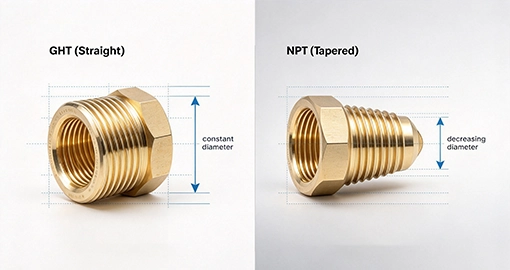
Straight Thread vs Tapered Thread
3. Sealing Method
This is where the practical consequences really hit home.
GHT sealing:
- The threads provide the mechanical connection.
- A rubber washer or gasket at the face of the female fitting provides the seal.
- No thread sealant is needed (or should be used).
- The seal is at the flat face of the connection, not in the threads.
NPT sealing:
- The tapered threads create an interference fit as they tighten.
- A thread sealant (PTFE tape, pipe dope) is applied to fill any remaining gaps.
- The seal is in the threads themselves.
This is why you should never wrap Teflon tape on a GHT connection — it won’t help, and it may prevent the washer from seating properly. And it’s why an NPT connection without sealant will almost certainly leak under pressure.
4. Intended Application
| GHT | NPT |
|---|---|
| Garden hoses | Plumbing |
| Outdoor faucets | Valves |
| Hose accessories | Pumps |
| Washdown connections | Piping systems |
| Sprinklers | Industrial equipment |
A note on accuracy: GHT is not used only for garden hoses. It’s also found on washdown stations, RV water systems, boat deck fittings, and some industrial hose and water-service connections. But the common thread is that GHT is designed for hose-to-fixture connections, while NPT is designed for pipe-to-pipe or pipe-to-equipment connections.
GHT is mainly for hose-to-fixture connections; NPT is mainly for pipe-to-pipe or pipe-to-equipment connections. For a fuller comparison, see brass hose fittings vs brass pipe fittings.

GHT in Garden hoses vs NPT in Plumbing
Can You Connect 3/4″ GHT to 3/4″ NPT?
Short answer: No. They should not be connected directly.
They are not designed to mate or seal with each other. Some combinations may produce limited thread engagement — often described as “it starts to screw on” — but this is not a correct connection. The thread pitch mismatch (11.5 vs 14 TPI) and the straight-vs-tapered geometry mean that any apparent engagement is coincidental, not functional.
What Happens If You Force Them Together?
This is a scenario that plays out in workshops every day. Let’s walk through it:
Common Mistake
3/4″ GHT female hose fitting
↓
3/4″ NPT male fitting
↓
“It seems to start threading…”
↓
❌ Wrong connection
What actually happens when you force a GHT and NPT connection:
- Cross-threading — The mismatched pitches cause the threads to cut into each other at an angle instead of engaging properly.
- Damaged threads — Both fittings may sustain permanent thread deformation, making them unusable even with the correct mating part.
- Leakage — Even if the connection appears tight, the sealing surfaces don’t align. Water will find a path through.
- Difficult disassembly — Galling and deformation can make the fittings extremely difficult to separate without damaging them further.
- Safety risk — A fitting that blows off under pressure can cause injury or property damage.
Don’t force it. Use the right adapter.
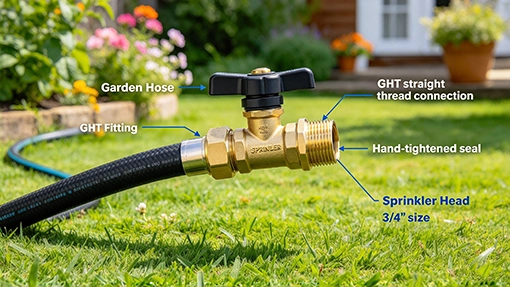
GHT in Sprinklers
How to Connect 3/4″ GHT to 3/4″ NPT Correctly
This is the section that turns a “why doesn’t this work?” article into a “here’s how to solve it” article.
Use a GHT-to-NPT Adapter
The solution is a brass adapter specifically designed to bridge the two thread systems. These adapters have a GHT thread on one end and an NPT thread on the other.
The connection path looks like this:
Garden Hose → 3/4″ GHT → Brass Adapter → 3/4″ NPT → Valve / Pipe / Equipment
These adapters are widely available. For example, a common configuration is a 3/4″ Female GHT × 3/4″ Male NPT adapter in cast brass.
Not sure whether you need a connector, an adapter, or a coupling? See brass hose connectors, adapters and couplings before you order.
Choose the Correct Male/Female Combination
This is where many orders go wrong. You need to specify four things, not just “3/4 inch”:
| Existing Connection | Adapter Side Needed |
|---|---|
| Female GHT | Male GHT |
| Male GHT | Female GHT |
| Female NPT | Male NPT |
| Male NPT | Female NPT |
Don’t order an adapter based only on “3/4 inch.” Always confirm:
- Size — 3/4″ / 1/2″ / etc.
- Thread standard — GHT or NPT
- Gender — Male or female
- Connection type — Swivel or rigid
Get any one of these wrong, and you’ll be returning the adapter. If you’re still unsure how to match a brass hose fitting to your hose, read brass hose fitting size and thread matching. It walks through size, thread, and gender step by step.
And if you’re not sure whether you need a connector, adapter, or coupling in the first place, that’s a separate question worth understanding before you place an order.
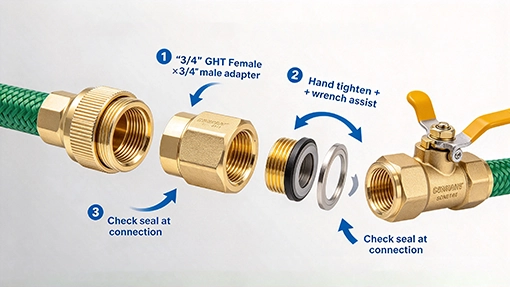
Connect 3/4″GHT to 3/4″ NPT Correctly
How to Identify Whether a Brass Fitting Is GHT or NPT
For B2B buyers and maintenance teams, this identification process is worth learning well.
Step 1 — Check the Application
- Garden hose, faucet, sprinkler? → GHT more likely
- Valve, pipe, pump, equipment port? → NPT more likely
But don’t rely on application alone. Plenty of exceptions exist.
Step 2 — Check the Thread Form
Look at the thread from the side. Does the diameter stay constant (straight), or does it visibly decrease toward the end (tapered)?
Step 3 — Count the Threads
Use a thread pitch gauge or simply measure over a 1-inch span:
- 11.5 TPI → GHT
- 14 TPI → NPT
Step 4 — Check the Sealing Method
- Is there a rubber washer at the bottom of the female fitting? → GHT
- Are there signs of thread sealant residue (white tape, paste)? → NPT
Step 5 — Check the Marking, Drawing, or Datasheet
This is the most reliable method — and the one B2B buyers should always insist on. A proper fitting specification will list the thread standard explicitly: “3/4-11.5 NH” or “3/4-14 NPT.” If the datasheet only says “3/4 inch,” ask for clarification.
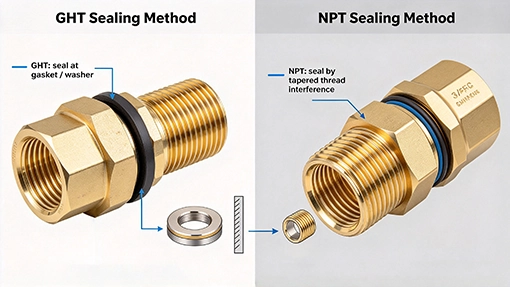
the Sealing Method between GHT and NPT
GHT vs NPT: Which One Should You Choose?
This isn’t a question of which is better. It’s a question of which one matches the connection already present in your system.
| If you are connecting… | Check for… |
|---|---|
| Garden hose to faucet | GHT |
| Garden hose to valve | GHT + appropriate adapter |
| Pipe to valve | NPT |
| Hose to pump | Check pump port + hose connection |
| Hose to industrial equipment | Confirm thread standard from drawing/specification |
If you’re still deciding between flared, compression, nipple, or coupling, see different brass pipe fitting connection types.
Common Buying Mistakes When Ordering Brass Hose Fittings
Mistake 1: Saying “3/4-inch fitting” without specifying GHT or NPT
This is the #1 cause of wrong orders. “3/4 inch” alone is ambiguous.
Mistake 2: Assuming GHT and NPT are interchangeable because they’re both “3/4 inch”
They are not. See everything above.
Mistake 3: Confirming male/female but not the thread standard
A male GHT and a male NPT are both “male.” But they won’t connect to the same female fittings.
Mistake 4: Measuring only the outside diameter
A 3/4″ GHT and a 3/4″ NPT have very similar outside diameters (1.0625″ vs ~1.050″). Diameter alone won’t tell you which thread standard you have.
Mistake 5: Not confirming the sealing method
If you order a GHT fitting but plan to seal it with Teflon tape, you’ll have a problem. GHT needs a washer. NPT needs sealant.
Mistake 6: Confusing hose size with thread size
A “3/4-inch hose” refers to the hose’s inside diameter, not the thread size on the fitting. Don’t assume they’re the same.
For more on nominal vs actual dimensions, see brass pipe fitting sizes and dimensions. It explains why a “3/4-inch” fitting may not measure 3/4 inch.

NPT in Industrial equipment
GHT vs NPT FAQ
Q1: Is 3/4″ GHT the same as 3/4″ NPT?
No. They are different thread standards with different pitch (11.5 vs 14 TPI), different thread form (straight vs tapered), and different sealing methods.
Q2: Can I connect a 3/4″ garden hose to a 3/4″ NPT port?
Not directly. An appropriate GHT-to-NPT adapter is required.
Q3: What is the thread size of a standard garden hose?
For the common North American garden hose connection, the standard designation is 3/4″-11.5 NH (GHT).
Q4: Is GHT straight or tapered?
GHT is a straight (parallel) thread.
Q5: Is NPT straight or tapered?
NPT is a tapered thread, with a taper rate of 1:16.
Q6: Does GHT use Teflon tape?
No. GHT connections normally rely on a rubber washer or gasket for the face seal. Teflon tape is not required and may interfere with proper sealing.
Q7: What adapter do I need for GHT to NPT?
It depends on the male/female configuration on both ends and the NPT size on the equipment side. Specify size + thread standard + gender for both ends when ordering.
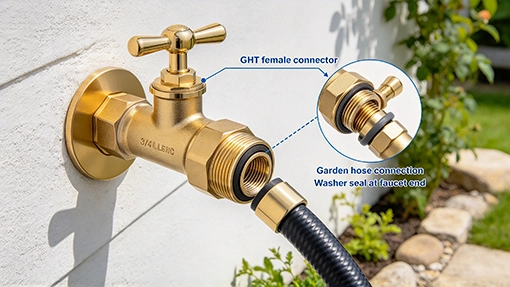
GHT in Outdoor faucets
The Bottom Line
3/4″ GHT and 3/4″ NPT may look alike, but they belong to different thread systems with different engineering principles. GHT is a straight thread that seals with a washer. NPT is a tapered thread that seals through interference and sealant. They are not interchangeable.
If you need to connect them, use a proper adapter — and always specify size, thread standard, and gender when ordering.
Know your thread. Get the right fit. Avoid the leak.
Need Help Matching GHT, NPT, or a Custom Adapter?
Before you order another “3/4-inch” fitting, send us your thread standard, gender, and application. Luoyang Datang Energy Tech Co., Ltd can confirm the right brass hose fitting or adapter — and help you avoid cross-threading, leaks, and returns.
Not sure which thread you have? A photo of the fitting next to a ruler, plus a short description of the application, is usually enough for us to point you in the right direction.
RELATED POSTS
How To Build An Electrical Water Softener That Wraps Around The Supply Pipe
High Quality PE100 & PE80 High Density Polyethylene Pipe In Water Supply and Drainage System

How to Choose HDPE Pipes for Water Supply Projects
Industrial PPR Pipes In Chemical Media and Process Water Transportation

PE Pipe in Agricultural Irrigation & Drip Irrigation System