LUOYANG DATANG ENERGY TECH CO.,LTD


What Is the Difference Between Rigid and Flexible Pipe Clamps?
A pipe is never truly still. It grows when it heats up, shrinks when it cools down, and hums with the rhythm of every pump and compressor upstream. The clamp you choose decides how much of that movement the pipe is allowed to express—and where the rest of it goes. Rigid and flexible pipe clamps sit at opposite ends of that decision, but the line between them is blurrier than most product catalogs admit. A rubber-lined clamp is not automatically a “flexible” clamp in the engineering sense. A rigid clamp is not automatically a fixed anchor. Understanding rigid vs flexible pipe clamps starts with understanding what kind of movement your piping system needs to survive.
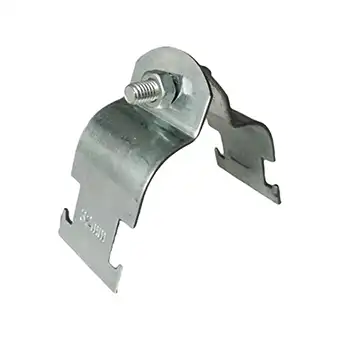
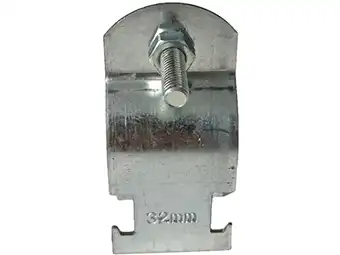
Rigid Pipe Clamps
1. What Are Rigid and Flexible Pipe Clamps?
What Are Rigid Pipe Clamps?
Rigid pipe clamps are built to hold a pipe in a defined position with minimal compliance. The clamp body is structurally stiff, the fastening is firm, and the assembly is intended to resist translation or rotation in one or more directions. Common forms include two-piece rigid clamps, heavy-duty bolted clamps, and engineered rigid pipe support assemblies.
The word “rigid” describes the clamp’s structural behavior—not a guarantee that it restrains every direction. A rigid clamp that bolts a pipe to a bracket restrains radial movement and often axial movement, but the actual constraint directions depend on the bracket, the bolt torque, and how the assembly is anchored to the structure. A rigid clamp in isolation is only one link in the restraint chain.
What Are Flexible Pipe Clamps?
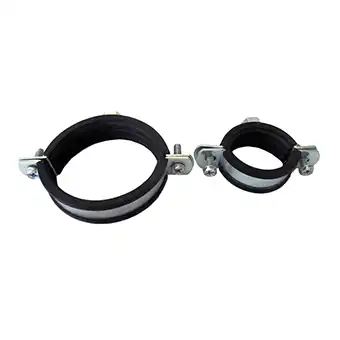
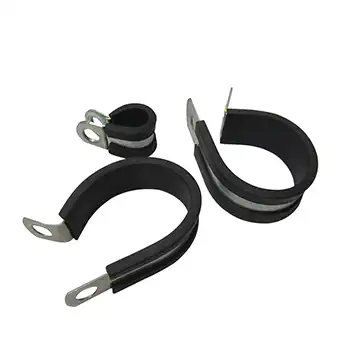
Flexible pipe clamps introduce a compliant element into the pipe–support interface. That compliance may come from an elastomer liner, a flexible connection geometry, or a purpose-built sliding interface. The goal is not “looseness.” The goal is controlled accommodation—reducing vibration transmission, permitting a defined range of relative displacement, or both.
This is where a critical distinction enters. A rubber-lined clamp is not the same thing as a flexible pipe clamp that permits axial sliding. The rubber liner in a standard lined clamp is there to damp vibration, protect the pipe surface, and prevent metal-to-metal contact. It grips the pipe. In fact, rubber-lined clips are explicitly not suitable for long pipe runs precisely because they grip too hard and do not allow the pipe to slide as it expands and contracts.
| Feature | Rigid Pipe Clamps | Flexible Pipe Clamps |
|---|---|---|
| Structural intent | Positional restraint | Compliant support or controlled movement |
| Compliance source | Stiff clamp body and bracket | Elastomer, flexible geometry, or sliding interface |
| Rubber liner = flexible? | No—liner may be present but clamp remains a gripping restraint | No—only if the design explicitly permits movement |
| Typical movement behavior | Restrains or limits movement | Accommodates a defined movement range, if designed to |
The label on the box is not the engineering answer. The load path and the interface behavior are.
Flexible Pipe Clamps
2. How Do Rigid Pipe Clamps Work?
Restricting Unwanted Pipe Movement
A rigid clamp works by closing the load path tight. The pipe is gripped, the clamp is bolted to a bracket or structure, and movement in the restrained directions is resisted by the stiffness of the assembly. That is useful when a pipe must stay where the designer put it: at an equipment nozzle, at a branch connection, or at a point where a defined alignment protects downstream components.
But rigidity is a directional property. A clamp that prevents a pipe from lifting off a support does not necessarily prevent it from sliding along the support. A clamp that grips the pipe tightly may restrain axial movement while the bracket beneath it permits rotation. Rigid pipe support design is about closing the right degrees of freedom, not closing all of them.
Maintaining Alignment in Piping Systems
Industrial piping is not laid out by accident. Pump flanges, valve bodies, and vessel nozzles expect the pipe to arrive within a specific alignment window. Rigid pipe clamps help hold that geometry under dead weight, pressure thrust, and modest external loads.
The risk appears when rigidity is applied without a movement plan. If every support point is a hard restraint, the pipe’s thermal growth has nowhere to go. The resulting axial force does not disappear—it travels into the clamp, the bracket, the anchor, or the equipment nozzle. A rigid clamp is a tool for restraint, not a substitute for a thermal expansion strategy.
Rigid pipe clamps are commonly specified when:
- The pipe position must remain stable under operating loads.
- The support point is designed as a restraint or anchor in a defined direction.
- Equipment connections require controlled pipe alignment.
- The piping system needs structural restraint against occasional loads.
- The support assembly has been rated for the imposed mechanical loads.
3. How Do Flexible Pipe Clamps Work?
Accommodating Certain Types of Pipe Movement
A true flexible or movement-accommodating pipe clamp does not let the pipe wander. It defines a permitted envelope—a sliding range, a lateral compliance, or a rotational allowance—and keeps the pipe within it. The movement may be axial (thermal growth), lateral (vibration or displacement), or angular. Which movement is permitted depends entirely on the product design, and the manufacturer’s displacement rating is the controlling data point.
A rubber-lined clamp that grips the pipe firmly is not a movement-accommodating support, even if the liner feels soft to the touch. The liner changes the contact mechanics; it does not automatically change the kinematic behavior of the clamp.
Reducing Vibration and Noise Transmission
Pumps, compressors, and rotating equipment push pulsation and structure-borne noise into the piping. A rigid metal-to-metal clamp gives that vibration a stiff path into the building structure. A resilient-lined clamp interrupts part of that path by placing a damping material between the pipe wall and the clamp body.
But vibration isolation is not a yes/no property. It depends on the liner material, hardness, thickness, the clamp’s clamping force, the mass of the pipe section, and the frequency content of the vibration. A cushioned clamp can reduce transmission at some frequencies and amplify it at others if the support layout is not considered as a system. For high-energy pulsation from reciprocating equipment, a clamp change alone is rarely the complete answer—support spacing, bracing, and dedicated vibration-damping supports may all be required.
Supporting Thermal Expansion and Contraction
This is where the clamp conversation becomes a piping design conversation. A carbon steel pipe 10 m long, heated by 50°C, with a linear expansion coefficient of roughly 12 × 10⁻⁶ /°C, grows by:ΔL=αLΔT=12×10−6×10×50=0.006 m=6 mm
Six millimeters sounds small—until it is restrained at both ends. That 6 mm of free growth becomes an axial force pushing against every clamp, bracket, and nozzle in between. If the entire run is rigidly clamped, the pipe cannot relieve that displacement, and the restraint system must absorb it.
This is why a piping system needs more than one clamp type. A fixed support (anchor) holds a point completely. A guide prevents lateral movement while permitting axial movement. A sliding support carries dead weight while allowing the pipe to translate in the axial direction. The clamps on a hot line are not interchangeable parts—they are elements in a movement-management system.
A flexible clamp is not automatically a sliding support, and a rubber liner is not automatically a low-friction slide surface. If the design intent is to allow thermal displacement, the support must be engineered for that displacement—with the friction behavior, guide geometry, and load path to match.
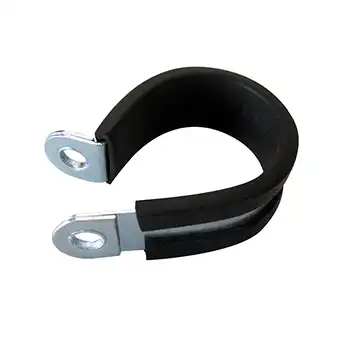
Rigid vs. Flexible Pipe Clamps
4. Rigid vs. Flexible Pipe Clamps: Key Differences Compared
| Comparison Factor | Rigid Pipe Clamps | Flexible Pipe Clamps |
|---|---|---|
| Primary function | Positional restraint | Compliant support or defined movement accommodation |
| Structural stiffness | High; load path is intentionally stiff | Reduced or engineered compliance at the interface |
| Axial movement | Restrained or limited by clamp grip | May be permitted only if the design explicitly allows it |
| Vibration transmission | Generally high; rigid metal path | Can be reduced in suitable designs; not guaranteed |
| Thermal expansion handling | Used at anchors/fixed points; requires sliding/guide points elsewhere | Some designs accommodate movement, but a flexible clamp alone does not solve thermal expansion |
| Rubber liner | May be present for wear/noise, but clamp remains a gripping restraint | Not equivalent to a movement-accommodating clamp |
| Typical role | Positioning, alignment, structural restraint | Vibration isolation or a specific displacement function |
Which Type Provides Better Vibration Control?
A standard rigid clamp is not designed for isolation—it transmits. A resilient-lined clamp can reduce transmission, but “better” depends on the vibration spectrum and the support layout. A soft liner under a light clamp may do little at low frequencies; a heavily torqued lined clamp may still create a stiff path through the bolt. Vibration control is a system property, not a clamp accessory.
Which Type Is Better for Thermal Expansion?
Neither—because thermal expansion is not solved by a clamp type. It is solved by a support scheme: anchors to define a fixed point, guides to keep the pipe on axis, and sliding supports to let the pipe move where it must. A rigid clamp at a fixed point and a sliding support a few meters away are not competing choices. They are complementary roles in the same system.
5. Where Are Rigid and Flexible Pipe Clamps Used?
Typical Applications of Rigid Pipe Clamps
| Application | Why Rigid Support May Be Used |
|---|---|
| Industrial process piping | Maintain defined pipe positions at equipment interfaces |
| Water supply systems | Support and restrain pipe runs at designated points |
| Equipment connections | Control alignment at pump, valve, and vessel nozzles |
| Structural pipe supports | Provide specified restraint against dead weight and occasional loads |
Typical Applications of Flexible Pipe Clamps
| Application | Why Flexible Support May Be Used |
|---|---|
| HVAC piping | Reduce vibration and noise transmission in suitable installations |
| Pump connections | Support vibration-sensitive pipe sections near rotating equipment |
| Compressor piping | Manage pulsation and vibration with appropriate support design |
| Noise-sensitive buildings | Reduce structure-borne noise paths |
| Thermal movement areas | Only when the clamp or support is explicitly designed for the required displacement |
A flexible clamp near a pump is not a substitute for a proper piping layout. Equipment nozzle load limits, support spacing, and the possible need for flexible connectors all remain part of the design. The clamp is one component in a vibration and movement control strategy—not the strategy itself.
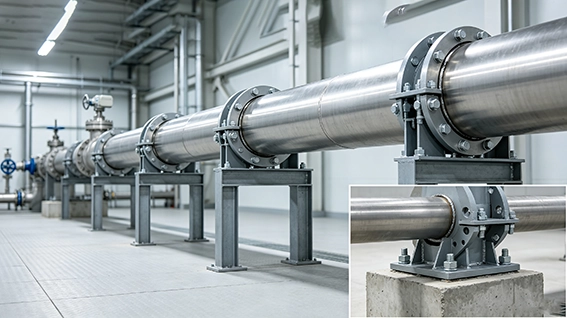
Rigid Pipe Clamps Used in Water supply systems
6. How to Choose Between Rigid and Flexible Pipe Clamps?
Start with Pipe Movement Requirements
Ask four questions before opening a catalog:
- Does the pipe need to stay fixed in a specific direction? → Rigid restraint.
- Is there calculated axial thermal growth that must be accommodated? → Guide and sliding supports, not a standard lined clamp.
- Is vibration transmission the problem? → A resilient-lined or isolation support, selected for the vibration spectrum.
- Is the pipe near a nozzle with strict load limits? → The support scheme must protect the nozzle, often with a combination of restraint and controlled movement.
Check Operating Conditions
Temperature, pressure, pipe material, diameter, fluid weight, vibration level, and corrosion exposure all shape the clamp choice. A rubber-lined clamp may be useful for vibration and wear protection at moderate temperatures, but standard rubber liners are not a universal high-temperature solution—the liner and the clamp body must both be rated for the service condition.
Verify Clamp Materials and Structural Ratings
Clamp body material, liner material, corrosion resistance, allowable load, temperature range, and fastener specification must all be checked against the support load path, not just the pipe diameter. A clamp rated for a static vertical load is not automatically rated for a thermal sliding application or a vibration-fatigue environment.
Confirm Installation and Support Requirements
| Your Requirement | Recommended Direction |
|---|---|
| Maintain a defined pipe position | Rigid clamp or engineered restraint |
| Reduce metal-to-metal contact | Lined clamp—but confirm whether movement is permitted |
| Reduce vibration transmission | Resilient-lined or purpose-built vibration-isolating support |
| Allow calculated axial movement | Engineered sliding support, not a standard gripping clamp |
| Guide thermal expansion | Dedicated pipe guide |
| Support a high-load section | Load-rated engineered pipe support |
The real decision is rarely “rigid or flexible?” in isolation. It is “which combination of restraint, guidance, and compliance does this pipe run need?”
7. Common Mistakes When Selecting Rigid or Flexible Pipe Clamps
- Assuming “flexible” means free movement. A flexible element may accommodate a defined displacement—not unlimited sliding. The manufacturer’s movement rating is the boundary.
- Treating a rubber-lined clamp as a thermal sliding support. A rubber liner grips. It is designed for vibration, wear protection, and noise reduction—not for low-friction axial travel.
- Choosing clamps by pipe diameter alone. Diameter is one input. Load, temperature, movement, vibration, and support spacing are equally part of the selection.
- Ignoring thermal expansion because the number “looks small.” Six millimeters over 10 m becomes a real axial force when restrained at both ends. Small displacement does not mean negligible load.
- Swapping one clamp type for another without checking the support system. A clamp change does not redesign the load path. Guides, anchors, and sliding points have to work together.
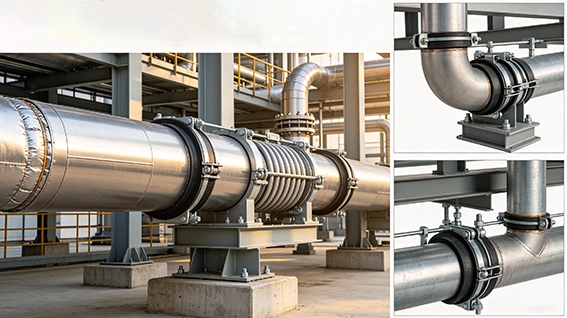
Flexible Pipe Clamps in Thermal movement areas
8. Frequently Asked Questions About Rigid and Flexible Pipe Clamps
Q1: What is the main difference between rigid and flexible pipe clamps?
Rigid clamps restrain pipe movement; flexible designs introduce compliance or accommodate a defined displacement. The key is not the label but the actual load path and whether the clamp grips, slides, or isolates.
Q2: Are flexible pipe clamps better for vibration control?
A suitable resilient-lined or isolation support can reduce transmission, but effectiveness depends on the liner, clamping force, vibration frequency, and support layout. A flexible clamp in the wrong support scheme can still transmit vibration.
Q3: Can rigid pipe clamps handle thermal expansion?
Rigid clamps are appropriate at anchors and fixed points. They cannot be the only support type on a run with meaningful thermal growth. Guides and sliding supports are required to let the pipe move where the design intends.
Q4: Do rubber-lined pipe clamps allow pipes to move?
Not inherently. The liner is primarily for vibration damping, wear protection, and metal isolation. Rubber-lined clamps typically grip the pipe; if axial sliding is required, a purpose-designed sliding support should be used.
Q5: Which pipe clamp is suitable for HVAC systems?
HVAC piping often benefits from resilient-lined clamps for vibration and noise, but the choice must account for pipe weight, temperature, support spacing, and whether the line has thermal movement. No single clamp type covers every HVAC run.
Q6: Can rigid and flexible pipe clamps be used in the same piping system?
Yes—and they usually should be. A hot or vibrating line may need rigid restraint at an anchor, guides to control direction, sliding supports to allow thermal movement, and resilient clamps to manage vibration. The system works when each clamp performs its intended role.
9. Need Help Choosing the Right Pipe Clamp?
Pipe clamp selection is not a diameter-matching exercise. It is a movement and load-path decision: where the pipe must stay fixed, where it must be allowed to move, and where vibration needs to be interrupted. A clamp that is correct in isolation can be wrong in the support scheme.
Looking for Pipe Clamps for Your Industrial Piping Project? Share your pipe diameter, material, operating temperature, support layout, and movement requirements. Luoyang Datang Energy Tech Co., Ltd. can help evaluate rigid restraint, resilient-lined isolation, and movement-accommodating support options against the actual operating conditions of your line—so the clamp you install is the one your piping system can live with.
RELATED POSTS
HDPE Water Pipe To Ensure Water Quality & Save Resources
High-Density Polyethylene Pipes: Multi-Purpose Applications and Advantages
How to Install HDPE Pipes Underground: Key Steps, Methods, and Best Practices
HDPE Pipes & PVC Pipes In Injection and Streamline System
