LUOYANG DATANG ENERGY TECH CO.,LTD


Stainless Steel vs. Carbon Steel Pipe Clamps: Which Material Should You Specify?
Two pipe clamps can look almost identical on a warehouse shelf. Same profile, same bore, same bolt pattern. But once the installation leaves the warehouse — into a coastal plant, a chemical area, or a dry indoor mechanical room — the material inside that clamp starts making decisions on your behalf.
That is why the real question is not “which material is stronger.” It is which material belongs in this specific service environment, for this service life, at this maintenance philosophy. This article walks through that decision the way a procurement engineer actually faces it: corrosion first, strength second, cost third, and the specification checklist last.
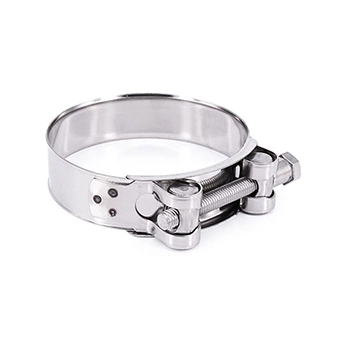
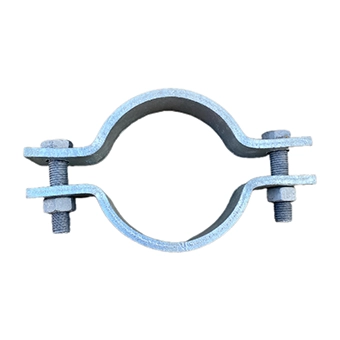
Stainless Steel vs. Carbon Steel Pipe Clamps
1. What Actually Separates Stainless from Carbon Steel in a Pipe Clamp?
The short answer is not “stainless never rusts.” It is how each material handles the corrosion mechanism it will face.
| Stainless Steel Pipe Clamps | Carbon Steel Pipe Clamps | |
|---|---|---|
| Base composition | Iron + chromium (typically 16–19% Cr), plus other alloying elements | Primarily iron and carbon |
| Corrosion protection mechanism | Inherent passive film formed by chromium | Depends on applied coating (zinc, paint, etc.) |
| Common grades in clamps | 304 / 316 / 316L 304 / 316 / 316L | Q235, mild steel, various structural grades |
| Typical surface finish | Pickled, passivated, or polished | Hot-dip galvanized (HDG), electro-galvanized, painted |
| Maintenance model | Inspect only in most services | Inspect coating integrity; recoat or replace |
The critical distinction sits inside the stainless family. 304 is the workhorse grade for general industrial and humid indoor service. 316 adds 2–3 wt% molybdenum, and that single alloying addition changes how the material behaves around chlorides. It does not make 316 “immune” — it raises the threshold before pitting and crevice attack take hold.
Carbon steel takes a completely different route. Bare carbon steel has essentially no meaningful atmospheric corrosion resistance on its own. Its service life is created by the coating on top of it — and the coating type matters far more than most buyers realize.
2. Corrosion Resistance: The Decision That Actually Matters
This is where the specification is won or lost. Not at the strength table — here.
Indoor, dry environments
In a dry mechanical room, a warehouse, or a covered industrial building, hot-dip galvanized carbon steel is a rational, cost-effective choice for most general pipe support. There is no continuous moisture film, no chloride deposition, and the zinc coating is not being asked to do heavy lifting.
The nuance many specifications miss: not all “galvanized” is the same. Hot-dip galvanizing (HDG) produces a metallurgical zinc-iron bond with coating thickness typically 45–100+ μm, and atmospheric service life in the range of 25–75+ years depending on environment. Electro-galvanizing deposits only 5–25 μm and is rated for roughly 2–10 years in mild environments. A clamp described simply as “galvanized” without a process callout can therefore carry a service-life expectation that differs by a factor of five or more.
Outdoor exposure: rain, humidity, temperature cycling
For outdoor exposed pipe support, HDG carbon steel remains a legitimate contender. A 100 μm hot-dip coating in a moderate environment is commonly referenced as giving roughly 50 years before first maintenance, and 85 μm coatings are associated with 20–30 years in industrial or marine atmospheres.
But the word “coastal” needs to be handled carefully. Standard shop-primed carbon steel clamps have been reported to survive only 3–5 years in moderate offshore environments, while stainless clamps in identical conditions last 25+ years — at 3–4× the initial material cost. That is the fork in the road: carbon steel is not disqualified outdoors, but the coating system and the chloride load have to be honestly matched.
Chloride-rich and chemical environments
Once the service environment carries meaningful chloride — salt air, de-icing salts, wash-down chemicals, certain process streams — the material conversation shifts decisively.
304 is vulnerable in chloride-bearing environments, particularly as temperature rises. In chloride-containing service above roughly 60°C, 304 is reported to be susceptible to pitting, crevice corrosion, and chloride stress corrosion cracking; 316 resists these mechanisms significantly longer, though it is not immune either. In practical chloride-exposure terms, 304 is often associated with service up to around 200 ppm chloride, while 316 is associated with a ceiling closer to 1,000 ppm — a different class of environment, not a cosmetic upgrade.
For offshore platforms, chemical process areas, and swimming-pool mechanical rooms, 316 is the grade that belongs in the specification conversation; for general coastal within roughly 5 km and humidity above 70% annually, 304 may be defensible if the chloride load is genuinely moderate. The point is not to memorize a decision tree, but to stop specifying “stainless” as a single material and start specifying the grade against the environment.
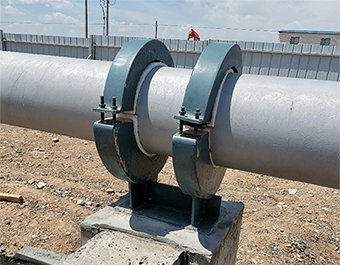
Carbon Steel Pipe Clamps in real situation
3. Strength: Does Stainless Steel Actually Carry More Load?
This is the assumption that causes the most quiet specification errors.
The common working numbers for annealed austenitic stainless in clamp-relevant forms are yield strength around 205 MPa minimum and tensile strength around 515 MPa minimum for both 304 and 316. Typical ranges run 205–300 MPa yield and 515–750 MPa tensile for 304, with 316 sitting in a broadly similar band.
Now compare that with a standard structural carbon steel used in clamps. Q235 — a very common carbon steel grade for pipe support hardware — carries yield strength ≥235 MPa (for thickness ≤16 mm) and tensile strength 370–500 MPa. In other words, the yield strength of ordinary Q235 carbon steel is not lower than that of annealed 304/316 stainless. The idea that “stainless is stronger” is, at the material-property level, not supported.
What actually sets clamp load capacity is a stack of variables that sit above the material datasheet:
| What drives load capacity | Why it matters |
|---|---|
| Clamp thickness and cross-section | A thicker carbon steel clamp can outperform a thin stainless clamp |
| Structural design | Two-bolt vs. single-bolt, profile geometry, rib design |
| Bolt grade and torque | The fastener often sets the practical limit, not the clamp body |
| Insert and pipe interface | Vibration, friction, and point loading change the real service condition |
| Test data for the specific product | Catalogue “load ratings” mean little without the test standard behind them |
So the honest formulation is not “stainless is stronger” or “carbon steel is stronger.” It is: load capacity is a product-level property, not a material-level property. Specify the clamp by its tested rating, not by the metal’s family name.
4. Cost vs. Service Life: The Calculation Buyers Actually Need
Unit price is the easiest number to compare and the least useful one in a corrosive service.
Stainless steel clamps carry a 3–4× initial material cost premium over carbon steel in aggressive service, and roughly 2–3× at the 304 level in wet or coastal duty. If the comparison stops there, carbon steel wins every time. It should not stop there.
A published life-cycle example for a 2-inch clamp in offshore salt air illustrates the reversal:
| Carbon steel clamp | 316 stainless clamp | |
|---|---|---|
| Initial cost | $45 | $165 |
| Coating maintenance | $120 recoating every 5 years | $0 |
| 15-year cumulative | $285 | $165 |
| Break-even | — | ~8 years, then stainless saves ~45% |
Data source: published offshore clamp life-cycle example.
The number that makes or breaks this calculation is access cost, not clamp cost. Recoating a clamp on a pipe rack at grade level is routine maintenance. Replacing a clamp on an offshore platform requires rigging, scaffolding, and day-rate access that can run $15,000+/day. When access cost is high and the environment is aggressive, the stainless premium is not a “nice-to-have” — it is the cheaper decision over the asset life.
On the other side of the ledger, carbon steel wins decisively in dry, accessible, non-critical service — indoor HVAC, dry-climate refineries, temporary installations, and general utility lines where periodic inspection is already part of the maintenance plan. Paying for 316 where HDG carbon steel will comfortably outlive the pipe is not conservatism; it is misallocation.
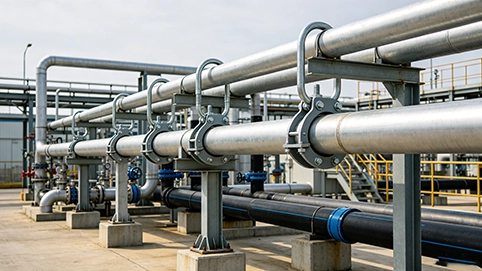
Pipe Clamps used in Outdoor pipe support, moderate climate
5. So Which Material Should You Specify?
The honest answer is “depends” — but a structured depends, not a shrug. Here is the directional map that most industrial pipe support specifications converge on, stated as a starting point rather than a mandate.
| Application | Directional material call | Why |
|---|---|---|
| General indoor plumbing / dry service | HDG carbon steel (stainless acceptable where aesthetics or washdown matter) | Coating protection is sufficient; stainless premium buys little |
| Outdoor pipe support, moderate climate | HDG carbon steel or 304 stainless | HDG is serviceable if coating integrity is maintained |
| Coastal installations (within ~5 km, humidity >70%) | 304 stainless as a defensible baseline; 316 where chloride load is meaningful | 304 handles moderate chloride; 316 extends the threshold |
| Offshore / salt-spray / de-icing salt exposure | 316 stainless (316L where welding/corrosion allowance matters) | 304 has documented rapid pitting in these services |
| Chemical processing | Grade selected against the specific chemical exposure, often 316 or higher | “Stainless” alone is not a specification here |
| Food / pharmaceutical / hygiene-critical | Appropriate stainless grade subject to hygiene and cleanability requirements | Carbon steel coatings and crevices are the issue, not just corrosion |
Two specification habits separate a clean decision from a costly one. First, state the grade, not the family: “SS316” is a specification; “stainless steel” is a category. Second, state the coating process, not the coating word: “HDG to ISO 1461, 60–80 μm minimum” is a specification; “galvanized” is a price that will not be comparable across quotes.
6. Before You Send the RFQ: Six Things Buyers Should Lock Down
The material decision is only as good as the line items that carry it into the purchase order.
- Material grade, explicitly — SS304, SS316/316L, or carbon steel with the structural grade stated. “Stainless” is not an orderable specification.
- Surface treatment process and thickness — HDG to ISO 1461 or ASTM A123, with minimum micron callout; electro-galvanized only where the environment genuinely supports it.
- Pipe outside diameter and clamp bore match — the clamp is a fit-critical part; a correct material in the wrong bore is still a wrong part.
- Clamp thickness, profile, and bolt grade — these set the practical load path more directly than the base metal family.
- Load rating and the test basis behind it — ask for the standard or the test report, not just the catalogue number.
- Service environment stated in the RFQ — chloride exposure, humidity, temperature range, indoor/outdoor, washdown chemicals. The supplier cannot select responsibly against an unstated environment.
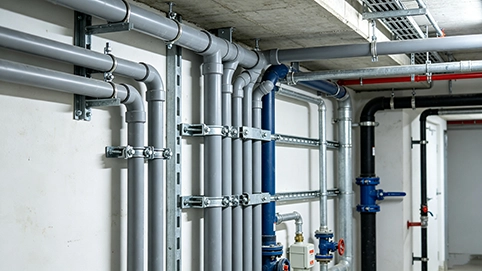
Pipe Clamps used in General indoor plumbing
FAQ
Are stainless steel pipe clamps better than galvanized steel clamps?
Not as a blanket statement. Galvanized carbon steel — specifically hot-dip galvanized — is the better economic choice in dry, accessible, non-critical service, where the coating is not under continuous chloride or moisture attack. Stainless becomes the better choice when corrosion protection cannot depend on a coating that may be damaged, or when maintenance access is expensive enough that recoating cycles dominate the life-cycle cost. The deciding variable is the service environment and the access cost, not the material category.
Do carbon steel pipe clamps rust outdoors?
Bare carbon steel will corrode outdoors; the question is how fast, and whether the coating system keeps the base metal out of the corrosion circuit. Hot-dip galvanized carbon steel provides sacrificial zinc protection and has a documented atmospheric service-life range of 25–75+ years, depending on coating thickness and environment severity, with 20–30 years commonly associated with industrial/marine atmospheres at ~85 μm. Electro-galvanized surfaces, by contrast, are rated at roughly 2–10 years in mild environments. “Outdoors” is therefore not a yes/no condition — coating process and coating thickness are the actual specification variables.
Should I choose SS304 or SS316 pipe clamps?
Choose 304 when the service is general industrial, humid indoor, or moderately coastal with a chloride load that stays genuinely moderate — it is the cost-effective stainless baseline. Choose 316 when the environment carries salt spray, de-icing salts, washdown chemicals, or offshore/chemical exposure, because the 2–3% molybdenum addition raises the pitting resistance equivalent number from roughly 18–20 (304) to roughly 24–28 (316) and extends the chloride threshold substantially. Neither grade is immune to chlorides; 316 buys a higher threshold, not immunity. State the grade in the RFQ, and if the environment sits near a boundary, ask the supplier for the grade-specific corrosion basis rather than defaulting to “stainless.”
Not Sure Which Grade to Specify?
Send us the pipe diameter range, service environment (indoor / outdoor / coastal / chemical), target service life, and any coating or grade preference. Luoyang Datang Energy Tech Co., Ltd. will review the material call against the actual exposure and come back with a grade and finish recommendation you can put directly into your RFQ — not a catalogue page.
RELATED POSTS
In-depth Analysis of Industrial PEX-AL-PEX Pipe
How to Choose PPR Pipes?
Butt Weld Fittings or Grooved Fittings? Understanding the Best Connection Method for Industrial Piping Systems

Stop Buying Brass Pipe Valves on Price Alone! 3 “Cost-Cutting” Secrets 90% of Buyers Miss.
Eco-Friendly PPR Pipes: Expert Guide to Avoid Cheap Materials & Failures