LUOYANG DATANG ENERGY TECH CO.,LTD


How to Choose the Right Unistrut Clamp for Your Pipe Support System
The same pipe. The same strut channel. Two installations six months apart: one is rock-solid, the other has already loosened, vibrated, or started to corrode at the contact point.
The difference is rarely the pipe. It is almost always the clamp — and more precisely, whether the clamp was matched to the pipe’s actual outside diameter, the pipe material, and the environment it sits in. An Unistrut clamp is a small line item, but it is the point where load, vibration, thermal movement, and corrosion all converge.
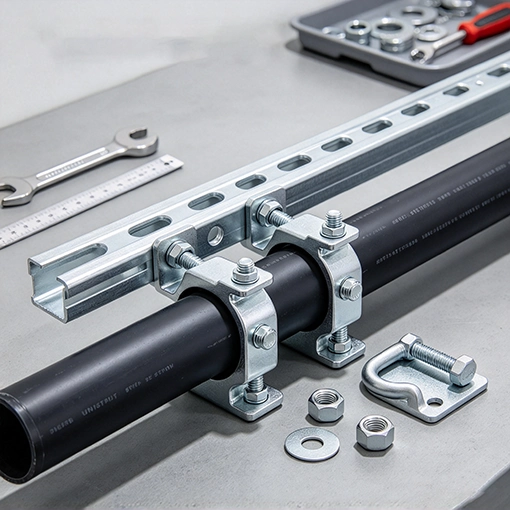
Unistrut Clamp for Pipe Support System
1. What Is an Unistrut Clamp and How Does It Work?
An Unistrut clamp is a bracket that wraps around a pipe’s outside diameter and bolts into the open slot of a strut channel. The clamp’s “feet” seat into the channel slot, and a channel nut — often a spring nut — slides to any position before locking down. That sliding freedom is the practical value: you position the support exactly where the load needs it, without drilling a fixed hole.
Unistrut is a brand name, but in daily specification language it is often used interchangeably with strut channel clamps or metal framing pipe clamps. The generic term matters because not every clamp sold for a 1-5/8″ channel is structurally identical. Confirm the channel series, slot width, and bolt size before assuming compatibility.
These clamps show up wherever pipe needs a rigid, removable support: industrial process piping, HVAC and hydronic runs, commercial plumbing, and electrical conduit secured to metal framing.
2. Different Types of Unistrut Pipe Clamps
“Unistrut pipe clamp” is an umbrella term. The functional family you choose decides whether the support absorbs vibration, isolates dissimilar metals, or simply holds a heavy line in place.
Table 1: Common Functional Types
| Clamp Type | What It Does | Where It Fits |
|---|---|---|
| Standard pipe clamp | Basic mechanical hold on bare pipe | General utility piping |
| Cushioned clamp | Rubber or elastomer liner separates pipe from metal; reduces vibration and isolates dissimilar metals | HVAC, refrigeration, insulated lines, copper piping |
| Rigid strut clamp | Higher holding strength with tighter tolerance | Industrial piping, vertical runs |
| Adjustable clamp | Accommodates a range of diameters or field variations | Retrofit and field-fit conditions |
A cushioned Unistrut clamp deserves special attention. The liner is not a comfort feature. It is the barrier that prevents galvanic corrosion when a copper or brass pipe sits in a steel clamp, and it is often the difference between a quiet HVAC line and a vibration complaint. Municipal specifications routinely require plastic inserts or PVC-coated clamps wherever copper contacts ferrous metal.
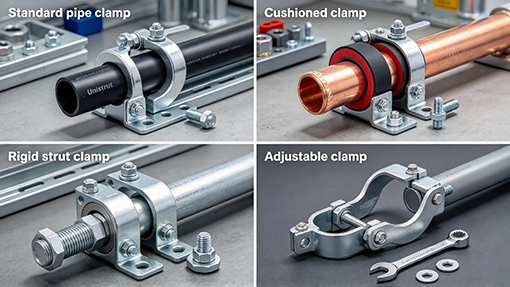
Clamp Types
3. How to Match Unistrut Clamps to Pipe Sizes and Materials
This is where most selection errors begin. Two rules matter more than any others.
Rule 1: Match the outside diameter, not the nominal size
A 1″ nominal pipe is not 1.000″ on the outside. Copper, stainless, PVC, and steel pipe of the same nominal size can have different outside diameters. If you order a clamp by nominal size alone, you can end up with a loose fit that rattles under vibration, or a clamp that has to be over-tightened just to touch the pipe.
Measure the OD with a caliper or tape, then select the clamp whose listed range includes that measured OD. “Nominal pipe size” on a clamp listing is a starting point, not a guarantee.
Rule 2: Match clamp material to pipe material and environment
Table 2: Clamp Material Quick Reference
| Clamp Material | Strength & Cost | Corrosion Behavior | Watch Out For |
|---|---|---|---|
| Carbon steel | Good strength, economical | Needs coating; raw steel rusts | Verify finish matches indoor/outdoor exposure |
| Electro-galvanized | Moderate corrosion protection | Suitable for sheltered or mild exposure | Thin zinc layer; not for coastal/chemical |
| Hot-dip galvanized | Thicker zinc, better durability | Good for outdoor and humid industrial air | Check coating compatibility with pipe |
| Stainless 304 | Higher cost, strong corrosion resistance | Most general outdoor and indoor service | Not ideal for chlorides |
| Stainless 316 | Highest corrosion resistance | Coastal air, de-icing salts, wash-down, chemical | Verify fastener grade matches clamp |
| Rubber-lined / cushion | Adds isolation, not structural strength | Prevents metal-to-metal contact | Check liner temperature rating |
A 316 stainless clamp in a coastal parking structure is not overkill — it is the minimum that survives chloride exposure. Conversely, a bare carbon steel clamp on a copper line is a corrosion cell waiting to happen, even indoors.
For plastic pipe, the clamp selection shifts: the risk is crushing or stress concentration, not corrosion. A cushioned or broad-contact clamp distributes load and avoids point-loading the pipe wall.
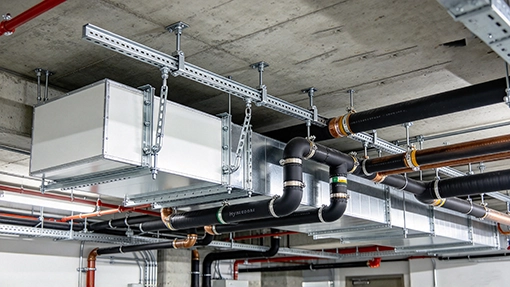
an Unistrut Clamp in HVAC and hydronic runs
4. Installation Mistakes That Quietly Ruin Pipe Support Performance
Even a correctly specified clamp can fail in service if installation ignores a few hard realities. These are the recurring ones.
① Seating the channel nut only partially. A partially seated nut will not develop full holding strength. The nut must sit fully in the channel slot before the clamp bolt is tightened. This is the single most common cause of a clamp that “tightens” but still slides.
② Using hardware of the wrong grade or material. A stainless clamp paired with a zinc-plated bolt creates a dissimilar-metal couple at the fastener. Match bolt and nut material to the clamp and the environment.
③ Treating every support as a rigid anchor. Pipes expand and contract. A run that is clamped rigid at every support has nowhere to move, so the movement goes into the clamp, the pipe wall, or the connection. Fixed and guided supports serve different purposes; clamps on guided supports should allow limited axial movement, and spacing should follow the governing specification.
④ Over-tightening to “make it fit.” A clamp that is cranked down to close an OD mismatch can deform the pipe, crack a protective coating, or crush a plastic liner. Unistrut’s published torque values are not suggestions: for 1/4″ screws in a two-piece pipe clamp, the specified torque is 5 ft-lbs (60 in-lbs); general 1/4″ recommended torque is 6 ft-lbs with a 7 ft-lb maximum. Torque is the only reliable way to know the clamp is tight enough without being destructive.
⑤ Judging load capacity by clamp size alone. Clamp load ratings are based on connection strength with a safety factor of 5.0 in many Unistrut pipe clamp lines, but the clamp is only one element of the support. Pipe weight, fluid weight, insulation, thermal movement, vibration, and support spacing all feed into the actual load. A clamp that is “big enough” for the pipe diameter can still be undersized for the support spacing.
5. Where Are Unistrut Clamps Commonly Used?
The application changes what “right” means. A clamp that is ideal in one service can be wrong in another.
- Industrial process piping: rigid support and load capacity dominate; material selection follows the fluid and ambient corrosion risk.
- HVAC and refrigeration: vibration and condensation are the enemies. Cushioned clamps are the default where metal-to-metal contact would transmit noise or trap moisture.
- Commercial plumbing: copper and PEX lines make galvanic isolation and OD matching critical. Plastic inserts or coated clamps are standard where copper meets steel.
- Water supply and drainage: outdoor and buried transitions put a premium on coating integrity and fastener grade.
- Mechanical and electrical service installations: conduit and cable tray runs prioritize repeatable spacing, straight alignment, and compatibility with the channel series.
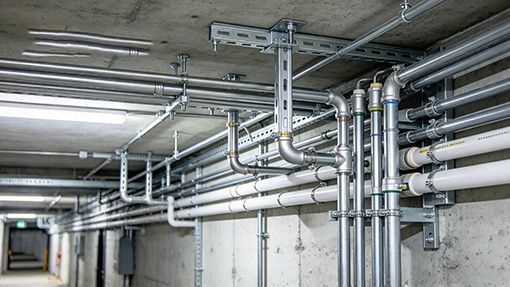
an Unistrut Clamp in electrical conduit
Not sure which clamp family fits the job?
Send us four details and we can narrow the shortlist quickly: pipe outside diameter and material, installation orientation, indoor or outdoor exposure, and whether the line carries vibration or thermal movement. Luoyang Datang Energy Tech Co., Ltd. will match the clamp type, material and finish, and fasteners to the actual service — not just the nominal pipe size.
Still weighing clamp-based supports against other support methods? Start with our guide to different types of pipe support clamps before you lock the bill of materials.
RELATED POSTS
PVC Pipes Play An Important Role In Plumbing, Drainage & Sewage Treatment.
Why PPR pipes and fittings become the ideal choice for indoor water supply in the Middle East, Africa and Southeast Asia hot areas?

PE Pipe Vs PVC Pipe in Agricultural Irrigation: Comparative Analysis
Brass Hose Barb vs Threaded Fitting: Which One Is Right for Your Hose?
HDPE Pipes & PVC Pipes In Injection and Streamline System