LUOYANG DATANG ENERGY TECH CO.,LTD


ISO 4437-1:2026 Is Here: What Changed for PE Gas Pipe Buyers and Installers
ISO 4437-1:2026 was published on 14 October 2026. It is the third edition, and it cancels and replaces ISO 4437-1:2024 with a technical revision—not a reprint with a new cover.
The headline changes fall into four areas: how slow-crack-growth resistance is verified, which test paths are accepted, whether pipe and fitting compounds are formally compatible, and what the standard now says—informatively—about PE100-RC installation and hydrogen. For buyers and installers, the practical question is not “what edition is current?” It is: does your specification, your supplier’s test report, and your electrofusion jointing procedure still reflect the old logic?
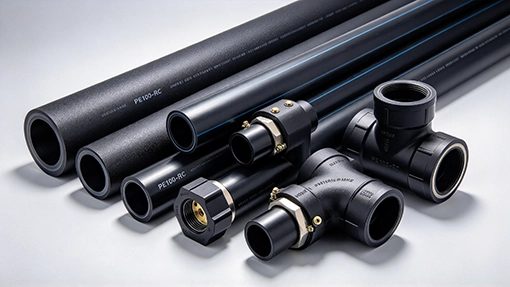
PE100-RC gas pipe and electrofusion fittings under ISO 4437-1:2026
1. The CRB Test Now Has a Conversion and Normalisation Step—What That Changes for Material Verification
The cracked round bar (CRB) test is the accelerated method used to screen PE100-RC compounds for resistance to slow crack growth (SCG). In ISO 4437-1:2026, a conversion and normalisation step has been included in the CRB requirement, alongside recommended CRB stress ranges and specified AFNCT stress levels.
The conversion and normalisation step matters because CRB results are sensitive to specimen geometry, notch preparation, and testing conditions. Without a normalisation protocol, two laboratories can test the “same” compound and report numbers that are not directly comparable. The new step narrows that gap. It does not make CRB a perfect test—no accelerated test is—but it makes cross-laboratory comparison a formal expectation rather than a courtesy.
The recommended stress ranges add a second layer. Reported CRB data should now be read alongside the stress range under which it was generated. A passing result at one stress level does not automatically translate to a passing result at another. The standard’s move toward recommended ranges is an attempt to standardise the interrogation window, not to lower or raise the bar uniformly.
The AFNCT remains the referee test in case of dispute. The standard states that in case of dispute, the AFNCT applies. That division of labour is worth noting: CRB is the screening and quality-control tool; AFNCT is the arbiter when results are contested.
| Change | Compound supplier | Pipe buyer | Installer / inspector |
|---|---|---|---|
| CRB conversion and normalisation | Test reports need to follow the new step; cross-laboratory comparability becomes an expectation | The credibility of supplier CRB data increases, but buyers must confirm it was generated under the new edition | Site sampling and judgment criteria become more consistent |
| Recommended CRB stress ranges | Certification testing now has clearer reference conditions | Buyers can check whether the supplier’s report states the stress range used | Clarifies why reported values may differ across batches or reports |
| AFNCT stress levels | Arbitration testing conditions for slow crack growth are more specific | Provides a technical due-diligence question for buyers | Reduces vague reports that give conclusions without test conditions |
What to ask your supplier now: “Was the CRB data generated under ISO 4437-1:2026, with the conversion and normalisation step applied? Which stress range was used?” If the answer is a single sentence—“CRB passed”—that is not a 2026-compliant answer.

CRB test specimen for PE gas pipe slow crack growth verification
2. Strip-Bend and Crush Tests Are Now Accepted Alternatives—A Wider Path, Not a Looser One
The second technical change is easy to misread. The strip-bend test (ISO 21751) and the crush test (ISO 13955) have been added as alternatives to the peel test outlined in ISO 13954.
This is not a relaxation of joint-quality requirements. It is a broadening of the verification toolkit. Different destructive test methods interrogate different aspects of an electrofusion joint. The peel test has been the long-standing reference; strip-bend and crush tests offer alternative paths to assessing decohesion behaviour, and different joint geometries or fitting designs may be better served by one method than another.
Three things buyers should confirm under this change:
- Does your specification still cite only ISO 13954? If yes, it needs a deliberate decision: accept ISO 21751 or ISO 13955 as alternatives, or specify one path explicitly.
- Which path did the supplier’s test report use? Results from different paths are not interchangeable without understanding what each method actually measures.
- Alternative ≠ equivalent for every failure mode. The strip-bend test adds information about fusion-zone behaviour; it does not replace the need to review CRB/AFNCT data for slow-crack-growth resistance of the compound itself.
3. PE100-RC and Hydrogen: Two Informative Annexes That Signal Where the Conversation Is Going
ISO 4437-1:2026 adds Annex A (informative): additional information related to the installation of PE100-RC systems, and Annex D (informative): additional information related to the suitability of PE pipe systems for 100% hydrogen and its admixtures with natural gas.
Neither annex is a mandatory compliance gate. That is precisely why they matter commercially. Informative annexes are where a standard signals the direction of travel without turning a technical discussion into a regulatory requirement prematurely.
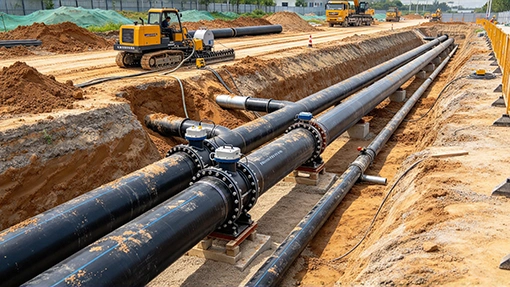
PE100-RC gas pipe installation with controlled backfill under Annex A
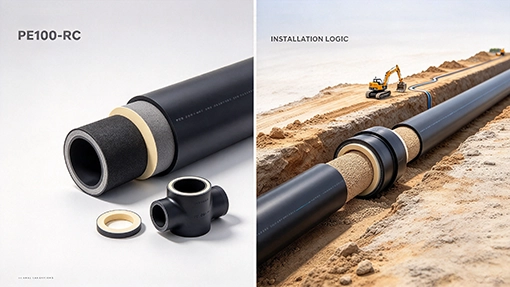
Annex A: PE100-RC is a material grade plus an installation logic
PE100-RC is a variant of PE100 with enhanced resistance to slow crack growth. Its practical significance extends beyond a laboratory number: the material’s higher tolerance for point loads, surface scratches, and less-than-ideal backfill conditions changes what installation methods are defensible.
Industry guidance on PE100-RC consistently points in the same direction: sand embedding is no longer mandatory for safe operation under appropriate conditions, and installation in open trenches with reused excavated material as backfill becomes a defensible option, with reported total installation cost savings in the range of 20% to 50%. Those savings figures are application-dependent and should not be read as a universal guarantee—but the direction is clear: the value proposition of PE100-RC is inseparable from the installation practice it enables.
Annex A collects that logic into a normative-adjacent reference. For buyers and installers, the action is not “switch to PE100-RC.” The action is: if you specify PE100-RC, specify the installation method it was designed for. A PE100-RC pipe installed as if it were conventional PE100 leaves value on the table—and may create a false sense that the material alone solves every trench-side problem.
Annex D: hydrogen is not the topic of this article, but it is a test of supplier readiness
Annex D addresses the suitability of PE pipe systems for 100% hydrogen and its admixtures with natural gas. Research and field experience point in a consistent direction: PE100 and PE100-RC are chemically resistant to hydrogen, with no observed or expected physical or chemical degradation in contact with up to 100% hydrogen. A four-year Dutch field trial exposing existing PE pipes to natural gas–hydrogen mixtures found that electrofusion and squeeze-off performance did not compromise pipeline integrity.
But chemical compatibility is not the same as system readiness. Permeation remains a design consideration, and existing devices are not simply suitable for 100% hydrogen without revision of standards, work instructions, and training. Annex D provides the framework for that conversation; it does not issue a blanket clearance.
For buyers planning hydrogen-adjacent projects, the useful question is not “does your PE pipe comply with Annex D?”—because Annex D is informative. The useful question is: can your supplier explain the applicability boundaries of its PE100 or PE100-RC compound in hydrogen service, and point to the evidence behind that explanation?
4. Electrofusion Compatibility Is Now a Formal Requirement—Four Questions Buyers Should Ask
The fourth technical change is the one with the most direct procurement consequence: a requirement for electrofusion compatibility has been added. The standard defines fusion compatibility as “the ability of two similar or dissimilar polyethylene compounds to be fused together to form a joint”.
The implication is straightforward and overdue: “both are PE100” does not automatically mean “they will fuse reliably together.” Compound formulation, melt flow behaviour, and dimensional tolerances all influence whether a pipe–fitting combination produces a joint that holds up over decades. Formalising compatibility as a requirement moves this from an assumption to a verifiable interface.
Four questions to put into the fitting procurement conversation:
- Is the pipe–fitting compound combination supported by fusion-compatibility evidence, or are pipe and fitting each merely compliant with ISO 4437-1 in isolation?
- What is the basis of that evidence—internal supplier data, or traceable third-party testing?
- Were the welding parameters validated for this specific combination, or are they “general parameters” carried over from another pairing?
- Does batch traceability cover compound information for both pipe and fitting, so that a future issue can be traced to a material lot rather than to an entire product family?
A supplier who can answer these questions is demonstrating interface engineering. A supplier who answers “we meet the standard” without addressing the combination is answering a different question.
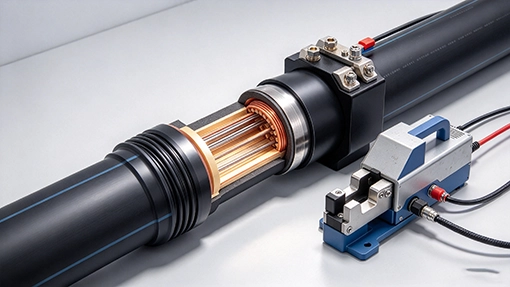
Electrofusion compatibility between PE gas pipe and fitting compounds
5. What Actually Changes in Your Specification and Incoming Inspection
The standard is explicit about responsibility: it is the responsibility of the purchaser or specifier to make the appropriate selections, taking into account particular requirements, national guidance or regulations, and installation practices or codes.
That sentence has a procurement consequence: “Complies with ISO 4437-1:2026” cannot be the only technical requirement in a specification. The standard tells you what the system must be capable of; it does not tell the supplier which selections you have made. Those selections need to appear in the RFQ and the incoming inspection plan.
| Item | Typical old wording | Recommended action under ISO 4437-1:2026 |
|---|---|---|
| Material grade | “PE100” | “PE100 or PE100-RC, selected according to installation conditions and backfill control” |
| SCG verification | “CRB passed” | “CRB report must state the conversion/normalisation step and the stress range used” |
| Test path | ISO 13954 only | Accept ISO 21751 strip-bend or ISO 13955 crush as alternatives, or specify one path explicitly |
| Electrofusion | “Fittings comply with ISO 4437” | “Fusion compatibility of the pipe–fitting combination must be supported by traceable evidence” |
| Hydrogen suitability (if relevant) | Not addressed | Require supplier to provide applicability statement and evidence boundaries under the Annex D framework |
| Purchaser responsibility | None | Specification states: “Selection responsibility rests with the purchaser/specifier; supplier must respond item by item” |
This table is not a template to copy wholesale. It is a translation layer between the standard’s technical content and the language of procurement. The point is not to make specifications longer. The point is to make them checkable—so that “compliance” becomes a set of answers rather than a single word.
6. Frequently Asked Questions
Q1: Is ISO 4437-1:2026 a mandatory replacement for the 2024 edition?
ISO standards are voluntary in themselves, but they become contractually binding when cited in a project specification, national regulation, or purchase order. The practical obligation arises from the reference, not from the publication. Buyers should confirm whether their contract documents have been updated to cite the 2026 edition.
Q2: Does the new CRB requirement invalidate existing PE100-RC certifications?
Not automatically. Certifications remain valid under their own schemes until those schemes are updated. What changes is the interrogation standard: buyers can now ask whether the CRB data behind a certificate was generated with the conversion/normalisation step and a declared stress range. The certificate’s existence is one question; the test conditions behind it are another.
Q3: Do I need PE100-RC now, or is PE100 still acceptable?
PE100 remains a compliant material under ISO 4437-1:2026; the standard includes both PE100 and PE100-RC. The choice depends on installation conditions: backfill control, point-load risk, trenchless methods, and the installation practice the project can realistically execute. Annex A is guidance for when PE100-RC is selected—it is not a mandate to select it.
Q4: What does Annex D mean for hydrogen projects?
Annex D is informative, not a compliance clearance. It provides additional information on the suitability of PE pipe systems for 100% hydrogen and natural gas admixtures. Research supports PE100 and PE100-RC chemical compatibility with hydrogen, but system-level readiness also involves permeation design, device suitability, and revised work instructions. Annex D is a starting framework for that conversation, not its conclusion.
Q5: What is the single most important change buyers should make to their specifications?
Move from “complies with ISO 4437-1:2026” as a single line to itemised, checkable requirements: CRB test conditions and stress range; accepted joint-test path; documented fusion compatibility for the pipe–fitting combination. The standard number belongs in the specification. It just should not be the only technical sentence in it.
PE100-RC is a material grade plus an installation logic
Need to Update Your PE Gas Pipe Specification? Let’s Make It Checkable.
If you are revising a specification for ISO 4437-1:2026—or vetting a supplier’s CRB report, joint-test path, and fusion-compatibility documentation—send Luoyang Datang Energy Tech Co., Ltd. the checklist items you are working with. We will match them against PE100-RC pipe and compatible electrofusion fittings with traceable test documentation, and flag the points where your current wording still reflects the 2024 logic.
Two ways to start:
- Compare specifications — share your current pipe and fitting requirements; we will return a clause-by-clause gap note against the 2026 edition.
- Request product documentation — ask for the PE100-RC pipe and electrofusion fitting datasheets, CRB test summaries, and fusion-compatibility evidence relevant to your project.
No obligation, no generic brochure. Just the checkable items your next RFQ actually needs.
RELATED POSTS

Polyvinyl Chloride (PVC) Market Patterns & Applications: From Construction to Renewable Energy (2026 Outlook)
How To Id Unmarked Pipe “Water Supply”

Why Are HDPE Pipe Prices Different? A Buyer’s Guide to Cost Factors

Advantages and Applications of PPR pipes and Fittings in Home Decoration
Brass Plumbing Manifolds:The Durable Core of Modern Piping Systems