LUOYANG DATANG ENERGY TECH CO.,LTD

Why Metal Detectors Miss Buried PE Gas Pipes — and What Actually Finds Them
A field guide to tracer wire, radar, acoustics, and the locating methods that work after backfill
6 min read · 5 locating methods compared · for excavation, O&M, and gas utility technical teams
PE gas pipe is corrosion-proof, flexible, joint-friendly, and built to last decades underground. It also does not conduct electricity and does not respond to a magnet. A metal detector that chirps over a steel main will sweep across a PE gas pipe in total silence. There is no signal to miss, because there is no signal at all.
The consequences are not theoretical. In the first five months of 2026, China recorded 68 third-party excavation damage incidents on gas pipelines, accounting for 95% of all pipeline network accidents. A judicial review found that failure to identify the pipeline’s location was the leading cause, present in 16 of 19 mechanical-damage cases. The 2024 Yanjiao explosion was linked in part to the operator not knowing where the pipe actually ran.
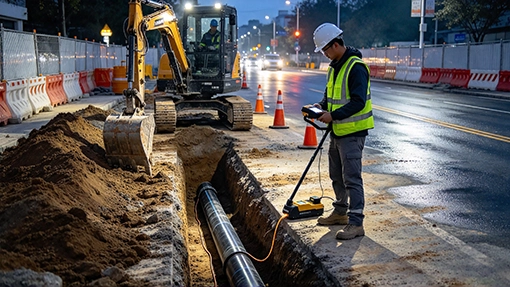
Buried PE gas pipe and tracer wire exposed in an excavation trench at night, with a technician holding a pipe locator showing no signal
The tracer wire was supposed to solve this. It didn’t.
The standard answer is simple: bury a metallic tracer wire beside the pipe, send a signal down it, and walk the surface with a receiver. When the wire is intact, this works well. It is cheap, familiar, and every locating crew knows the equipment.
But “intact” is doing a lot of heavy lifting in that sentence.
Operational data from a city gas group tells the story: for PE networks in service for five years, tracer wire integrity falls below 55%. Breaks cluster at joints, bends, and crossing sections. Installation crews pull the wire too tight. Backfill settlement stretches it. A later directional drill or anchor cuts it. Acidic or alkaline soils eat through the copper-clad steel.
And because the PE pipe itself is invisible to electromagnetic locating instruments, a broken wire does not cause “graceful degradation.” It makes the pipe completely undetectable by the method that was supposed to guarantee its detectability.
Worse, a broken tracer wire can produce a misleading signal. The receiver may pick up a faint return current from the break point or a nearby metallic structure, and the screen shows a line that is not the pipe. The crew marks the wrong place. The excavator digs the right place. The accident report says “pipeline location not accurately identified.”
Not one method. A decision based on what you’re standing on.
The locating industry has spent two decades developing alternatives. The 2026 Urban Gas review catalogues nine methods. The 2024 T/CASEI 042-2024 standard sets out the detection workflow for PE gas pipe up to 0.8 MPa. The 2025 T/CAS1100-2025 specification codifies the active acoustic source method for horizontal locating.
But a method list is not a field manual. On-site, the real questions are narrower: Is there a tracer wire, and is it continuous? What is the surface — asphalt, concrete, turf, compacted fill? How deep, and what is the soil? Can you connect at a valve, a regulator, or a riser? Can you take it out of service, or does it have to stay live?
Five locating methods, at a glance
| Method | Best suited for | Main limitation |
|---|---|---|
| Tracer wire (EM) | New networks; wire confirmed continuous | Fails when wire breaks; 5-year integrity can fall below 55%; broken wire may give a false route |
| Ground-penetrating radar (GPR) | No tracer wire; non-excavation surface; depth data needed | Clay, saline soil, and high moisture block the signal; small PE pipes reflect weakly |
| Active acoustic method | Existing pipes; live gas operation; no embedded infrastructure | Traffic and construction vibration; frequency matching; signal attenuation over distance |
| Electronic marker (RFID) | New networks; locating plus data in one | Depth often limited to ~1.5 m; hard to retrofit; deep or gravel layers fail |
| Inertial gyro | Crossing sections; directional drilling; centimetre-level 3D coordinates | Requires pipe access; not for daily quick locating of live small-diameter pipe; high cost |
The key insight is not “pick the best method.” It is: no single method survives every field condition, and each failure mode is predictable enough to plan around.
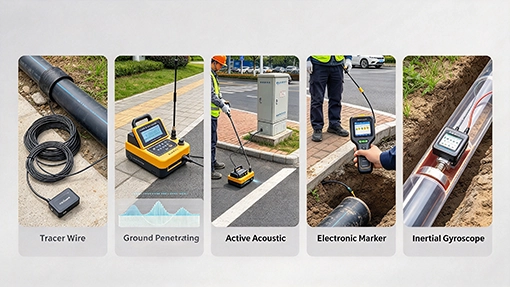
Five locating methods
What the field looks like when you stop relying on one tool
Suzhou offers a practical example of method stacking. Inspectors used a three-step sequence on several hundred kilometres of PE gas main: acoustic first, radar second, direct probe third.
The acoustic source connected at a regulator or vent and sent a specific frequency down the pipe. The receiver walked the surface and picked up the resonance. Where the acoustic signal was ambiguous — near a tee, a bend, or a noisy intersection — GPR confirmed depth and position. Before excavation, a probe rod confirmed the pipe in soft ground.
The sequence matters more than any single instrument. Acoustics gives speed and coverage without a tracer wire. GPR gives depth and a second, independent physical basis. The probe rod gives certainty at the exact point where the bucket will bite.
For pipes already in the ground with no tracer wire at all, acoustic methods have moved from laboratory curiosity to standardised practice. The T/CAS1100-2025 specification exists because active acoustic locating is now mature enough to be written into a technical code. Field systems can send a broad-frequency signal from a valve or regulator, receive the pipe’s acoustic response at the surface, and resolve horizontal position to the decimetre level in favourable conditions.
GPR, meanwhile, is not a universal answer. Its performance collapses in clay-heavy or salt-contaminated soils. In high-moisture conditions, the signal is attenuated before it reaches the pipe. A common rule of thumb: a pipe must increase in diameter by roughly one inch for every foot of depth to remain visible to GPR. A small-diameter PE service line at depth can simply disappear.
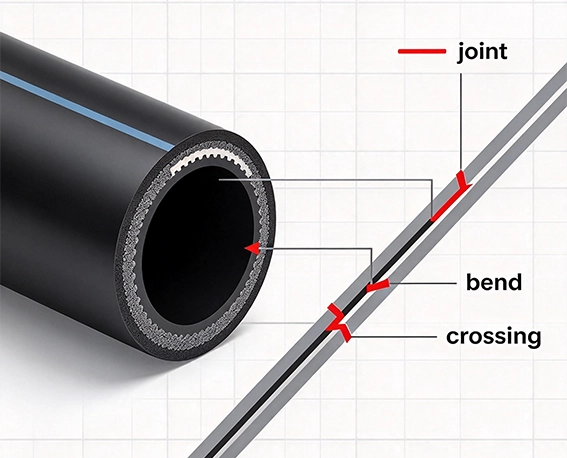
Diagram of PE gas pipe tracer wire break points at joints, bends, and crossing sections
The part that gets ignored: locating is a data problem as much as a hardware problem
Even the best acoustic array or GPR antenna cannot compensate for a missing record.
PE pipe locating is hard not only because the pipe is non-metallic. The information about where it was laid is often gone or wrong: as-built drawings lost, coordinates never captured, surface markers destroyed by road resurfacing, reference buildings demolished. A crew arriving with the latest instrument is still arriving with a data gap.
This is why the industry conversation is shifting from “which locator is best” to “what must be captured at installation and maintained over the asset life.” A tracer wire without continuity records is a false assurance. A GPR survey without a coordinate framework is a snapshot, not a record. T/CASEI 042-2024 places detection inside a quality-management frame for exactly this reason: the output of a locate is not a spray-painted mark. It is a position that can be stored, checked, and reused.
The practical implication is blunt: a PE pipe installed today without a functioning tracer wire, electronic markers, and a coordinate record is creating a locating problem that will surface five, ten, or fifteen years from now — exactly when someone is about to dig.
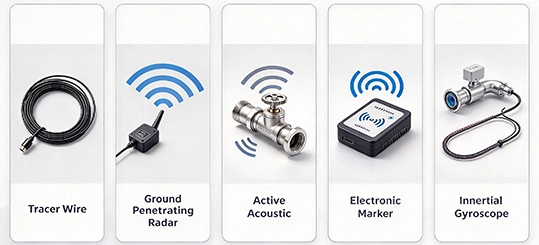
Comparison of five PE gas pipe locating methods: tracer wire, GPR, active acoustic, electronic marker, and inertial gyro
What to do before the excavator arrives
1. Establish what the pipe was born with.
Was a tracer wire installed? Is it continuous end-to-end? Can you connect at a valve, a riser, or a regulator? A continuity test takes minutes and separates easy locates from hard ones.
2. Match the method to the ground, not to the catalogue.
Asphalt and compacted fill behave differently from turf and wet clay. A tracer wire method on a broken wire is worse than no method, because it can produce a confident wrong answer. If the wire is suspect, go acoustic or radar before spray-painting anything.
3. Treat depth as a separate question from position.
Acoustic and electromagnetic methods give you a line on the surface. GPR and inertial tools give you depth; gyro can give a three-dimensional trajectory. A mark without a depth is half a locate.
4. If there is no tracer wire and no reliable record, fix the locating infrastructure — not just the locator.
A spliced tracer wire, a retrofitted electronic marker at a valve box, or a documented acoustic baseline costs a fraction of an emergency response.
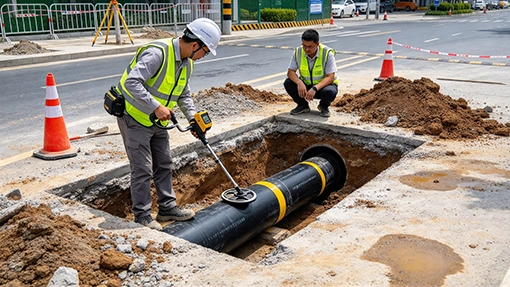
Metal Detectors Miss Buried PE Gas Pipes
Don’t Bury a Locating Problem Along With the Pipe
Metal detectors miss PE gas pipes because there is nothing to detect. Tracer wire helps — until it breaks, which it predictably will. The methods that actually find the pipe are acoustic locating where the pipe is live and accessible, radar where the ground cooperates and depth matters, inertial tools where a 3D trajectory is worth the cost, and a written record of where the pipe was buried in the first place.
So before the next PE gas pipe goes into the ground, make the locating infrastructure part of the specification, not an afterthought. That means three things on the delivery checklist: a tracer wire with continuity tested and documented, electronic markers at valves and key fittings, and as-built coordinates that can be stored, checked, and reused.
If you are specifying PE gas pipe and fittings, talk to our team before the trench is backfilled. Luoyang Datang Energy Tech Co., Ltd. supply PE gas pipe, fittings, tracer wire, and electronic markers — and we would rather help you specify them correctly now than sell you a better locator after the wire breaks.
RELATED POSTS
How To Install Supply Pipe For Water
PPR Pipes: The Invisible Backbone of Modern Water Supply and Urban Construction
HDPE Pipe vs Ductile Iron Pipe: Which Is Better for Water Supply Projects?
Will This Brass Hose Fitting Fit Your Hose? Size and Thread Matching Explained
Which is better?HDPE Pipes vs PE Pipes.
