LUOYANG DATANG ENERGY TECH CO.,LTD


What Makes One PEX Pipe More Expensive Than Another?
Two PEX pipes can look almost identical. Same nominal size, similar color, maybe even the same “hot and cold water” label on the coil. Yet one quotation comes back at a noticeably higher number than the other.
This is the moment where a lot of buyers make a quiet, expensive assumption: the cheaper one is the better deal, or the pricier one is automatically the better pipe. Neither conclusion survives contact with a real specification sheet.
PEX pipe price is not a single number that floats up or down with brand mood. It is the sum of crosslinking process, dimensional standards, wall thickness, pressure rating, certification status, coil format, order quantity, freight terms, and what the supplier has actually quoted you—product only, or product plus the paperwork that lets it pass inspection.
The difference often comes down to specifications, compliance requirements, and what is actually included in the quote. Let’s unpack the layers.
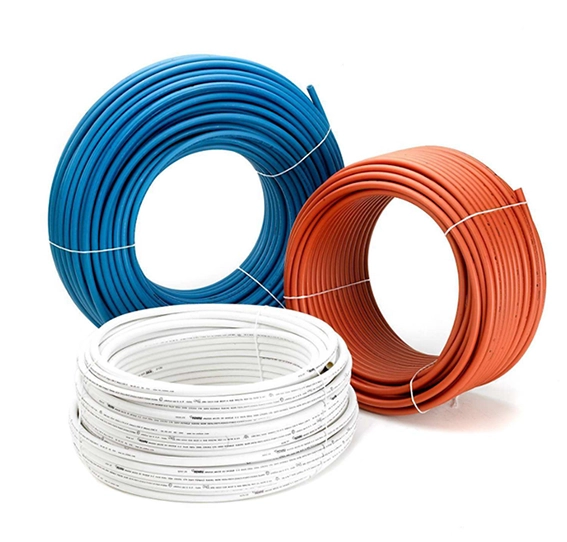
PEX pipes in different sizes and coil lengths for price comparison
Are You Really Comparing the Same PEX Pipe?
Before price, there is a more uncomfortable question: are the two quotations even for the same product? “PEX pipe” is a family name, not a specification.
What Does “Same Size” Actually Mean?
A buyer says “1/2-inch PEX” or “20mm PEX,” and both suppliers nod. But the nominal size on the label does not fully define what is inside the coil.
What actually needs to line up:
- Nominal size and outside diameter (OD) — nominal is a label; OD is a measured dimension.
- Wall thickness — often governed by a Standard Dimension Ratio (SDR), such as SDR-9 in ASTM F876 tubing. The same OD with a different wall thickness is not the same pressure capability.
- Pressure and temperature rating — ratings are conditional. A PEX tube may be rated 160 psi at 73°F, 100 psi at 180°F, and 80 psi at 200°F. Comparing only the room-temperature number hides the high-temperature derating.
- Applicable standard and edition — ASTM F876, ASTM F877, ISO 15875, or a regional equivalent. A “compliant” claim without the standard number and edition is not a specification.
Two pipes can both carry “1/2 inch, PEX” on the invoice and still differ in wall thickness tolerance, pressure class, and certified application. That is not a price difference. It is a product difference wearing the same label.
Table 1: Two PEX Pipes That Look Similar
| Comparison | Pipe A | Pipe B |
|---|---|---|
| Product name | PEX pipe | PEX pipe |
| Nominal size | 1/2 inch | 1/2 inch |
| Crosslinking type | PEX-A | PEX-B |
| Applicable standard | To be verified | To be verified |
| Wall thickness | Check datasheet | Check datasheet |
| Certification | Check documentation | Check documentation |
| Quoted price | Different | Different |
Illustrative comparison only. Verify all parameters against the actual datasheet and certification documents.
Does PEX-A Really Cost More Than PEX-B?
Here is where the conversation usually gets lazy: “PEX-A is more expensive because it’s better.” That sentence contains two claims, and only one of them has a predictable relationship with price.
Different Crosslinking Processes, Different Production Costs
PEX-A uses the peroxide (Engel) method, crosslinking the polyethylene at high temperature during extrusion. PEX-B uses the silane (moisture-cure) method, crosslinking after extrusion through exposure to moisture. PEX-C uses electron-beam irradiation. These processes involve different equipment, energy inputs, and process control demands, which feed into manufacturing cost structure.
But manufacturing cost is not selling price. A PEX-A producer running large volumes, with mature certification and efficient logistics, can quote a landed price that undercuts a small PEX-B producer shipping short runs. The letter on the spool describes the crosslinking route, not the commercial strategy behind the quotation.
Why PEX-A Is Not Always the Most Expensive Option
Several forces can flip the expected ranking:
- Manufacturer pricing strategy — a producer may position PEX-A as a volume product in one market and a premium product in another.
- Production scale — higher volume spreads certification and setup costs across more meters.
- Certification scope — a PEX-A product certified for potable water plus radiant heating carries a different compliance cost than an industrial-only PEX-B product.
- Brand positioning and specification bias — some project specifications name PEX-A explicitly; that demand support can hold price up, or attract enough supply to push it down.
- Purchasing volume and freight allocation — a full container of PEX-A can carry a lower per-meter freight burden than a mixed, less-than-container load of PEX-B.
Table 2: PEX-A vs PEX-B vs PEX-C — Cost Considerations
| Factor | PEX-A | PEX-B | PEX-C |
|---|---|---|---|
| Crosslinking method | Peroxide | Silane | Electron beam |
| Manufacturing cost drivers | Thermal process control | Moisture curing and process control | Irradiation equipment and processing |
| Product availability | Depends on market | Depends on market | Depends on market |
| Final selling price | Supplier-dependent | Supplier-dependent | Supplier-dependent |
| Buying consideration | Approved connection system | Approved connection system | Approved connection system |
Do not treat this table as a price ranking. Compare compliant products with equivalent specifications, then compare quotations.
Market data does show a recurring PEX-A premium in some retail and residential contexts—often quoted around 15–25% per foot over PEX-B, with ½-inch PEX-A sometimes listed near $0.59 per foot against PEX-B near $0.36 per foot. But those are point-of-sale examples, not B2B landed-cost laws. A wholesale quotation at container volume, with equivalent certification scope, can tell a very different story. Use the public numbers as a sanity check, not as a negotiating floor.
For a deeper comparison of the three crosslinking routes, see our PEX-A vs PEX-B vs PEX-C guide.
How Pipe Diameter, Wall Thickness and Pressure Ratings Affect Price
If crosslinking type is the headline, dimensions are the quiet line item that moves material consumption—and therefore the quotation—more than most buyers expect.
Larger Pipe Diameters Usually Require More Material
A larger outside diameter increases the volume of polyethylene per meter. The relationship is not perfectly linear across every size family, because wall thickness and SDR may stay constant while OD grows, but the direction is reliable: more material per meter generally means a higher material cost component in the price. That is one reason PEX pipe price per meter for a 25mm product is not simply the 16mm price multiplied by a size label ratio.
Why Wall Thickness Matters
Wall thickness is where “same OD” becomes misleading. Two pipes with the same outside diameter can have different wall thickness and therefore different pressure capability. ASTM F876 tubing commonly uses SDR-9 wall thickness, but the actual millimeter value still needs to be confirmed on the datasheet, not assumed from the nominal size.
A thicker wall consumes more compound per meter. It may also change coil stiffness, bending radius, and the coil weight that the installer has to handle. All of those can feed into packaging and handling cost, not only the raw material line.
Pressure Ratings Must Be Compared Under the Same Conditions
A pressure number without a temperature is incomplete. The same tubing family can carry different allowable pressures at different temperatures—for example, a PEX product rated 160 psi at 73°F, 100 psi at 180°F, and 80 psi at 200°F is not “a 160 psi pipe” in every operating condition. When two quotations show “160 psi” and “PN16,” check the temperature basis, the standard behind the rating, and whether the rating applies to the full coil or a derated continuous condition.
Table 3: Specification Factors That Influence PEX Pipe Cost
| Factor | Potential Cost Impact | What Buyers Should Check |
|---|---|---|
| Outside diameter | Larger sizes generally use more material | OD and nominal size |
| Wall thickness | Thicker walls can increase material consumption | Actual wall thickness or SDR |
| Pressure rating | May require different designs | Rating at specified temperature |
| Pipe length | Influences packaging and handling | Length per coil |
| Applicable standard | Affects dimensional and testing requirements | Standard and edition |
For installation-side implications—bend radius, support spacing, fitting behavior—see our PEX water pipe installation guide.
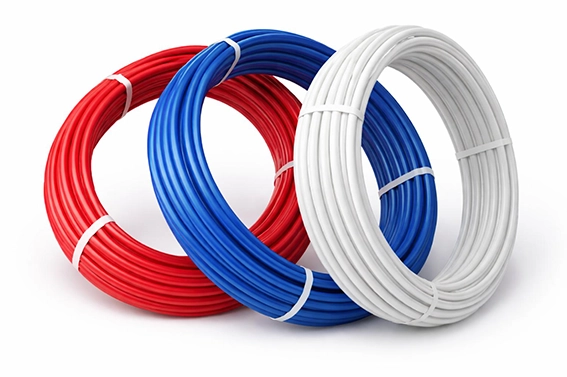
PEX pipe diameter and wall thickness comparison
Why Certifications and Quality Control Can Increase PEX Pipe Prices
A certification is not a sticker. It is a cost line. Testing, surveillance audits, batch traceability, and the documentation that lets an importer clear customs and a contractor pass inspection all have to be paid for somewhere—and that somewhere is usually the unit price.
Not Every PEX Pipe Is Approved for the Same Application
Potable water, hot-and-cold plumbing, and radiant floor heating do not carry the same compliance bar. A pipe that is technically “PEX” may be acceptable for one application and excluded from another because the certification scope does not cover it.
For potable water in North America, NSF/ANSI/CAN 61 covers health effects of drinking water system components. PEX tubing meeting that requirement typically bears the NSF-61 or NSF pw mark on the print string. ASTM F876 and F877 cover tubing and hot-and-cold distribution system requirements; they are technical standards, not the same thing as a third-party certification to NSF/ANSI 61. A product can cite the standard without holding the certification, or hold the certification for a narrower scope than the buyer assumes.
What Certifications Should Buyers Ask For?
Depending on the destination market and application, relevant references include ASTM F876, ASTM F877, NSF/ANSI/CAN 61 for potable water, and ISO 15875 for international plumbing applications. But the checklist item is not “does the supplier mention a standard?” The checklist item is “which standard, which edition, which certifying body, and does the certificate cover this exact product and size?”
Why Documentation Matters for Importers
For an importer, the certification file is part of the product. Product traceability, batch identification, test reports tied to the production run, and compliance documentation are what turn a coil of pipe into a shippable, inspectable, resalable lot. A lower unit price with incomplete or generic documentation can become a much higher landed cost once inspection, re-testing, or rejection is factored in.
For project buyers, a lower price means little if the pipe cannot meet the required specifications or approval conditions.
If you are matching fittings to a certified pipe system, see our note on PEX-A and PEX-B fitting compatibility.
Does Coil Length Make One PEX Pipe More Expensive?
Coil length is one of the easiest places to compare the wrong number. A 200m coil and a 100m coil are not two prices; they are two quantities.
Comparing 50m, 100m and 200m Coils
Longer coils reduce the number of joints on site and can lower installation labor per meter. They also change packaging, coil weight, handling requirements, and the number of coils per pallet or container. A longer coil is not automatically cheaper per meter—it depends on how the supplier prices the coil, what packaging is included, and how the freight is allocated.
Why Price Per Coil Can Be Misleading
A lower price per coil may simply mean less pipe in the coil. The comparable number is price per meter, calculated on identical specifications.
Price per meter = Total pipe price ÷ Total pipe length
That calculation only becomes meaningful when the pipe type, OD, wall thickness, standard, certification scope, and trade term are the same. Otherwise you are dividing two different products by two different lengths and calling the result a price comparison.
Packaging, Shipping and Hidden Costs
A PEX quotation that stops at the product price is an incomplete quotation. The pipe still has to travel.
Why Packaging Can Affect International Shipping Costs
PEX is light relative to its volume. A coil-only container load may weigh far less than the container’s payload ceiling—coil volume and loading efficiency, not tonnage, often drive the freight economics. That means coil diameter, pallet pattern, stacking method, and whether the supplier can load a full container or only a partial one can change the per-meter freight burden significantly.
EXW, FOB and CIF Quotes Are Not the Same
An EXW price excludes export clearance and main carriage. An FOB price includes delivery to the port and export clearance, but not ocean freight or destination charges. A CIF price includes cost, insurance, and freight to the named destination port—but still does not cover import duties, taxes, or destination handling. Comparing an EXW number against a CIF number is not a price comparison; it is a scope comparison.
Why Buyers Should Compare Landed Cost
The number that matters is landed cost: product price, freight, insurance where applicable, import duties and taxes, and destination handling. A supplier with a slightly higher FOB price but efficient coil packaging, complete documentation, and a full-container loading plan can land cheaper than a lower-FOB supplier whose coils cube out the container early.
For a broader comparison of connection-method costs—expansion versus crimp versus clamp—see our PEX expansion vs crimp vs clamp article.
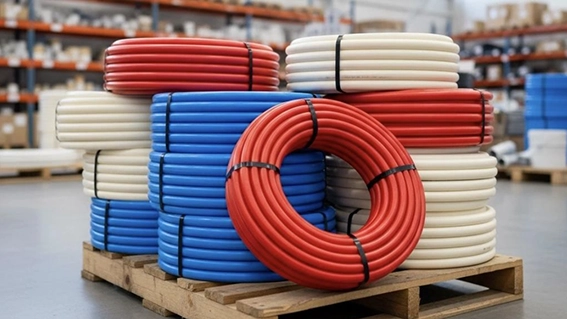
PEX pipe coils with different lengths and packaging
Does Buying PEX Pipe in Bulk Always Mean a Lower Price?
Bulk buying usually improves the unit price, but “usually” is doing a lot of work in that sentence. The relationship between order quantity and PEX pipe cost depends on MOQ structure, production batch size, packaging efficiency, and how freight is allocated across the order.
How Order Quantity Affects Supplier Quotations
A supplier quoting 5,000 meters and a supplier quoting a full container of mixed sizes are solving different problems. The first quote may carry a higher per-meter setup and handling allocation; the second may benefit from consolidated production and loading, but only if the specification mix does not create changeover penalties.
Public wholesale listings for PEX-type products often show broad ranges—for example, unit prices moving from around $0.20 to $1.30 per meter depending on material, size, and quantity tier, with MOQ thresholds in the thousands of meters for some offers. Those ranges are directionally useful, but they are not a substitute for a specification-matched quotation.
Why the Cheapest Bulk Quote Is Not Always the Best
The lowest bulk number can hide weaknesses that only show up after the order is placed: specification drift between the sample and the production batch, incomplete quality documentation, a delivery schedule that slips, or an after-sales process that does not exist. For a distributor, a batch that fails inspection or generates field complaints can cost more than the price difference on the original order.
Can Buyers Combine Different Sizes in One Order?
Sometimes, yes—but it is a supplier-specific commercial question, not a universal right. Mixed-size orders can improve container utilization and reduce the number of shipments, but they may also trigger separate MOQ requirements per size or changeover costs. Ask the supplier to quote the mixed order and the single-size order separately, and compare the landed cost per meter for each size.
A realistic distributor scenario: a buyer needs 16mm, 20mm, and 25mm PEX for a plumbing distribution project. Rather than accepting one blended “average” price, request a line-item quotation for each size, with coil length, packing unit, and MOQ stated separately. That is the only way to see whether the mix is actually saving money or just moving it between line items.
For a higher-level material comparison, see our PEX vs PPR pipe article.
What Should Buyers Check Before Accepting a PEX Pipe Quote?
A quotation is only as useful as the specifications attached to it. Before comparing numbers, make the quotation comparable.
Table 4: PEX Pipe Quotation Checklist
| Item | Information to Confirm |
|---|---|
| Pipe type | PEX-A / PEX-B / PEX-C |
| Application | Potable water / heating / other |
| Size | Nominal size and OD |
| Wall thickness | Required dimensions or SDR |
| Standard | Applicable ASTM / ISO standard and edition |
| Certification | Required approval, certifying body, and documents |
| Coil length | Meters per coil |
| Quantity | Total meters / number of coils |
| Packaging | Coil / pallet requirements |
| Trade terms | EXW / FOB / CIF |
| Destination | Port or delivery location |
| Lead time | Required delivery schedule |
A reliable PEX pipe quotation should be based on clearly defined specifications, not just a product name and quantity. If a line item cannot be filled in, the quote is not ready to be compared—it is ready to be questioned.
When lead times and delivery schedules are part of the decision, it also helps to understand how PEX pipe coil length and packing affect what actually ships, not just what is quoted.
FAQ
Is PEX-A always more expensive than PEX-B?
No. PEX-A often carries a premium in retail and residential contexts, sometimes quoted around 15–25% per foot over PEX-B, but wholesale pricing at container volume with equivalent certification scope can invert or eliminate that gap. Compare compliant products, not letter labels.
Does thicker PEX pipe always cost more?
Other factors being equal, a thicker wall consumes more material and tends to raise the material cost component. But a thicker-wall product in one standard is not automatically comparable to a thinner-wall product in another, and design or standard requirements may make the price difference larger or smaller than the raw-material delta alone.
How should buyers compare PEX pipe prices per meter?
Normalize the basis first: same pipe type, same OD and wall thickness, same standard and edition, same certification scope, same coil length, same trade term, same currency. Then calculate total price ÷ total meters. If any of those inputs differ, the per-meter numbers are not directly comparable.
Can bulk orders reduce PEX pipe costs?
Bulk orders can improve the unit price through production batching, packaging efficiency, and freight consolidation, but the result depends on MOQ structure, specification mix, and whether the freight saving is real or offset by changeover costs. Ask for a line-item quotation at the target quantity and compare landed cost, not just the headline unit price.
What information is needed for a PEX pipe quotation?
At minimum: pipe type (PEX-A/B/C), application, nominal size and OD, wall thickness or SDR, standard and edition, required certification, coil length, total quantity, packaging requirement, trade term, and delivery destination. The more of these are defined before the quote, the fewer surprises remain after the order.
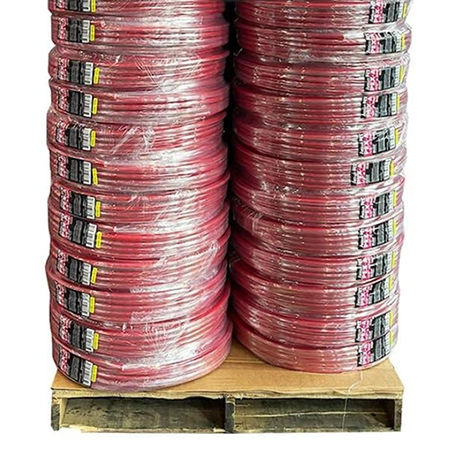
Bulk PEX pipe coils packed for wholesale orders and shipping
Looking for PEX Pipe for Your Next Project?
Looking for PEX pipes for a plumbing, heating, or distribution project?
At Luoyang Datang Energy Tech Co., Ltd., we help international buyers source PEX pipes based on their required specifications, quantities, and project needs. We are a sourcing and export partner, not a manufacturer—our job is to match the specification to the supply, and to make the quotation comparable before the order goes out.
Whether you are comparing PEX-A and PEX-B products or planning a bulk order, our team can assist with product selection and supplier quotations.
Send us your required pipe type, size, standard, quantity, and delivery destination to request a quotation.
RELATED POSTS
Industrial-grade PE100 Pipes For Seawater Desalination Revolution
Dia12-1600mm HDPE pipe -High Density Polyethylene Pipe

Essential Reading on Brass Fittings: Specifications & Advantages

10 Factors Engineers Should Consider Before Ordering HDPE Pipe
How Long Water Supply Pipe Stick Out From The Wall