LUOYANG DATANG ENERGY TECH CO.,LTD


Can PEX-A and PEX-B Use the Same Fittings?
A buyer orders PEX-B tubing for a commercial plumbing project. The supplier sends fittings that are commonly sold with PEX-A. The sizes match: 1/2 inch, 3/4 inch, the barbs slide into the pipe without resistance. Everything looks installable. The question is whether “installable” and “approved” mean the same thing.
They do not—at least not always. The short answer is that PEX-A and PEX-B can share the same fittings in many common connection systems, but only when the pipe, fitting, ring and tool belong to a listed, compatible system. Crimp and clamp connections are the most broadly interchangeable because they are designed against tubing dimensions, not against the letters A or B. Cold expansion is the exception: it requires tubing that the fitting manufacturer has specifically listed for expansion, and that listing does not automatically follow the PEX-A label.
This distinction matters more at the purchasing stage than at the installation stage. A buyer who understands why two fittings are compatible can ask the right questions before the container leaves the port. A buyer who only checks the nominal size is relying on the supplier to catch a compatibility problem that may not surface until inspection—or warranty claim.
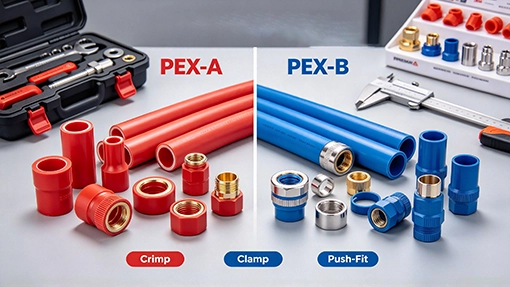
PEX-A and PEX-B
Can PEX-A and PEX-B Actually Share the Same Fittings?
Yes, in most crimp, clamp and push-fit scenarios, but the compatibility does not come from the PEX-A or PEX-B designation. It comes from a shared dimensional standard.
PEX-A, PEX-B and PEX-C describe how the polyethylene was crosslinked—peroxide, silane, or electron beam—not three different pipe sizes. ASTM F876, the tubing specification, requires that PEX tubing be “outside diameter controlled, made in nominal SDR9 tubing dimension ratios,” regardless of crosslinking route. A 1/2-inch PEX-A tube and a 1/2-inch PEX-B tube that both meet ASTM F876 share the same controlled outside diameter. The fitting engages the outside diameter. It cannot detect which crosslinking method produced the pipe.
That is why crimp and clamp fitting standards—ASTM F1807 for metal insert fittings, ASTM F2159 for plastic insert fittings—are written against the tubing specification, not against PEX-A or PEX-B. Neither scope mentions the letters A, B or C.
What “Compatible” Actually Means
Compatibility operates on three separate layers, and confusing them is the root of most purchasing errors:
Physical fit. The pipe slides onto the fitting and the ring or clamp sits in the correct position. This is the layer a buyer can verify by hand sample. It is also the least meaningful layer on its own.
System listing. The fitting manufacturer has tested and listed its product with the specific pipe, ring and tool combination. “Listed” is not the same as “fits.” A fitting can slide onto a pipe and still fall outside the manufacturer’s approved assembly.
Code and warranty acceptance. The local plumbing code recognizes the system, and the manufacturer’s warranty remains valid for the combination as installed. Mixing expansion rings from one brand with another brand’s PEX pipe, for example, may physically work but can limit the warranty on the entire system.
Key takeaway: Just because a fitting fits the pipe does not mean the connection is approved.
Quick-Reference Compatibility Matrix
| Fitting system | PEX-A | PEX-B | What the buyer should verify |
|---|---|---|---|
| Crimp (ASTM F1807 metal / F2159 plastic) | Commonly compatible | Commonly compatible | Pipe meets ASTM F876; fitting scope matches metal or plastic insert; ring and crimp tool match the system |
| Clamp (ASTM F2098) | Commonly compatible | Commonly compatible | Insert fitting is approved for clamp use; stainless clamp and cinch tool match the fitting |
| Cold expansion (ASTM F1960) | Commonly listed | Product-specific—some PEX-B is listed, many are not | The specific tubing must appear in the fitting manufacturer’s F1960 listing; expansion ring and tool must match |
| Push-fit (ASSE 1061) | Product-dependent | Product-dependent | Tube material, outside diameter, insertion depth and the fitting’s published compatibility list |
The table is a starting point, not a green light. The binding authority is the fitting maker’s listing and the applicable code, not the PEX category name.
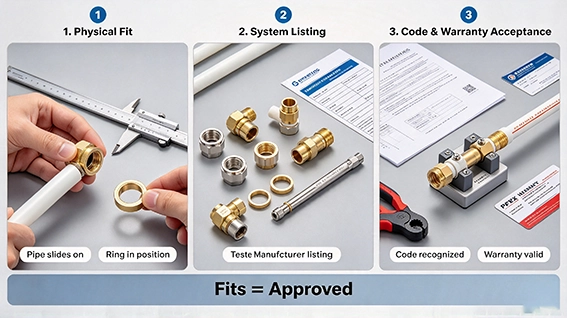
Three layers of PEX compatibility: physical fit, system listing, code & warranty acceptance
Which PEX Fittings Work with Both PEX-A and PEX-B?
Four connection families dominate the market, and their compatibility logic differs enough that they should not be treated as interchangeable options under a single “PEX fitting” label.
Crimp Fittings: Built Against Tube Dimensions, Not Tube Letters
Crimp is the most direct answer to “can you use crimp fittings on PEX-A.” A crimp connection uses an insert fitting—lead-free brass to ASTM F1807 or engineered plastic to ASTM F2159—with a copper crimp ring compressed by a mechanical tool. The fitting standard is written against the tubing dimensions, so a crimp system that lists PEX-A tube will generally also accommodate PEX-B tube made to the same dimensional specification.
For a buyer, the practical consequence is that crimp is the lowest-risk system for mixed PEX-A and PEX-B inventory, provided the ring, fitting and tool come from the same listed system. A copper ring from one supplier and a brass insert from another may both meet F1807 individually, but the assembly has not necessarily been listed together. That distinction rarely appears on a quotation, which is why the purchase order should name the system, not just the component standard.
Clamp Fittings: Same Insert Logic, Different Fastening Component
Clamp fittings use a stainless steel cinch clamp (ASTM F2098) in place of a copper crimp ring. The insert fitting side is similar—metal or plastic barbed fittings—but the clamp and the cinch tool are a separate system from crimp. A clamp and a crimp ring are not interchangeable fasteners, even when both fit over the same pipe and insert.
The compatibility logic is otherwise close to crimp: clamp systems are generally available for both PEX-A and PEX-B because they clamp the tube onto a barb rather than relying on the tube’s elastic recovery. The buyer’s checklist is the same: confirm the insert is listed for clamp use, the clamp matches the fitting size and material, and the cinch tool is calibrated for that clamp profile.
Expansion Fittings: Where the PEX-A/PEX-B Label Actually Matters
Cold expansion is the one connection family where the letters A and B do real work in the compatibility conversation—but even here, the label is not the final authority.
An ASTM F1960 expansion connection stretches the pipe and a reinforcing ring, inserts the fitting, and relies on the pipe’s memory to contract onto the fitting. That mechanism asks more of the tube than a crimp ring does. PEX-A, with its higher and more uniform crosslinking degree, is the grade most commonly listed for expansion. But the F1960 standard itself does not say “PEX-A only”; it keys on tubing meeting ASTM F876 or F3253. The restriction to PEX-A comes from the fitting manufacturer’s listing, not from the standard’s scope.
That gap between standard scope and manufacturer listing is where purchasing errors live. Some PEX-B products are listed for F1960 expansion. Sioux Chief, for example, lists its PowerPEX Type-B tubing as compatible with ASTM F1960 among other fitting systems, and recommends a self-rotating power expansion tool for those joints. Other PEX-B products are not listed, and expanding them can stress-crack the pipe wall because of the lower crosslinking uniformity.
The correct purchasing instruction is therefore not “PEX-B cannot use expansion.” It is: confirm that the specific tubing product appears in the expansion fitting manufacturer’s approved tubing list, and follow that manufacturer’s tool and ring requirements.
Push-Fit Fittings: Convenience Does Not Equal Universal Approval
Push-fit fittings (ASSE 1061) are often marketed as working across PEX, copper and CPVC. That breadth is real, but it is product-specific. The fitting’s published compatibility list, the tube’s outside diameter and wall condition, and the insertion depth all affect whether the connection is approved. A push-fit fitting that accepts PEX-A does not automatically accept every PEX-B product on the market, and vice versa. For a B2B order, the safe approach is to treat push-fit as a product-level compatibility question, not a category-level one.
Four Systems at a Glance
| Method | Main components | Primary compatibility question |
|---|---|---|
| Crimp | Insert fitting + copper crimp ring | Is the insert listed with this pipe and ring? |
| Clamp | Insert fitting + stainless cinch clamp | Is the clamp and tool matched to the insert? |
| Expansion | Expansion fitting + reinforcing ring | Is this specific tubing listed for F1960 expansion? |
| Push-fit | Push-to-connect fitting | Does the fitting’s published list include this tube product? |
Recommended reading: If connection cost and tool investment are part of the decision, the earlier comparison of PEX expansion, crimp, clamp and push-fit costs covers per-joint and tool economics in more detail.
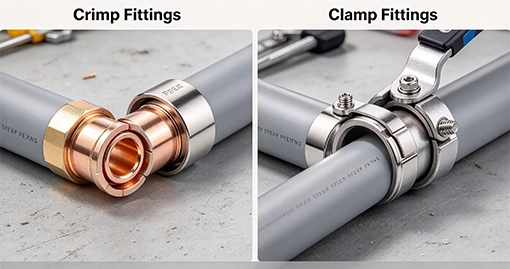
Crimp Fittings vs Clamp Fittings
Why Fitting Standards Matter More Than the PEX-A or PEX-B Label
A purchasing specification that says “PEX-A fittings” is less precise than one that says “ASTM F1960 expansion fittings, brass, 1/2 inch, listed for [tubing brand and product].” The standard tells the supplier what the component must meet. The listing tells the buyer whether the assembly is approved together.
The ASTM Standards a Buyer Should Recognize
| Standard | What it covers | Why it belongs in the purchase file |
|---|---|---|
| ASTM F876 | PEX tubing, outside-diameter controlled, SDR9 | Confirms the dimensional basis for fitting compatibility |
| ASTM F877 | PEX hot- and cold-water distribution systems | System-level performance reference |
| ASTM F1807 | Metal insert fittings with copper crimp rings | Identifies brass crimp fittings |
| ASTM F2159 | Plastic insert fittings with copper crimp rings | Identifies engineered-polymer crimp fittings |
| ASTM F1960 | Cold expansion fittings and reinforcing rings | Identifies expansion components; the listing, not the standard alone, controls tubing eligibility |
| ASTM F2098 | Stainless steel clamps for PEX insert fittings | Identifies clamp fastening components |
The standards are necessary but not sufficient. Two products can both be made to F1807 and still not be listed as an assembly with the same ring and tool. That is why a supplier’s quotation should reference the fitting system, not only the component standard. A line item that says “F1807 brass elbow” is a component description. A line item that says “F1807 brass elbow, listed with [ring brand/type] and [tool type]” is a purchasing decision.
Does the Same Nominal Size Mean the Fitting Will Work?
No. Nominal PEX size is a category label, not a measurement. A 1/2-inch PEX fitting is matched to a 1/2-inch nominal tube within a specific dimensional system—typically SDR9, outside-diameter-controlled tubing under ASTM F876.
For common SDR9 PEX tubing, the outside diameters are approximately:
| Nominal PEX size | Outside diameter (SDR9) | Approx. metric |
|---|---|---|
| 3/8 inch | 0.500 in | 12.70 mm |
| 1/2 inch | 0.625 in | 15.88 mm |
| 3/4 inch | 0.875 in | 22.23 mm |
| 1 inch | 1.125 in | 28.58 mm |
These are tubing outside diameters under the ASTM F876 SDR9 system, not fitting dimensions, and not a universal compatibility key for every PEX product sold internationally. A fitting that fits a 0.625-inch OD tube from one manufacturer is not automatically listed for a 0.625-inch OD tube from another if the wall thickness, material formulation or certification scope differs.
For a buyer, the practical rule is: never send only “1/2 inch PEX fittings” in an RFQ. Add the tubing standard, the connection method and the application. The next article in this series covers PEX tubing size measurement and dimension systems in more detail; for fitting procurement, the relevant point is that nominal size is the beginning of the specification, not the end.
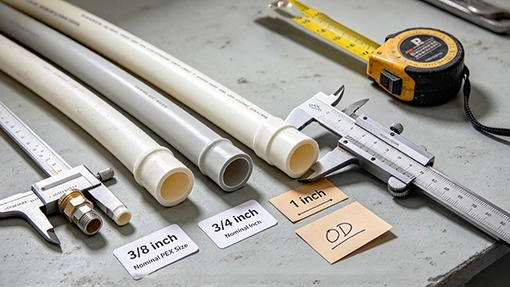
Nominal PEX size
Three Mistakes Buyers Make When Mixing PEX Fittings
Mistake 1: Treating the PEX-B Label as an Expansion Prohibition—or a Permission
“PEX-B cannot use expansion fittings” is a blanket statement that is now demonstrably false as written. Some PEX-B products are listed for F1960 expansion. The opposite error is equally costly: assuming that because one PEX-B product is expandable, every PEX-B product is. The correct position is neither prohibition nor permission by label, but verification by product listing.
Mistake 2: Mixing Fittings and Rings from Different Systems
A copper crimp ring and a stainless clamp are not interchangeable fasteners, even when both fit over the same insert and tube. The ring and tool are part of a connection system. Buying F1807 fittings from one supplier and “equivalent” rings from another may satisfy individual component standards while leaving the assembly outside any manufacturer’s listing. For expansion systems specifically, mixing expansion rings across brands is a known warranty limitation: Uponor states that using other manufacturers’ expansion rings with its PEX pipe, or its rings with other pipe, will limit its 25-year system warranty.
Mistake 3: Ordering on Nominal Size Alone
“1/2-inch PEX fittings, 500 pieces” is enough information to quote a commodity item, but not enough to quote a compatible item. The missing variables—pipe standard, fitting material, connection method, certification and application—are exactly the variables that determine whether the shipment can be installed and inspected without a return.
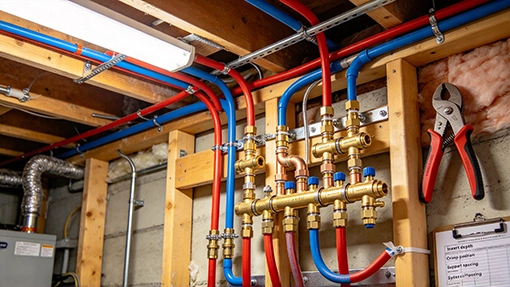
PEX Fittings in real application
What Buyers Should Check Before Ordering PEX Fittings
The most useful purchasing tool for this category is not a compatibility chart on a blog. It is a checklist that forces the RFQ to carry enough technical information for the supplier to confirm the system.
Before the RFQ: A Four-Step Decision Path
1. Identify the tubing. Record the PEX grade, the standard printed on the pipe (ASTM F876 is the dimensional baseline), the nominal size, and the manufacturer/product name if available.
2. Choose the connection method. Crimp, clamp, expansion or push-fit. The method should be driven by the installer’s tooling, the project specification and the tube’s listing—not by habit alone.
3. Verify the system. Confirm that the fitting, ring/clamp and tool are a listed combination, and that the tube is within the fitting manufacturer’s approved range. For expansion, this step is non-negotiable.
4. Build the RFQ. Provide the variables in the table below. A supplier who receives this information can quote a compatible system rather than a generic part number.
PEX Fitting RFQ Checklist
| Information | Example | Why it changes the quote |
|---|---|---|
| Pipe type | PEX-A / PEX-B | Narrows the fitting and connection options |
| Pipe standard | ASTM F876, SDR9 | Confirms dimensional basis |
| Pipe size | 1/2″, 3/4″, 1″ | Determines fitting size |
| Fitting type | Elbow, tee, coupling, adapter | Determines tooling and price |
| Connection method | Crimp / clamp / expansion / push-fit | Determines ring/clamp and tool |
| Fitting material | Lead-free brass / engineered polymer | Affects pressure/temperature suitability and cost |
| Application | Potable hot and cold water | Affects certification and material selection |
| Certification | Applicable ASTM, NSF/ANSI 61, NSF/ANSI 372 | Confirms compliance for the market |
| Quantity | 500 / 1,000 / 5,000 pcs | Drives pricing and packaging |
| Tubing brand/product (if fixed) | Manufacturer + product name | Allows the supplier to cross-check listing |
This checklist is also a filter against a common procurement shortcut: buying pipe and fittings from separate suppliers without aligning the technical requirements. Consolidating the specification before ordering reduces the risk of dimensional or listing mismatches between suppliers. It does not, however, make two products automatically compatible simply because they ship from the same source—the listing still controls.
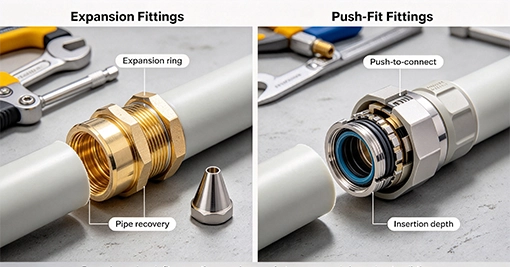
Expansion Fittings vs Push-Fit Fittings
When Should a Buyer Choose a Different Fitting System?
Compatibility is not the only variable. Three common project situations pull the decision in different directions:
Existing crimp inventory or tooling. If the contractor already owns calibrated crimp tools and the project tubing is listed for crimp, staying within a crimp system avoids new tool investment. Crimp is also the lowest-cost entry point on the tool side, which matters for price-sensitive volume work.
New PEX-A project with expansion specified. If the specification calls for F1960 expansion and the tube is listed, expansion is a valid system choice—but the buyer should verify the expansion tool and ring supply alongside the fittings. Expansion tooling carries a higher upfront cost than crimp or cinch tools, and the system is less forgiving of unlisted tubing.
Mixed PEX-A/PEX-B inventory. When both grades are in stock, crimp and clamp systems offer the broadest dimensional compatibility across the two grades. Expansion should be reserved for tubing that appears on the fitting maker’s F1960 list, regardless of whether the tube is labeled A or B.
Frequently Asked Questions
Q1. Can you use PEX-B fittings on PEX-A pipe?
In most crimp and clamp systems, yes, because the fitting standards are written against tubing dimensions under ASTM F876, not against the A/B/C label. For expansion, the specific PEX-A tube must be listed by the fitting manufacturer for F1960 use. Verify the listing, not just the category.
Q2. Can PEX-A use crimp fittings instead of expansion fittings?
Yes, when the PEX-A tubing is listed for the crimp system. PEX-A is commonly compatible with crimp and clamp connections; the crimp fitting standard does not require the tube to be expansion-rated. Confirm the insert, ring and tool are a listed assembly.
Q3. Can PEX-B use expansion fittings?
Not as a blanket rule. Some PEX-B products are listed for ASTM F1960 expansion, while others are not. The deciding document is the expansion fitting manufacturer’s approved tubing list. Expanding unlisted PEX-B can stress-crack the pipe wall because of its lower crosslinking uniformity.
Q4. Are brass PEX fittings better than plastic fittings?
Neither material is universally superior. Lead-free brass (ASTM F1807) is hard-wearing and widely accepted; engineered polymer (ASTM F2159) resists corrosion and is often more cost-effective. The selection should follow the application, the certification required and the fitting system’s listing—not a generic material preference.
Q5. Can you mix different brands of PEX pipe and fittings?
Only after checking the listing and warranty terms. A fitting may fit a tube from another brand, but the assembly may fall outside both manufacturers’ approved combinations. For expansion systems especially, cross-brand ring use is a documented warranty limitation. The safe purchasing practice is to specify the system, not just the component dimensions.
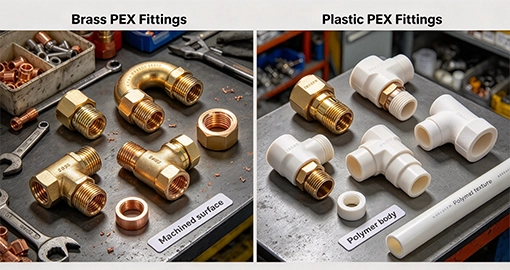
PEX fittings vs plastic fittings
Need Compatible PEX Pipes and Fittings for Your Project?
Fitting compatibility is ultimately a documentation question. The pipe, fitting, ring and tool either belong to a listed system or they do not—and the label on the pipe is not enough to answer that on its own.
If you are sourcing PEX pipe and fittings for a project, send us the tubing specification, fitting types, connection method and estimated quantities. Luoyang Datang Energy Tech Co., Ltd. can review suitable sourcing options against the requirements you provide and prepare a quotation for the RFQ. The more complete the technical information at the inquiry stage, the fewer compatibility questions remain at the installation stage.
RELATED POSTS

PEX-A vs PEX-B vs PEX-C: What Buyers Need to Know
WHAT IS SLOTTED PVC PIPE USED FOR?
High Density Polyethylene Pipe:Types, Characteristics & Multiple Applications
Water Supply Lines Safe To Connect To Pvc Pipe?
Industrial-grade PE100 Pipes For Seawater Desalination Revolution
