LUOYANG DATANG ENERGY TECH CO.,LTD


Can PEX Pipe Be Used for Both Hot and Cold Water? Temperature and Pressure Explained
Short answer: Yes—PEX tubing that carries the correct temperature–pressure ratings, complies with the applicable standards, and is approved for the destination market can be used in both hot- and cold-water supply systems. The real question is not “PEX or not.” It is “which PEX, rated for what, under which code.”
This article unpacks three things that separate a confident specification from a costly guess: how to read PEX temperature and pressure ratings, what actually changes between hot- and cold-water systems, and why neither color nor a single “max temperature” number is a substitute for a complete product evaluation.
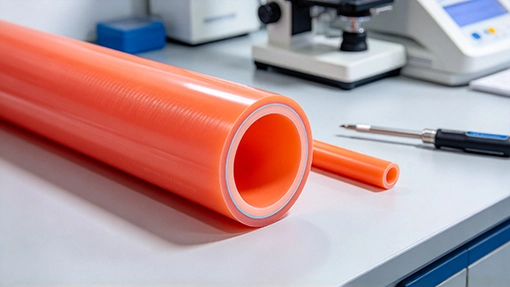
Crosslinked polyethylene (PEX) tubing
Can PEX Pipe Be Used for Both Hot and Cold Water?
Crosslinked polyethylene (PEX) tubing has been used in North American hot- and cold-water plumbing since the 1980s and is now the dominant material in residential plumbing distribution. It is inherently suitable for both supply lines—but “suitable” is a category-level statement, not a product-level guarantee.
The PPI PEX Plumbing Distribution Systems Design and Installation Guide, third edition (April 2026), is the current industry reference for designing and installing PEX hot- and cold-water systems in residential, multi-family, and commercial buildings. It is a joint publication from PPI, PPFA, and Home Innovation Research Labs, with support from IAPMO and ICC.
Is PEX Suitable for Domestic Hot Water?
Yes, provided the tubing is rated for the operating temperature and pressure of the hot-water system and, where relevant, carries the appropriate chlorine-resistance classification. Domestic hot water is not a single condition: a standard hot-water branch, a timed recirculation loop, and continuous recirculation expose the same pipe to very different cumulative hot-water hours.
Is PEX Suitable for Cold Drinking Water?
Potable-water approval is a separate gate. In North America, PEX tubing for drinking water typically carries NSF/ANSI 14 (plastics piping system components), NSF/ANSI 61 (drinking water system components—health effects), and NSF/ANSI/CAN 372 (lead content) listings. A pipe can be pressure-rated and still fail the potable-water requirement if those certifications are absent.
Does the Same PEX Pipe Work in Both Systems?
Not automatically. The same formulation may appear in both hot- and cold-water listings, but the product marking—not the color, not the shelf label—establishes what it is rated to do. The safe rule: treat every hot- and cold-water application as a rating-matching exercise, not a material-matching exercise.

PEX for Domestic Hot Water
How Temperature Affects PEX Pipe Pressure Ratings
This is the technical heart of the article. Plastic pipe does not behave like metal: as water temperature rises, the long-term hydrostatic strength of the material falls, and the allowable pressure rating must fall with it. The relationship is not a marketing preference—it is established through long-term hydrostatic testing and evaluated under PPI TR-3 and the applicable ASTM product standard.
Why Pressure Ratings Change with Water Temperature
A PEX pressure rating is not a burst pressure. It is a long-term design value derived from stress-rupture data, with a design factor applied. Higher temperature accelerates polymer chain relaxation and oxidation, so the same wall thickness supports less pressure over the same design life. That is why a number printed at 73°F cannot be carried over to a 180°F line.
Typical PEX Temperature and Pressure Ratings
The table below shows a widely published rating pattern for PEX tubing. It is an industry-common example, not a universal specification: confirm the exact values for the specific product and standard before design.
| Temperature | Pressure rating |
|---|---|
| 73.4°F / 23°C | 160 psi |
| 180°F / 82°C | 100 psi |
| 200°F / 93°C | 80 psi |
Source pattern: manufacturer temperature–pressure bulletins and PPI TR-3 evaluation; values vary by product and standard.
The 200°F / 80 psi row is an upper-bound rating, not an invitation to run a system continuously at 200°F. Continuous operating temperature, short-term excursion allowance, and the product’s maximum temperature are three different concepts and must not be collapsed into one number.
Maximum Temperature vs. Continuous Operating Temperature
For domestic hot-water and hot-water recirculation, the normal operating limit used in chlorine-resistance evaluation is 140°F (60°C) at 80 psi (5.5 bar) under ASTM F2023. This is the condition against which PEX chlorine-resistance ratings are defined—not the 200°F ceiling.
The Material Designation Code (MDC) marked on PEX tubing translates this into practical application classes. The first digit after “PEX” signals chlorine resistance and the intended hot-water exposure pattern:
| MDC digit MDC | Intended hot-water exposure | Practical meaning |
|---|---|---|
| 1 | 25% of time at 140°F (≈6 h/day) | Traditional domestic hot water |
| 3 | 50% of time at 140°F (≈12 h/day) | Timed recirculation |
| 5 | 100% of time at 140°F (24 h/day) | Continuous recirculation |
Source: PPI TN-53 and ASTM F876 MDC requirements
A “1” rated pipe is not wrong for a standard trunk-and-branch hot-water system. But putting it into a continuously circulating loop and assuming “it’s PEX, it’ll be fine” is exactly the kind of specification error the MDC exists to prevent. PPI TN-53 explicitly notes that continuous recirculation of hot chlorinated water above 140°F in commercial systems is beyond the intended application of the standard chlorine ratings.

PEX for Cold Drinking Water
PEX for Hot Water vs. Cold Water: Key Differences
The differences are not about whether PEX “can handle” hot or cold water. They are about which load case governs the design and which product attributes move to the front of the checklist.
| Comparison item | Hot-water system | Cold-water system |
|---|---|---|
| Primary condition | Higher, often varying water temperature | Normally lower water temperature |
| Key rating to verify | Working temperature + corresponding pressure + chlorine/recirculation class | Pressure rating at the expected temperature |
| Design focus | Thermal expansion, recirculation, heat-source connection | Water pressure, flow, layout |
| Shared requirements | Product standard, fitting compatibility, local code | Product standard, fitting compatibility, local code |
What Changes in a Hot-Water System?
Hot water shifts the governing question from “will it hold pressure?” to “will it hold pressure and resist degradation at temperature over time?” That brings chlorine resistance, thermal expansion, and the heat-source connection into the specification. A hot-water line that cycles between ambient and 140°F repeatedly is not the same duty as a cold line sitting at 60°F.
What Matters in a Cold-Water System?
Cold-water design is more straightforward on the temperature axis, but pressure and flow still govern. The pressure rating at the expected cold-water temperature, the inside diameter relative to flow demand, and the fitting system’s pressure integrity are the core checks. Potable-water certifications remain mandatory for drinking-water lines regardless of temperature.
What About Hot-Water Recirculation?
Recirculation is where hot-water PEX specifications most often go wrong. A recirculation loop keeps hot water moving continuously or on a timer, so the pipe sees far more cumulative hours at elevated temperature than a standard branch line. The correct question is not “what is the maximum temperature?” but “what percentage of operating time will this pipe spend at 140°F, and does its MDC cover that pattern?”

PEX for Hot Water vs. Cold Water
Does Red, Blue, or White PEX Pipe Make a Difference?
No performance difference. Red, white, and blue PEX are all intended for potable-water systems; the colors exist to distinguish hot and cold distribution lines and to align with code identification conventions. SharkBite states this directly: “There are no performance differences between red, white, blue and white PEX and all are intended for use in potable water systems. The colors can be used to easily distinguish between hot and cold distribution lines”.
Why PEX Tubing Comes in Different Colors
Color is an identification aid, not a rating. A red coil is conventionally used for hot water and a blue coil for cold water, but the color does not independently certify temperature resistance, pressure class, chlorine resistance, or potable-water approval. A red PEX with an MDC of “1” and a blue PEX with an MDC of “5” are both possible; the marking, not the hue, tells you what the product is rated to do.
Can White PEX Be Used for Hot and Cold Water?
Yes, if the specific white PEX product carries the appropriate hot-water rating and, for potable use, the required certifications. White is a base color used across multiple product lines; it does not signal a lower or higher temperature class by itself.
Should You Choose PEX by Color or Specification?
Choose by specification. Color can make installation and inspection easier, but it cannot substitute for the product standard, the MDC, the pressure–temperature table, and the certification listings. Color identifies the line; product markings establish its ratings and compliance.
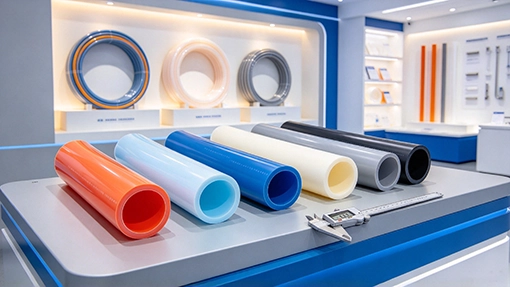
PEX Tubing Comes in Different Colors
Which PEX Pipe Standards and Certifications Should You Check?
Two ASTM standards sit at the center of PEX hot- and cold-water specification, and they do different jobs.
ASTM F876: PEX Tubing Requirements
ASTM F876 is the Standard Specification for Crosslinked Polyethylene (PEX) Tubing. It sets requirements for the tubing itself, including long-term hydrostatic strength, chlorine resistance, UV resistance, and the material designation code. ASTM F876 was first published in 1984 and has been revised repeatedly; PPI TR-56 documents its evolution through 2024
ASTM F877: Hot- and Cold-Water Distribution Systems
ASTM F877 is the Standard Specification for Crosslinked Polyethylene (PEX) Hot- and Cold-Water Distribution Systems. It addresses performance requirements for fittings used as a system with PEX tubing, not just the tube in isolation. Not all fittings are compatible with all PEX tubing; the system standard is what ties the tube and fitting into an evaluated assembly.
Potable Water Approval and Local Plumbing Codes
ASTM compliance is necessary but not sufficient. Drinking-water applications require health-effects and lead-content certifications—typically NSF/ANSI 61 and NSF/ANSI/CAN 372, alongside NSF/ANSI 14 for the piping system components. Local plumbing codes may add or reference additional requirements, and the adopted code edition governs the project, not the standard’s latest draft.
A common misconception to retire: meeting an ASTM standard does not automatically satisfy every country’s or region’s drinking-water regulation. The destination market’s conformity route must be checked separately.
How to Choose PEX Pipe for a Hot- and Cold-Water Plumbing Project
The technical sections above translate into a short, practical selection sequence.
Confirm the Operating Temperature and Pressure
Start with the actual duty, not the product family. What is the normal continuous temperature? What is the system pressure at that temperature? Is there a recirculation loop, and if so, is it timed or continuous? Match these answers to the product’s temperature–pressure table and its MDC.
Check Pipe Size, Fittings, and System Compatibility
PEX is a system, not a tube. Verify that the fitting system is evaluated with the specific tubing under ASTM F877 or the applicable system standard, and that the inside diameter supports the required flow at the design pressure.
Verify Certifications for the Destination Market
Potable-water listings, lead-free compliance, and any local code approvals belong in the same specification review as the pressure rating. For export projects, confirm the certification scheme recognized by the importing country before the order is placed.
A compact pre-order checklist:
- Temperature–pressure table for the exact product, not the product family
- MDC digit matching the hot-water exposure pattern
- ASTM F876 tubing compliance and ASTM F877 system compliance
- NSF/ANSI 14, 61, and 372 listings for potable-water service
- Fitting system compatibility confirmed by the tubing manufacturer
- Destination-market code and certification review
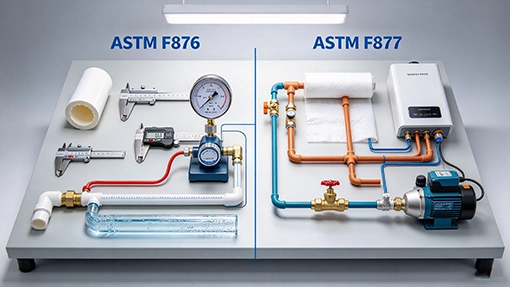
ASTM F876 VS ASTM F877
Frequently Asked Questions
Can PEX pipe be used for hot water?
Yes, if the specific product’s temperature–pressure rating covers the system’s operating conditions and, for recirculation, its MDC covers the intended hot-water exposure pattern. “PEX” as a material category is not the same as a rated hot-water product.
Can PEX pipe be used for cold drinking water?
Yes, with potable-water certifications such as NSF/ANSI 61 and NSF/ANSI/CAN 372, plus NSF/ANSI 14 for the piping components. Pressure rating alone does not establish drinking-water compliance.
Does PEX pressure rating decrease as temperature increases?
Yes. PEX pressure ratings are long-term design values derived from stress-rupture behavior; higher temperature reduces the allowable pressure for the same design life. The rating at 73°F should not be applied to a 180°F line.
Is PEX suitable for continuous hot-water recirculation?
Only when the product is rated for that duty. Continuous recirculation at 140°F corresponds to MDC “5”; many standard domestic PEX products are rated at “1” (≈6 hours/day at 140°F) or “3” (≈12 hours/day). Using a lower-rated product in continuous service is a specification error, not a color choice.
Need PEX Pipe for Your Plumbing Project?
If you are a contractor, wholesaler, or importer sourcing PEX for hot- and cold-water projects, send us the operating temperature and pressure, the intended application (standard domestic, timed recirculation, or continuous recirculation), the required certifications for your market, and the pipe sizes you need. Luoyang Datang Energy Tech Co., Ltd. will match the specification to a product with the right temperature–pressure rating, MDC, and compliance documentation—so the pipe you install is rated for the duty it actually sees.
RELATED POSTS
Which Pipe Is Best For Water Supply
Brass Machino Coupling Guide: Reliable Fire Hose Connections & Water Hose Fittings Selection

Why Are HDPE Pipe Prices Different? A Buyer’s Guide to Cost Factors

How to Choose Brass Pipe Fittings for Water, Gas and HVAC Systems
NPT vs BSP Threads: Which Thread Should You Choose for Brass Fittings?