LUOYANG DATANG ENERGY TECH CO.,LTD


Which Pipe Wrench Works Best for Your Job? Types, Sizes and Uses Compared
A pipe wrench may look like a simple hand tool, but choosing the wrong type or size can make pipe installation and maintenance more difficult than necessary. Whether you are tightening threaded steel pipes, removing damaged fittings, or carrying out routine plumbing repairs, the right wrench makes a noticeable difference in grip, leverage, and working efficiency.
Not all pipe wrenches are designed for the same purpose. A straight pipe wrench is a popular choice for general pipe installation, while an adjustable pipe wrench accommodates different pipe diameters. An internal pipe wrench serves a more specialized role, particularly when removing broken pipe nipples or fittings that cannot be gripped from the outside.
So, which pipe wrench works best for your job? The answer depends on the pipe size, connection type, working environment, and the amount of torque required.
In this article, we compare common pipe wrench types, explain their practical applications, and explore the key specifications buyers should consider before choosing a pipe wrench for plumbing or industrial piping work.
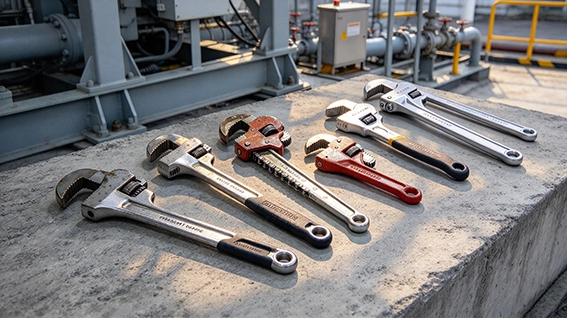
Pipe wrench types
1. What Is a Pipe Wrench and How Does It Work?
A pipe wrench is a hand-operated tool designed to grip, turn, tighten, or loosen round pipes and threaded fittings. Unlike conventional spanners that engage hexagonal nuts and bolts, a traditional pipe wrench uses serrated jaws to hold cylindrical surfaces securely.
Most conventional pipe wrenches use a self-tightening jaw mechanism. When the operator applies force to the handle, the angled jaws increase their gripping pressure against the pipe surface. This allows the wrench to generate sufficient rotational force for tightening or loosening threaded connections.
A typical pipe wrench consists of several main components:
- Hook jaw: The movable upper jaw that grips the pipe.
- Heel jaw: The lower gripping jaw that supports the workpiece.
- Adjusting nut: Allows the jaw opening to be changed according to pipe diameter.
- Handle: Provides leverage for applying rotational force.
- Spring assembly: Helps maintain jaw positioning in certain designs.
The combination of adjustable jaws and mechanical leverage makes pipe wrenches particularly useful for plumbing, pipeline installation, and industrial maintenance.
Common applications include:
- Installing and removing threaded steel pipes.
- Tightening and loosening threaded pipe fittings.
- Maintaining water supply and plumbing systems.
- Repairing industrial piping connections.
- Working with threaded metal pipe assemblies.
However, conventional serrated pipe wrenches are not suitable for every pipe material. Their teeth can damage plastic pipes, polished surfaces, and protective coatings. Selecting the appropriate gripping tool is therefore essential.
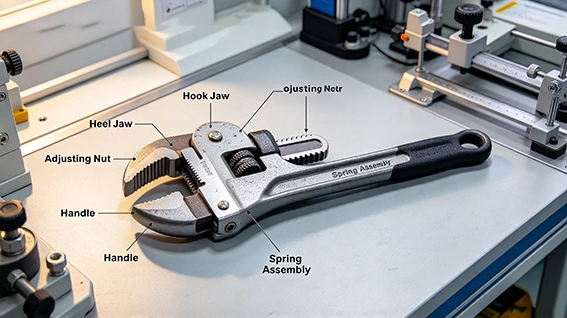
A typical pipe wrench consists of several main components
2. Which Types of Pipe Wrenches Are Available?
Different pipe wrench designs are intended for different working conditions. Understanding their construction and applications helps contractors, distributors, and maintenance professionals choose the right equipment.
2.1 Straight Pipe Wrench: The Versatile Choice for General Piping Work
A straight pipe wrench is one of the most widely used designs in plumbing and mechanical maintenance. It features a straight handle and adjustable serrated jaws that grip the outside of a pipe.
Its straightforward construction makes it suitable for a broad range of everyday piping operations.
Main features:
- Straight handle for conventional pipe access.
- Adjustable hook and heel jaws.
- Serrated gripping surfaces.
- Available in different handle lengths and capacities.
- Suitable for tightening and loosening threaded pipe connections.
Typical applications:
- Residential and commercial plumbing.
- Water supply pipe installation.
- Threaded steel pipe connections.
- Industrial piping maintenance.
- General mechanical repair.
For plumbers and maintenance technicians who regularly work with threaded metal pipes, a straight pipe wrench is often a practical starting point.
It offers a combination of versatility, mechanical leverage, and straightforward operation without requiring a specialized gripping mechanism.
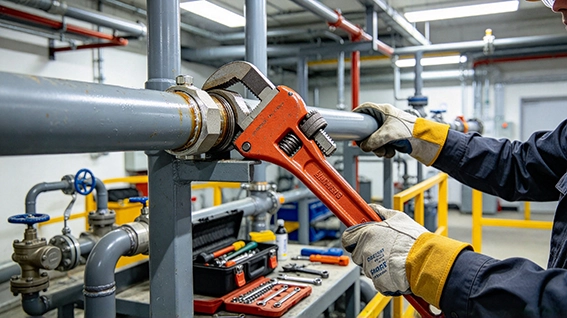
Straight Pipe Wrench for General Piping Work
2.2 Adjustable Pipe Wrench: One Tool for Different Pipe Diameters
An adjustable pipe wrench is designed to accommodate different pipe outside diameters through a movable jaw mechanism.
It is important to understand that most traditional straight pipe wrenches are also adjustable. Therefore, straight and adjustable pipe wrenches are not necessarily separate product categories. Straight describes the overall configuration, while adjustable describes how the jaws are positioned.
The main advantage of an adjustable pipe wrench is flexibility. Instead of carrying a separate fixed-size wrench for every pipe diameter, operators can use one tool across several compatible sizes.
Why choose an adjustable pipe wrench?
- Accommodates different pipe diameters within its rated capacity.
- Reduces the number of tools required for general maintenance.
- Provides adjustable gripping pressure through its jaw mechanism.
- Works well for plumbing contractors handling different pipe sizes.
- Suitable for many installation and repair operations.
When comparing adjustable pipe wrenches, pay particular attention to the maximum jaw opening, overall handle length, jaw material, and rated pipe capacity.
A wrench with insufficient jaw capacity may not grip the workpiece properly, while an unnecessarily large wrench can be difficult to handle in restricted spaces.
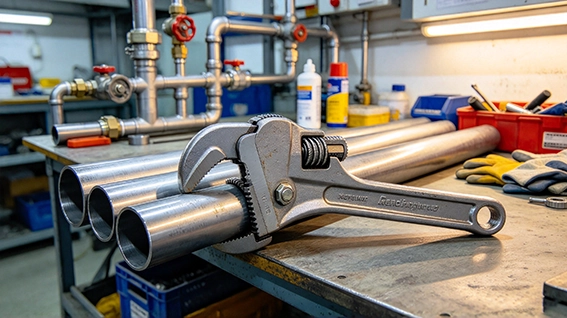
Adjustable Pipe Wrench for Different Pipe Diameters
2.3 Internal Pipe Wrench: Designed for Hard-to-Reach Fittings
An internal pipe wrench is a specialized tool that grips a compatible component from the inside rather than engaging its external surface.
Depending on the model, it may use an expanding gripping mechanism or internal engagement features to hold the workpiece during rotation.
This design is particularly useful when a broken pipe nipple or damaged fitting remains inside a threaded connection and cannot be removed with a conventional external pipe wrench.
Common applications include:
- Removing broken pipe nipples.
- Extracting damaged threaded pipe sections.
- Removing fittings with limited external gripping access.
- Plumbing repairs involving recessed connections.
- Specialized maintenance work in confined spaces.
For example, when a threaded pipe nipple breaks off inside a fitting, an ordinary straight pipe wrench may have no exposed surface to grip. An internal pipe wrench can engage the remaining section from the inside, making removal possible without replacing the entire connection in some situations.
However, internal pipe wrenches are not general-purpose substitutes for conventional pipe wrenches. Their compatibility depends on the internal diameter, fitting geometry, and gripping mechanism.
2.4 Other Pipe Wrench Designs Worth Knowing
Beyond straight, adjustable, and internal pipe wrenches, several other designs address more specialized working conditions.
| Pipe wrench type | Main characteristic | Typical application |
|---|---|---|
| Straight pipe wrench | Conventional straight handle and adjustable jaws | General pipe installation |
| Offset pipe wrench | Angled head for improved access | Confined piping areas |
| End pipe wrench | Designed for gripping pipes near obstructions | Restricted-access plumbing |
| Chain pipe wrench | Uses a chain to grip cylindrical workpieces | Large or heavy-duty piping |
| Strap wrench | Uses a flexible strap instead of serrated jaws | Surfaces requiring reduced marking |
| Aluminum pipe wrench | Lightweight body construction | Field maintenance and installation |
Each design has its own advantages. The best choice depends on pipe diameter, accessibility, surface material, and the torque requirements of the job.
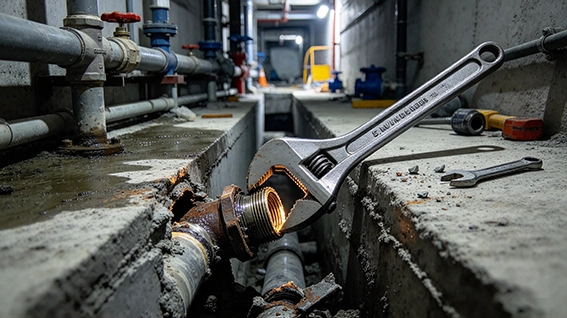
Internal Pipe Wrench for Hard-to-Reach Fittings
3. Straight vs. Adjustable vs. Internal Pipe Wrenches: Which Should You Choose?
Although these tools are used in piping work, their gripping methods and intended applications differ.
The following comparison helps identify the most appropriate design for common working conditions.
| Comparison factor | Straight pipe wrench | Adjustable pipe wrench | Internal pipe wrench |
|---|---|---|---|
| Gripping method | External serrated jaws | External adjustable jaws | Internal gripping mechanism |
| Main purpose | General pipe turning | Handling different external diameters | Removing compatible internal pipe sections |
| Jaw adjustment | Usually adjustable | Adjustable | Depends on design |
| General plumbing | Excellent | Excellent | Limited |
| Threaded steel pipes | Suitable | Suitable | Specialized removal tasks |
| Broken pipe nipple removal | Limited | Limited | Suitable |
| Confined-space repairs | Depends on handle clearance | Depends on handle clearance | Useful for suitable recessed fittings |
| Versatility | High | High | Specialized |
One important distinction is that a straight pipe wrench can also be an adjustable pipe wrench. These descriptions refer to different characteristics rather than completely independent mechanisms.
Which one should you choose?
- Choose a straight pipe wrench for general threaded pipe installation and maintenance.
- Choose an adjustable pipe wrench when you need to work with multiple pipe diameters using one tool.
- Choose an internal pipe wrench when removing broken or recessed pipe sections that cannot be gripped externally.
- Consider an offset or end pipe wrench when conventional tools cannot reach the working area.
- Choose a strap wrench when reducing surface damage is more important than the aggressive grip of serrated jaws.
For most general plumbing applications involving threaded metal pipes, a straight adjustable pipe wrench is a versatile option. Specialized designs should be selected according to the actual repair or installation requirements.
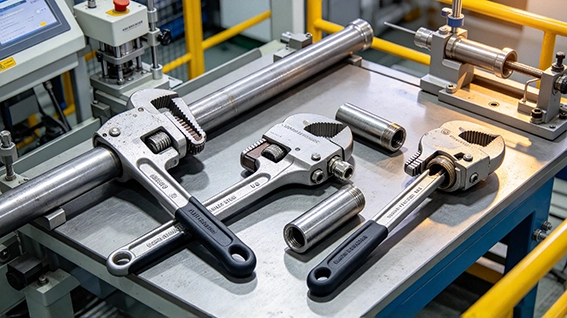
Straight vs. Adjustable vs. Internal Pipe Wrenches
4. Pipe Wrench Sizes: How to Choose the Right Length and Capacity
Pipe wrench size is one of the most important purchasing considerations. A tool that is too small may not open wide enough to grip the pipe, while an oversized wrench can be difficult to control and may create excessive force.
Most traditional pipe wrenches are classified by overall handle length. Common sizes include 8, 10, 12, 14, 18, 24, 36, and 48 inches.
However, handle length and maximum pipe capacity are not the same measurement.
A 14-inch pipe wrench, for example, does not necessarily accommodate a 14-inch pipe. Buyers should always check the manufacturer’s specified maximum pipe diameter and jaw opening.
Common Pipe Wrench Sizes and Their Applications
| Nominal wrench length | General applications | Typical users |
|---|---|---|
| 8 inches | Small plumbing repairs and restricted spaces | Plumbers and maintenance technicians |
| 10 inches | Light-duty pipe installation and repair | Residential plumbers |
| 12 inches | General plumbing and maintenance | Contractors |
| 14 inches | Medium-duty piping work | Plumbing professionals |
| 18 inches | Larger threaded pipe connections | Installation teams |
| 24 inches | Heavy-duty plumbing and industrial maintenance | Industrial technicians |
| 36 inches | Large piping systems | Pipeline and maintenance crews |
| 48 inches | Heavy-duty industrial applications | Specialized maintenance teams |
These are general application examples rather than fixed capacity specifications. Actual pipe diameter limits vary by manufacturer and wrench design.
Three Factors to Consider When Selecting Pipe Wrench Size
1. Pipe outside diameter
The wrench must have sufficient jaw opening to grip the outside diameter of the pipe or fitting. Do not select a wrench based only on the nominal pipe size.
2. Available working space
A longer handle provides additional leverage, but it also requires more clearance. In narrow installation areas, a shorter wrench or an offset design may be more practical.
3. Required torque
Larger threaded connections may require greater rotational force. A longer handle can provide additional leverage, but excessive force can damage the pipe, connection, or tool.
The objective is not to choose the largest wrench available. It is to select a tool with sufficient capacity and leverage for the intended application.
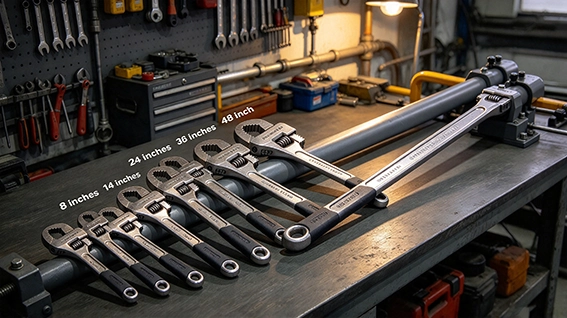
Nominal wrench length
5. What Materials Are Used in Pipe Wrench Construction?
Material selection affects a pipe wrench’s weight, strength, durability, and suitability for different working environments.
For professional buyers, comparing construction materials is an important part of evaluating product quality.
Cast Iron Pipe Wrenches
Cast iron is commonly used in traditional heavy-duty pipe wrench bodies.
Its rigidity makes it suitable for tools designed for demanding mechanical and plumbing applications.
Advantages:
- Rigid body construction.
- Suitable for conventional heavy-duty designs.
- Widely available in traditional pipe wrench products.
Considerations:
- Relatively heavy.
- Can be vulnerable to fracture under severe impact or misuse.
- Requires appropriate manufacturing quality and inspection.
Aluminum Pipe Wrenches
Aluminum pipe wrenches are designed to reduce tool weight while maintaining practical gripping performance.
They are particularly useful for technicians who frequently carry equipment between job sites or work overhead.
Advantages:
- Lighter than comparable traditional cast-iron designs.
- Easier to transport.
- Convenient for frequent field use.
Considerations:
- Actual strength depends on alloy and design.
- Buyers should verify rated capacity and construction quality.
- Lightweight construction does not automatically mean suitability for every heavy-duty application.
Steel Components
Steel is commonly used in pipe wrench jaws, adjustment components, and other load-bearing parts.
The quality of the steel, heat treatment, machining, and surface finishing can influence jaw wear resistance and overall service life.
When purchasing pipe wrenches in bulk, it is worth checking both body construction and the quality of the gripping components rather than focusing on a single material specification.
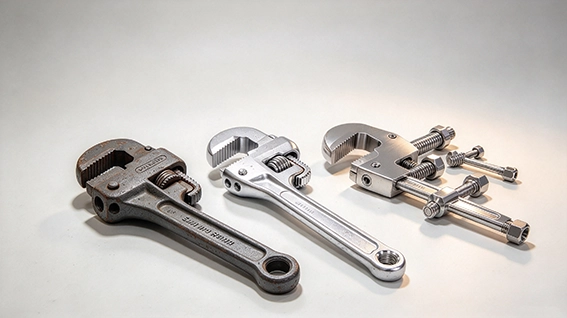
Cast Iron Pipe Wrenches vs Aluminum Pipe Wrenches vs Steel Components
6. What Makes a Good Pipe Wrench for Plumbing Work?
A suitable pipe wrench should provide reliable gripping performance, practical handling, and sufficient durability for its intended working conditions.
Here are five features worth evaluating.
6.1 Strong and Durable Jaws
The jaws are responsible for engaging the pipe surface and transmitting rotational force.
Look for well-machined gripping teeth, appropriate hardness, and secure jaw alignment.
Poorly manufactured teeth may wear prematurely or fail to maintain consistent engagement.
6.2 Smooth Adjustment Mechanism
The adjusting nut should move smoothly without excessive looseness or binding.
A reliable adjustment mechanism allows the operator to position the jaws correctly for different pipe diameters.
6.3 Adequate Handle Strength
The handle must withstand the intended operating forces.
Its length, cross-section, material, and connection to the wrench body all influence performance.
Avoid using extension pipes to increase leverage unless the manufacturer specifically permits it.
6.4 Comfortable Handling
Tool weight and handle design influence operator comfort, especially during repeated installation and maintenance work.
A lightweight wrench may be advantageous for field technicians, while a heavier-duty design may be more appropriate for certain industrial applications.
6.5 Consistent Manufacturing Quality
For distributors and wholesale buyers, product consistency matters just as much as the specifications of an individual sample.
Check jaw alignment, adjustment performance, surface finish, dimensional accuracy, and batch-to-batch consistency.
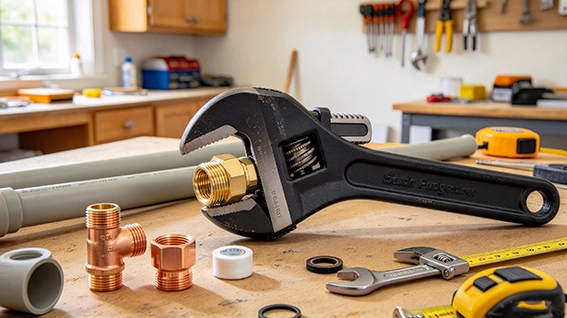
a Good Pipe Wrench for Plumbing Work
7. Pipe Wrench vs. Plumbing Spanner Wrench: Are They the Same?
The terms pipe wrench and plumbing spanner wrench are sometimes used interchangeably in general online searches. However, they can refer to different tools.
A conventional pipe wrench is designed to grip and turn round pipes and cylindrical fittings. A plumbing spanner wrench is a broader description that may refer to adjustable spanners, basin wrenches, and other specialized plumbing tools.
| Tool | Main function | Typical application |
|---|---|---|
| Pipe wrench | Grips and rotates round pipes | Threaded pipe installation |
| Adjustable spanner | Turns hexagonal nuts and fittings | Plumbing connections |
| Basin wrench | Reaches mounting nuts in restricted spaces | Sink installation |
| Strap wrench | Grips cylindrical objects with a flexible strap | Surface-sensitive components |
For example, a pipe wrench is appropriate for turning a threaded steel pipe, whereas an adjustable spanner is generally more suitable for a hexagonal fitting.
Using the wrong tool can damage the workpiece, reduce gripping efficiency, or make installation unnecessarily difficult.
8. What Should Buyers Consider When Ordering Pipe Wrenches in Bulk?
For plumbing contractors, hardware distributors, and industrial tool wholesalers, purchasing pipe wrenches involves more than comparing unit prices.
A clear product specification helps suppliers provide accurate quotations and reduces the risk of receiving tools that do not meet the intended requirements.
Before placing an order, consider the following checklist.
Product specifications
- Wrench type: straight, adjustable, internal, offset, or chain.
- Overall length and maximum pipe capacity.
- Maximum jaw opening.
- Body and handle material.
- Jaw material and gripping tooth design.
- Surface treatment and corrosion protection.
- Product weight and packaging dimensions.
Supplier evaluation
- Request actual product photos and detailed specifications.
- Confirm material and manufacturing details.
- Check product samples where appropriate.
- Review quality inspection procedures.
- Confirm consistency between different production batches.
- Ask about replacement jaws and spare components where available.
Commercial and logistics details
- Minimum order quantity.
- Available sizes and product combinations.
- Wholesale pricing and volume discounts.
- Packaging and labeling requirements.
- Production lead time.
- Shipping methods and delivery arrangements.
For importers and distributors, a supplier that can provide consistent specifications and dependable order fulfillment is often more valuable than one offering only a low initial quotation.
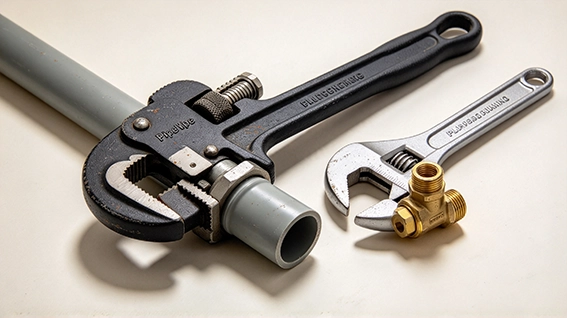
Pipe Wrench vs. Plumbing Spanner Wrench
9. Frequently Asked Questions About Pipe Wrenches
Q1. Which pipe wrench works best for general plumbing?
A straight adjustable pipe wrench is a versatile choice for general plumbing involving threaded metal pipes and fittings. The correct size depends on pipe diameter, available working space, and the manufacturer’s rated capacity.
Q2. What is the difference between a straight pipe wrench and an adjustable pipe wrench?
A straight pipe wrench describes the overall configuration, while adjustable refers to its movable jaw mechanism. Most traditional straight pipe wrenches are adjustable, so the terms can overlap.
Q3. What is an internal pipe wrench used for?
An internal pipe wrench is used to grip and remove compatible pipe sections or fittings from the inside. It is particularly useful for removing broken pipe nipples and damaged threaded components that cannot be accessed externally.
Q4. What size pipe wrench should I buy?
The appropriate size depends on the pipe’s outside diameter, the wrench’s rated capacity, and the available clearance. Common wrench lengths range from 8 to 48 inches, but always check the manufacturer’s specifications before purchasing.
Q5. Can I use a pipe wrench on plastic pipes?
Conventional serrated pipe wrenches are generally unsuitable for direct gripping of plastic pipes because their teeth can damage or deform the material. Use appropriate plastic pipe tools or protective gripping solutions recommended for the application.
Find the Right Pipe Wrench for Your Next Order
From straight pipe wrenches for everyday installation to adjustable models for different pipe diameters and internal pipe wrenches for specialized repairs, choosing the right tool starts with understanding the actual working requirements.
For plumbing contractors, hardware distributors, and industrial buyers, product specifications, material quality, gripping performance, and supply consistency should all be considered before placing an order.
Looking for reliable pipe wrenches for wholesale distribution, plumbing projects, or industrial maintenance?
Contact Luoyang Datang Energy Tech Co., Ltd. with your preferred wrench types, sizes, specifications, and order quantities. We can help you identify suitable products and provide a quotation based on your purchasing requirement
RELATED POSTS
Can PEX-A and PEX-B Use the Same Fittings?
What Makes a Brass Hose Fitting Leak? 7 Common Causes

PVC Underground Drainage Pipe: Benefits, Applications & Installation
What Kind of Pipe For Underground Water Supply?