LUOYANG DATANG ENERGY TECH CO.,LTD


Can a PVC Pipe Cutter Cut Large-Diameter Pipes? Capacity Limits, Tool Types and Alternatives
Small-diameter PVC pipe is forgiving. A compact scissor cutter, a firm grip and a clean snap — job done. But as the pipe steps up through 63 mm, 75 mm, 110 mm and beyond, the physics changes. The blade has to travel a longer path through more material. The handles need more leverage. And the pipe itself starts to fight back with weight, flex and an irritating tendency to go out of round the moment you clamp it.
The real question is not whether a cutter can physically fit around a large pipe. It is whether it can cut through the wall without crushing, deforming or leaving an edge that refuses to solvent-weld. This article separates rated capacity from real-world capability, explains what actually limits a PVC pipe cutter, and maps out when a saw or a dedicated cutting machine becomes the smarter engineering choice.
For a broader comparison of cutter mechanisms, see Pipe Cutter Types Explained: Which Cutter Works Best for Different Pipes?
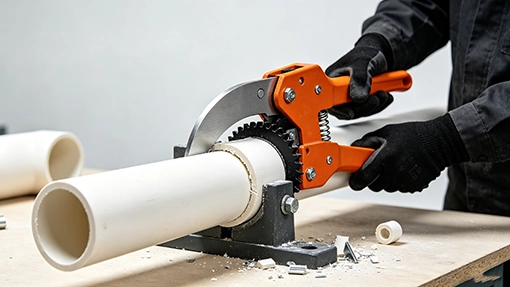
a PVC Pipe Cutter Cut Large-Diameter Pipes
1. Can a PVC Pipe Cutter Handle Large-Diameter Pipes?
Yes — but only inside a much narrower window than the label suggests. A cutter rated to 42 mm outside diameter will struggle the moment the wall thickens. A 75 mm ratchet cutter may open wide enough for the pipe yet still fail on Schedule 80 pressure pipe because the blade cannot sustain the cutting force. Capacity is a three-variable equation, not a single number.
Table 1. What actually determines whether a cut succeeds
| Factor | What it controls | Common misjudgment |
|---|---|---|
| Cutter opening | Whether the pipe physically enters the jaw | Treating “maximum OD” as “all walls at that OD” |
| Blade travel and rigidity | Whether the blade reaches through the wall without deflecting | Assuming a longer stroke equals more force |
| Pipe wall thickness and class | Cutting resistance; jaw flex under load | Comparing only nominal pipe size, not Schedule or pressure rating |
| Material and temperature | Ductility vs. brittleness at the moment of cut | Cutting cold CPVC with a compression-style cutter |
Why Pipe Diameter Alone Does Not Determine Cutting Capacity
A 4-inch nominal PVC pipe has an actual outside diameter of 4.500 inches (114.3 mm). Schedule 40 wall thickness is 0.237 inches (≈6.0 mm); Schedule 80 jumps to 0.337 inches (≈8.6 mm). Same nominal size, radically different cutting load. A 6-inch Schedule 80 pipe is 6.625 inches OD with a 0.432-inch wall — nearly 11 mm of material for the blade to traverse.
A cutter advertised at “up to 4-inch pipe” is almost certainly referencing a thin-wall interpretation. Before trusting that label, verify the actual outside diameter and wall class, not the trade size printed on the pipe.
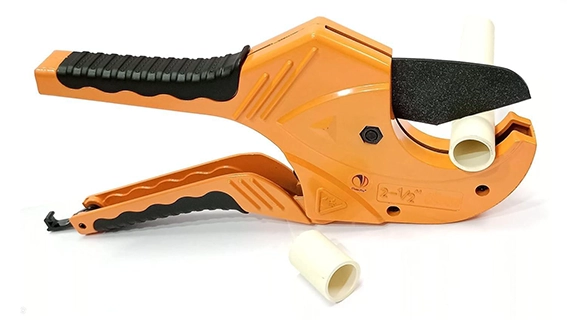
a Ratchet PVC Pipe Cutter
2. Which Types of PVC Pipe Cutters Work for Large Pipes?
Ratchet PVC Pipe Cutters
A ratchet cutter converts one hard squeeze into a series of smaller increments. Each pump of the handle advances the blade a short distance, letting the operator apply force progressively rather than in a single maximal effort. The mainstream professional range sits around 42–63 mm outside diameter for ratchet models, with heavy-duty variants reaching 75 mm — but the 75 mm class carries an explicit caveat: thin-wall only, typically up to 3.5 mm wall thickness, and not recommended for Schedule 80 or PN16 pressure pipe.
Ratchet cutters are at their best on compatible thin-to-medium wall PVC in accessible locations. They become a liability when the operator has to force the final few ratchets through a thick wall — that is where jaw flex, blade deflection and a crooked cut begin.
Scissor-Type PVC Pipe Cutters
The simplest mechanism: direct blade pressure, no ratchet, no mechanical advantage beyond handle length. Typical scissor cutters top out around 25–42 mm depending on the model. They are fast and intuitive on small conduit and thin-wall pipe. On larger diameters, the blade tends to drift off the cut line as the material resists, and the cut quality degrades before the tool physically fails.
Rotary PVC Pipe Cutters
This is where the capacity story changes. Rotary plastic pipe cutters — particularly inline designs that wrap around the pipe and are turned in repeated passes — are available in sizes from roughly 160 mm to 800 mm outside diameter, with wall-thickness capability that scales down as diameter increases. A representative 800 mm rotary cutter handles up to 25.4 mm wall at the largest size, while a 355 mm model can take up to 51 mm wall. Some designs also cut and bevel in a single pass, and spring-loaded guide rollers help maintain a square cut even on out-of-round pipe.
Caution: “Rotary cutter” is not one product category. A small handheld rotary tool and a heavy inline pipe cutter share a principle, not a capacity class. Always match the specific tool’s published range to the pipe.
Table 2. Cutter types compared
| Cutter type | Mechanism | Typical compatible range | Main limitation |
|---|---|---|---|
| Scissor cutter | Direct blade pressure | Small-diameter thin-wall plastic | Blade drift on larger OD; operator fatigue |
| Ratchet cutter | Incremental blade advance | 42–63 mm common; 75 mm thin-wall heavy-duty | Thick-wall pressure pipe exceeds practical force |
| Rotary inline cutter | Repeated circumferential passes | Large OD, wall capacity decreases with size | Setup, clearance and tool-specific range |
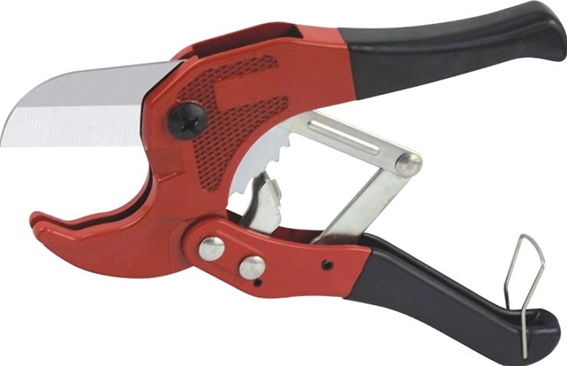
a Scissor cutter
3. What Limits the Cutting Capacity of a PVC Pipe Cutter?
Maximum Opening and Blade Travel
The jaw opening gets the pipe in. The blade travel gets the blade through. These are different constraints, and a cutter can pass the first test while failing the second. A blade that cannot reach the pipe’s centerline — or that flexes before it reaches full depth — will leave an incomplete cut no matter how hard the operator squeezes.
PVC Pipe Wall Thickness
Wall thickness is the silent capacity killer. A 75 mm cutter that comfortably handles 3 mm wall thin-wall drainage pipe is not the same tool requirement as a 75 mm Schedule 80 pressure pipe with roughly 5.6 mm wall, where five-stage ratcheting or a powered saw becomes the realistic route. The thicker the wall, the more the blade must function as a cutting wedge rather than a scoring wheel — and the more the cutter’s frame must resist torsional flex.
Pipe Diameter and Material Hardness
Longer cut path means more friction, more heat and more opportunity for the blade to wander. Material formulation matters too. CPVC behaves differently from PVC, and at temperatures below roughly 10°C (50°F), ratchet cutters are explicitly not recommended on CPVC because the compressive action increases the risk of cracking; a fine-toothed saw (16–18 TPI, minimal set) or a wheel cutter is the safer choice. Forcing a compression cutter through cold CPVC is not a productivity shortcut — it is a crack initiation event.
Pipe Support and Cutting Stability
A large-diameter pipe is a lever. If it is not supported on both sides of the cut, the operator is fighting the pipe’s weight and movement at the same time as the cutting resistance. That combination produces angled cuts, uneven blade loading and premature blade wear. Support stands, pipe vices or purpose-built clamping cradles are not accessories — they are part of the cutting system.
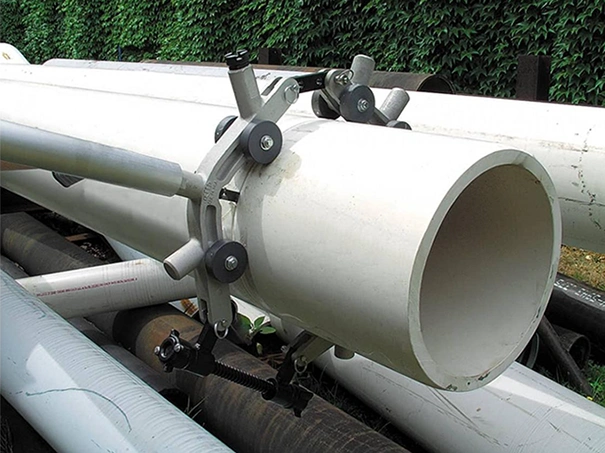
a Rotary PVC Pipe Cutter
4. When Should You Use a Saw Instead of a PVC Pipe Cutter?
The decision point is not a single diameter. It is the moment when the cutter can no longer maintain blade alignment and cutting force simultaneously. Three signals should trigger the switch: the blade visibly deflects before completing the wall; the jaw distorts or the pipe ovalizes under clamping; or the required handle force exceeds what an operator can sustain for a clean, controlled stroke. At that point, continuing with the cutter produces a worse edge than a properly guided saw.
Circular Saw for Large-Diameter PVC Pipes
A circular saw, fitted with a blade suitable for plastic, produces the straightest ends on long runs — but only when the pipe is properly supported and the cut line is guided. The practical challenge is geometry: a full-size circular saw’s wide kerf wastes material and is harder to guide on a curved surface. On large-diameter pipe, the operator typically rotates the pipe or walks the saw around a marked circumference. Setup quality determines outcome more than saw power.
Reciprocating Saw
The reciprocating saw is the versatility play: it reaches into trenches, tight spaces and installed runs where a circular saw cannot go. With a fine-tooth plastic blade (10–14 TPI is a practical starting range) and a firmly supported pipe, it produces good-to-very-good cuts. The trade-off is that cut quality depends heavily on operator control — vibration, blade wander and inadequate support show up directly in the edge.
Dedicated Plastic Pipe Cutting Machines
For repetitive or production cutting, manual and semi-manual tools stop being the right economic answer. Industrial plastic pipe cutting machines cover ranges from a few tens of millimeters to over 1,000 mm outside diameter, with wall-thickness capacity and cut-length repeatability that hand tools cannot match. Some industrial saw-based units handle up to 630 mm diameter with programmable cut lengths; larger band-saw and planetary machines extend well beyond that. The investment case is built on throughput and consistency, not portability.
Table 3. Cutter vs. saw vs. machine — matching the tool to the job
| Tool | Best application | Cut precision | Portability | Deciding consideration |
|---|---|---|---|---|
| Ratchet pipe cutter | Compatible thin/medium-wall pipe in accessible locations | Good when correctly sized | High | Rated capacity vs. actual wall class |
| Circular saw | Long runs; straight ends on supported pipe | High with guide | Medium | Support and blade selection |
| Reciprocating saw | In-trench, repair and tight-space cuts | Operator-dependent | High | Vibration control and pipe support |
| Cutting machine | Repetitive production cutting | High and repeatable | Low | Throughput, cut length, equipment cost |
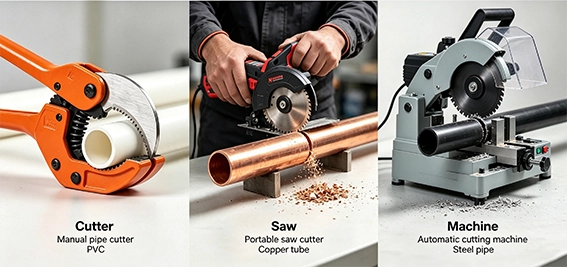
Cutter vs. saw vs. machine
5. How to Cut Large-Diameter PVC Pipes Cleanly and Accurately
Step 1 — Measure and mark around the circumference. A wrap-around marker or a flexible tape used as a guide produces a true perpendicular line; a single pencil tick does not. On large OD, a line that is 1 mm out at the start becomes visibly angled by the time the cut closes.
Step 2 — Support the pipe on both sides of the cut. The pipe must not roll, slide or cantilever during the cut. Support stands positioned close to the cut line reduce both movement and vibration.
Step 3 — Verify the tool against the actual pipe, not the nominal size. Check outside diameter, wall thickness and material. For cold CPVC, default to a fine-tooth saw rather than a compression cutter.
Step 4 — Let the tool cut, do not force it. In a ratchet cutter, advance the blade incrementally; in a saw, let the teeth clear material at their own pace. Pushing harder generates heat, and heat turns PVC from a cutting problem into a smearing problem.
Step 5 — Deburr and inspect before joining. Remove internal and external burrs, confirm the cut is square, and check for cracks — especially on CPVC and cold-weather cuts. A burr left inside the pipe becomes a turbulence point and, eventually, a leak path.
6. How to Choose the Right Cutting Tool for Your PVC Pipe Size
Check actual OD first. A “4-inch” pipe is 4.500 inches OD; a “6-inch” pipe is 6.625 inches OD. The cutter’s maximum capacity refers to OD, not nominal trade size.
Then check wall class. Schedule 40 and Schedule 80 at the same nominal size are different cutting propositions. A 75 mm ratchet cutter that suits thin-wall drainage may be entirely unsuited to Schedule 80 at the same OD.
Match frequency and environment. Occasional installation work rewards portability; repetitive production work rewards repeatability and throughput. There is no universal “best” tool — only the right trade-off for the job.
Table 4. Selection logic by requirement
| Your requirement | What to prioritize |
|---|---|
| Small pipe, occasional use | Compact manual cutter within verified OD range |
| Frequent thin/medium-wall cutting | Durable ratchet with clear capacity marking |
| Large compatible OD, thin wall | Heavy-duty ratchet within published wall limit |
| Large OD or thick pressure wall beyond cutter range | Guided circular saw, reciprocating saw or inline rotary cutter |
| Repetitive production cutting | Industrial cutting machine with repeatable cut length |
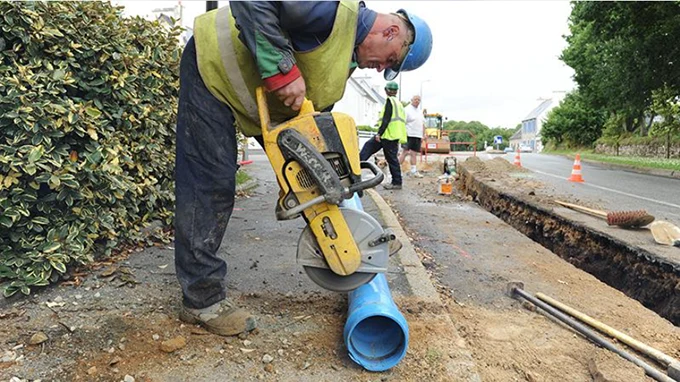
Circular Saw for Large-Diameter PVC Pipes
7. Frequently Asked Questions About Cutting Large PVC Pipes
Can a PVC pipe cutter cut 4-inch pipe?
A 4-inch nominal PVC pipe is 4.500 inches OD. Some heavy-duty ratchet cutters reach this OD range, but success depends on wall thickness and material class. A cutter that handles thin-wall 4-inch pipe may not complete a Schedule 80 cut at the same OD.
Can you cut 6-inch PVC pipe with a manual pipe cutter?
6-inch pipe is 6.625 inches OD, with Schedule 80 wall at 0.432 inches. That is generally beyond the practical range of manual ratchet cutters. A guided saw or an inline rotary cutter sized for the OD is the realistic tool.
What is the best tool for cutting large-diameter PVC pipes?
There is no single best tool. The decisive variables are OD, wall thickness, material class, access and cut count. A 110 mm thin-wall drain line and a 110 mm pressure pipe demand different answers.
Can a ratchet pipe cutter cut thick-wall PVC pipe?
The ratchet mechanism helps apply force in increments, but it does not eliminate the wall-thickness limit. Many 75 mm-class ratchet cutters are restricted to ≈3.5 mm wall and are not intended for Schedule 80 pressure pipe.
Is a circular saw better than a PVC pipe cutter?
Not universally. A guided circular saw produces straighter ends on supported large pipe; a manual cutter is faster and cleaner within its verified range. Support and blade choice often matter more than the tool category.
How do you prevent PVC pipes from cracking during cutting?
Match the tool to the material and temperature, keep the blade sharp, support the pipe rigidly, and avoid compressive cutters on cold CPVC. Below roughly 10°C, use a fine-toothed saw or wheel cutter instead of a ratchet cutter.
Need the Right Pipe Cutting Tools for Your Application?
The right choice depends on pipe material, actual outside diameter, wall thickness, cutting frequency and site conditions. Whether you are equipping an installation crew with manual cutters or sourcing heavy-duty cutting solutions for larger pipe, selecting by verified specification — not by nominal size alone — is what keeps cuts square and joints leak-free.
Contact Luoyang Datang Energy Tech Co., Ltd. to discuss your pipe cutting requirements and find the right tool configuration for your application.
RELATED POSTS
HDPE Pipes Build An Efficient Water-Saving Irrigation System
Why Brass Hose Fittings Are Still a Preferred Choice for Industrial Applications?

How To Choose PP-R Pipe Fittings For Home Decoration Pipes
Brass Plumbing Manifolds:The Durable Core of Modern Piping Systems
The Three Pillars of Modern Piping Systems
