LUOYANG DATANG ENERGY TECH CO.,LTD


Pipe Cutter Types Explained: Which Cutter Works Best for Different Pipes?
A plumber reaches for a hacksaw on a copper line, and the cut looks fine—until the fitting won’t seat. A contractor forces a scissor cutter through cold PPR and wonders why the pipe cracks at the jaw. These are not tool failures. They are matching failures. A pipe cutter is not a universal device; it is a family of mechanisms, each with a physical logic that suits certain materials, wall thicknesses, and diameters—and quietly punishes everything outside that envelope.
This guide is not a catalog. It is a matching framework: what each cutter type actually does at the material level, where it belongs, and where it will let you down.
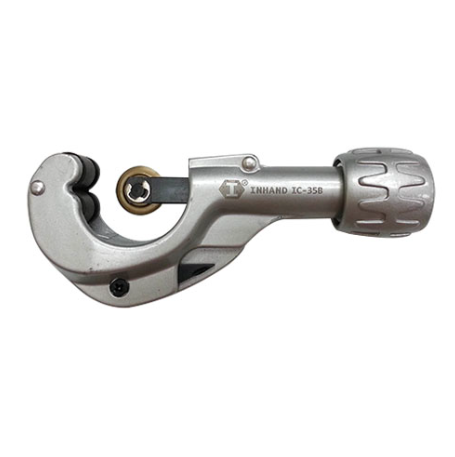
a Pipe Cutter
What Is a Pipe Cutter and How Does It Work?
A pipe cutter severs pipe by concentrated, controlled pressure along a narrow contact line, not by removing material the way a saw does. The tool’s cutting wheel or blade displaces a thin band of the pipe wall while the pipe is held rigid; the resulting cut is square, dimensionally consistent, and largely free of the torn burrs that a hacksaw leaves behind.
The practical difference from sawing is downstream, not cosmetic. A saw cut creates a heat-affected zone and irregular burrs that interfere with threading, grooving, soldering, brazing, or press-fitting. A pipe cutter’s shear-based cut is designed to feed directly into a joint, provided the correct cutter is paired with the correct pipe.
What Are the Main Types of Pipe Cutters?
Five families cover the vast majority of field and shop work. The table below gives the operating logic and representative capacity, not a universal rating—every specific model has its own documented range.
Table 1: Pipe cutter types at a glance
| Cutter Type | Operating Mechanism | Representative Capacity | Best-Fit Material |
|---|---|---|---|
| Rotary Cutter | Hardened wheel rolled around pipe under increasing pressure | ~12–54 mm OD; stainless up to 1.65 mm wall | Copper, thin-wall stainless, aluminum |
| Ratchet Cutter | Geared handle multiplies hand force per stroke | ~3–63 mm OD (plastic) | PVC, CPVC, PP, PEX, PE |
| Scissor Cutter | Single-stroke shearing action | ~3–42 mm OD | Small-diameter plastic and rubber tube |
| Heavy-Duty Cutter | Reinforced frame and larger wheel/blade for thicker walls | Model-dependent; up to large OD | Thicker-wall plastic, larger metal pipe |
| Powered Cutter | Motor-driven wheel, blade, or saw head | 12–400 mm OD depending on platform | Repeated cutting, high-volume production |
6-42mm Manual Rotary Pipe Cutter for PVC, PPR & PE Pipes
Rotary Pipe Cutters
A rotary cutter wraps a hardened wheel around the pipe and tightens incrementally with each revolution. The wheel does not cut through in one pass; it fatigues a narrow band of wall until the material parts. The method is clean and controlled, but it has a hard ceiling: stainless steel above roughly 1.65 mm wall thickness is outside the comfort zone of standard rotary designs, and thicker walls demand a different tool family entirely.
The real skill with a rotary cutter is feed discipline. Cranking the knob hard on a thin-wall copper tube ovalizes the pipe before the wheel ever breaks through. Light pressure, many revolutions, is the rule that keeps the bore round and the cut square.
Ratchet Pipe Cutters
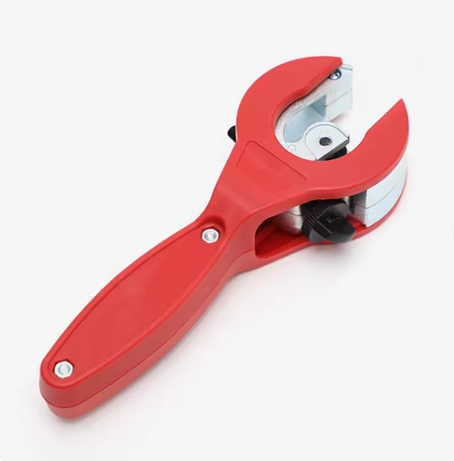
A ratchet cutter uses a geared mechanism to multiply hand force stroke by stroke, which is why it handles stiff, cold plastic that would defeat a single-squeeze tool. The burr-free cutting action is designed for plastic and multilayer tubing, and a 63 mm-capacity ratchet covers the common PVC, CPVC, PEX, and PE range in one tool family.
Where ratchets fail is where users push them beyond material design. A ratchet built for PVC will not magically become a PPR tool just because the jaw opens wide enough. The blade geometry and the material’s response to shearing still have to agree.
Scissor-Type Pipe Cutters
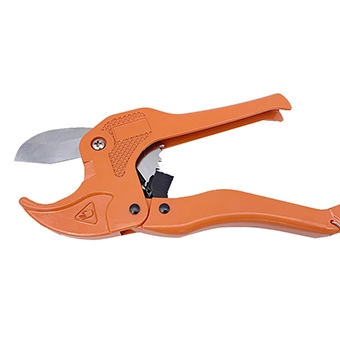
A scissor cutter is the simplest mechanism: two handles, a spring, a blade, and a single shearing stroke. Its speed is real—one squeeze on small PVC or PEX—but its capacity ceiling is equally real, typically topping out at around 42 mm OD. More importantly, the shearing action that works beautifully on brittle PVC can crack or deform softer PPR, because the two plastics fail differently under concentrated shear.
Scissor cutters are a convenience tool, not a production tool. They belong in service kits and light installation work where the pipe is small, the material is known, and the cut count is low.
A ratchet cutter
Heavy-Duty Pipe Cutters
“Heavy-duty” describes a design intent, not a single specification. These cutters use larger wheels or blades, reinforced frames, and longer handles to handle thicker walls and larger diameters than a standard rotary or ratchet. In plastic pipe work, an adjustable heavy-duty cutter is the recommended step-up for 50–63 mm multilayer or HDPE pipe, where a 42 mm ratchet no longer provides enough mechanical authority.
The trade-off is physical. Heavier heads and longer handles mean more leverage but also more weight and more clearance required around the pipe. In a tight mechanical room, a heavy-duty cutter may not physically fit where a compact ratchet would.
Powered Pipe Cutters
Powered cutters replace hand force with a motor—and that changes the economics of cutting. A cordless unit can complete a small-diameter cut in seconds, and the labor savings become decisive when a crew is cutting more than roughly a dozen pipes per day. The capital cost is higher, but the per-cut cost falls quickly under volume.
Powered cutters are not automatically “better cuts.” The blade or wheel still has to match the material. A powered head spinning the wrong consumable on stainless will glaze the wheel and burnish the cut face faster than a hand tool would, because the energy input is higher.
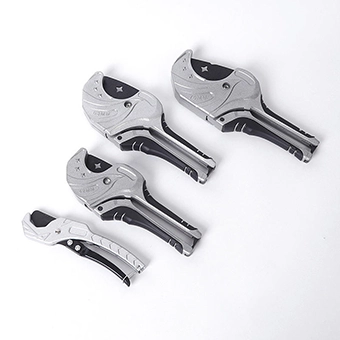
Heavy-Duty Scissor-Type Pipe Cutter for PVC & PPR Pipes
Which Pipe Cutter Works Best for Different Pipe Materials?
This is where the matching framework becomes operational. The same cutter type can be right for one plastic and wrong for another, because “plastic pipe” is not a materials category—it is a grouping of polymers with different hardness, ductility, and thermal response.
Table 2: Material-to-cutter matching
PVC and CPVC Pipes
PVC is brittle and responds well to shear. A ratchet cutter produces a burr-free, square cut on PVC and CPVC up to common diameters, and the geared handle keeps the cut controlled on hard, cold material. A scissor cutter is fine for small PVC where speed matters more than capacity.
The mistake to avoid is assuming “plastic” means interchangeable. A scissor cutter that snaps through PVC cleanly will crack or deform PPR, because PPR is softer and fails by yielding rather than fracturing.
PPR Pipes
PPR sits between PVC and PE in stiffness. A ratchet cutter with the correct blade is the standard hand-tool choice up to roughly 42 mm, and the cut must be square and deburred on both faces before fusion—a rough or lipped face compromises the weld.
PPR punishes single-squeeze habits. One hard compression stroke tears the material and leaves a rougher face than several controlled ratchet passes. Let the gear train do the work.
HDPE Pipes
HDPE is softer and more ductile than PVC or PPR. The cutting challenge is holding the pipe firmly without crushing it, then applying enough controlled force to part a tough, semi-crystalline wall. A ratchet or adjustable heavy-duty cutter with a wide, non-deforming clamping jaw is the correct family; a tool that grips by point-loading will dent HDPE before it cuts it.
For 50–63 mm multilayer or HDPE pipe, step up to an adjustable heavy-duty cutter. A 42 mm ratchet is past its comfortable authority at that diameter.
Copper and Aluminum Tubes
A rotary wheel cutter is the default for copper and aluminum because it produces a square, clean, flareable cut without the chips and heat of sawing. The cut is not burr-free on the inside—a small inner ridge remains—but it is uniform and easy to ream before brazing or pressing.
The copper-specific risk is ovalization, not burring. Feed the wheel a quarter-turn or less per revolution. A hard, fast feed on soft copper produces an elliptical bore that a flaring tool cannot rescue.
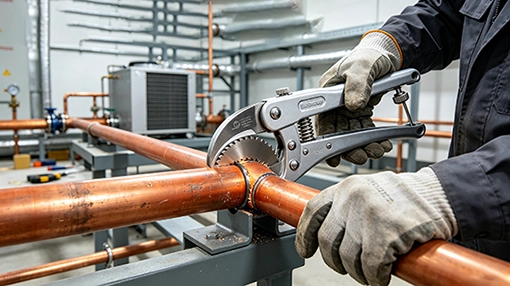
Pipe Cutter in refrigeration copper
Stainless Steel and Carbon Steel Pipes
Stainless is where cutter selection gets genuinely constrained. Standard steel cutter wheels glaze quickly on stainless and leave a burnished, work-hardened face; carbide or stainless-specific wheels are required. Standard rotary cutters typically handle stainless only up to about 1.65 mm wall thickness; thicker walls push the task into saw or heavy-duty rotary territory.
Carbon steel is more forgiving but still wall-dependent. A rotary cutter works on thin-wall carbon steel; thicker walls and larger diameters belong to powered saws or heavy-duty rotary heads sized to the OD and wall.
Pipe Cutter vs. Tube Cutter: What’s the Difference?
The terms are often used interchangeably in catalogs, but the distinction matters at the specification level. “Tube” generally refers to a smaller-diameter, thin-wall product measured by OD and wall; “pipe” refers to a larger, often standardized product measured by nominal pipe size. The tooling follows the product: a tube cutter is typically a compact wheel tool for thin-wall copper, brass, aluminum, and light stainless, while a pipe cutter may carry a heavier frame and larger wheel for steel and iron pipe.
In practice, check the marked OD range, not the name on the label. A “tubing cutter” rated 1/8“–1-1/8” is the right tool for HVAC copper and the wrong tool for 2“ Schedule 40 black iron—not because of the word on the package, but because the jaw will not open wide enough and the wheel is not graded for the wall.
5 Factors to Consider When Choosing a Pipe Cutter
1. Pipe Material
The first filter is not diameter—it is how the material fails. Brittle PVC shears cleanly; ductile HDPE deforms; stainless work-hardens; copper ovalizes under excess feed. The cutter must be designed for that failure mode, not just for the nominal pipe size.
2. Outside Diameter
Cutters are sized by OD range, and the marked range is a hard boundary, not a suggestion. A tool that “almost” opens to the pipe OD will grip off-center, cut crooked, and load the wheel unevenly.
3. Wall Thickness
Wall thickness determines whether the cutting mechanism can physically penetrate and whether the pipe can withstand clamping without collapse. Standard rotary cutters cap out on stainless around 1.65 mm; thin-wall pipe can collapse under incorrect clamping before the cut completes.
4. Cutting Accuracy
“Accuracy” here means squareness and bore roundness, not cosmetic smoothness. A crooked cut from a dull wheel or worn idle bearing creates a beveled face that a fitting cannot seal; an ovalized bore from over-feeding a rotary cutter defeats flaring and press-fitting.
5. Cutting Frequency and Working Environment
A service plumber cutting three pipes a day and a fabrication shop cutting three hundred have different economics. Powered cutters pay back through labor savings above roughly a dozen cuts per day, but they add weight, power dependency, and clearance requirements that may not suit a tight mechanical room.
Common Pipe Cutting Problems and How to Avoid Them
Table 3: Symptom → root cause → fix
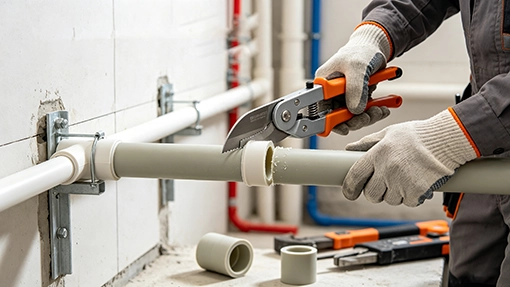
Pipe Cutter in PPR fusion installation
How to Match the Right Pipe Cutter to Your Application
Table 4: Application-based selection summary
The cleanest cut is not the one made by the most expensive tool. It is the one made by the tool whose mechanism, blade grade, and clamping geometry match the pipe’s material, OD, and wall—and the joint that follows. Get that match right, and the deburring pass becomes a formality. Get it wrong, and no amount of technique will rescue the fitting.
Ready to Match a Cutter to Your Pipe?
Send Luoyang Datang Energy Tech Co., Ltd. the pipe material, outside diameter, wall thickness, and joining method you are working with. We will come back with a cutter-type shortlist and blade/wheel recommendation—not a generic catalog page. Whether you are sourcing PVC pipe cutters, plastic pipe cutters, pipe tube cutters, or heavy-duty pipe cutting tools for a project or a product line, the starting point is the pipe, not the tool.
📧 [email] | 💬 [WhatsApp/WeChat] | 🔗 [Contact page]
Subject line: “Pipe Cutter Matching”
RELATED POSTS

Essential Reading on Brass Fittings: Specifications & Advantages
Why Industries Are Switching to HDPE Piping Systems
What Pipe Is Used For Water Supply

How Strong Are Brass Elbows and Hose Couplings? A Guide to Durability and Performance