LUOYANG DATANG ENERGY TECH CO.,LTD


How to Compare PPR Pipe Fittings Quotes: 7 Details Beyond Unit Price
When you are sourcing PPR pipe fittings, two quotes can look almost identical on paper — same fitting type, same size range, similar unit price — yet the orders they represent can be worlds apart. One supplier may have quoted PN20 fittings with virgin material from a certified resin source, while the other quietly priced PN10 fittings with recycled content. One includes a batch-level quality certificate; the other sends a generic test report from three years ago.
The only way to avoid this trap is to treat a quote as a data package, not a price tag. This article walks through seven details you should compare before committing to a PPR fittings order — the same checklist that experienced buyers use to separate genuinely competitive suppliers from those just competing on price.
Whether you are placing a first trial order or negotiating a repeat bulk shipment, these comparison points will help you read a PPR fittings quote the way a procurement professional should.
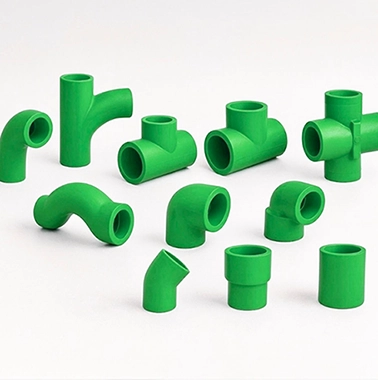
PPR pipe fittings for supplier quote comparison
Why the Lowest PPR Fittings Quote May Not Be the Best Deal
A quote that comes in 30% below the others is not automatically a red flag — but it is always a signal to look closer. In the PPR fittings market, low prices usually come from one of a few places: thinner wall thickness, lower pressure rating, recycled or off-spec raw material, reduced packaging protection, or delivery terms that shift cost and risk to you.
PPR is a commodity polymer, but fittings are injection-moulded precision components. The difference between a well-made 25mm elbow and a poorly made one is not visible at arm’s length. It shows up in dimensional tolerance, fusion compatibility, and long-term hydrostatic performance. A fitting that fails at month eight costs far more than the 15 cents you saved at the quote stage.
The practical approach is to normalise every quote to the same specification baseline before you compare numbers. Ask each supplier to confirm fitting type, size, pressure class, material grade, standard, packaging, delivery terms, and quality documentation. Only then does the unit price mean anything.
Quick takeaway: Never compare unit prices until you have confirmed that both suppliers are quoting the same fitting to the same standard, with the same delivery and documentation scope.
1. Confirm the Exact Fitting Type and Dimensions
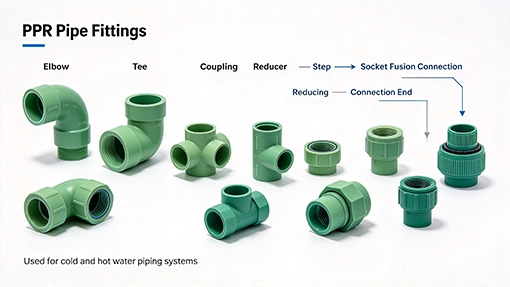
PPR fittings cover a wide product family: elbows (90° and 45°), tees, reducers, couplers, unions, caps, flanges, brass-threaded adapters, valves, and more. Even within one category, dimension matters enormously. A 25mm × ½” male threaded elbow from Supplier A and a “25mm elbow” from Supplier B may not be the same product at all.
What to check in the quote:
- Fitting category and angle — elbow, tee, reducer, socket, union, adapter, valve, etc.
- Nominal diameter (DN/OD) — typically 20mm to 160mm for standard PPR systems.
- Connection type — socket fusion, threaded (brass insert), or flanged.
- Thread specification — BSP, NPT, or metric; male or female.
- Dimensional standard — ISO 15874-3 or DIN 16962 for fittings.
A 2026 Chinese market price table lists a PPR external-thread straight fitting (de 20mm) at 11.00 RMB including tax — but that same category spans dozens of SKUs with prices ranging from ¥3 to ¥60 or more depending on size and type. If the quote does not specify the exact item, you are comparing a category to a category, not a product to a product.
Practical tip: Always request a line-item quote with a specification sheet or technical drawing attachment. If a supplier resists providing dimensioned drawings, that itself is information.
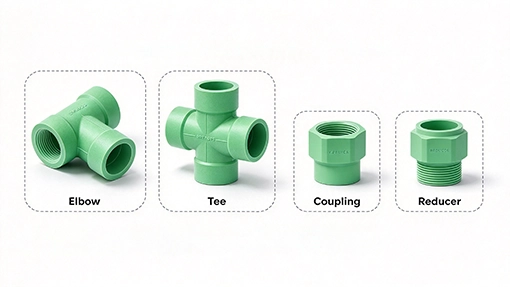
PPR pipe fitting types and dimensions for order verification
2. Check Material Grade and Applicable Standards
Not all PPR is the same PPR. The raw material grade is the single most important factor behind fitting performance — and the easiest thing to cut corners on.
Key material facts:
- PPR (Type 3) is the standard material for hot and cold water pressure piping. The relevant international standard is ISO 15874, which specifies requirements for polypropylene piping systems for hot and cold water installations.
- DIN 8077/8078 are commonly referenced in European procurement alongside EN ISO 15874. These standards regulate material properties, dimensional tolerances, and wall thickness.
- Reputable suppliers use virgin PP-R material — not recycled or blended feedstock. The material grade is typically designated as Type 3 or PP-R, with specific melt flow rate and density parameters.
- For potable water applications, additional certifications matter: WRAS (UK), DVGW (Germany), AENOR (Spain), NSF (US), and CE marking for EU conformity.
A supplier may list “ISO 15874” in a quote without being able to produce a third-party test report that covers the specific fitting range you are buying. Ask for the certificate scope — not just the standard number.
| Material check | What to request | Red flag |
|---|---|---|
| Raw material grade | PP-R Type 3 confirmation, virgin material statement | “PPR” without grade specification |
| Applicable standard | ISO 15874-3 or DIN 16962 certificate | Standard mentioned but no certificate |
| Potable water compliance | WRAS / DVGW / NSF certificate | “Food grade” claim without certificate |
| Third-party test report | Lab report covering the fitting type you are ordering | Generic certificate from years ago |
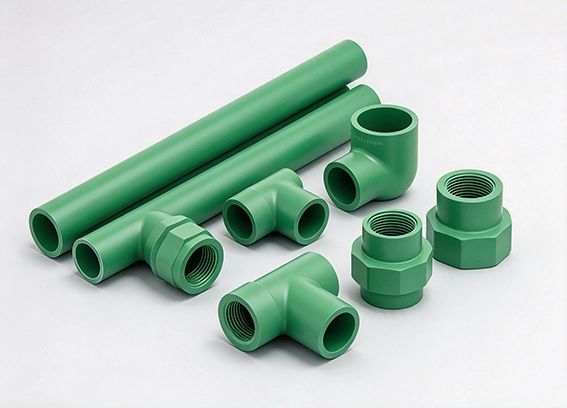
PPR pipe fittings material and pressure rating specifications
3. Compare Pressure and Temperature Requirements
This is where “PN” numbers become commercial decisions. PPR fittings are rated by nominal pressure (PN) at a reference temperature of 20°C. The three common classes are PN10, PN16, and PN20 — with PN20 being the standard choice for hot water applications.
The critical point: pressure rating is temperature-dependent. A fitting rated PN20 (2.0 MPa at 20°C) can typically handle about 0.8 MPa at 70°C. If a supplier quotes PN20 but your system runs continuously at 70°C with occasional surges to 95°C, you need to confirm that the fitting’s derated pressure at working temperature still exceeds your system pressure.
| Pressure class | Rated pressure at 20°C | Approx. working pressure at 70°C | Typical application |
|---|---|---|---|
| PN10 | 1.0 MPa | ~0.4–0.5 MPa | Cold water only |
| PN16 | 1.6 MPa | ~0.6–0.7 MPa | Cold water, low-pressure hot water |
| PN20 | 2.0 MPa | ~0.8 MPa | Standard hot and cold water |
| PN25 | 2.5 MPa | ~1.0 MPa | High-pressure / industrial |
Note: Exact derating curves depend on the S-series (wall thickness) and material formulation. Always verify against the supplier’s pressure-temperature derating table.
The difference in raw material cost between PN10 and PN20 wall thickness is real — a 25mm PN10 fitting has a 2.3mm wall, while the PN20 version has a 2.8mm wall. That 0.5mm difference is roughly 20% more material per fitting. If one supplier quotes PN10 prices while another quotes PN20, you are comparing apples to oranges.
What to confirm in the quote:
- Pressure class (PN rating) — stated explicitly, not implied.
- Applicable S-series — S5, S4, S3.2, S2.5 correspond to different wall thicknesses.
- Maximum continuous working temperature — typically 70°C; short-term up to 95°C.
- Derating table — request the pressure-temperature relationship for the specific fitting.
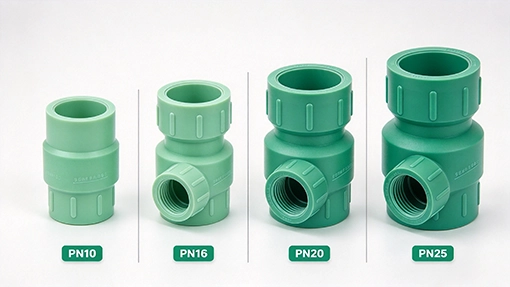
Pressure class of HDPE pipes
4. Check Quantity and Price Breaks
PPR fittings are usually priced in tiers: sample quantity, small order, carton-level, and container-level. The unit price difference between 500 pieces and 50,000 pieces can be 30–50%, but the price break structure itself tells you something about the supplier’s production model.
Typical market range (2026): PPR fittings from Chinese suppliers are commonly quoted between $0.02 and $1.01 per piece, depending on size, type, pressure class, and order volume. A 25mm elbow might be $0.04 at 4,000 pieces from one supplier, while a smaller-volume supplier quotes $0.18 at 50 pieces.
What to examine:
- MOQ and unit of measure — is it per piece, per carton, or per container? A supplier quoting “one container, mixed sizes” is not being vague — that is genuinely how many factories calculate their minimum, because the container is the shipping unit, and the mix of sizes determines what fits.
- Price break structure — request a table with quantities and corresponding unit prices for the specific SKUs you need.
- Quantity tolerance — under UCP 600 sub-article 30(b), documentary credits allow a 5% quantity tolerance unless the credit specifies a piece count. For mixed pipe-and-fitting orders, this can catch buyers off guard.
| Quantity tier | Typical MOQ | Unit price indication | Best suited for |
|---|---|---|---|
| Sample / trial | 10–500 pcs | Higher unit cost | Specification verification |
| Carton-level | 500–5,000 pcs | Mid-range pricing | Small projects, retail restocking |
| Container-level | 20–50,000+ pcs | Lowest unit cost | Bulk projects, distribution |
Practical tip: When comparing two quotes at different quantity tiers, calculate the landed cost per 1,000 pieces including freight and duty. A lower unit price at a higher quantity can still be more expensive per piece once logistics are factored in.
5. Confirm Packaging and Order Consistency
Packaging is not glamorous, but it is one of the most reliable indicators of a supplier’s operational discipline. A factory that cares about how fittings are packed is usually a factory that cares about how they are made.
What a well-specified PPR fittings quote should state:
- Inner packaging — poly bag, shrink wrap, or individual box.
- Carton configuration — pieces per carton, carton dimensions, gross weight.
- Carton marking — manufacturer name, product designation, size, quantity per carton, batch number, production date.
- Palletisation — pallet size, cartons per pallet, stretch wrapping.
Product traceability requirements for PPR fittings typically require that packaging labels include the manufacturer identity, nominal diameter, production period (at least month and year), and batch number. If a supplier cannot confirm these elements in the quote, traceability after delivery becomes very difficult.
Why it matters in practice: If you are receiving 20 cartons of 25mm elbows from one supplier and 20 cartons from another, you need to be able to identify which batch each carton belongs to if a quality issue arises. Without carton-level marking, your entire delivery is one undifferentiated pile.
| Packaging element | Specify in RFQ | Check on delivery |
|---|---|---|
| Inner packaging | Bag / box / shrink | Consistent across cartons |
| Pieces per carton | Exact count | Count a sample carton |
| Carton marking | Manufacturer, size, batch, date | Legible and complete |
| Pallet configuration | Size, layers, wrapping | Stable and protected |
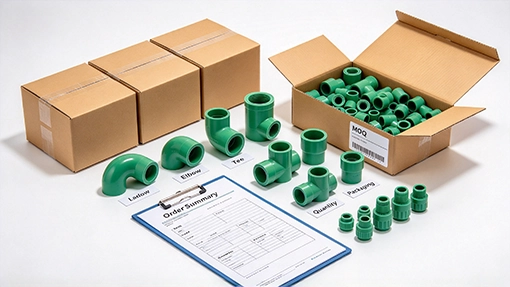
Bulk PPR pipe fittings order quantity and packaging comparison
6. Compare Delivery Time and Shipping Terms
Two quotes with the same unit price but different Incoterms are not comparable. FOB Ningbo and CIF Hamburg carry very different cost and responsibility profiles. One of the most common mistakes buyers make is comparing an EXW quote to a DDP quote without normalising the delivery terms.
What to pin down in every quote:
- Incoterm — FOB, CIF, CFR, EXW, DDP, etc. FOB from Ningbo or Shanghai is the standard baseline for Chinese PPR suppliers.
- Lead time — distinguish between production lead time (from order confirmation to goods ready) and total transit time (including inland transport, port handling, and ocean freight).
- Standard vs. express production — many Chinese PPR factories operate on 20–35 day standard lead times, with express cycles of 12–18 days available for urgent orders at a premium.
- Port of loading — Ningbo-Zhoushan is the dominant port for Zhejiang-based suppliers; Shanghai and Qingdao serve other clusters.
Normalising for comparison: Convert every quote to FOB port of loading terms. Add estimated freight and insurance separately. This gives you a true apples-to-apples landed cost estimate before you negotiate.
| Delivery term | Supplier responsibility | Buyer responsibility | Best for |
|---|---|---|---|
| EXW | Goods at factory | Everything from pickup | Buyers with own logistics |
| FOB | Goods loaded on vessel | Ocean freight, insurance, import | Standard comparison baseline |
| CIF | Goods delivered to destination port | Import clearance, inland transport | Simplified first orders |
| DDP | Goods delivered to your door | Nothing (all-inclusive) | Buyers wanting zero hassle |
A note on lead time reliability: Ask for the supplier’s on-time delivery rate. A documented rate above 90% is a meaningful operational signal; below 80% suggests scheduling or capacity issues that will affect you eventually.
7. Request Quality Documents and Sample Confirmation
This is the step that most buyers skip on the first order and regret on the second. A quote without a quality document package is an incomplete quote.
Documents to request before confirming an order:
- ISO 15874-3 compliance certificate — from an accredited third-party lab, not a self-declaration. The certificate should cover the specific fitting types and size range you are purchasing.
- Raw material certificate — confirming virgin PP-R material, with grade and supplier traceability.
- Hydrostatic pressure test report — demonstrating the fitting’s pressure performance, typically at 1.5× rated pressure or at elevated temperature over an extended period.
- Dimensional inspection report — confirming wall thickness and diameter within the tolerance specified in the applicable standard.
- Potable water certification — WRAS, DVGW, NSF, or equivalent for drinking water applications.
- Batch-level quality certificate — issued per shipment, not just a generic factory certificate from the initial product approval.
Sample confirmation process: Request physical samples of the exact fitting types and sizes you plan to order. Verify dimensional accuracy with calipers, check surface finish, and — critically — test fusion compatibility with your pipe source. A sample that looks right but does not fuse properly is not a passing sample.
What samples cannot verify: A sample confirms design and basic workmanship. It does not certify the production batch. For that, you need the per-shipment batch certificate and, for high-value orders, third-party pre-shipment inspection.
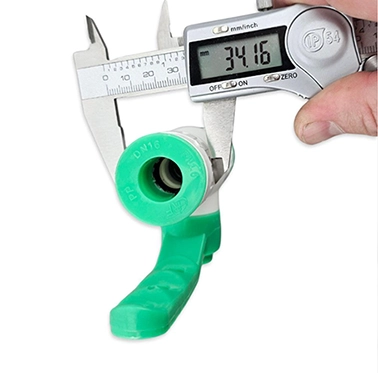
PPR pipe fittings quality inspection and specification document
A PPR Fittings Quote Comparison Table
Use this table as a working template. Copy it into your evaluation spreadsheet and fill it in for each supplier.
| Comparison item | Supplier A | Supplier B | Supplier C |
|---|---|---|---|
| Fitting type and size | Confirmed / Missing | Confirmed / Missing | Confirmed / Missing |
| Material grade and standard | Specified / Unclear | Specified / Unclear | Specified / Unclear |
| Pressure and temperature suitability | Confirmed / Missing | Confirmed / Missing | Confirmed / Missing |
| Unit price and MOQ | Quoted | Quoted | Quoted |
| Packaging and qty per carton | Specified / Missing | Specified / Missing | Specified / Missing |
| Lead time and shipping terms | Confirmed / Missing | Confirmed / Missing | Confirmed / Missing |
| Quality documents and inspection | Available / Unclear | Available / Unclear | Available / Unclear |
The rule: Do not compare the unit price column until every other column is filled in. A missing item is not “probably fine” — it is an unquantified risk.
What Should You Include in an RFQ?
A clear RFQ reduces back-and-forth and forces suppliers to quote to your specification, not theirs. Here is a copy-ready checklist:
Product specification:
- Fitting type(s) — e.g., 90° elbow, equal tee, reducer, socket
- Nominal diameter(s) — e.g., 20mm, 25mm, 32mm, 40mm, 50mm
- Connection type — socket fusion, threaded (specify BSP/NPT), flanged
- Pressure class — PN10 / PN16 / PN20 / PN25
- Applicable standard — ISO 15874-3 / DIN 16962 / GB/T 18742.3
Commercial terms:
- Required quantity per size
- Target delivery date
- Incoterm and destination port
- Payment terms preference (T/T, L/C, etc.)
Quality and documentation:
- Required certificates (ISO 15874-3, WRAS, DVGW, etc.)
- Batch certificate requirements
- Third-party inspection requirement (yes/no)
- Sample request before bulk order
Packaging:
- Pieces per carton or bag
- Carton marking requirements
- Palletisation requirements
A supplier who responds to all of these points with specific answers is a supplier worth developing. A supplier who responds with “we will quote separately” or ignores half the RFQ is telling you something about their sales process — which usually reflects their production process.
FAQ
Q: Can I compare quotes if one is in USD and another in RMB?
Yes, but use a consistent exchange rate for all conversions and note the date of the rate. Currency fluctuation over a 30–60 day order cycle can shift the effective price by 2–5%. If you are comparing supplier quotes received on different dates, normalise the exchange rate to a single reference date.
Q: How many PPR fittings are in a standard carton?
It varies by fitting type and size. A common configuration is 200–500 pieces per carton for small fittings (20–32mm), and 50–100 pieces for larger fittings (63–110mm). Always confirm the exact quantity per carton — a “carton price” is meaningless without the piece count.
Q: What is the difference between PN20 and PN25 fittings in terms of actual use?
PN20 is the standard for residential and commercial hot water systems. PN25 is used for higher-pressure industrial applications or where system pressure plus surge exceeds PN20 derated capacity at working temperature. For most building services projects, PN20 is sufficient.
Q: Should I order a sample before a bulk order?
Always, for a first-time supplier. Request samples of 2–3 representative sizes, verify dimensions with calipers, and if possible, fusion-weld one sample to a pipe and conduct a simple pressure test. A sample order is a small cost compared to a rejected container.
PPR pipe fittings
Request a Quote for Your PPR Fittings Order
Need a quote for PPR pipe fittings?
Send Luoyang Datang Energy Tech Co., Ltd. your fitting types, sizes, required quantities, applicable standards, and destination port. We can review your requirements and help you compare suitable supply options — with specification confirmation, supplier coordination, and delivery support at every step.
📩 Email us your RFQ — include the checklist above and we will respond with a comparable, specification-based quote.