LUOYANG DATANG ENERGY TECH CO.,LTD


Brass Pipe Fittings Explained: Brass Elbow, Hose Connector & Hose Coupling
When choosing a fitting for a plumbing or fluid transfer system, the challenge is often not finding a fitting, but choosing the right one.
Brass pipe fittings are widely used in plumbing and fluid systems. But different fittings serve different functions. Brass elbows change flow direction. Hose connectors connect hoses to pipes or fittings. Hose couplings connect pipe or hose sections.
This guide explains the differences, applications, connection methods and selection considerations for these three essential brass fittings.
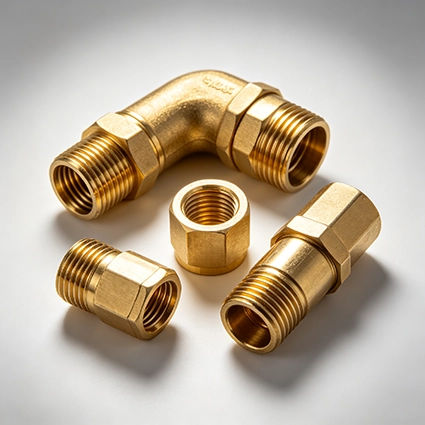
Brass Pipe Fittings
What Are Brass Pipe Fittings?
Brass pipe fittings are components used to connect, redirect, adapt, or terminate pipes and hoses in fluid handling systems. Made from an alloy of copper and zinc, brass offers an excellent balance of strength, machinability, and corrosion resistance.
Brass fittings are commonly connected through threaded connections (NPT, BSP), compression fittings, or barbed hose connections. They are suitable for transporting water, air, gas, and various industrial fluids.
Key Features of Brass Pipe Fittings:
| Feature | Description |
|---|---|
| Material | Brass (copper-zinc alloy) |
| Main Function | Connecting, redirecting, or adapting pipes and hoses |
| Common Connections | Threaded, compression, barbed |
| Typical Applications | Plumbing, water supply, air, gas, industrial systems |
Common Types of Brass Pipe Fittings
Before diving into the three main types, here is a quick overview of common brass fitting types:
| Fitting Type | Main Function | Typical Application |
|---|---|---|
| Brass Elbow | Change flow direction | Plumbing, piping |
| Brass Tee | Split or combine flow | Branch piping |
| Brass Coupling | Connect two sections | Pipe/hose extension |
| Brass Hose Connector | Connect hose to pipe/fitting | Water, irrigation |
| Brass Adapter | Connect different threads/types | Equipment connection |
| Brass Reducer | Connect different sizes | Piping transitions |
Today, we focus on three: Brass Elbow, Hose Connector, and Hose Coupling.
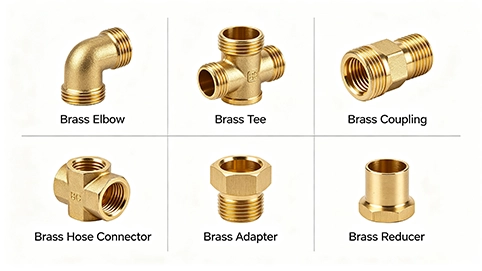
Common Types of Brass Pipe Fittings
What Is a Brass Elbow?
A brass elbow is a type of brass pipe fitting used to change the direction of flow in a piping system. It is installed between two lengths of pipe or tubing to create an angled turn.
How Does a Brass Elbow Work?
By altering the pipe direction at a specific angle—typically 45° or 90°—a brass elbow redirects fluid flow without requiring flexible tubing or excessive bending of rigid pipes. This makes it an essential component in both residential plumbing and industrial piping systems.
Common Types of Brass Elbows
- 90° brass elbow – Creates a right-angle turn, the most commonly used elbow type
- 45° brass elbow – Provides a gentler 45-degree bend, reducing flow resistance
- Male × Female elbow – One threaded male end, one threaded female end
- Female × Female elbow – Both ends are female threaded
- Male × Male elbow – Both ends are male threaded
- Threaded brass elbow – Features threaded connections on one or both ends
Where Are Brass Elbows Used?
- Residential plumbing
- Water supply systems
- Compressed air lines
- Industrial piping
- Equipment connections
- Heating systems

Brass Elbows Used in Residential plumbing
What Is a Brass Hose Connector?
A brass hose connector is a brass fitting designed to connect a flexible hose to another hose, a pipe, a fitting, or equipment. It bridges the gap between different connection types or components.
Unlike a rigid pipe fitting, a hose connector accommodates the flexibility of hoses while providing a secure, leak-resistant connection. Brass is a preferred material because it offers corrosion resistance for water and many fluids.
Common Brass Hose Connector Designs
- Threaded hose connector – Screws onto threaded pipe ends or equipment ports
- Barb hose connector – Features barbs that grip the inside of a hose, secured with a clamp
- Male hose connector – Has external threads for connecting to female-threaded components
- Female hose connector – Has internal threads for connecting to male-threaded components
- Hose-to-pipe connector – Connects a hose on one end and a rigid pipe on the other
Where Are Brass Hose Connectors Used?
- Garden irrigation
- Water supply connections
- Pump connections
- Air lines
- Industrial fluid transfer

Brass Hose Connectors Used in Garden irrigation
What Is a Brass Hose Coupling?
A brass hose coupling is a brass pipe fitting used to join two hose sections or two pipe sections together, typically to extend or repair a fluid line.
While a hose connector often connects different types of components (hose to pipe, hose to equipment), a coupling typically joins two similar ends—two hoses or two pipes—in a straight line.
Common Brass Coupling Types
- Straight coupling – Joins two sections in a straight line
- Threaded coupling – Features threaded ends for screw connections
- Male coupling – Both ends have male threads
- Female coupling – Both ends have female threads
- Hose coupling – Specifically designed for joining hose ends
Typical Applications
- Plumbing extensions
- Water transfer lines
- Irrigation systems
- Compressed air systems
- Industrial fluid systems
- Hose repair
Brass Elbow vs Hose Connector vs Hose Coupling
This is the most important section of this guide. Here is a clear comparison:
| Feature | Brass Elbow | Brass Hose Connector | Brass Hose Coupling |
|---|---|---|---|
| Primary Function | Change flow direction | Connect hose to another component | Join two hose/pipe sections |
| Typical Shape | Angled (45° / 90°) | Straight or varied | Usually straight |
| Common Angle | 45° / 90° | Straight | Straight |
| Main Connection | Threaded | Threaded or barbed | Threaded |
| Best For | Direction changes | Hose connections | Extending or connecting lines |
Quick Selection Guide
Choose a Brass Elbow When:
You need to change the direction of a rigid piping system—at 45°, 90°, or other angles. Use it when routing pipes around obstacles or through tight spaces.
Choose a Hose Connector When:
You need to connect a flexible hose to a rigid pipe, a piece of equipment, or another component with a different connection type.
Choose a Hose Coupling When:
You need to join two hose ends or two pipe ends together in a straight line—to extend a line, repair a broken section, or connect two sections.

Brass Hose Coupling used in Compressed air systems
How to Choose the Right Brass Pipe Fitting?
Selecting the right brass pipe fitting requires evaluating five key factors:
1. Connection Type
Identify the thread standard required for your system. The two most common are:
- NPT (National Pipe Taper) – Tapered thread, 60° thread angle, seals on the threads themselves. Common in North America
- BSP (British Standard Pipe) – 55° thread angle, available in parallel (BSPP) or tapered (BSPT). Common in Europe, Asia, and international markets
Important: NPT and BSP threads are not interchangeable. Forcing them together damages threads and causes leaks.
Other connection types include compression fittings and barbed connections.
2. Fitting Size
Match the fitting size to your pipe or hose dimensions. Key measurements include:
- Pipe outer diameter (OD)
- Pipe inner diameter (ID)
- Hose inner diameter (ID)
- Thread size (nominal size)
Always confirm the nominal size with a thread chart before ordering.
3. Working Pressure
Ensure the fitting’s pressure rating meets or exceeds your system’s operating pressure. Brass fittings are commonly rated for low to medium pressure applications. Typical brass fittings handle pressures up to 1200 PSI depending on size and temperature.
4. Fluid or Medium
Consider what will flow through the system:
- Water (potable or non-potable)
- Air
- Gas
- Oil
- Chemicals
For drinking water applications, ensure fittings are lead-free brass.
5. Installation Environment
Consider the operating environment:
- Indoor plumbing
- Outdoor irrigation
- Industrial equipment
- High-temperature environments
Brass fittings typically operate from -65°F to 250°F (-54°C to 121°C).
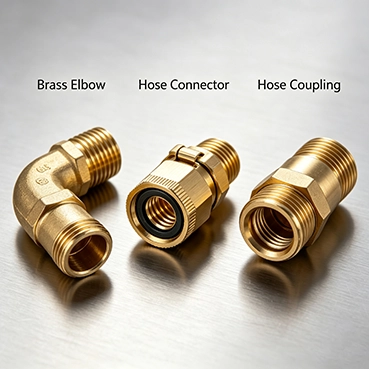
Brass Elbow vs Hose Connector vs Hose Coupling
Brass Pipe Fitting Sizes and Thread Standards
Understanding brass fitting sizes and thread types is essential for proper selection:
| Specification | What to Check |
|---|---|
| Fitting Size | Match pipe or hose size |
| Thread Type | NPT, BSP, or other |
| Thread Gender | Male or female |
| Connection Type | Threaded, compression, barbed |
| Pressure Rating | Match system working pressure |
| Temperature Range | Match system operating temperature |
Thread Standards at a Glance:
| Standard | Thread Angle | Thread Form | Sealing Method | Primary Region |
|---|---|---|---|---|
| NPT | 60° | Tapered | Thread sealing | North America |
| BSPP | 55° | Parallel | Washer/O-ring seal | Europe, Asia |
| BSPT | 55° | Tapered | Thread sealing | Europe, Asia |
Why Choose Brass Pipe Fittings?
Brass remains one of the most popular materials for pipe fittings. Here is why:
- Good mechanical strength – Brass fittings withstand significant pressure and mechanical stress
- Corrosion resistance – Resists corrosion from water, heat, and many acids
- Good machinability – Brass is easy to machine into precise threaded fittings
- Reliable threaded connections – Threads hold securely and seal effectively
- Long service life – Brass fittings last for decades in proper applications
- Versatility – Suitable for plumbing, air, gas, and industrial applications
For a deeper look at brass fitting specifications and advantages, see our guide to Brass Fittings: Specifications & Advantages.
Brass Pipe Fittings Applications
| Application | Common Fittings |
|---|---|
| Plumbing | Elbows, couplings, adapters / |
| Water Supply | Hose connectors, elbows |
| Irrigation | Hose connectors, couplings |
| Compressed Air | Elbows, connectors |
| Industrial Equipment | Adapters, elbows, couplings |
| Heating Systems | Elbows, connectors |
| Fluid Transfer | Hose connectors, couplings |

Brass Pipe Fittings used in Fluid Transfer
Common Brass Fitting Selection Mistakes
Avoid these common mistakes when selecting brass pipe fittings:
Mistake 1: Choosing the Wrong Thread Standard
NPT and BSP threads look similar but are not interchangeable. Using the wrong thread standard leads to leaks and system failure.
Mistake 2: Ignoring Hose or Pipe Size
A fitting that looks right may not fit if the dimensions are off. Always verify OD, ID, and thread size.
Mistake 3: Selecting the Wrong Fitting Type
Do not use a coupling when you need to change direction. Do not use an elbow when you need to connect a hose to a pipe. Each brass fitting type serves a specific purpose.
Mistake 4: Ignoring Pressure Requirements
Using a fitting rated below your system pressure risks failure—especially in industrial applications.
Mistake 5: Focusing Only on Price
The cheapest fitting is not always the best value. Consider material quality, machining precision, and connection reliability.
Frequently Asked Questions About Brass Pipe Fittings
Q1: What is the difference between a brass hose connector and coupling?
A: A hose connector connects a hose to a different component (pipe, equipment, or another connection type). A coupling joins two similar ends—two hoses or two pipes—in a straight line, typically to extend or repair a line.
Q2: Are brass hose connectors suitable for water applications?
A: Yes. Brass offers excellent corrosion resistance for water applications. For drinking water, ensure fittings are lead-free brass.
Q3: What thread types are commonly used for brass fittings?
A: The most common are NPT (National Pipe Taper, 60°) in North America and BSP (British Standard Pipe, 55°) in Europe, Asia, and international markets.
Q4: How do I choose the right brass fitting size?
A: Match the fitting size to your pipe or hose dimensions—check OD, ID, and thread size. Always verify nominal size against a thread chart before ordering.
Q5: Are brass fittings suitable for industrial applications?
A: Yes. Brass fittings are widely used in industrial piping for air, water, oil, and other fluids in low to medium pressure systems.
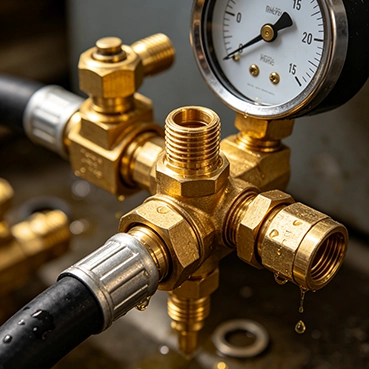
Brass Pipe Fittings used in Compressed Air
Choose the Right Brass Pipe Fittings for Your Application
The right brass pipe fitting depends on your pipe or hose size, connection type, thread standard, pressure requirements, and application environment. Whether you need a brass elbow to change direction, a hose connector to link a hose to a pipe, or a hose coupling to extend a line—understanding the differences is the first step to making the right choice.
Looking for brass elbows, hose connectors, couplings, or other brass pipe fittings?
Contact Luoyang Datang Energy Tech Co., Ltd for product specifications, sizes, thread standards, and customized requirements.
RELATED POSTS

PPR Pipe vs 304 Stainless Steel,Which is Safety?

Brass Hose Fitting vs Brass Pipe Fitting: What’s the Difference?
Ensuring Industrial Wastewater Compliance: Pipe System Solutions

How to Inspect HDPE Pipes Before Shipment: 7 Checks Buyers Should Make
What Is The Black Water Supply Pipe
