LUOYANG DATANG ENERGY TECH CO.,LTD


How to Choose the Right Pipe Clamp Size? A Practical Guide to Pipe Diameter and Fit
Choosing the right pipe clamp size is not as simple as matching the clamp to the pipe’s nominal label. A clamp that is too small may refuse to close; one that is too large may leave the pipe loose. The actual outside diameter, insulation thickness, liner compression, and mounting geometry all decide the final fit. For contractors and industrial buyers, getting these measurements right before ordering prevents rework, delays, and compatibility headaches. This guide walks through pipe clamp sizes, measurement methods, pipe clamp size charts, and the checks that keep a project moving.
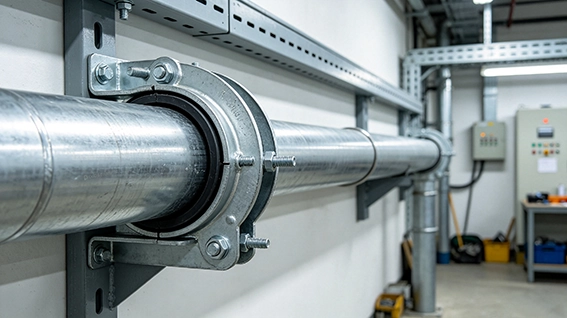
Right Pipe Clamp Size
1. Why Does the Correct Pipe Clamp Size Matter?
Clamp fit problems rarely stay isolated. They cascade into the installation schedule.
| If the clamp is too small | If the clamp is too large |
|---|---|
| Difficult or impossible to install | Poor pipe positioning |
| Excess pressure on pipe surface | Excessive clearance between clamp and pipe |
| Damage to coating or insulation | Insufficient restraint for the application |
| Rework and schedule delays | Potential movement or vibration |
An oversized clamp does not automatically cause vibration—mounting rigidity, liner type, and fastener torque all matter. But it removes the margin of safety that a correctly sized clamp provides.
Pipe Size and Clamp Size Are Not the Same Thing
“Pipe size” usually refers to a nominal designation. “Clamp size” may refer to a compatible pipe outside diameter range, the clamp’s internal diameter, or a nominal label the manufacturer assigns. Always check the manufacturer’s dimensional drawing rather than relying on the nominal pipe size alone. This single habit prevents most ordering errors.
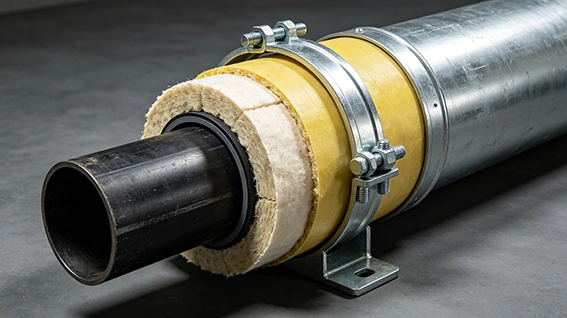
Cross-sectional dimensions of pipe clamps for insulated piping
2. Understand Pipe Diameter Before Choosing a Pipe Clamp
What Is Nominal Pipe Size (NPS)?
NPS is a nominal sizing system, not a direct measurement of the pipe. For a given NPS, ASME B36.10M steel pipe keeps the outside diameter fixed while the wall thickness—and therefore the bore—changes with schedule. A 2-inch NPS steel pipe does not have a 2-inch outside diameter; its standard OD is 2.375 inches (60.3 mm). That gap between the label and the physical pipe is where clamp sizing goes wrong.
Table 1. NPS vs. Actual Outside Diameter (ASME B36.10M steel pipe reference)
| NPS | Actual OD (inch) | Actual OD (mm) |
|---|---|---|
| 1/2″ | 0.840 | 21.3 |
| 3/4″ | 1.050 | 26.7 |
| 1″ | 1.315 | 33.4 |
| 1-1/4″ | 1.660 | 42.2 |
| 1-1/2″ | 1.900 | 48.3 |
| 2″ | 2.375 | 60.3 |
| 2-1/2″ | 2.875 | 73.0 |
| 3″ | 3.500 | 88.9 |
| 4″ | 4.500 | 114.3 |
Values follow ASME B36.10M. Plastic, copper, and other pipe families may use different outside diameters for the same nominal label.
Why Outside Diameter Beats Nominal Size
A clamp touches the outer surface of the pipe, not the nominal designation. For most pipe clamp selection, the actual OD is the more useful reference. When the pipe is coated or lined, the “envelope” at the support point grows again—measure the surface the clamp will actually grip, not the bare pipe underneath.
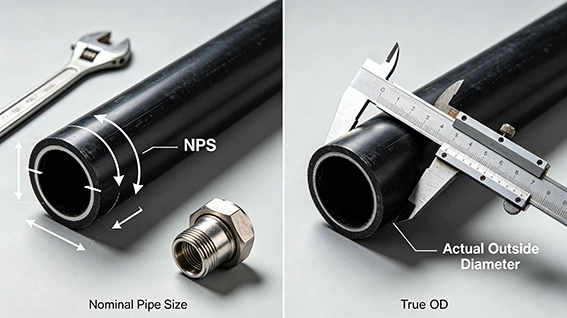
NPS vs. Actual Outside Diameter
3. How to Measure Pipe Clamp Size Correctly
Step 1 — Measure the Pipe Outside Diameter
Use a vernier caliper or outside micrometer across the bare pipe. If no caliper is at hand, wrap a flexible tape around the circumference and divide by π (3.1416):Measure at more than one location. An ovalized or locally coated section can give a misleading single reading.
Step 2 — Check for Insulation or Lining
Note insulation thickness, protective jacket thickness, rubber lining, and the clearance the support design requires. A clamp selected on bare-pipe OD will not close around an insulated pipe.
Step 3 — Read the Clamp’s Internal Dimensions
Check internal diameter, adjustable range, clamp opening, liner thickness, and fastener position. For a lined clamp, a first geometric estimate is: available inside diameter = metal bore − 2 × liner thickness. That arithmetic catches a missing layer; it does not predict final grip, because the liner compresses and the clamp ears move during tightening.
Step 4 — Match Against the Manufacturer’s Drawing
Ignore the product name’s “2-inch” or “DN50” until you have confirmed the pipe clamp dimensions on the drawing. The label describes a size system; the drawing describes the product.
4. Pipe Clamp Sizes for Insulated Pipes
For an insulated pipe, the overall diameter is:where D_pipe is the bare pipe OD and t is the insulation thickness on one side. A 60.3 mm pipe with 25 mm insulation gives 60.3 + 2 × 25 = 110.3 mm. But do not buy a 110.3 mm standard clamp based on that number alone. Insulated pipe supports must account for insulation compression limits, load-bearing capacity, vapour-barrier protection, and the manufacturer’s specified clearance.
Many insulated systems require a dedicated insulated pipe support or a load-bearing insulation block—not an ordinary clamp. The formula tells you the geometric envelope; the support specification tells you what product actually belongs there.
5. Different Clamp Designs, Different Dimensions to Check
| Clamp type | Key dimensions |
|---|---|
| Standard pipe clamp | Internal diameter, width, bolt spacing |
| U-bolt clamp | Inside width, inside height, thread length |
| Rubber-lined clamp | Inner diameter, liner thickness, compression allowance |
| Unistrut-compatible clamp | Pipe OD range, channel connection geometry |
A rubber-lined pipe clamp adds a compression variable: the liner must deform enough to grip without crushing the coating. A Unistrut pipe clamp must match both the pipe OD and the channel’s internal profile. Same pipe, different clamp architecture—different number to put on the purchase order.
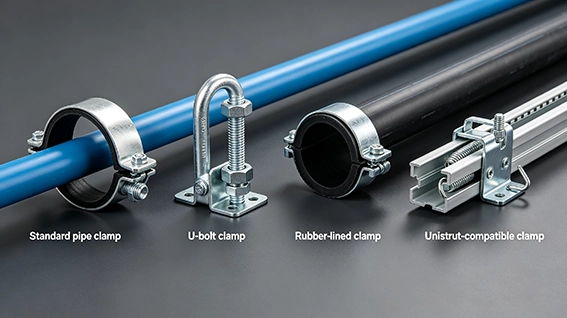
Clamp types
6. Material and Operating Conditions Still Matter
A dimensionally correct clamp can still be the wrong clamp. Carbon steel is cost-effective in protected environments; stainless steel earns its premium where moisture or corrosives are present—but “stainless” is not a universal pass, and grade selection must match the chemical exposure.
Temperature swings, thermal expansion, vibration, and pipe weight (including fluid) all feed into the support load calculation. Heavy-duty and rubber-lined designs exist for these reasons, not as catalogue decoration.
7. Five Ordering Mistakes That Cost Time and Money
- Using nominal pipe size instead of actual OD.
- Forgetting the insulation thickness—or adding it only once instead of twice.
- Confusing clamp internal diameter with pipe nominal diameter.
- Overlooking bolt spacing and mounting compatibility.
- Selecting on size alone without checking material grade or load rating.
For bulk orders, confirm the dimensional drawing, material certificate, and load rating before the PO goes out.
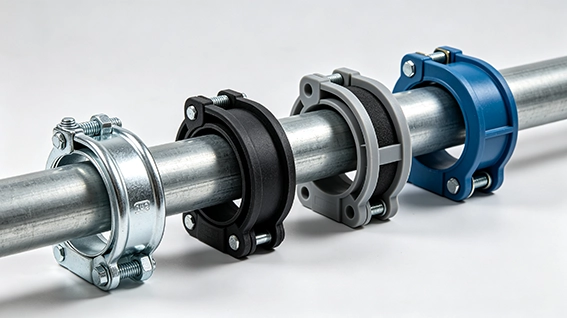
Industrial Applications of Pipe Clamps Made from Various Materials
8. What to Send When You Order Pipe Clamps
| Required information | Example |
|---|---|
| Pipe nominal size | 2″ / DN50 |
| Actual outside diameter | 60.3 mm |
| Pipe material | Carbon steel / Stainless steel / HDPE |
| Insulation? | Yes / No |
| Insulation thickness | 25 mm |
| Clamp type | Standard / U-bolt / Unistrut |
| Clamp material | Carbon steel / SS304 / SS316 |
| Application | Water / HVAC / Industrial piping |
| Quantity | Project quantity |
| Special requirements | Coating / Rubber lining / Custom dimensions |
Providing the actual pipe OD and the application does more than speed up a quote—it lets the supplier cross-check the clamp drawing and flag a mismatch before it ships.
FAQ
1. How do I know what size pipe clamp I need?
Measure the actual outside diameter first, then check the clamp’s internal diameter, adjustable range, and mounting geometry against the manufacturer’s drawing.
2. Is pipe clamp size the same as pipe size?
No. Pipe size is usually a nominal designation (NPS/DN); clamp size refers to the clamp’s actual fit dimensions. A 2″ NPS steel pipe has a 60.3 mm OD, not 50.8 mm.
3. How do you measure a pipe clamp?
Measure internal diameter, opening, and bolt spacing—what you measure depends on clamp type. For a lined clamp, subtract twice the liner thickness from the metal bore as a first geometric check.
4. Should pipe clamps be the same size as the pipe OD?
For an unlined standard clamp, the clamp’s compatible OD range should cover the pipe OD. For lined or insulated systems, the envelope at the support point is larger than the bare pipe OD, and the clamp must be selected against that envelope—not the pipe label.
5. What size pipe clamp is needed for a 2-inch pipe?
A 2″ NPS steel pipe has a standard 60.3 mm (2.375″) OD. Use that OD as the starting point, then confirm pipe material, insulation, and clamp drawing—do not order a “2-inch clamp” on the label alone.
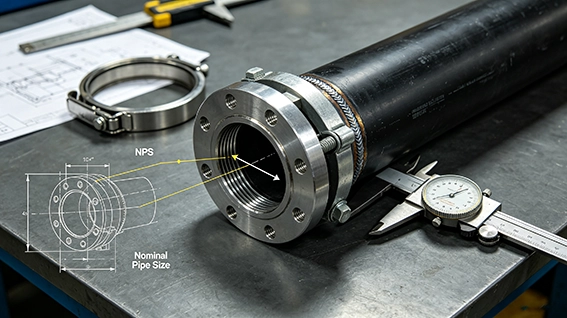
Schematic of NPS and OD Dimensions
Need the Right Pipe Clamp Size for Your Project?
Send your pipe OD, pipe material, insulation details, and clamp type. Luoyang Datang Energy Tech Co., Ltd. will cross-check the dimensions against suitable pipe clamp specifications and come back with a size recommendation—not a generic catalogue page. Whether you need standard, U-bolt, rubber-lined, or Unistrut-compatible industrial pipe clamps, the measurement is the starting point, and the drawing is the proof.
RELATED POSTS
Why Brass Hose Fittings Are Still a Preferred Choice for Industrial Applications?

Complete Guide to PVC Pipes and Fittings for Water Supply Systems
Innovative Applications of PVC Pipes in Plumbing System

PE Pipe Vs PVC Pipe in Agricultural Irrigation: Comparative Analysis