LUOYANG DATANG ENERGY TECH CO.,LTD

Rubber-Lined vs. Unlined Pipe Clamps: When Does the Lining Matter?
Two pipe clamps can look almost identical on a shelf. The difference — a strip of rubber on the inside — is easy to overlook until noise complaints start arriving, a coated pipe shows wear marks at the support point, or a plastic line gets crushed by a metal saddle. But the opposite mistake is just as common: paying a premium for rubber-lined clamps on a project where an unlined clamp would have done the job perfectly well.
So the question is not “which is better.” The question is: does adding a rubber lining actually improve performance for your pipe support condition, or is it solving a problem you do not have?
What Are Rubber-Lined and Unlined Pipe Clamps?
Rubber-lined pipe clamps place a rubber or elastomer insert between the metal clamp body and the pipe’s outer wall. The insert is the functional layer: it cushions the contact, separates the pipe surface from the metal, and — under the right conditions — interrupts the path along which vibration travels from the pipe into the building structure. Common liner materials are EPDM and NBR, with silicone available for higher-temperature duties.
Unlined pipe clamps are the simpler animal: bare metal against the pipe, no intermediate layer. They are not “cheap versions” of lined clamps. They are the correct tool when the support point does not need cushioning, surface separation, or acoustic decoupling — and when the pipe and clamp are metallurgically and mechanically compatible in direct contact.
The distinction matters because the liner changes what happens at the interface, not what happens to the clamp’s load rating. A rubber strip does not turn a standard clamp into a heavy-duty clamp.
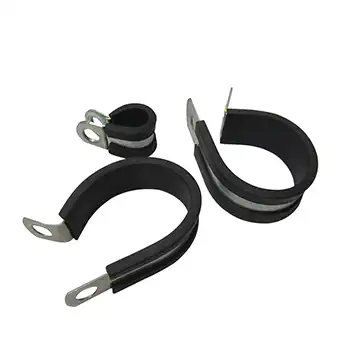
Rubber-Lined Pipe Clamps
Key Differences at a Glance
Three points deserve to be stated plainly, because they get lost in product brochures:
Rubber lining does not increase load capacity. The clamp’s safe working load is a function of the metal body, bolt, and structure — not the liner. If the support needs more capacity, the answer is a heavier clamp, not a thicker rubber strip.
A liner does not guarantee a specific noise reduction figure. Published attenuation values are tied to test standards, mounting conditions, and frequency bands. A clamp tested to DIN 4109 in a laboratory wall assembly is not a promise for your site’s piping layout.
Full separation is the whole game. Walraven’s technical guidance is blunt: the support fixing point must never directly contact the pipe, because “the smallest direct contact will act as a sound carrying bridge.” If the liner is compressed flat, displaced during installation, or bridged by a metal fastener, the acoustic benefit collapses.
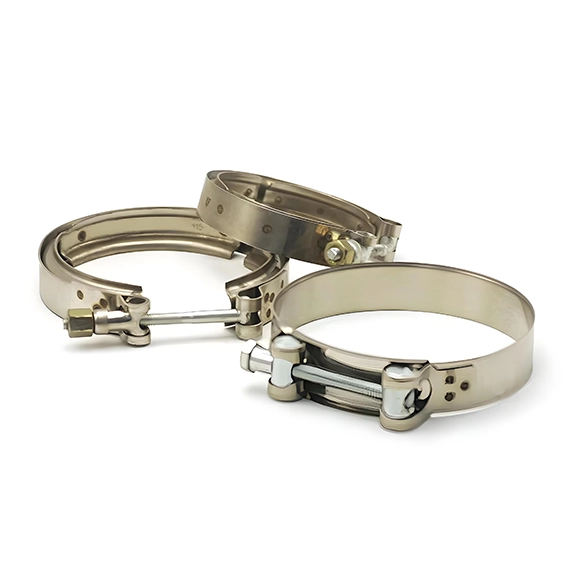
Unlined Pipe Clamps
When the Lining Actually Matters
Vibration and noise: a path problem, not a clamp problem
Rubber-lined clamps earn their keep when vibration has a structure-borne path you need to interrupt — pump-connected piping, HVAC distribution near occupied spaces, mechanical equipment connections, and lines subject to water hammer or pulsation. The elastomer introduces a compliant layer that decouples the pipe wall from the clamp body, and by extension from the building structure.
But here is the judgment that separates a useful article from a sales pitch: a rubber-lined clamp is a local fix for a system-level problem. If the vibration originates at a pump or compressor, changing the clamp at one support point does not address the source. Equipment isolation, pipe routing, and the stiffness of the overall support system still determine the outcome. A lined clamp helps manage the transmission path; it does not cancel the excitation.
Surface protection: where direct metal contact becomes destructive
This is the less glamorous but often more consequential reason to specify a liner. Plastic pipes, coated steel, painted finishes, thin-wall stainless, and composite piping all sit in the risk zone. A bare metal clamp concentrates contact stress and, if any relative movement occurs — thermal expansion, settling, vibration — the interface becomes an abrasion point.
The GRE/GRP piping world takes this seriously: support clamps are commonly lined with rubber to prevent wear on the fiberglass, and the liner also compensates for the uneven outer surface and wear caused by pipe movement and vibration. For a thermoplastic line, an unlined metal saddle can also create a galvanic or chemical incompatibility at the contact point — a failure mode that has nothing to do with load and everything to do with the interface.
Material separation: useful, but do not overclaim it
In mixed-metal support assemblies, an elastomer liner can reduce direct metal-to-metal contact that would otherwise support galvanic activity. That is a real consideration for stainless or copper lines on steel structures, and for coated pipes where a scratch becomes a corrosion initiation site.
But “rubber lining prevents galvanic corrosion” is too broad to be useful. The actual outcome depends on the specific metal pair, electrolyte availability, humidity, and whether the liner remains in place over the service life. The liner reduces one pathway; it is not a corrosion-engineering solution in itself.
| Application | Lining worth considering? | The actual reason |
|---|---|---|
| Pump-connected piping | Often yes | Interrupts structure-borne vibration path |
| HVAC near occupied areas | Often yes | Reduces transmitted noise under tested conditions |
| Plastic or composite pipe | Strongly consider | Prevents abrasion and point-load damage |
| Coated or painted steel | Often yes | Protects finish at the contact point |
| High axial movement | Not a substitute | Needs a sliding/guide support design, not just a liner |
| Bare steel, general service | Not automatically | Direct contact may be acceptable |
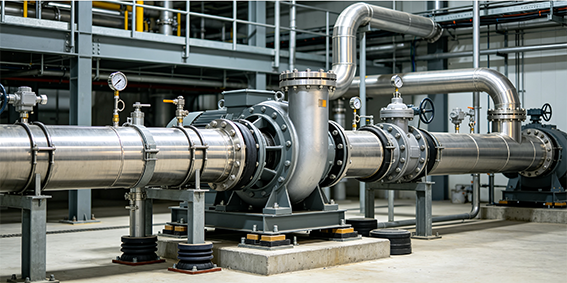
Pump-connected piping
Choosing the Liner Material: EPDM, NBR, and Beyond
The presence of a liner is only half the decision. The compound determines whether the liner survives the service environment — or becomes the weak point.
EPDM is the default for water, steam (within limits), outdoor exposure, and ozone/UV resistance. Typical continuous service ranges cited in the industry sit around −40 °C to +130 °C, but these are compound-dependent and should be confirmed against the specific product datasheet. EPDM is a poor choice near mineral oils and hydrocarbon solvents — it swells and degrades.
NBR is the oil-side material. It resists petroleum-based hydraulic fluids, lubricating oils, fuels, and greases, with typical continuous ranges around −30 °C to +100 °C. Its weakness is weathering: NBR has poor ozone and UV resistance and is not the right choice for long-term outdoor exposure without protection.
Silicone enters when temperature climbs beyond the comfortable range of EPDM or NBR. It handles higher continuous temperatures, but its mechanical strength and resistance to some chemicals are lower — it is a thermal solution, not a universal upgrade.
| Liner | Typical strength | What must be checked |
|---|---|---|
| EPDM | Weather, ozone, water, steam | Oil/hydrocarbon exposure; actual compound temperature limit |
| NBR | Oils, fuels, greases | UV/ozone exposure; upper temperature |
| Silicone | Higher continuous temperature | Mechanical loads; chemical compatibility |
One more limit worth knowing: standard rubber-lined clamps are generally not suitable above roughly 120 °C, and high-temperature lines may require all-metal or specialized configurations rather than a standard elastomer liner. If the line runs hot, the liner conversation changes entirely.
When Unlined Clamps Are the Better Choice
An article that only argues for lined clamps is a catalog page, not a selection guide. Unlined clamps are the right answer in a meaningful set of conditions:
- The pipe surface does not need protection — bare carbon steel in general industrial service, where the clamp and pipe are compatible in direct contact.
- There is no vibration or noise pathway to interrupt — static lines far from occupied areas, plant rooms where acoustic performance is not a design criterion.
- The project values simplicity and first cost — no liner to inspect, no liner to degrade, and a lower unit price.
- The engineering specification explicitly calls for direct metal support — some support standards and load paths assume metal-to-metal contact.
- The operating temperature exceeds the practical limit of elastomer liners — above roughly 120 °C, standard rubber lining is off the table anyway.
And the critical boundary: if the pipe needs to slide, expand, or move axially, neither a standard lined clamp nor an unlined clamp is the design solution. Axial movement requires a sliding support, guide, or saddle designed for that movement. A rubber liner can reduce wear caused by movement, but it does not accommodate movement. GRE piping guidance is explicit that axial expansion needs separate support design consideration — the liner is a wear interface, not a motion joint.
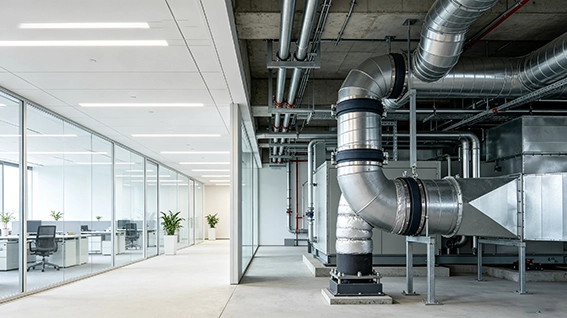
HVAC near occupied areas
What to Confirm Before You Specify
The difference between a clamp that works and one that becomes a maintenance item usually comes down to six details that are easy to overlook in a fast RFQ:
- Actual pipe outside diameter — not the nominal size. Liner thickness changes the effective clamping diameter.
- Pipe material and surface finish — plastic, coated, composite, and thin-wall pipes shift the calculation toward a liner; bare steel may not.
- Continuous operating temperature — check the liner’s compound-specific limit, not a generic “rubber” rating.
- Contact medium and environment — oil, water, steam, UV, humidity, and chemicals each point to a different compound.
- Support function — fixed, sliding, or guided. The liner does not change the support’s kinematic role.
- Load and installation — confirm the clamp’s rated load and torque; over-compressing the liner can negate its benefit.
Frequently Asked Questions
Are rubber-lined clamps always better than unlined?
No. They are better when the support point needs surface protection, vibration-path interruption, or material separation. In plain static service on compatible bare metal, an unlined clamp can be the more appropriate and economical choice.
Do rubber-lined clamps reduce vibration?
They can reduce structure-borne transmission when the liner maintains full separation between pipe and clamp. The effect depends on compound, hardness, thickness, installation quality, and the broader support design. A liner does not cancel vibration at the source.
Can lined clamps be used on plastic pipe?
Yes, and they are often the more sensible choice — but confirm clamping force, liner hardness, and the pipe manufacturer’s support requirements. An over-tightened lined clamp can still damage a plastic pipe.
EPDM or NBR?
EPDM for water, weather, and ozone exposure; NBR for oil and fuel contact. Neither is universally superior — the wrong compound in the right application is still the wrong choice.
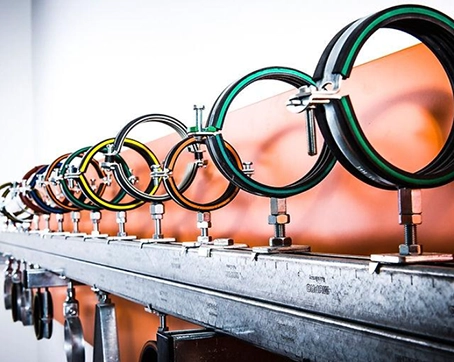
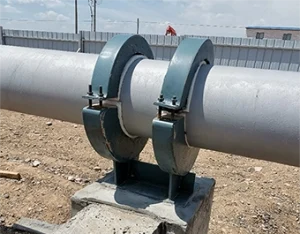
Rubber lined pipe clamps installed on an industrial piping support system
Find the Right Clamp for Your Application
The lining question is ultimately a question about what is happening at the interface: is the pipe surface at risk, is vibration traveling through the support, is the environment going to attack the elastomer? Answer those, and the lined-vs-unlined decision usually makes itself.
Share your pipe outside diameter, material, operating temperature, support function, and any vibration or movement requirements with our team. Luoyang Datang Energy Tech Co., Ltd. will help you narrow the specification to a clamp configuration that fits the actual duty — lined or unlined, with the compound that matches the environment.
Related reading:
- How Much Weight Can a Pipe Clamp Hold? → pipe clamp load capacity
- Stainless Steel vs. Carbon Steel Pipe Clamps → pipe clamp material selection
- What Is the Difference Between Rigid and Flexible Pipe Clamps? → rigid and flexible pipe clamps
- How to Choose the Right Pipe Clamp Size? → pipe clamp sizing
- Pipe Clamps, Clevis Hangers or Pipe Brackets? → different types of pipe supports
RELATED POSTS

Understanding Brass Valves: Types, Features, and Applications

Choosing the Right Control Valve for Industrial Flow Control
PVC Pipe Full Analysis: New Era of Green, Corrosion Resistance and Market Opportunity
HDPE Pipes & PVC Pipes In Injection and Streamline System
Cast vs. Forged Brass Ball Valve: The Grain Flow Difference That Separates 5-Year Failures from 25-Year Reliability