LUOYANG DATANG ENERGY TECH CO.,LTD


Why Does Your PVC Pipe Cutter Leave Uneven or Crushed Edges?
You line up the cutter, squeeze the handle, and expect a clean, square end. Instead, the PVC pipe comes away with a slanted face, a flattened mouth, or a furry lip that no fitting will sit on properly. It is a small failure with an outsized consequence: solvent cement cannot fuse two mismatched surfaces, and a crushed end grips the fitting unevenly on one side while sitting loose on the other. Crooked cuts are among the leading hidden causes of joint leaks—the connection looks fine, but it seats badly from the inside.
So the useful question is not simply “why is my cut bad?” but which part of the cutter is failing to do its job—the blade, the alignment, the capacity, or the way force is delivered. That is where the fix lives.
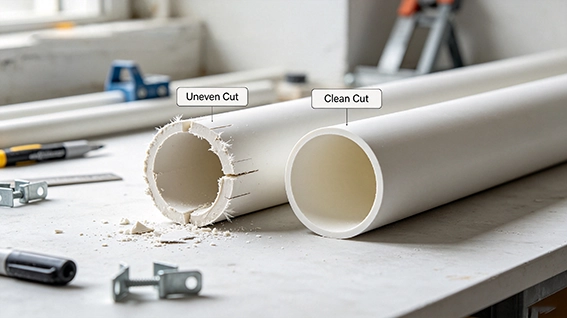
PVC pipe cutter leaving uneven and clean pipe edges
1. Why Does a PVC Pipe Cutter Leave Uneven Edges?
An uneven edge is rarely random. It usually traces back to one of three conditions inside the cutter itself.
Dull or Damaged Cutting Blades
A sharp blade slices; a dull blade tears. When the edge wears down, the blade stops shearing the PVC wall and starts dragging through it, pulling the material instead of separating it cleanly. Chipped or missing sections make it worse: the damaged portion creates uneven cutting forces that push the blade off its intended path, producing angled cuts and surface irregularities in the same stroke. If you notice the cutter suddenly requiring noticeably more hand force than it used to, the blade is the first thing to inspect—not the last.
Incorrect Blade Alignment
The cutting wheel or blade must sit perpendicular to the pipe’s axis, centered on the cut line. When it is offset to one side, the force distribution collapses: one side of the wall gets compressed before the blade has even begun to sever the other side, and the cut ovalizes or wanders. Loose mounting hardware and worn guide components are common mechanical culprits—they allow the blade to drift slightly during the squeeze, and a small drift at the start becomes a visible slant by the end.
Incorrect Pipe Positioning
A pipe that is not fully seated in the cutter’s jaw, or that moves as the blade advances, forces the blade to cut a surface that is shifting underneath it. Cutting close to the pipe end with no support makes the wall flex away from the blade at the moment of highest pressure. The result looks like a blade problem, but it is a support problem.
| Problem | Possible Cause | Result |
|---|---|---|
| Angled cut | Misaligned cutter or blade drift | Uneven pipe end |
| Rough surface | Dull or chipped blade | Irregular cutting edge |
| Partial cut | Poor pipe positioning | Incomplete separation |
| Repeated cutting marks | Worn blade or stopped-and-restarted cut | Rough finish |
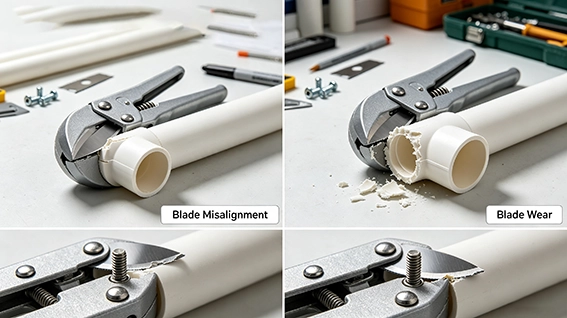
PVC pipe cutter blade alignment and wear problems
2. Why Does a PVC Pipe Cutter Crush the Pipe?
A crushed end and an uneven end are not the same failure. Uneven edges come from the blade’s path; crushing comes from force overwhelming the pipe’s ability to stay round. The distinction matters because the fix is different: sharpening or realigning a blade will not solve a pressure problem.
Excessive Cutting Pressure
PVC is rigid, but not forgiving. When you bear down in one hard squeeze—especially with a ratchet cutter—the wall can ovalize before the blade has finished severing it. Ratcheting mechanisms are designed to advance the blade in measured increments and avoid exactly this kind of over-exertion. If you find yourself rushing the ratchet or forcing the handles together, the cutter will compress the pipe before it cuts through it.
Using the Wrong Cutter Size
A cutter rated for 1-inch pipe will not behave the same way on 2-inch Schedule 40. When the tool’s maximum cutting capacity is below the pipe’s outside diameter, the blade cannot generate enough concentrated force to shear the wall; instead, the jaws compress the pipe across its whole cross-section. A cutter that works beautifully on ½-inch pipe can turn into an oval-making machine on larger stock.
Cold or Brittle PVC Pipes
Low temperature changes the equation entirely. For every 10°C drop in temperature, the impact strength of PVC pipe falls by roughly 15–20%, and below 5°C ordinary PVC-U enters a critical brittle state. Tool manufacturers draw practical lines: one warns against cutting PVC below 40°F (4°C) , another notes that PVC and CPVC can shatter when cut below 50°F (10°C) . In this condition, adding more cutting pressure does not “get through” the pipe—it cracks or shatters it.
| Condition | What Happens | What to Check |
|---|---|---|
| Excessive pressure | Pipe wall compressed into an oval | Cutting force and ratchet rhythm |
| Undersized cutter | Incomplete or uneven cut | Cutter capacity vs. pipe OD |
| Low temperature | Increased cracking/shattering risk | Pipe temperature and material state |
| Poor pipe support | Local deformation at the cut | Support position on both sides |
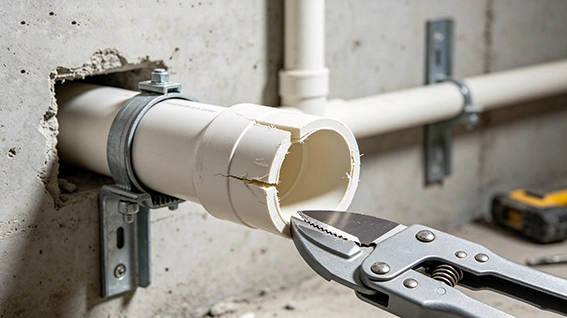
Crushed PVC pipe end caused by excessive cutting pressure
3. How to Get a Clean, Straight Cut on PVC Pipe
The sequence below follows the actual order of failure: set the pipe up before you pick up the cutter, then let the tool work in controlled increments.
Step 1: Match the cutter to the pipe.
Confirm the tool’s rated outside-diameter range covers the pipe in front of you—not the pipe you usually cut. Capacity is not a suggestion; it is the mechanical limit of the jaw and blade geometry.
Step 2: Mark the line, then score it.
A permanent marker line gives the blade a target. A light score with a blade gives it a defined edge instead of a slippery one, reducing the chance that the cutting wheel skates off-line on the first squeeze.
Step 3: Support both sides of the cut.
If the pipe hangs in midair, the wall moves away from the blade under pressure and flattens on the unsupported side. A cradle, a V-notch scrap board, or even a second pair of hands on the offcut keeps the cross-section round while the blade passes through.
Step 4: Seat the cutter square and check alignment from two sides.
Close the cutter slowly until the blade touches the pipe, then look at the cut line from left and right before applying real force. The blade should be centered on the mark, not offset toward either jaw face.
Step 5: Apply controlled pressure—ratchet in rhythm, do not rush.
With a ratchet cutter, let each click advance the blade; do not try to collapse the handles in one motion. With a manual cutter, tighten in small increments (about ⅛ turn after each rotation) and keep the tool moving around the circumference rather than pushing straight in.
Step 6: Finish the cut in one continuous pass, then inspect for roundness—not just appearance.
Stopping and restarting makes the blade tear the wall instead of shearing it, leaving a burr exactly where you picked the cut back up. Once separated, do not just eyeball the face. Check whether the opening has gone oval and whether any micro-crack runs inward from the cut edge. A face that looks flat can still be out-of-round enough to compromise cement coverage.
Step 7: Deburr and chamfer—inside and out.
A burr or ridge on the inner edge forms when the blade dulls, the pipe is not held securely, or force is applied too early. A dedicated deburring tool removes the inner ridge and outer lip in the same rotation and can add a slight chamfer so the fitting seats without scraping cement off the pipe wall. The chamfer also helps the cement push ahead of the pipe rather than bunching at the shoulder.
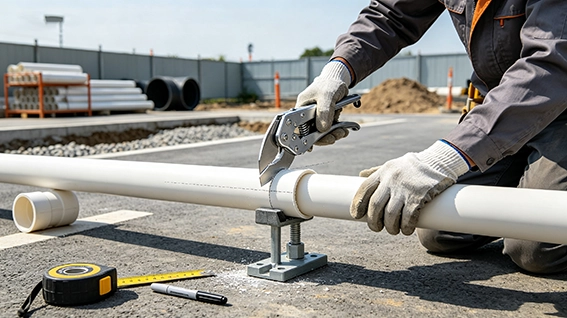
Cut PVC pipe straight with a pipe cutter
4. PVC Pipe Cutting Problems and How to Fix Them
Use this as a diagnostic table, not a checklist. The value is in matching the visible symptom to the component that is actually failing.
| Cutting Problem | Likely Cause | Recommended Solution |
|---|---|---|
| Crooked cut | Cutter misalignment or blade drift | Reposition the cutter square on the line; check guide components |
| Crushed pipe end | Excessive pressure or undersized cutter | Reduce force, use ratchet increments; verify capacity |
| Rough cutting edge | Dull, chipped, or fouled blade | Clean, sharpen, or replace the blade |
| Cracked pipe | Brittle pipe or cutting below safe temperature | Warm the pipe or postpone the cut; check material condition |
| Oval-shaped opening | Pipe deformation from poor support or over-compression | Support both sides; reduce compression |
| Incomplete cut | Insufficient cutter capacity | Use a cutter rated for the pipe OD |
These problems often arrive together. A dull blade increases cutting resistance; the operator responds by squeezing harder; the harder squeeze turns a cutting action into a compression action; and the pipe ends up both rough and oval. That is why fixing only the visible surface symptom—sanding the edge, for instance—rarely solves the underlying cutting problem. The chain starts upstream, at the blade and the force delivered through it.
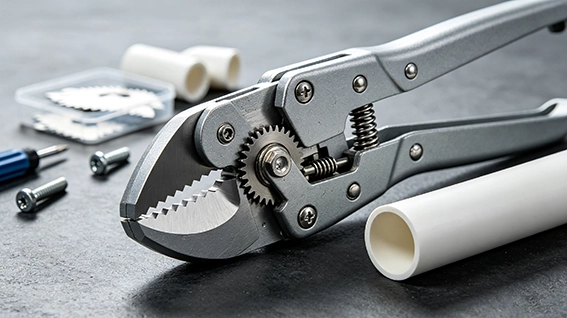
PVC pipe cutter blade and ratchet mechanism
5. When Should You Replace Your PVC Pipe Cutter?
Not every bad cut calls for a new tool. Blade replacement and tool replacement are two different decisions, and conflating them costs money without solving the problem. Replace the blade first when the symptoms point to the cutting edge. Consider the whole cutter when the mechanism that holds and advances the blade has lost its precision.
Replace the blade when:
- The cutting edge shows visible chips, cracks, or a rolled-over lip.
- Cutting requires noticeably more force than it did on the same pipe size.
- The cut face is consistently rough or torn even after cleaning the blade.
Replace the cutter when:
- The ratchet mechanism slips, skips, or fails to advance the blade through the pipe.
- The blade holder or body is loose, and the blade no longer stays perpendicular under load.
- The jaw geometry is deformed or the tool has sustained impact damage.
6. How to Choose a PVC Pipe Cutter for Better Cutting Results
The purchase decision should be driven by the failure modes above, not by the largest number on the package.
Do not choose a cutter by maximum diameter alone. A tool rated for the largest pipe you occasionally cut may be oversized and imprecise for the pipe you cut every day—and imprecision at the jaw is exactly what produces crooked, ovalized ends. Match the tool to the working range, the blade quality to the material, and the force delivery to the wall thickness.
For a broader comparison of mechanism types, see our guide to different types of pipe cutters. If you are assembling a full kit rather than replacing one tool, selecting the right pipe tools starts with matching each tool’s rated capacity to the pipe schedule you actually run.
FAQs About PVC Pipe Cutter Problems
Q1: Why does my PVC pipe cutter make an angled cut?
The blade is not staying perpendicular to the pipe axis. Either the cutter was not seated square on the mark, the blade has drifted because of loose mounting hardware or worn guides, or the pipe moved during the squeeze. Check alignment from two sides before applying force, and support the pipe so neither side can shift.
Q2: Can a PVC pipe cutter crush a pipe instead of cutting it?
Yes—when the force exceeds what the wall can resist in its round shape. A cutter rated below the pipe’s outside diameter cannot concentrate enough force at the blade tip, so the jaws compress the whole cross-section. Rushing a ratchet or forcing the handles together produces the same result even with a correctly sized tool.
Q3: How do I prevent PVC pipes from cracking during cutting?
Start by checking the pipe, not the cutter. Below 50°F (10°C) , PVC and CPVC can shatter; below 40°F (4°C) , cutting is not recommended at all with some tools. Let cold pipe acclimatize, cut slowly, and use a cutter whose capacity matches the pipe. More pressure is the wrong response to a brittle pipe.
Q4: Should I replace the blade if my PVC pipe cutter leaves rough edges?
First check three things: whether the blade is dull or chipped, whether it is seated correctly in the holder, and whether it is aligned with the cut line. A blade that is simply loose or fouled can produce the same rough edge as a worn one. If the edge is visibly damaged or the roughness persists after cleaning and realignment, replace it.
Looking for Reliable Pipe Cutting Tools?
Whether you need PVC pipe cutters for routine plumbing work or professional installation projects, choosing tools with suitable cutting capacity, durable blades, and stable construction helps improve cutting consistency. Contact Luoyang Datang Energy Tech Co., Ltd. to discuss your pipe tool requirements.