


LUOYANG CAME ENERGY TECH CO., LTD

Wat is die sleutelvereistes vir die installering van HDPE-pypstelsels?
1. Connection process requirements (core link)
One of the advantages of HDPE pyp is that they can achieve completely fused and leak-free connections, but this also imposes strict requirements on the connection process.
Before any fusion work begins, pipes should be allowed to acclimate to the sub-surface soil temperature. This helps minimize the effects of thermal expansion during the joining process and ensures more consistent fusion results.
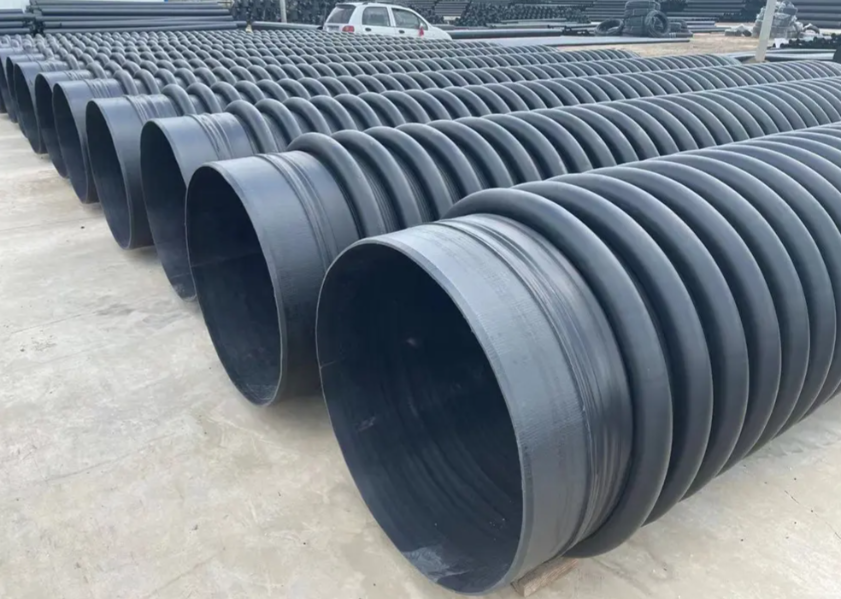
1.1 Clean pipe ends: Before connection, the dust, olie, and moisture on the connection surfaces of the pipes and fittings must be thoroughly removed using a clean cloth or special tools to ensure a clean fusion surface.
1.2 Precise cutting and trimming: The pipes must be cut perpendicularly to the axis, with a smooth and burr-free cut. Use a special scraper to remove the oxide layer (usually scrape 1-2mm), ensuring the fusion surface is fresh polyethylene material.
1.3 Correct use of hot-melt equipment:
- Hot plate temperature: The correct hot plate heating temperature must be set according to the pipe size and ambient temperature (usually 210±10℃ for PE100 material).
- Heating time and pressure: Strictly follow the standards (soos ISO 21307 or ASTM F2620) for heating time, heating pressure, and cooling hold time. Insufficient time leads to insufficient fusion, while excessive time may degrade the material.
- A quick note on standards: ASTM F2620 (widely used in the US) specifies a single higher interfacial pressure method (60–90 psi), while ISO 21307 (international standard) defines three methods — single low pressure, dual low pressure, and single high pressure — with the dual low pressure method recommended for thick-wall pipes. Choosing the right standard for your project and equipment is essential.
- Butt joint process: After heating, quickly remove the hot plate and join the two pipe ends at the specified pressure within the prescribed time to form a uniform “flare” (curl).
1.4 Electrofusion connection precautions: For electrofusion fittings, ensure the correct insertion depth of the pipe, a tight fit between the fitting and the pipe outer wall, and that the welding parameters (voltage, time) match the fitting.
1.5 Full cooling: After fusion, the pipe must be held under pressure and cooled without external force for the specified time (gewoonlik 1-2 times the welding time). Do not cool with water or move the pipe, as this may cause the joint to crack.
2. Trench and foundation requirements

2.1 Trench excavation: The bottom of the trench should be flat, free of sharp stones, tree roots, and other hard objects to prevent uneven force on the pipe after backfilling.
For projects requiring non‑destructive installation, mini‑horizontal directional drilling (mini‑HDD) is becoming an increasingly popular alternative. This method allows HDPE pipes to be placed underground with minimal surface disruption, making it ideal for urban environments, river crossings, and environmentally sensitive areas.
2.2 Foundation treatment: According to soil conditions, lay an appropriate base layer (such as fine sand, fine soil, or crushed stone layer), typically 100-150mm thick, to provide uniform support for the pipe.
2.3 Trench width: It should be wide enough to allow operators to perform connection work, gewoonlik 1.5-2 times the pipe diameter. Some industry guidelines recommend a minimum trench width of 450mm greater than the outside diameter of the pipe to ensure adequate space for proper compaction around the pipe.
3. Pipe laying requirements
3.1 Avoid excessive bending: Although HDPE pipes are flexible, the bending radius must not be less than the minimum allowable bending radius (gewoonlik 20-30 times the pipe diameter) to prevent pipe wall wrinkling or damage.
3.2 Prevent scratches and impacts: Handle and lay the pipes gently, use non-metallic lifting tools, and avoid friction or collision with hard objects.
3.3 Temperature influence: HDPE has a high coefficient of thermal expansion. For long straight pipe sections, consider the expansion and contraction caused by temperature changes. If necessary, set up flexible connections or bends to absorb displacement.
The coefficient of thermal expansion for HDPE is approximately 1.2 × 10⁻⁴ ft/ft/°F (of 9.0 × 10⁻⁵ in/in/°F for some PE grades). For buried pipes, it is recommended to install with excess length between anchor points to accommodate contraction caused by temperature drops. For above‑ground installations, additional design considerations — such as UV protection and mechanical restraint — are required to manage thermal movement.
3.4 Burial depth requirements: Comply with local regulations, typically buried below the frost line with sufficient cover thickness (generally ≥0.8m) to protect the pipe.
More specifically:
- Under roadways: minimum cover depth of 0.9m (ongeveer. 3 ft)
- Under green belts or residential branch lines: minimum 0.6m
- In permafrost or seasonally frozen ground: pipe top must be buried below the frost line
For projects under AASHTO H20 loading conditions, a cover depth of3 ft (0.9m) is generally considered sufficient without additional calculation.
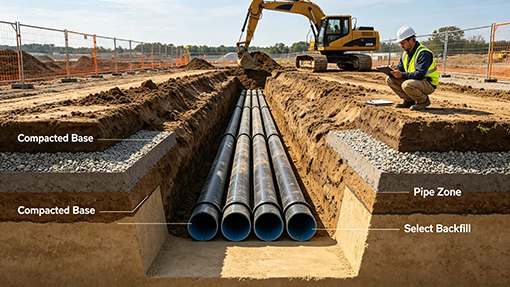
HDPE pipe trenching laying and backfilling
4. Backfilling requirements
4.1 Layered backfilling: Within 300mm from the bottom to the top of the pipe, use fine soil or sand for manual layered backfilling and compaction. Each layer should not exceed 200mm in thickness. Mechanical direct compaction above the pipe is strictly prohibited. For more precise control, many specifications require backfill layers not exceeding 6 duim (150mm) in compacted depth.
4.2 Backfill material: Must not contain stones larger than 25mm in diameter, frozen soil blocks, or construction waste. According to ASTM D2321, acceptable backfill materials should be free of stones or rock fragments larger than 37.5mm in any direction. Native soil meeting Class I, II, or III classifications is generally acceptable. Pea gravel or small chips (passing a 3/8″ sieve) are also suitable options.
4.3 Symmetrical backfilling: Backfill on both sides should be carried out simultaneously to ensure uniform force on the pipe and prevent displacement.
5. Pressure testing and quality inspection
5.1 Visual inspection: Check that the flares of all fusion joints are uniform, symmetrical, and smooth, without holes, collapses, or misalignment.
5.2 Flare removal inspection: For critical projects or sampling inspections, remove part of the flares as required by the standard to inspect the internal fusion condition.
5.3 Druktoetsing: After system installation, a water pressure test (gewoonlik 1.5 keer die werksdruk, with a stabilization time of no less than 1 hour) must be conducted to ensure no leakage. Gas pressure testing is strictly prohibited to prevent explosion risks.
For field hydrostatic testing, ASTM F2164 provides the standard procedure. Key steps include:
- Isolate the test section from the rest of the system
- Fill the section slowly with water and purge all air from high points
- Allow at least 24 hours for the pipe to saturate before pressurization
- Allow welded joints to cool for at least 1 hour before testing
- Once stabilized, reduce pressure by 10 psi and monitor for 1 hour
The successful installation of HDPE pipe systems hinges on strictly adhering to standards, using qualified equipment, and training professional personnel. Any oversight, particularly during the fusion and backfilling processes, can lead to system leakage, deformation, or premature failure. Therefore, selecting an experienced construction team and implementing full-process quality control are fundamental guarantees for ensuring the long-term safe operation of HDPE water supply pipelines.
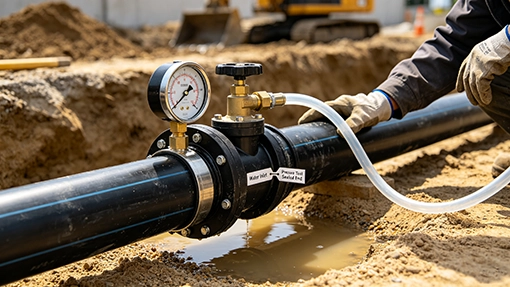
HDPE pipe hydrostatic pressure testing ASTM F2164
Verskaffer
Luoyang Datang Energy Tech Co.Ltd is 'n toonaangewende Chinese vervaardiger wat spesialiseer in hoë-gehalte plastiek pype en toebehore. Toegerus met state-of-the-art outomatiese produksie lyne en ondersteun deur 'n span van 200 professionele persone, ons bied 'n uitgebreide produkreeks wat uit oor 150 types of plastic pipes and fittings designed for water supply and drainage systems, gas transmissie, en vloerverwarmingstelsels. Ons vernaamste produkte sluit in PVC-pype en -toebehore, PE (HDPE) Pype en toebehore, PPR pype en toebehore, en PEX vloerverwarmingpype.
Indien u enige navrae het rakende PPR pype,Koper kleppe en koper toebehore, moet asseblief nie huiwer om ons te kontak nie!
Tel.:0086-183 3790 0677
Wechat: 0086-183 3790 0677
Whatsapp: 0086-183 3790 0677
VERWANTE plasings
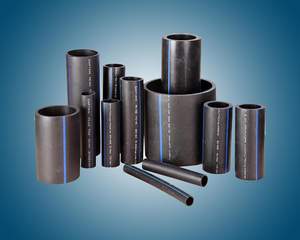
Hoë-digtheid poliëtileen watertoevoerpyp vir drupbesproeiingstelsel
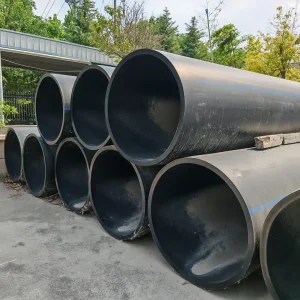
HDPE pyp: 'n Multi-funksionele plastiekpyp

Drupbesproeiing vs. Sprinkelbesproeiing: Watter pypstelsel werk die beste?
Pex-pyp en vloerverhittingstelsel perfekte ontmoeting.”1+1>2″
