LUOYANG DATANG ENERGY TECH CO.,LTD


PVC Pipe Cutter vs. Hacksaw: Cut Quality, Speed and When to Use Each
A PVC pipe cut is never just a cut. It is the foundation of a solvent-weld joint that either holds for decades or weeps within a season. Two tools dominate the conversation on job sites and in procurement meetings — the dedicated PVC Pipe Cutter and the ordinary Hacksaw — and the question is rarely “which one is better.” The useful question is: which one produces the cut your job actually requires, on the pipe diameter you actually have, with the post-cut work you are actually prepared to do?
The two tools remove material in fundamentally different ways. A PVC Pipe Cutter — whether ratchet-style or scissor-style — drives a blade through the pipe wall, compressing and shearing the plastic as it goes. A Hacksaw does something else entirely: it cuts a kerf, removing a thin channel of material with each reciprocating stroke. That distinction sounds academic until you look at the pipe end twenty seconds later. Shear cutting tends to produce a smoother face but carries a risk of deformation; sawing tends to leave the wall round but leaves burrs and depends almost entirely on the operator’s hand to stay square.
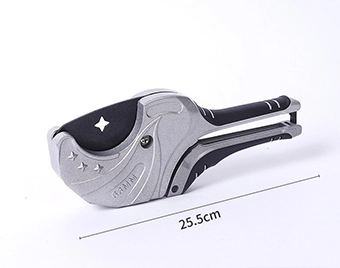
a PVC Pipe Cutter
Side by side: the differences that change the job
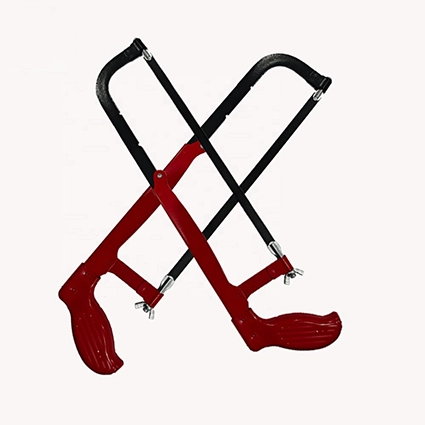
Hacksaw
Which tool actually leaves a better cut?
On small and medium PVC — typically under 1¼ inches for a ratchet cutter, and up to about 2 inches for a scissor-style cutter — the PVC Pipe Cutter usually wins on both smoothness and speed. A sharp ratchet cutter produces a face that needs minimal deburring, which matters because every minute spent filing a pipe end is a minute not spent assembling the joint. The cut is also easier to keep square because the tool body references the pipe’s outside diameter rather than relying on the user’s wrist.
But “cleaner cut” is not the same as “undamaged pipe.” A PVC Pipe Cutter works by compression, and compression has a failure mode. Force a dull blade, or over-squeeze a thick-wall Schedule 80 pipe, and the wall can crush or ovalize before the blade completes the pass. The cut face may look tidy in the moment, but the pipe end is no longer round enough to seat evenly in a fitting socket.
A Hacksaw, by contrast, does not compress the pipe into shape. With a 18–24 TPI blade — the range generally recommended for PVC — and the pipe secured in a vise, it can leave the wall round and the cut face reasonably flat. The catch is squareness. Trade guidance is blunt on this point: a hacksaw is “the toughest saw to keep cutting square”. A cut that runs even a few degrees off 90° lets one side of the pipe bottom out in the socket while the other leaves a gap, and the cement floods that gap unevenly. The joint passes a visual check and fails under pressure.
The honest comparison, then, is this: the PVC Pipe Cutter tends to win the surface finish contest; the Hacksaw tends to preserve wall geometry better. But neither result is guaranteed by the tool alone. Blade sharpness, pipe support, and operator technique decide whether either tool delivers a cut worth cementing.
Which tool is faster — and where does “faster” actually come from?
Within its rated capacity, a PVC Pipe Cutter is faster in the situations that dominate real installation work: repetitive cuts on small-to-medium pipe, and cuts in confined spaces where a full hacksaw stroke is impossible. A ratchet mechanism converts a short handle squeeze into a partial blade advance, so the user does not need a long sawing arc to make progress.
The Hacksaw’s speed story is different. On a single cut in a large-diameter pipe, or where no cutter is available, a hacksaw may be the only practical option — but “practical” is not the same as “fast.” Each stroke removes a kerf’s worth of material, and progress scales with stroke length, blade sharpness, and the operator’s stamina. In a day of repetitive cutting, that stamina becomes a variable the cutter does not have.
But cutting speed is not just the seconds the blade spends in the plastic. It is cut time + setup time + finishing time. A cutter that leaves a near-burr-free edge can save post-cut filing. A hacksaw that keeps the wall round but leaves a burr ridge adds a deburring step. A cut that is fast but not square adds a rework step that neither tool advertises. The fastest tool is the one whose total workflow — cut, check, finish — is shortest for the pipe in front of you.
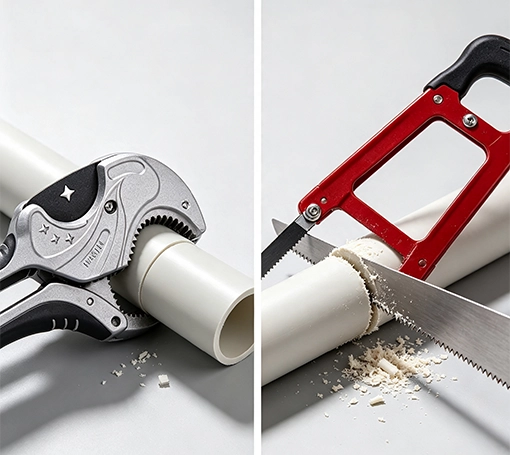
PVC pipe cutter vs hacksaw
When the PVC Pipe Cutter is the right call
- The pipe is within the tool’s rated capacity. This is non-negotiable. A cutter rated to 1⅝ inches will not become a 2-inch cutter through force; it will crush the pipe trying.
- You are making multiple cuts of the same size. Repetition is where the cutter’s consistency and low physical effort compound into real time savings.
- The joint is going to be solvent-welded and you want minimal post-cut work. A near-burr-free face from a sharp cutter reduces the deburring step, and a square reference from the tool body reduces the risk of an off-angle seat.
- The working space is tight. Ratchet and scissor cutters need handle swing, but far less than a hacksaw needs in stroke length.
For a structured look at the cutter family itself — ratchet, scissor, wheel, and where each fits — see our guide to different types of PVC pipe cutters.
When the Hacksaw earns its place
- The pipe exceeds any cutter you have. Capacity limits are real. When the diameter is beyond the largest cutter on the truck, a hacksaw with a 24 TPI bi-metal blade becomes the practical instrument.
- The cut volume does not justify a dedicated tool. For a single repair or a handful of cuts, the hacksaw’s versatility across materials and sizes can outweigh its slower per-cut speed.
- You are already carrying a saw for other materials. A hacksaw that cuts metal conduit and threaded rod can also cut PVC with the right blade.
For the specific challenges of cutting beyond a cutter’s range, see cutting large-diameter PVC pipes.
The step most comparisons skip: what happens after the blade stops
Neither tool delivers a joint-ready pipe end on its own. Deburring and chamfering are not optional refinements; they are part of the cut. Quality checkpoints for plastic piping put the acceptance criteria plainly: cut 90° to the pipe axis, no burrs exceeding 1 mm, chamfer 1–2 mm on both surfaces.
An internal burr ridge restricts flow and collects debris. An external burr prevents the pipe from seating fully and can scrape cement out of the socket during insertion. A slight external chamfer — commonly around 15°, roughly 2 mm — lets the pipe slide home and helps the cement distribute evenly. Whether the pipe was sheared by a cutter or sawed by a hacksaw, this step belongs to the job, not to the tool choice.
If your cuts are coming out crushed or uneven regardless of the tool, the problem may be technique or blade condition rather than the tool category itself. Our breakdown of uneven or crushed PVC pipe cuts covers the specific failure modes and their causes.
So — PVC Pipe Cutter or Hacksaw?
| Your situation | The tool that fits |
|---|---|
| Repeated cuts, pipe under ~1¼″ | PVC Pipe Cutter (ratchet) |
| Cuts up to ~2″, solvent-weld joint | PVC Pipe Cutter (scissor), sharp blade |
| Pipe exceeds your largest cutter’s capacity | Hacksaw with 18–24 TPI blade |
| One or two cuts, no cutter on hand | Hacksaw, pipe secured in a vise |
| Tight space, short handle swing only | PVC Pipe Cutter, if within capacity |
| Mixed pipe sizes, limited tool budget | Hacksaw, fine-tooth blade, miter guide |
Neither tool is universally correct. A PVC Pipe Cutter is not “more professional” when it is being forced past its capacity, and a Hacksaw is not “low quality” when it is cutting a diameter no hand cutter can reach. The decision turns on three variables: diameter versus rated capacity, cut volume, and the post-cut workflow you are actually set up to execute. Get those three aligned, and the tool choice stops being a debate and becomes a consequence.
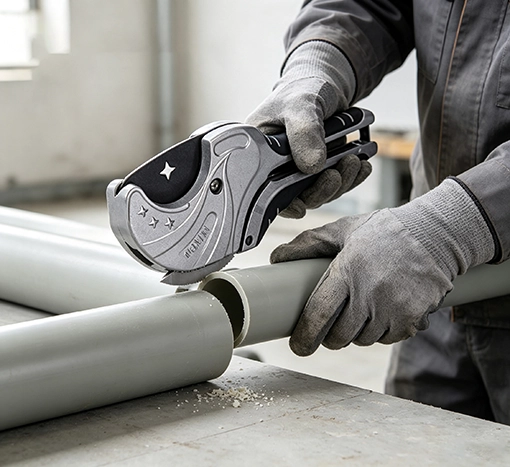
PVC Pipe Cutter in use
FAQ
Does a PVC pipe cutter make a cleaner cut than a hacksaw?
Within its rated capacity, a sharp PVC Pipe Cutter typically produces a smoother, more consistent face with minimal deburring, especially on thin-wall pipe. But “cleaner” at the surface does not rule out compression damage; an over-squeezed cutter can ovalize the wall while leaving a tidy-looking edge.
Can you cut PVC pipe with a hacksaw?
Yes. Use a 18–24 TPI blade suited to plastic or general-purpose metal cutting, secure the pipe firmly so it does not vibrate, and mark the cut line around the full circumference. Cut with slow, controlled strokes and check squareness as you go. Deburr and chamfer afterward.
Which tool is better for large PVC pipe?
If the diameter exceeds the maximum capacity of your PVC Pipe Cutter, a hacksaw — or another saw suited to large plastic pipe — becomes the practical choice. Confirm the cutter’s rated maximum before assuming a hand cutter can handle the job.
How do you keep a PVC pipe cutter from crushing the pipe?
Use a cutter rated for the pipe diameter and wall thickness, keep the blade sharp, apply steady pressure rather than a sudden squeeze, and advance the ratchet in controlled increments. A dull blade and an undersized cutter are the two most common causes of crushing.
Do you have to deburr PVC pipe after cutting?
Yes — internal and external burrs should both be addressed. Internal burrs restrict flow and trap debris; external burrs interfere with socket seating and can scrape cement during assembly. A light external chamfer (commonly around 2 mm at roughly 15°) helps the pipe enter the fitting and supports even cement distribution.
Need the right PVC pipe cutting tool for the work?
The right choice starts with your pipe schedule, diameter range, and whether the job is a one-off repair or a production installation. If you are sourcing PVC pipe cutters or other pipe cutting tools for a project, talk to us about the diameters you are cutting, the joint method you are using, and the volume of cuts involved — Luoyang Datang Energy Tech Co., Ltd. can help match the tool to the work.
RELATED POSTS
What Size Water Supply Pipe To The Second Floor
Brass Fittings in 2026: Material Innovation, Lead-Free Trends, and Global Market Opportunities

What Type Of Pipe Is Used For Potable Water Underground Supply
High-Performance Materials Substitution Trends in the Pipe Industry
How Long Water Supply Pipe Stick Out From The Wall