LUOYANG DATANG ENERGY TECH CO.,LTD

What are the differences between PE pipes and HDPE pipes?
The difference between HDPE pipes and PE pipes is a question that is often asked. It seems simple, but few people explain it clearly. Here we will systematically introduce it to you.
PE pipes are Polyethylene plastic pipes. As the most basic type of plastic, PE has excellent resistance to most household and industrial chemicals. Common plastic bags, cling film, etc. are all made of PE.
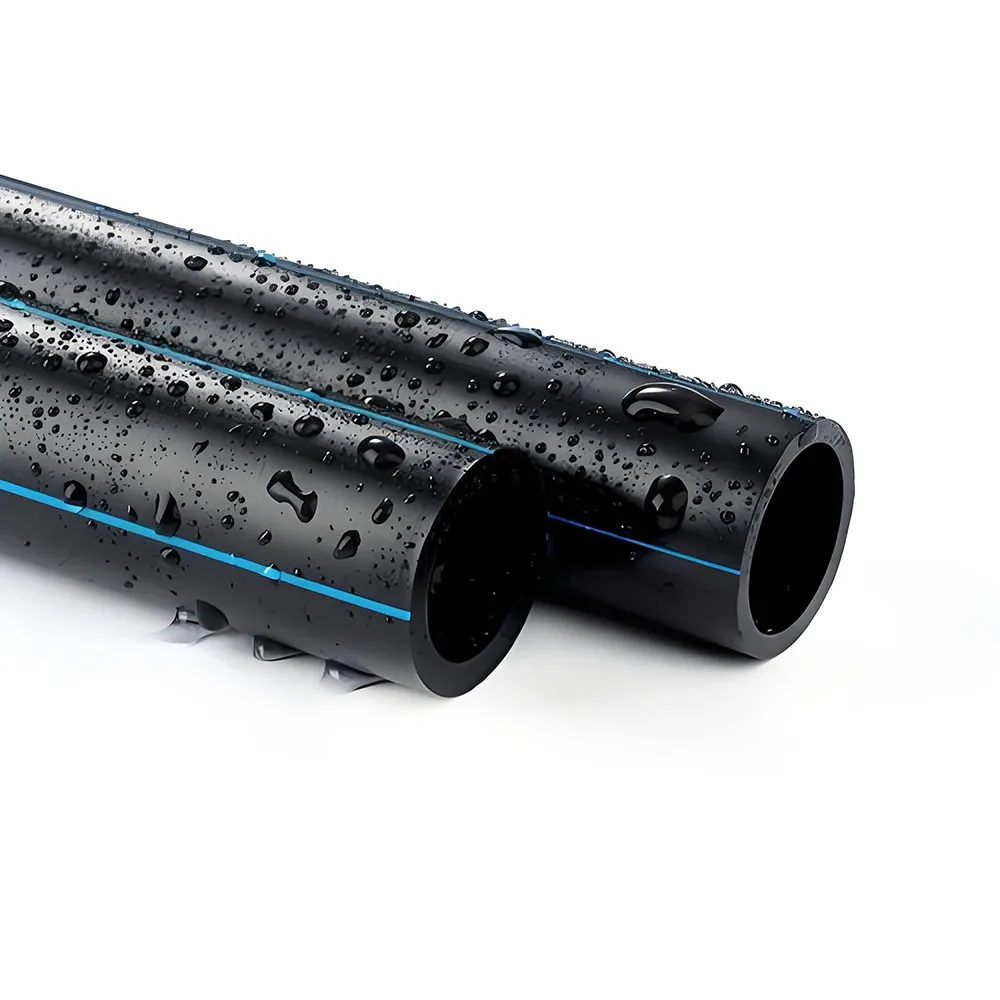
PE pipes as a whole can be classified into three types: low-density polyethylene pipes (LDPE pipes), medium-density polyethylene pipes (MDPE pipes), and high-density polyethylene pipes (HDPE pipes).
PE Pipe Family at a Glance
| Type | Density (g/cm³) | Crystallinity | Key Characteristics | Common Applications |
|---|---|---|---|---|
| LDPE | 0.910–0.925 | 55%–65% | Soft, flexible, low melting point | Films, packaging, cling wrap |
| MDPE | 0.926–0.940 | 70%–80% | Balanced flexibility and strength | Gas pipes, pressure pipes, packaging |
| HDPE | 0.941–0.965 | 80%–95% | High rigidity, strength, chemical resistance | Water supply, gas transmission, industrial piping |
1. Low density polyethylene (abbreviated as LDPE)
Low-density polyethylene is generally produced by high-pressure polymerization with a density of 0.9910 -0.925g/cm ³. The molecular structure of low-density polyethylene is a linear macromolecule with many side chains. The side chains of different lengths on the main chain affect the regularity of the macromolecule arrangement, and the stacking is not tight, which hinders the crystallization of polyethylene. Therefore, the crystallinity is 55% -65%. Low-density polyethylene has a low melting point and a soft texture. The long side chains give it low viscosity at high shear rates during processing and high melt strength during stretching, making it very suitable for the blown film process and mainly used in the production of agricultural films, heavy packaging films, etc.
2. Medium-density polyethylene (MDPE for short)
Medium-density polyethylene (MDPE) is controlled in density by A-olefin copolymerization at medium and low pressures using an efficient catalyst
(0.926-0.940q/cm3), with a crystallinity of 70%-80%. Due to its numerous and long side chains, density and crystallinity decrease, medium-density polyethylene has better flexibility and low-temperature properties, and its tensile strength, hardness, thermal properties, etc. are inferior to those of high-density polyethylene. Due to the fact that copolyolefin can increase the intergranular linking chains of the crystal sheets of medium-density polyethylene, its resistance to slow cracking and long-term retention of mechanical strength are greatly improved compared to LDPE. Medium-density polyethylene can be used in the production of pressure pipes, delivery pipes, various containers and packaging films.
3. High-density Polyethylene (HDPE for short)
High-density polyethylene (HDPE) is produced by a low-pressure polymerization process, is linear, has a density of 0.94-0.965q/cm ³, has a crystallinity of 80%-95%, and is a white powder or granule. Compared with low-density polyethylene, it has fewer other sub-chains, a nearly linear structure, regular and close-packed molecules, and thus has high crystallinity, high density, relative molecular mass ranging from hundreds of thousands to hundreds of thousands, and a narrow range of melt flow rates. High density polyethylene has high rigidity and toughness, good mechanical strength and heat resistance, as well as good resistance to deep agents and steam penetration. High-density polyethylene has the lowest permeability among all types of polyethylene, the strongest corrosion resistance, and good rigidity, and is mainly used in the production of various pressure pipes, injection molded products, etc.
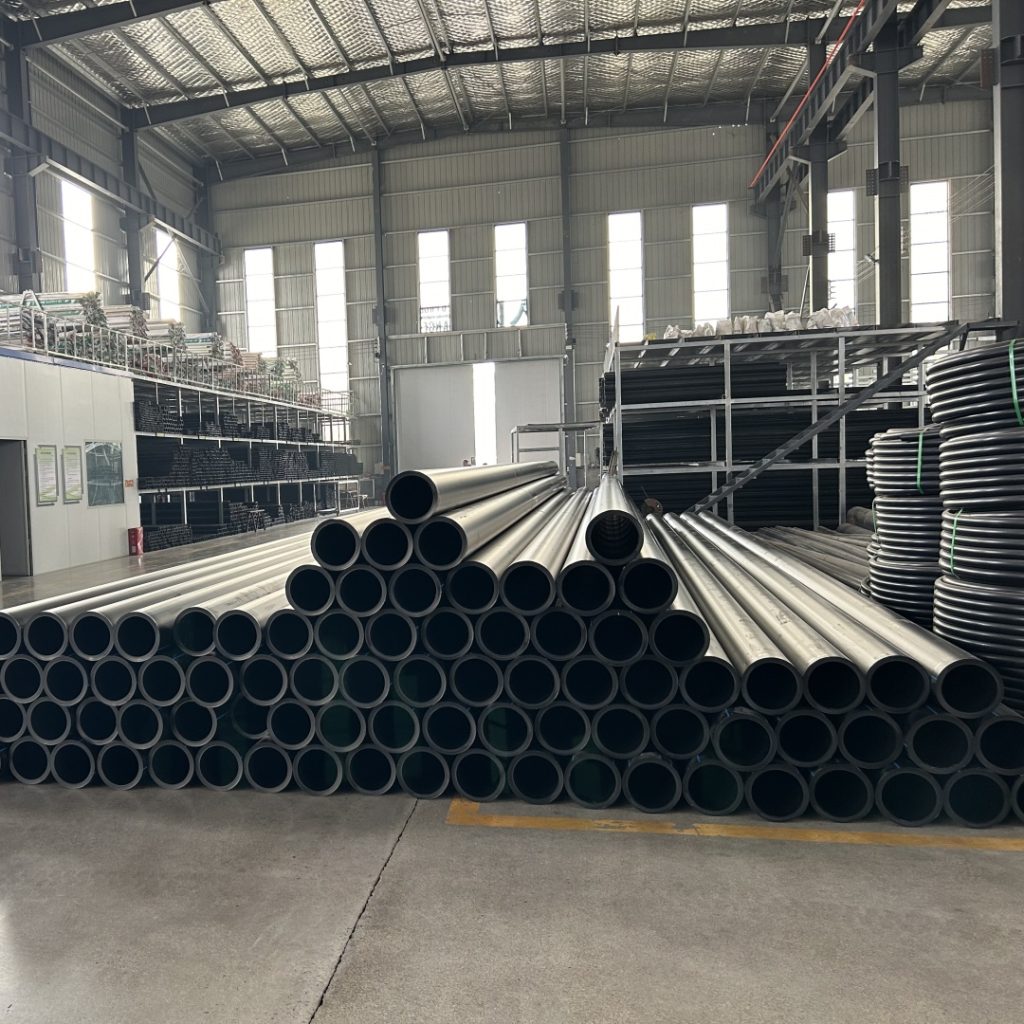
HDPE pipe is a type of PE pipe, but the performance of HDPE pipe is superior to that of ordinary PE pipe, which we can summarize as follows:
PE Pipe vs HDPE Pipe: Quick Comparison
| Factor | General PE Pipe | HDPE Pipe |
|---|---|---|
| Pressure Resistance | Lower | Higher (up to 9x stronger) |
| Abrasion Resistance | Moderate | Best among engineering plastics |
| Primary Applications | Gas transport, flexible tubing | Water supply, gas, industrial, buried systems |
| Connection Method | Mechanical fittings, quick-connect | Heat fusion (butt fusion, electrofusion) |
| Initial Cost | Lower | Higher |
| Long-term Value | Shorter lifespan, higher maintenance | Longer lifespan, lower lifecycle cost |
1, Different pressure resistance:
- HDPE pipes must be able to withstand certain pressures, and usually a high molecular weight and good mechanical properties PE resin is chosen, such as HDPE resin, which is nine times stronger than ordinary polyethylene pipes (PE pipes);
2, the wear resistance is different
- Among all engineering plastics, HDPE has the best abrasion resistance. The higher the molecular weight, the more wear-resistant the material is, even more than many metal materials (such as carbon steel, stainless steel, bronze, etc.) the abrasion resistance of common PE is only one-tenth of that of HDPE;
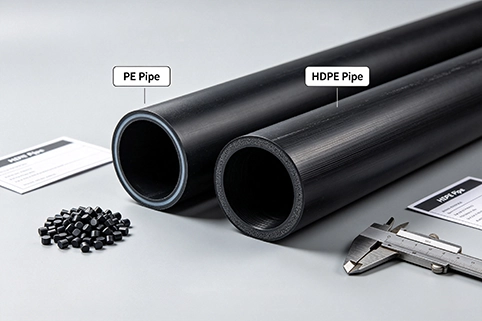
PE Pipe vs HDPE Pipe
- General PE pipes (medium-density polyethylene pipes) are suitable for transporting gaseous artificial gas, natural gas, liquefied petroleum gas, while low-density polyethylene pipes are flexible tubes;
- HDPE pipes (high-density polyethylene pipes) are mainly used for transporting natural gas, municipal engineering water supply systems, indoor water supply systems of buildings, outdoor buried water supply systems and buried water supply systems in residential areas and factories, old pipeline repair, water treatment engineering pipeline systems, and industrial water pipes in gardens, irrigation and other fields.
- HDPE pipes can be used as a replacement for traditional steel pipes and polyvinyl chloride drinking water pipes, which ordinary PE pipes cannot.
4,Different connection methods:
- General PE pipes, especially LDPE and MDPE, are often connected using mechanical fittings or quick-connect joints, which are convenient for flexible tubing and low-pressure applications.
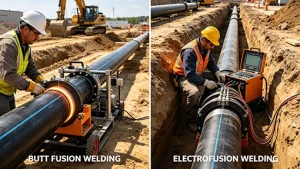
- HDPE pipes, on the other hand, are widely recognized for their compatibility with heat fusion technology. Butt fusion and electrofusion create a seamless joint that is as strong as the pipe itself, ensuring a completely leak-proof system for high-pressure water and gas transmission.
5,Cost and economic value:
While general PE materials are generally cheaper and widely used in packaging and low-stress environments, HDPE pipes offer a higher initial investment but deliver exceptional long-term value.,
Due to their superior durability, lower maintenance needs, and extended lifespan, HDPE pipes significantly reduce replacement and operational costs over decades of use, making them highly cost-effective for major infrastructure projects.
How to Choose Between PE and HDPE Pipes
The choice isn’t about which pipe is “better”—it’s about which one fits your application.
- Choose general PE pipes (LDPE or MDPE) if: you’re working with low-pressure gas transport, need flexible tubing, or have budget constraints on short-term projects.
- Choose HDPE pipes if: you need high-pressure water or gas transmission, require leak-proof fusion joints, demand long-term durability with minimal maintenance, or are building infrastructure meant to last decades.
For most municipal, industrial, and buried applications, HDPE is the clear winner. For temporary or low-stress uses, general PE pipes offer a cost-effective solution.
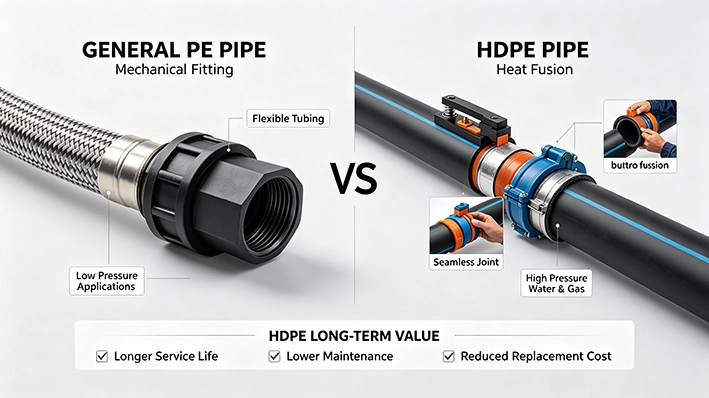
PE pipe and HDPE pipe connection methods comparison including mechanical fittings and heat fusion technology
Frequently Asked Questions
Q1: Is HDPE pipe the same as PE pipe?
A: No. HDPE is a specific type of PE pipe. All HDPE pipes are PE pipes, but not all PE pipes are HDPE.
Q2: Which is stronger, PE or HDPE?
A: HDPE is significantly stronger. Its higher density and crystallinity give it superior pressure resistance, abrasion resistance, and mechanical strength.
Q3: Can PE pipes be used for drinking water?
A: General PE pipes may not meet drinking water standards. HDPE pipes are widely certified for potable water systems.
Q4: What is the main difference in installation?
A: General PE pipes typically use mechanical fittings. HDPE pipes use heat fusion (butt fusion or electrofusion), which creates joints as strong as the pipe itself.
Supplier
Luoyang Datang Energy Tech Co., Ltd. is a leading Chinese manufacturer specializing in high-quality plastic pipes and fittings. Equipped with state-of-the-art automated production lines and supported by a team of 200 professionals, we offer an extensive product line comprising over 150 types of plastic pipes and fittings designed for water supply and drainage systems, gas transmission, and floor heating systems. Our main products include PVC Pipes and Fittings, PE (HDPE) Pipes and Fittings, PPR Pipes and Fittings, and PEX Floor Heating Pipes.
Should you have any inquiries regarding PVC Pipe & PE Pipe in Agricultural Irrigation, please do not hesitate to contact us!
- Tel.:0086-183 3790 0677
- Wechat: 0086-183 3790 0677
- Whatsapp: 0086-183 3790 0677
- Email: sales@pipesandfittings.net
RELATED POSTS
How To Size Pipe For Gravity Water Supply Of Livestock
Corrosion Resistant PPR Pipe in Chemical Pipeline System
Why HDPE pipes are the best choice?

PPR Pipes & Fittings:The Top Choice For Home Decoration
Agricultural Irrigation Pipes: HDPE, PVC, or PPR – Which is the Best Choice for Your Farm?