LUOYANG DATANG ENERGY TECH CO.,LTD


Cold Welds Pass the Tightness Test. That’s Why They Leak Six Months Later.
One line before we start:
The tightness test asks “does it leak now?” It does not ask “is the interface fused?”
A joint can pass the first and fail the second.
1. Friday Afternoon, Six Months Later
A gas line passes its tightness test on a Friday afternoon. The gauge holds. The contractor signs off.
Six months later, a crew is digging up the same stretch because a joint that “tested fine” is leaking.
This is not a rare edge case. It’s a structural blind spot in how PE gas systems are tested and accepted.
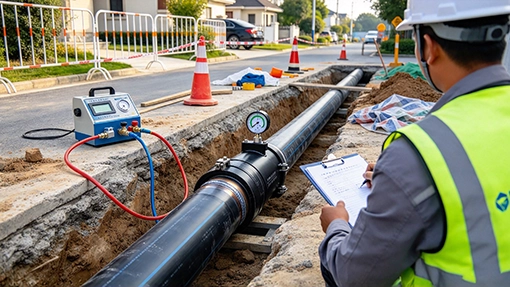
PE gas line with an electrofusion coupling and a stable pressure gauge during a tightness test in a trench.
2. A Cold Weld Is Not “No Weld”—It’s “Just Enough Weld to Hold”
Electrofusion runs current through a resistance wire embedded in the fitting. The wire heats the pipe–fitting interface until a melt pool forms. Current cuts off. The melt re-solidifies.
In a sound joint, PE molecular chains diffuse across the interface and entangle on both sides. That entanglement gives the joint its long-term strength.
A cold weld is what happens when heat input is insufficient. The melt pool never gets deep enough. The interface doesn’t fully close. The two surfaces are in contact—but not fused into one material.
The key sentence:
A cold weld can still be gas-tight at the moment of testing.
3. What the Test Sees—and What It Doesn’t
A short-term tightness test checks one thing:
leakage at test pressure, at test temperature, for test duration.
It does not measure interfacial entanglement, heat-affected zone depth, or resistance to slow crack growth.
Visual inspection only sees the outside. A short-term pressure test, even when it holds, does not assure long-term performance.
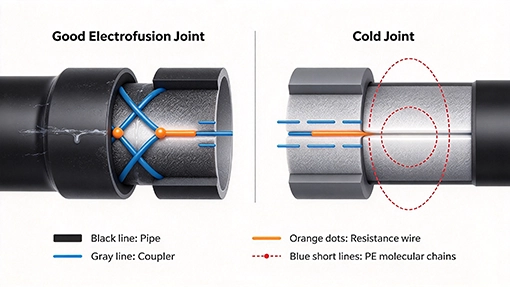
Schematic comparing a fully fused PE electrofusion joint with a cold weld showing an unfused interface.
4. Cold Weld vs. Over-Weld: Both Pass the Test, But the Signals Differ
Over-welds are the other side of the same coin: too much heat causes chain scission, degradation, and abnormal recrystallisation. They also pass a short-term test—and also degrade long-term performance.
| Defect | Heat input | Interface | Tightness test | Long-term outcome | UT echo origin |
|---|---|---|---|---|---|
| Cold weld / lack of fusion | Too low | Not closed; chains didn’t diffuse | Can pass | Brittle fracture at interface; slow crack growth | Sleeve inside surface |
| Over-weld | Too high | Wire displacement; material degradation | Can pass | Low brittle-peel %, but microstructure degraded | Pipe inside surface |
| Voids / porosity | Normal or off | Local volumetric defect | May pass | Stress concentration; crack initiation | Volumetric signal |
| Short stab | Normal | Effective fusion area too small | Can pass | Reduced load area; early failure | Interface position shift |
| Contamination / inclusions | Normal or low | Interface interrupted by particles | May pass | Local lack of fusion; slow growth | Discrete reflections |
A verifiable detail: cold-weld echoes originate from the sleeve inside surface; over-weld echoes originate from the pipe inside surface, because the resistance wires have been displaced. In tensile peel testing, over-welds show a surprisingly low brittle-peel percentage—in one study, a maximum of only 11.71%—because the failure path shifts into the pipe material rather than the weld line.
5. The Cooling Phase: Where a Marginal Weld Becomes a Failed One
Cold weld is usually discussed as a heating problem. But cooling is equally unforgiving.
After current cuts off, the melt must re-solidify under restraint. The cooling phase starts immediately and continues beyond visual solidification. Any movement or external stress in this window can compromise the joint.
Pipe on both sides of an electrofusion coupling must be restrained and supported during fusion and cooling. For saddle fittings: do not attach anything to the outlet before fusion; install appurtenances only after cooling time has elapsed.
The field failure is mundane: welder beeps → operator moves the pipe → interface still cooling → stress field introduced. The joint may still pass that afternoon. The margin for year five is gone.
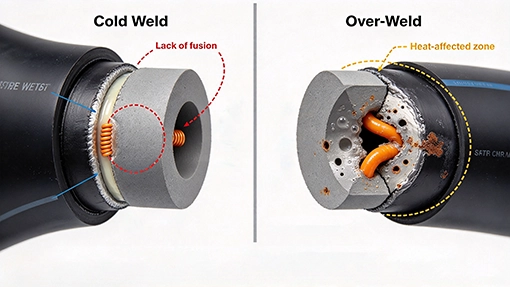
Cold Weld vs. Over-Weld
6. Questionable Joints: Cut Them Out, Don’t Test Them into Service
Industry guidance is blunt: if a fitting fails during fusion, or is questionable after installation but before service, it does not count as a joint failure—cut it out without penalty.
Why? Because the tightness test cannot distinguish a sound joint from a cold weld. A joint that looks wrong, sounds wrong, or was made under suspect conditions should not be “tested and accepted.” It should be removed.
The economics are simple. Field data on leak repair puts average cost per leak at roughly $500—before service disruption and emergency response. One coupling vs. excavating a live main six months later. Not the same order of magnitude.
7. What Actually Catches Cold Welds: Volumetric NDE, Not Pressure
If the tightness test can’t do it, what can?
Volumetric NDE that interrogates the fusion interface directly.
Phased array ultrasonic testing (PAUT) is the most established field-deployable option. It has been validated for lack of fusion, cold fusion, particulate contamination, and pipe under-penetration in electrofusion joints. Portable systems now support in-trench inspection from 90 mm to at least 900 mm diameter. ASTM has published a standard practice for PAUT of PE electrofusion joints, listing lack of fusion, cold fusion, contamination, inclusions, short stab depth, and voids as target flaw types.
PAUT doesn’t replace the tightness test. It answers a different question:
- Tightness test: Does it leak?
- PAUT: Is the interface fused?
A joint can pass the first and fail the second. That’s the argument for using both.
8. Three Things to Change on the Next Joint
1. Treat cooling time as part of the weld.
The joint is not done when current stops. It’s done when the specified cooling time has elapsed, under restraint, with no load on the fitting. No backfill, no pressure test, no saddle outlet connection before that.
2. Cut out questionable joints instead of testing them into service.
Suspect parameter set, poor scrape, short stab, movement during cooling—the fusion-quality question is already failed. A passing tightness test doesn’t change that.
3. Use volumetric NDE for critical or hard-to-access joints.
Under roads, beneath structures, anywhere excavation is expensive: PAUT or equivalent is the only inspection that addresses the failure mode cold welds actually have.
Closing:
The tightness test is not wrong. It is just answering a narrower question than the one that matters.
A gas system doesn’t fail because a joint leaked on test day. It fails because a joint that held on test day was never fully fused—and nobody asked the question that would have caught it.
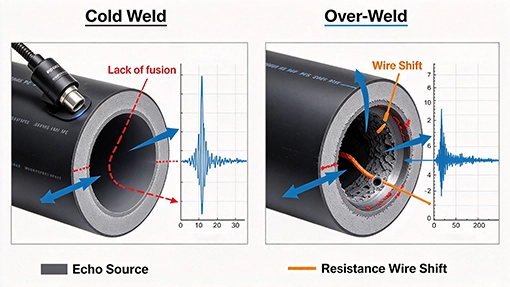
Portable phased array ultrasonic testing probe inspecting a PE electrofusion joint in a gas trench.
Need PE Electrofusion Fittings That Hold Up Beyond Test Day?
If you’re sourcing PE gas pipe and fittings for a project where excavation is expensive and failure is not an option, Luoyang Datang Energy Tech Co., Ltd. can help with:
- PE100 electrofusion couplings, saddles, and reducers with traceable batch and fusion parameters
- Material and dimensional compliance documentation (ASTM D2513 / EN 1555 / ISO 4437)
- Technical guidance on fusion parameters, cooling restraint, and inspection criteria
- Project-specific packing, marking, and delivery schedules
Tell us your pipe diameter, pressure class, and project location—we’ll come back with a specification-matched quote and the documents your inspector will ask for.
RELATED POSTS

3/4″ GHT vs 3/4″ NPT: Why Are These Brass Hose Fittings Not Interchangeable?
HDPE Pipes VS PVC Pipes For Drinking Water
Steady demand in infrastructure and energy industries: sustained growth in the high reliability pipes market

How to Specify Brass Hose Fittings for a Purchase Order
Optimizing Industrial Cooling Water Systems with Efficient Pipe Design