LUOYANG DATANG ENERGY TECH CO.,LTD


What Makes U-Bolt Pipe Clamps Different? Structure, Fit and Practical Uses
The Clamp That Does One Thing—and Does It Differently
Pipe supports are not a single product category with interchangeable parts. Some grips wrap both halves of a pipe; some hang it from above; some bear it from a wall. A U-bolt pipe clamp takes a distinct route: a U-shaped threaded bolt passes around the pipe, its two legs pierce a support plate or structural member, and two nuts draw the assembly tight. There is no hinge, no interlocking halves, no cushion—just a bolt, a saddle in some designs, and two fasteners.
This article answers four questions that a product photo cannot: What structure makes a U-bolt clamp work? Where does it sit relative to other pipe supports? Which pipes and installations actually suit it? And which dimensions beyond pipe diameter decide whether it fits at all?
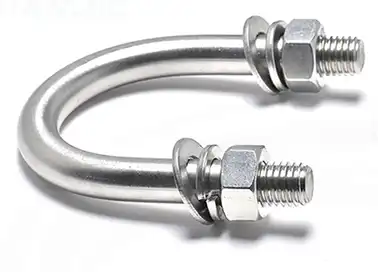
A U-bolt pipe clamp
How Do U-Bolt Pipe Clamps Work?
The Basic Structure
A typical U-bolt pipe clamp has four functional elements:
① U-shaped threaded bolt. ② Two threaded legs. ③ A mounting plate, saddle, or support surface. ④ Nuts and washers.
The saddle matters more than it appears in a thumbnail. Where present, it distributes clamping force across the pipe’s upper arc instead of concentrating it at two line contacts. Where absent—a bare U-bolt through a plate—the contact pattern is narrower.
How It Secures a Pipe
The U-shaped bend wraps the pipe from both sides and underneath. The threaded legs pass through holes in the support. Tightening the nuts pulls the U-bolt downward against the pipe, and the pipe is held between the U-bolt and the support surface or saddle. The load path runs from the pipe, through the U-bolt legs, into the support plate, and finally into the structural member behind it.
A critical limitation: the tightening torque that produces clamping force is also the torque that can crush or deform a thin-wall pipe. U-bolt clamps apply concentrated force compared with band clamps that distribute pressure across a larger surface area. That makes the U-bolt a restraint tool, not a precision sealing tool—unless the joint design explicitly accounts for deformation.
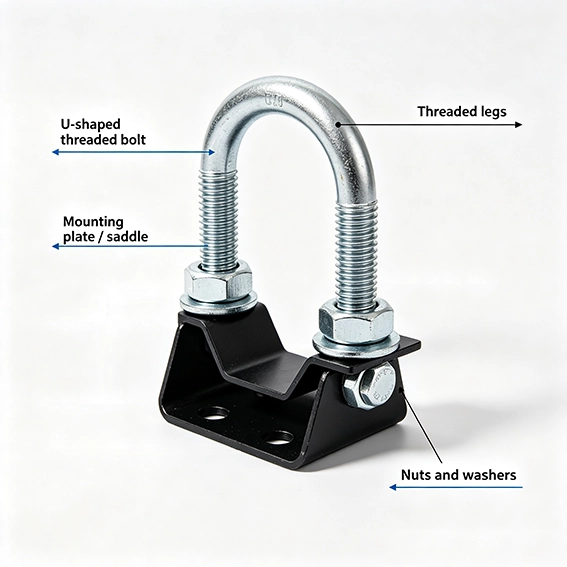
The Basic Structure of a typical U-bolt pipe clamp
What Makes U-Bolt Pipe Clamps Different from Other Pipe Clamps?
The difference is not “one is stronger.” It is how the clamp contacts the pipe and where the load goes.
| Type | Clamping structure | Typical application | Defining characteristic |
|---|---|---|---|
| U-bolt pipe clamp | U-shaped bolt wraps around pipe | Positioning, restraint, anchoring | Positive restraint; concentrated contact |
| Two-piece pipe clamp | Two halves fully surround pipe | Mechanical and process piping | More complete enclosure; often cushioned |
| Cushioned clamp | Elastomer lining between clamp and pipe | Vibration-sensitive lines | Reduces metal-to-metal contact and noise |
| Clevis hanger | Hanger body beneath pipe, rod above | Overhead horizontal runs | Suspends; allows slight misalignment |
| Pipe bracket | Bearing surface on wall or floor | Wall-mounted or floor-mounted runs | Bears projected weight |
When a U-Bolt Is the Better Choice—and When It Is Not
Reach for a U-bolt clamp when:
- The pipe must be held positively against a strut, plate, beam, or structural member.
- The installation is compact and does not need a full wraparound enclosure.
- The support is a guide or anchor in a piping system, where controlled restraint—not isolation—is the requirement.
- The pipe is heavy-wall or standard schedule, where the concentrated clamping force will not collapse the wall.
Do not substitute a bare U-bolt where:
- Vibration or noise is the controlling problem—use a cushioned clamp.
- The pipe has a coating or lining that metal-to-metal contact would damage.
- The line requires axial thermal movement. A standard U-bolt tightened metal-to-metal can behave as a guide, not a free-sliding support.
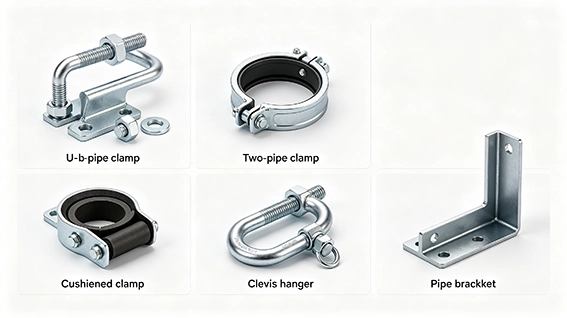
Clamp types
Where Are U-Bolt Pipe Clamps Commonly Used?
Industrial Piping and Structural Supports
The core application is securing pipe to Unistrut channels, support plates, beams, and fabricated steel. U-bolt clamps with hex nuts are specified under MSS SP-58 / SP-69 Type 24 for pipe support duty, and representative maximum recommended load values illustrate the range: 485 lb for 1/2–1″ pipe, 1,220 lb for 1-1/4–2″, and 2,260 lb for 2-1/2–5″ in one common stainless product line. These are maximum recommended loads, not universal ratings—the project’s safety factor and support spacing still govern.
Exhaust Systems: Same Shape, Different Job
A U-bolt exhaust clamp and a U-bolt pipe support clamp share a silhouette, not a function. Exhaust clamps are designed to seal and retain a slip joint under heat cycling and vibration; pipe support clamps are designed to transfer dead weight and restrain movement against a structure. A U-bolt exhaust clamp may use a different saddle geometry, a different grade of stainless, and a tightening protocol aimed at gas-tightness rather than structural anchorage. Do not treat one as a drop-in substitute for the other.
Plumbing and Mechanical Rooms
Where pipe runs near equipment and must be positioned against a wall, bracket, or strut, the U-bolt’s compact envelope is an advantage. But the same caveat applies: if noise transmission matters, a bare metal U-bolt is the wrong default.
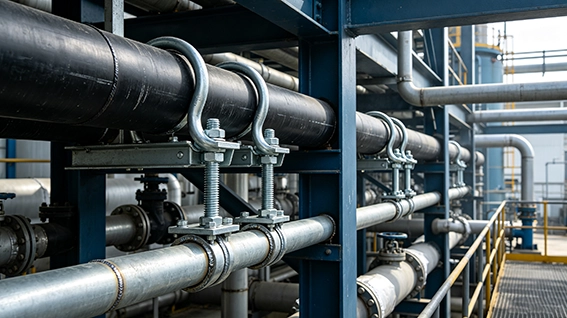
U-Bolt Pipe Clamps Used in Industrial Piping and Structural Supports
How to Match a U-Bolt Pipe Clamp to the Right Pipe
This is where most ordering errors occur—and it is not because buyers forget to measure the pipe. It is because pipe outside diameter is only one of several dimensions that must agree simultaneously.
Check the Actual Outside Diameter—Not the Nominal Size
U-bolt sizing follows pipe outside diameter (OD), not nominal pipe size. The relationship between NPS and OD is notoriously non-intuitive at small sizes:
| NPS | Actual OD (in) | Actual OD (mm) |
|---|---|---|
| 1/2″ | 0.840 | 21.3 |
| 3/4″ | 1.050 | 26.7 |
| 1″ | 1.315 | 33.4 |
| 1-1/2″ | 1.900 | 48.3 |
| 2″ | 2.375 | 60.3 |
| 3″ | 3.500 | 88.9 |
Source: ASME B36.10 / B36.19 dimensional basis; NPS is a label, not a measurement.
A “2-inch” pipe is 2.375 inches across the outside. Ordering a U-bolt by NPS alone leaves the actual fit to chance.
The Dimensions That Must Agree
Beyond OD, a U-bolt pipe clamp is defined by several interlocking dimensions:
- Inside width — the clear distance between the two legs. Must exceed pipe OD; if too large, the clamp bottoms out on the support before gripping the pipe.
- Inside length / leg height — how deep the U reaches below the pipe. Governs whether the support plate and nuts clear the pipe wall.
- Thread diameter and pitch — must match the nuts and the hole in the support plate.
- Thread length — must be sufficient for the plate thickness, washers, and full nut engagement.
- Mounting plate hole spacing — legs must pass through without binding.
For reference, a common size chart shows 1/2″ NPS with an inside width of roughly 7/8″, thread diameter 1/4″, and thread length 3/4″; 2″ NPS moves to inside width around 2-1/2″, thread diameter 3/8″, thread length 1″. These are typical catalog proportions, not universal fixed values—manufacturer tolerances and product families vary.
The most overlooked mismatch: pipe OD and U-bolt inside width are not interchangeable measurements. Two U-bolts both labeled “for 2-inch pipe” can have different bend radii and inside clearances. One may grip; the other may rattle or fail to seat.
Thread Compatibility Deserves a Second Look
If the U-bolt uses Unified Coarse threads, common sizes follow ASME B1.1: 3/8″-16 UNC and 1/2″-13 UNC. The nuts supplied with the U-bolt will match, but if the U-bolt is being threaded into an existing tapped plate or paired with replaced hardware, the thread callout must match diameter and pitch, not just diameter.
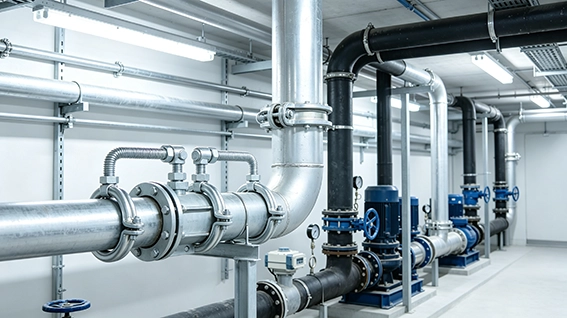
U-Bolt Pipe Clamps Used in Plumbing and Mechanical Rooms
Stainless Steel or Galvanized: Which Material Should You Choose?
The material decision is an environment match, not a ranking.
| Material | Strength / cost | Suitable environment | Watch-out |
|---|---|---|---|
| Carbon steel | High strength, lowest cost | Dry indoor, general industrial | Requires coating or plating |
| Galvanized steel | Good strength, moderate cost | Outdoor and general utility | Coating condition governs service life |
| 304 stainless | Good corrosion resistance, higher cost | Wet, washdown, many chemical exposures | Not ideal for chloride-rich settings |
| 316 stainless | Best chloride resistance, highest cost | Marine, coastal, aggressive chemical | Higher material cost |
304 handles general outdoor and food-contact duty; 316 adds molybdenum to resist chloride pitting near saltwater and de-icing salts. Galvanized steel offers better corrosion resistance than bare carbon or zinc-plated finishes, but it is not a stainless substitute in a chloride-heavy washdown.
A galvanic corrosion question worth asking: if the U-bolt contacts a stainless pipe or a coated support, the material pairing may create a galvanic couple. The bolt may be fine in isolation and fail in assembly.
Installation Considerations: The Tightening Question
U-bolt installation is not “tighten until it feels right.”
- Match the clamp to the pipe OD and support plate before tightening. The fit is decided by dimensions, not by torque.
- Tighten evenly on both legs. Uneven tightening twists the U-bolt and can distort the saddle.
- Respect the pipe wall. U-bolt clamps concentrate force and can mark or compress thin-wall pipe if over-tightened. For thin-wall or lined pipe, a saddle or a different clamp family may be required.
- Know whether the point is an anchor or a guide. A U-bolt tightened metal-to-metal can function as a guide that permits axial sliding but restrains lateral movement; if free thermal movement is required, the assembly must be designed with clearance or low-friction provisions.
- For vibratory service, do not rely on a bare metal U-bolt for isolation. Use a cushioned clamp or add a liner if vibration or noise is a design requirement.
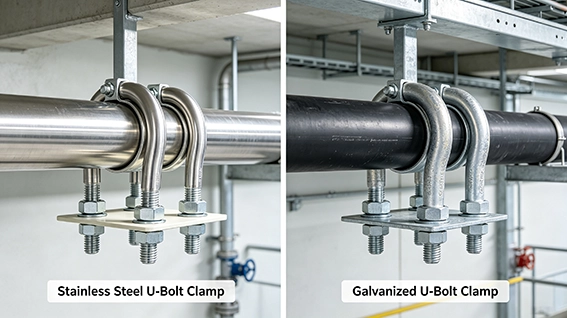
Stainless Steel or Galvanized U-Bolt Pipe Clamps
FAQ
Q1: What is a U-bolt pipe clamp used for?
Holding a pipe positively against a strut, support plate, beam, or structural member—positioning, restraining, or anchoring it rather than suspending or isolating it.
Q2: How do I measure for a U-bolt pipe clamp?
Measure pipe OD, then confirm inside width, inside length, thread diameter and pitch, and thread length against the support plate thickness and nut engagement.
Q3: Are stainless U-bolts always better than galvanized?
No. Stainless wins in wet, washdown, and chloride-bearing environments; galvanized carbon steel is cost-effective in dry or general outdoor service where the coating remains intact. The environment decides.
Q4: Can a U-bolt pipe clamp be used on an exhaust pipe?
A U-bolt exhaust clamp is a different product family designed for joint retention and sealing under heat and vibration. A pipe support U-bolt is designed for structural restraint. Match the product to the joint function—do not substitute one for the other based on shape alone.
Need U-Bolt Pipe Clamps for Your Piping Project?
Send us your pipe outside diameter, support plate or strut dimensions, thread requirement, material and surface finish, and whether the point is an anchor, guide, or simple positioning support. Luoyang Datang Energy Tech Co., Ltd. will help you confirm the U-bolt size, leg length, and material before the order is placed—so the clamp fits the pipe, the plate, and the load path in one pass.
RELATED POSTS
Why Choose PVC Pipeline For Water Supply System?
How To Prevent Water Supply Pipe In Ice Maker On A Refriegerator From Freezing
Which Is More Suitable For Drinking Water Pipe:PPR vs PE?

Advantages and Applications of PPR pipes and Fittings in Home Decoration

PEX Expansion vs Crimp vs Clamp vs Push-Fit: Which Connection Costs Less?